

Sponsored Content
AI Maturity Is the New Differentiator: Why Operationalization Matters More Than Model Capability
AI Maturity Is the New Differentiator: Why Operationalization Matters More Than Model Capability
LLM advantage is fading. Enterprises must shift to operational maturity with governance, reliability, measurement, and modular architecture to scale AI in production.
 CORE
·
CORE
·
Join the DZone community and get the full member experience.
Join For FreeEditor’s Note: The following is an article written for and published in DZone’s 2026 Trend Report, Generative AI: From Prototypes to Production, Operationalizing AI at Scale.
In 2026, the frantic race for the ultimate language model, the one that would be THE most powerful, is becoming irrelevant, if it ever was. As LLM capabilities converge, access to superior raw intelligence is no longer enough to guarantee a competitive edge. The real divide now lies in operationalization, the ability for an organization to transform a fragile prototype into a robust production solution. Achieving this requires a structural shift. It is time to move beyond isolated experiments toward a true stage of systemic maturity, which requires treating AI not as a mere technological curiosity but as a critical production dependency. This scaling relies on a rigorous discipline of reliability, measurement, governance, and engagement, and it requires turning operational maturity into the new strategic pivot.
The Mirage of Model-Based Advantage
Today, the most common mistake is believing that choosing the highest-performing model constitutes a winning bet in itself. This vision overlooks the technical reality of model convergence. Whether proprietary or open source, the performance gaps in standard reasoning tasks are narrowing to the point where generative AI is becoming a sophisticated commodity.
In fact, relying exclusively on a provider’s raw intelligence is becoming a delusion. In a production environment, AI must be viewed and treated as a critical dependency, not an isolated project. It is essential to understand that for a company, a model-based competitive advantage loses all value as soon as a competitor updates their API or a new “small language model” surpasses last year’s giants, for example. Differentiation no longer stems only from what the model can do; in reality, it also (and now primarily) comes from how the company masters its execution, reliability, and integration into the business value stream.
Symptoms of Operational Immaturity
This phenomenon recalls the early days of big data. Remember, without control over upstream data quality, pipelines propagated silent errors until they rendered management indicators completely useless. Once trust was broken, no one dared to use the reports anymore, leaving the system running empty. Today, the risk is identical since, without rigorous monitoring, models can end up producing hallucinations or subtle biases that degrade user trust without technical teams being alerted.
Added to this is an uncontrolled volatility of costs. Without a true LLMOps approach integrating a FinOps discipline, a simple prompt optimization or an increase in traffic can transform an API bill into a financial nightmare. Finally, immaturity manifests through data opacity. In particular, the company loses control over systems where one can neither audit the source of information nor guarantee the isolation of sensitive data. These organizations find themselves trapped in a cycle of “perpetual prototyping,” where every move to production reveals security or performance flaws that should have been anticipated by a robust architecture.
Five Shifts Toward Operational Maturity
To cross the threshold of industrialization, organizations must execute five strategic shifts. This scaling phase requires trading the sometimes permissive flexibility of a sandbox mode for the rigor of battle-tested industrial standards.
- Experimentation → ownership: Maturity begins with clarity. Every AI system must have a defined business owner. It is no longer an IT topic but a business dependency where responsibility for outputs and their impact is explicitly assigned.
- Subjective validation → systematic measurement: The era of the “vibe check” is ending. Relying on subjective gut feelings is not viable and should be replaced by automated evaluation pipelines. A mature organization leverages “LLM-as-a-judge” frameworks and rigorous benchmarks to quantify quality and detect regressions before they ever reach the end user.
- Fragility → a reliability posture: AI is probabilistic by nature. Maturity consists of accepting this uncertainty by designing architectures capable of managing failures. This involves fallback systems and guardrails to filter hallucinations, as well as proactive latency management.
- Blind consumption → cost discipline: Scaling requires a FinOps vision. This means actively arbitrating between the performance of a large model and the efficiency of a smaller specialized model, while implementing quotas and budget visibility per business unit.
- Monolith → modular architecture: Mature teams isolate AI behind standardized interfaces. This modular approach allows for replacing one model with another without rewriting the entire application, thus limiting technical debt and excessive vendor lock-in.
Table 1. AI operational maturity diagnostic: symptoms vs. signals
| maturity | ||
|---|---|---|
|
Maturity Dimension |
Immaturity Symptom |
Mature Signal |
|
Ownership |
Shadow AI and ambiguity regarding output responsibility |
Defined business owner for every system |
|
Measurement discipline |
Subjective manual validation (“vibe check”) |
Automated benchmarks and drift monitoring |
|
Reliability posture |
Fragility in the face of hallucinations or latency |
Design for failure modes |
|
Cost discipline |
Unpredictable invoices disconnected from value |
Active arbitration between quality, latency, and cost |
|
Data boundaries |
Inconsistent permissions and leakage risks |
Access governance and continuous auditability |
|
Architecture |
Model changes with unpredictable side effects |
Modular architecture limiting cascading failures |
|
Change management |
Forced updates causing system breakages |
Phased deployments and clear expectations |
Use this diagnostic table to identify your current maturity stage and prioritize your operational investments in the short term.
Standardize vs. Localize: Scaling Without Platform Paralysis
To scale without sacrificing speed, operational maturity requires a subtle balance between centralized control and local autonomy. Mature organizations standardize the elements that reduce risk and duplication. This includes elements such as measurement language, security protocols, interface conventions, and production-readiness expectations.
Conversely, everything related to user experience and business expertise is localized. Development teams must remain free to iterate on their workflow UX and on the context strategy specific to their domain. The golden rule is simple: You must standardize what protects the company and localize what preserves relevance and execution speed. Figure 1 illustrates how a mature and standardized architecture unlocks local innovation, whereas rigid governance creates bottlenecks that force the use of shadow AI.
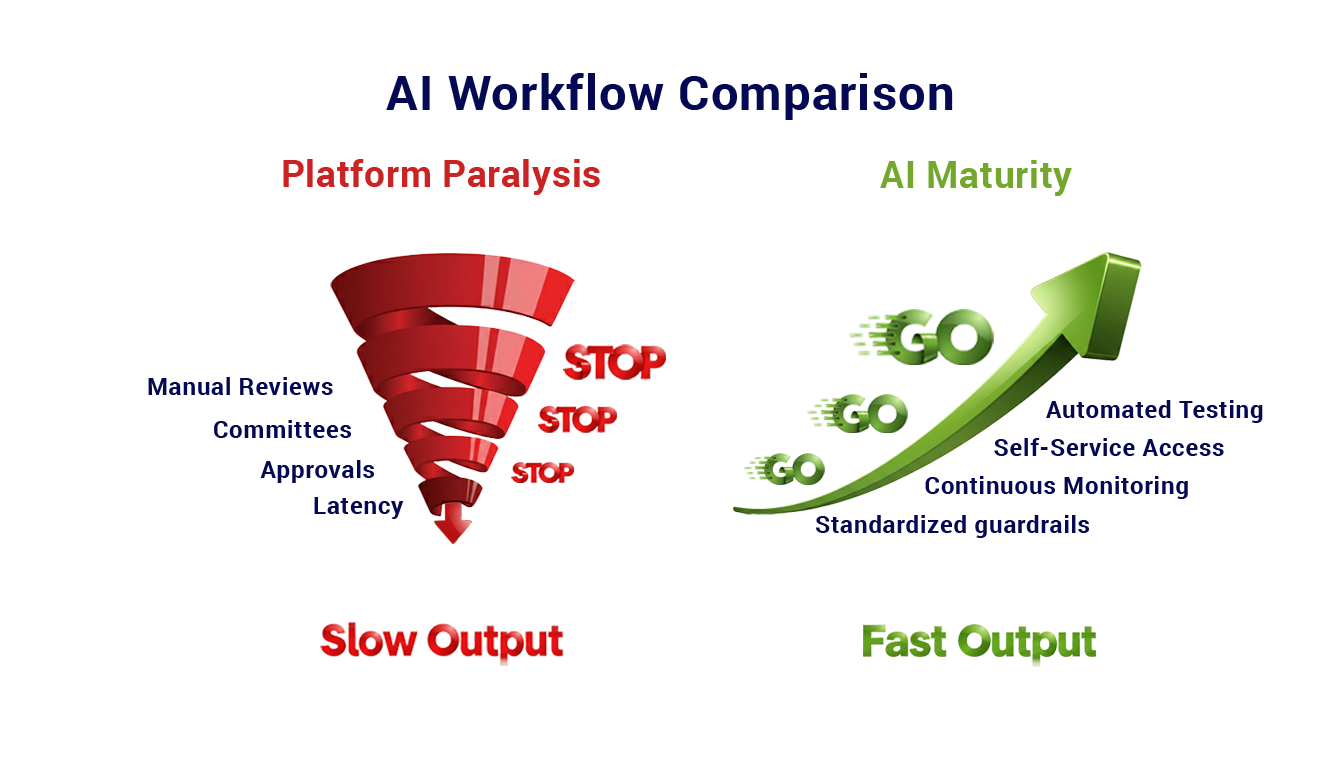
Figure 1. Balancing governance and agility in AI operations
Two Failure Modes That Hinder AI Efficiency
The path to maturity is often hindered by two extremes. The first is perpetual prototyping, when projects never move beyond the pilot stage due to a failure to build the operational muscles necessary for production. The second is platform paralysis. Excessive centralization creates bottlenecks where teams wait for endless approvals for every new prompt. These frictions inevitably push developers toward shadow AI solutions to maintain their pace, ruining any governance efforts.
Take the example of a product team wanting to adjust the “temperature” of the prompt to reduce a customer assistant’s verbosity. In an organization constrained by its platform, this minor change requires opening a change ticket, a two-week security review, and approval from a centralized architecture committee. Faced with this bottleneck, the team ends up using a personal OpenAI account and a private API key to bypass the queue. While this shadow AI scenario does not stem from bad intentions, it remains the result of a platform that confused governance with inertia, where teams were forced to choose between strict compliance and pragmatic efficiency.
Conclusion: Pick One Maturity Investment
In the context of massive adoption, operational maturity becomes the sole guarantor of sustainable value creation. So instead of trying to solve everything, adopt an approach that consists of identifying your most glaring symptom of immaturity through the maturity diagnostics table. This is only a starting point, a compass to guide your initial efforts. For instance, start by committing to a single first pillar, such as measurement automation or modularity. Remember that maturity is not a static destination but rather a continuous effort.
In 2026, the difference between a leader and a follower will not be measured by the number of models tested but instead by the robustness of the systems running them and the business value they deliver.
Additional resources:
- Artificial Intelligence Risk Management Framework, NIST
- Agents, Large Language Models, and Smart Apps, AI Infrastructure Alliance
- OWASP Top 10 for LLM Applications, OWASP
- “The Illusion of Deep Learning: Why ‘Stacking Layers’ Is No Longer Enough” by Frédéric Jacquet
- “The Rise of Shadow AI: When Innovation Outpaces Governance” by Frédéric Jacquet
This is an excerpt from DZone’s 2026 Trend Report, Generative AI: From Prototypes to Production, Operationalizing AI at Scale.
Read the Free Report
Opinions expressed by DZone contributors are their own.
{{ parent.title || parent.header.title}}
{{ parent.tldr }}
{{ parent.linkDescription }}
{{ parent.urlSource.name }}