

Sponsored Content
Designing a Secure API From Day One
Designing a Secure API From Day One
A startup builds API security from day one using identity, mTLS, validation, and automation — embedding defenses into architecture instead of reacting after failures.
 CORE
·
CORE
·
Join the DZone community and get the full member experience.
Join For FreeEditor’s Note: The following is an article written for and published in DZone’s 2026 Trend Report, Security by Design: AI Defense, Supply Chain Security, and Security-First Architecture in Practice.
Most APIs get secured after something breaks. A token leaks, an endpoint misbehaves, a pen test surfaces, an authorization gap. Suddenly, the team is patching a live system under pressure. That’s not a human failing — it’s an industry habit.
A cloud-native startup, building an API to handle user profile data and financial transactions, made an early decision that seems obvious in hindsight but is, in practice, deeply uncommon. They would treat security not as a phase of development but as a dimension of it. No security sprint after go-live. No compliance checkbox in Q3. They wanted defenses woven into the substrate of the architecture from the first commit.
Project Constraints That Shaped the Build
They had six months, a small team, a Kubernetes deployment on a public cloud provider, and regulatory obligations that required strict data handling, audit logging, and encryption at rest and in transit. The threat model was real: user PII, transaction records, and token-based authentication surfaces that could be abused.
Compliance shaped one implementation choice directly. Audit logging requirements mandated that every access event be traceable to a specific identity, a verified workload identity per service. This drove the team to implement mutual TLS across the Istio service mesh, using SPIFFE/SPIRE to issue pod-level identities. All service-to-service calls were cryptographically authenticated and encrypted in transit.
| Boundary | build implications |
|---|---|
|
Six months and small team |
Front-load the decisions; no “security sprint after go-live” |
|
Kubernetes on a public cloud |
Service-to-service and container posture part of day-1 architecture |
|
Regulatory obligations |
Audit logging and encryption can’t be postponed |
|
Real threat model (PII, financial transactions) |
Tokens, roles, inputs, and secrets treated as first-order design surfaces |
Given those boundaries, the interesting question isn’t what they believed about security. It’s what they were willing to bake into the system before launch.
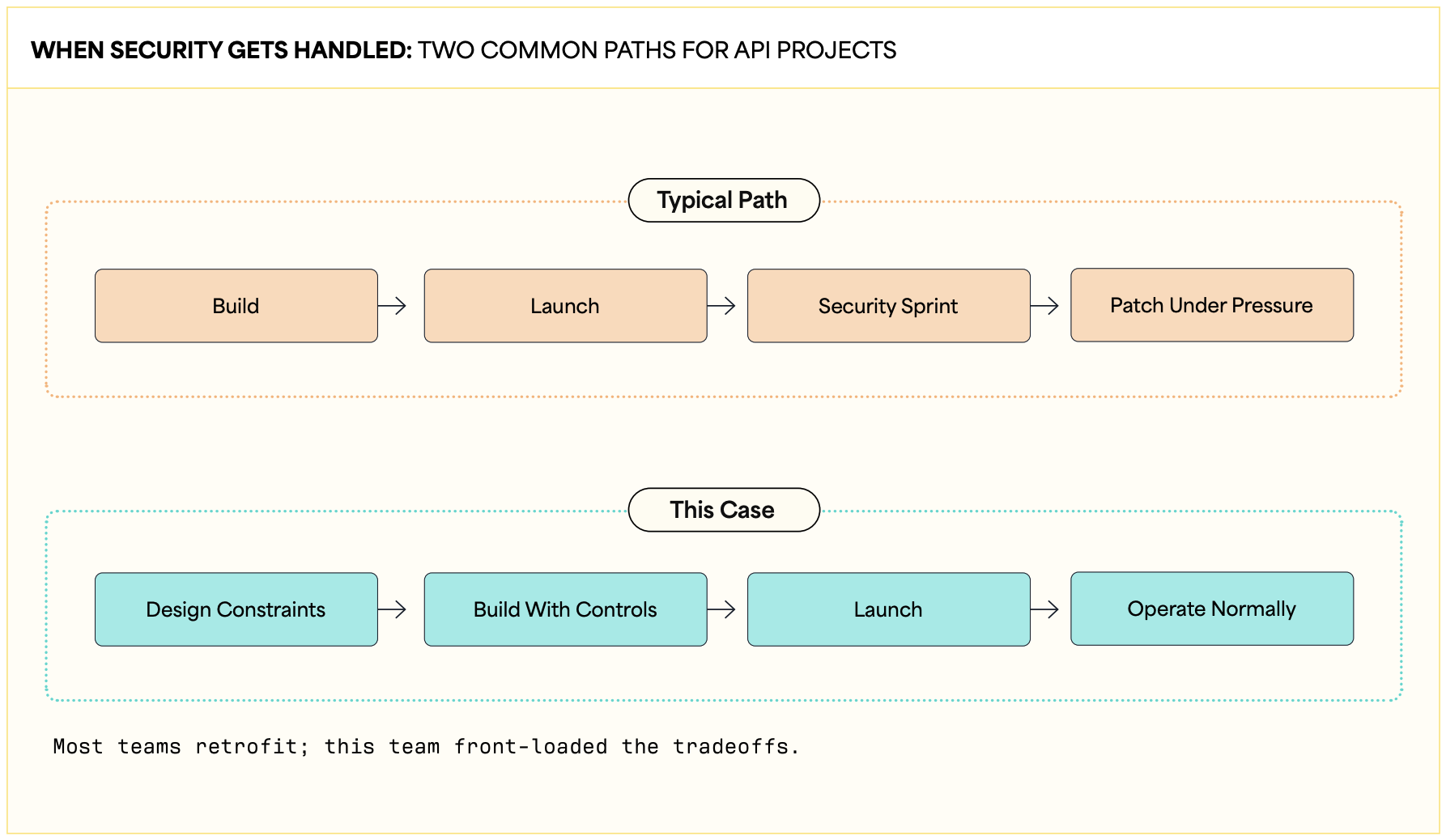
Figure 1
The Decisions That Actually Mattered
Let me be specific about what this team did because the specifics are where the value is. They treated security as a dimension of the system from the first commit, not something deferred to a later sprint.
Nothing here depended on a breakthrough, just disciplined execution under real constraints. What was uncommon was taking the tradeoffs seriously up front — accepting added complexity and friction early in exchange for reducing blast radius, tightening access boundaries, and making the security posture a continuous property of the build rather than a one-time audit.
They chose allow-lists over block-lists, enforced using a shared schema validation library built around the OpenAPI spec. This ran at the gateway layer, rejecting requests that didn’t match the expected schema before reaching any downstream application logic. Field types, formats, and length constraints were all defined explicitly.
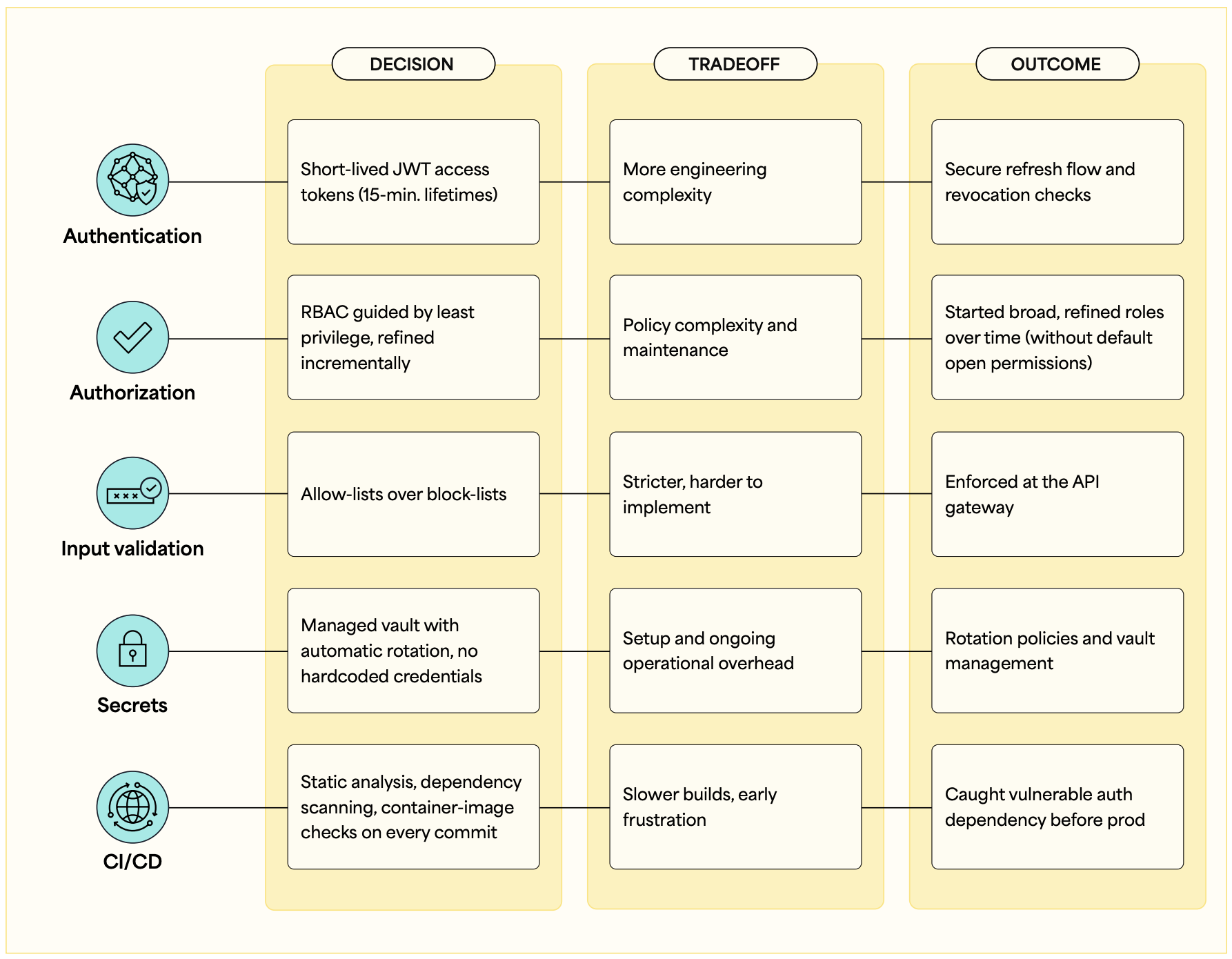
Figure 2
Automation as a Control Surface
Security by design is not a methodology; it’s a disposition. It’s the willingness to make a tradeoff — between convenience and safety, between velocity and resilience — before you’re forced to by an incident. Automation is the only honest answer to human error at scale. Rotating secrets manually, reviewing every commit for vulnerabilities by hand, auditing role assignments as the team grows. None of that survives contact with a real development pace.
The startup in this case study launched on schedule, with no major incidents in production. The defenses worked, not because they were exotic but because they were there.
Opinions expressed by DZone contributors are their own.
{{ parent.title || parent.header.title}}
{{ parent.tldr }}
{{ parent.linkDescription }}
{{ parent.urlSource.name }}