

Your AI Agent Shipped an Answer. But Did It Earn the Right To?
Bad Agentic AI output is rarely a generation problem. It's usually bad retrieval, bad planning, or bad execution upstream. Measure every stage, not just the result.
Join the DZone community and get the full member experience.
Join For FreeThere was a time when evaluating an AI system meant running a test set, computing an accuracy score, and calling it done. That was good enough when models answered questions in isolation. It is not good enough anymore. Agentic AI systems do not just answer questions. They retrieve documents, plan multi-step actions, call external tools, and synthesize responses that drive real decisions. Each of those steps can go wrong. And when they do, a single accuracy score tells you almost nothing about where the failure originated.
This is the core governance challenge of agentic AI. These are the systems built to act, not just predict/recommend. We need evaluation frameworks that match the architecture.
Old Evaluation Playbook Breaks Down
Most enterprise teams still evaluate their AI pipelines at the output layer. The model generates a response, a human reviewer scores it, and the team declares a quality level. As mentioned, agentic pipelines are fundamentally different. Consider an example of an agentic AI system. A user submits a query. A retrieval module fetches documents from a vector store. A planner decomposes the task into sub-goals and selects tools. An execution layer calls APIs, writes code, and reads files. A language model then synthesizes everything into a final response. Finally, the system routes that response back to the user and waits for feedback. Here, there are six distinct stages and six distinct failure modes. Yet most teams measure only the last one.
The consequence is a class of failures that look like output quality problems but are actually upstream retrieval or planning failures in disguise. A hallucinated answer often traces back not to the generation model but to irrelevant context retrieved in stage two. A task that fails halfway through often traces back to a poorly decomposed plan in stage three, not to a broken tool in stage four. Without stage-level measurement, you are debugging the symptom rather than the cause.
A Stage-by-Stage Quality Framework
The following framework assigns evaluation metrics to the specific pipeline stage where they are most causally relevant. This is not an exhaustive taxonomy. It is a practical starting point for teams building production agentic systems.
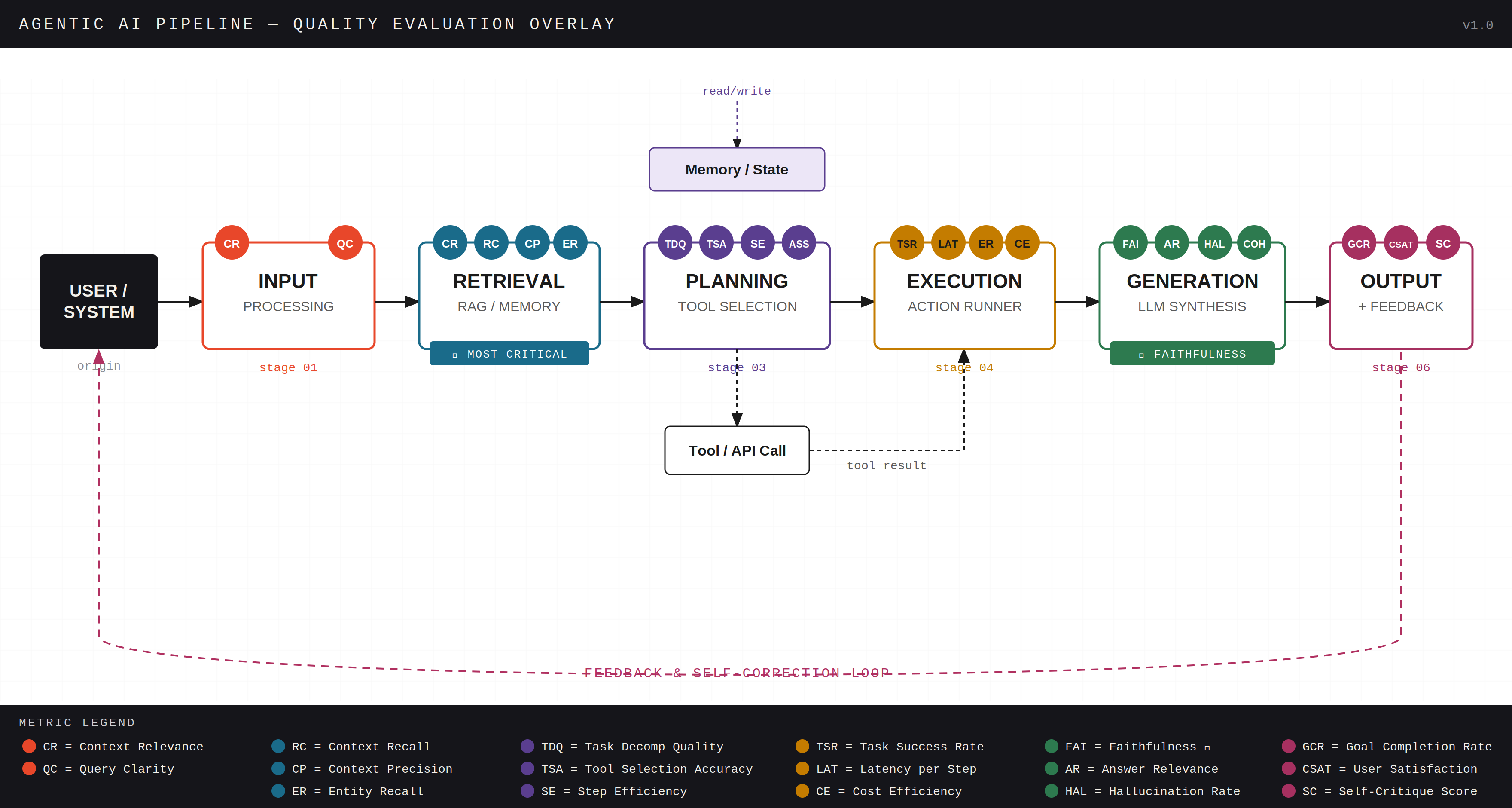
Stage 1: Input Reception
The first quality questions are about the query itself.
- Context relevance measurement enters the pipeline here. Before you retrieve anything, you need to know whether the incoming query maps coherently to the knowledge available to the agent.
- Query clarity scoring detects ambiguous or underspecified inputs before they propagate downstream.
- Input completeness checks confirm that all required parameters are present.
These are low-cost and high-leverage checks that prevent entire chains of wasted computation.
Stage 2: Retrieval and Grounding
This is where context relevance becomes the most critical metric in the entire pipeline. Retrieval quality is the single largest driver of generation quality in retrieval-augmented generation systems. Poor retrieval does not just reduce accuracy; it actively supplies the model with material to hallucinate from.
The RAGAS framework formalizes four metrics at this stage:
- Context relevance: Measures topical alignment between retrieved chunks and the query
- Context recall: Measures whether all necessary information was surfaced
- Context precision: Measures what proportion of retrieved material is actually useful.
- Context entity recall: Checks that key named entities, people, dates, figures appear in the retrieved set.
Stage 3: Planning and Tool Selection
Once retrieval is grounded, the agent must decompose the task and select the right tools. Quality measurement here shifts from information retrieval to reasoning evaluation.
- Task decomposition quality: Measures whether the generated sub-goals are logically derived from the original intent.
- Tool selection accuracy: Tracks whether the agent chose the right tool for each sub-task; mis-selection here cascades directly into execution failures.
- Step efficiency: Compares actual steps taken against the theoretical minimum, surfacing over-engineered plans that waste tokens and time.
- Action safety scoring: Evaluates whether any planned action carries irreversible or harmful consequences before execution begins.
This stage is also where human oversight checkpoints belong. High irreversibility scores plans with a significant proportion of delete, publish, or send actions, should trigger a mandatory review before the execution layer proceeds.
Stage 4: Execution
At the execution layer, the measurement focus shifts from reasoning quality to operational reliability.
- Task success rate: Tracks binary completion per action across runs.
- Latency per step: Identifies bottlenecks in multi-step pipelines that affect both user experience and cost.
- Error and retry rates: Leading indicators of planning failures or brittle tool integrations — a high retry rate almost always points back to a planning problem in stage three, not a tool problem in stage four.
- Token and cost efficiency metrics per completed task matter increasingly as enterprises scale agentic workflows across thousands of daily runs.
Stage 5: Generation
Generation is where faithfulness becomes the dominant metric.
- Faithfulness: Measures the proportion of claims in the generated output that are explicitly supported by the retrieved context. It is the primary anti-hallucination metric.
- Answer relevance: Measures whether the output actually addresses the original question. A response can be faithful to its context and still fail to answer the query.
- Hallucination rate makes the inverse of faithfulness explicit and quantifies unsupported factual claims as a distinct risk indicator.
- Response coherence evaluates structural and logical quality using a language model as judge.
These five metrics faithfulness, answer relevance, hallucination rate, answer completeness, and response coherence constitute the minimum viable evaluation surface for any production generation stage.
Stage 6: Feedback and Self-Correction
The final stage closes the loop.
- Goal completion rate is the top-level success metric answering the question: Did the agent fully resolve the user's stated objective, end to end?
- User satisfaction scores: Provide the ground-truth human signal that no automated metric can replace.
- Self-critique scoring: A critic model evaluates the agent's own output against a defined rubric and enables an autonomous quality gate before delivery.
- Memory utilization: Tracks how effectively the agent draws on prior context in multi-turn and multi-session workflows.
This stage also feeds the improvement cycle.
Aggregated metric trends across stages tell you where your pipeline is degrading over time and where model updates, retrieval changes, or prompt revisions are having measurable effect.
The Diagnostic Value of Stage-Level Measurement
Consider a practical scenario. Your agentic system's faithfulness score drops from 0.87 to 0.71 across a two-week period. Without stage-level instrumentation, you escalate to model evaluation, run prompting experiments, and try a different language model. Nothing moves the number.
With stage-level instrumentation, you check context precision at stage two first. It has dropped from 0.82 to 0.54. Your vector store was recently updated with a new document corpus, and retrieval quality degraded significantly. The generation model was never the problem. Two weeks of debugging the wrong layer cost real time and money.
This is the diagnostic value of the framework. Metrics at the output layer measure outcomes. Metrics at each upstream stage identify causes. Effective agentic AI governance requires both.
Opinions expressed by DZone contributors are their own.
Comments