

Agentic Commerce: A Developer's Guide to Google's Universal Commerce Protocol (UCP)
Google’s UCP lets AI agents handle end-to-end shopping across sites like Walmart. Sellers must optimize data for AI, saving time while introducing new privacy risks.
 CORE
·
CORE
·
Join the DZone community and get the full member experience.
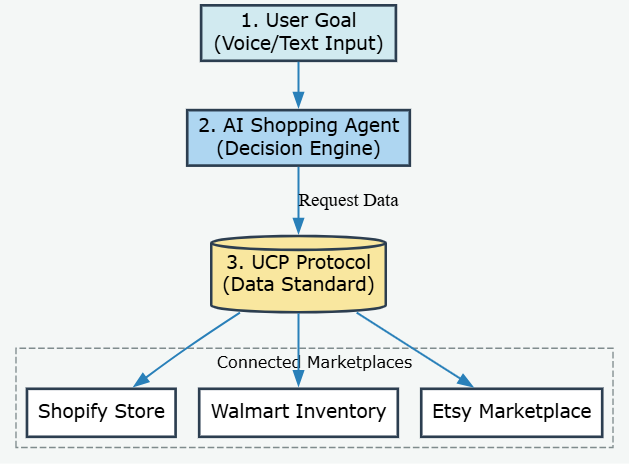
Join For FreeOnline shopping just got its biggest upgrade in years. On January 11, 2026, Google CEO Sundar Pichai announced the Universal Commerce Protocol (UCP) at the National Retail Federation conference — a new open standard co-developed with Shopify, Walmart, Etsy, Target, Wayfair, and others (with endorsements from Stripe, Visa, Mastercard, and more). UCP is designed for the era of agentic commerce, where AI agents handle the full shopping journey: discovery, comparison, cart management, discounts, checkout, and even post-purchase support.
No more humans clicking through tabs, managing carts, or entering payment details. Instead, AI agents act as trusted proxies, communicating directly with merchant systems via a standardized protocol. For developers and architects building e-commerce backends, integrations, or AI tools, this shift means rethinking how you expose data — not for human eyes, but for machines.
1. Beyond the Human-Centric Browsing Model
Traditionally, e-commerce relied on a human-centric model: users browse sites, compare prices manually, add items to carts, and check out. AI played a supporting role in recommendations and chatbots, but the heavy lifting (navigation and decision execution) stayed with people. This created friction: high cart abandonment, privacy challenges from repeated data entry, and accessibility barriers.
UCP flips this model. It defines a common language (using REST/JSON-RPC transports, compatible with protocols like Agent Payments Protocol, Agent2Agent, and Model Context Protocol) so AI agents can query merchants directly, negotiate capabilities, and execute transactions autonomously. Early rollouts power checkout in Google’s AI Mode (in Search) and the Gemini app for eligible U.S. retailers, initially using Google Pay. However, the protocol is vendor-agnostic and extensible.
2. Core Capabilities: What an AI Agent Can Do with UCP
Once integrated, an agent can perform these key functions without user clicks:
- Product Discovery: Queries global inventories for tailored matches (e.g., “best running shoes under $100”).
- Comparison Engine: Analyzes pricing, features, reviews, and discounts across retailers in real time.
- Automated Cart Management: Builds and modifies carts programmatically.
- Discount Application: Applies codes, loyalty perks, or dynamic offers based on rules.
- End-to-End Checkout: Handles payments, shipping selection, taxes, and confirmations; merchants remain the seller of record.
Consumers shift from hunters to supervisors: they state a need (“Get me noise-canceling headphones under $200 with fast shipping”), set guardrails (budget, brands, approval requirements), and let the agent handle execution.
3. The Developer’s Mandate: Implementing UCP on Your Backend
For merchants and platform developers, UCP requires a pivot from HTML/webpage optimization to machine-readable, structured data exposure. Capabilities are exposed via UCP endpoints so agents can discover what you support (e.g., payment handlers, discount logic) and execute actions securely.
Key data points to implement include:
- Product Listings: Structured metadata with live pricing, high-resolution image URLs, attributes (size, color, specs), and availability.
- Inventory and Policies: Real-time stock levels, shipping options, and return windows.
- Discounting Logic: Rules-based structures (e.g., percentage discounts for quantity thresholds, promo codes).
- Branding and Experience Specs: Guidelines for how agents should present your brand (e.g., packaging notes).
Here’s a simplified example of a UCP checkout response (drawn from Google’s reference implementation documentation):
{
  "ucp": {
    "version": "2026-01-11",
    "capabilities": [
      {
        "name": "dev.ucp.shopping.checkout",
        "version": "2026-01-11"
      }
    ]
  },
  "id": "session-abc123",
  "line_items": [
    {
      "id": "item-001",
      "item": {
        "id": "shoes-running-pro",
        "title": "Pro Running Shoes",
        "price": 7999
      },
      "quantity": 1
    }
  ],
  "buyer": {
    "full_name": "Jane Developer",
    "email": "[email protected]"
  },
  "status": "ready_for_complete",
  "currency": "USD",
  "totals": [
    {
      "type": "subtotal",
      "amount": 7999
    },
    {
      "type": "total",
      "amount": 7999
    }
  ],
  "payment": {
    "handlers": [
      "google_pay",
      "shop_pay",
      "stripe"
    ]
  },
  "discounts": {}
}
Merchants retain full control: pricing, inventory thresholds, and brand rules remain intact. The key change is synchronization — your backend now serves AI agents as first-class clients.
4. User Experience: From Hunter to Supervisor
Users express intent (via voice or text, e.g., “Find an eco-friendly laptop under $1,000 and buy it”), then oversee the process through preferences such as:
- Brand or style loyalties and price ceilings
- Approval modes (instant purchase vs. “top 3” review)
- Security controls like MFA for high-value items
- Custom rules for recurring purchases or vendor blacklists
This approach reduces cognitive load and improves accessibility for users who find traditional websites challenging.
5. Strategic Benefits and Developer Challenges
Advantages for Developers and Businesses
- Efficiency: Agents find and apply deals faster than humans.
- Better Value: Objective optimization across sources.
- Interoperability: Reduced lock-in as agents shop across all UCP-compliant platforms.
- Scalability: A standard protocol reduces custom integrations.
Risks and Considerations
- Privacy and Trust: Agents handle sensitive data and payments, requiring strong safeguards.
- Loss of Serendipity: Algorithmic shopping may reduce the joy of discovery.
- Brand Challenges: Harder to convey personality when AI intermediates decisions.
- Bias: Potential favoring of partnered platforms.
- Regulatory Scrutiny: As agents become ubiquitous, oversight on fairness and monopolistic behavior is likely.
6. The Future: Toward Universal Interoperability
UCP is a first step toward a truly universal marketplace. Its open, extensible design allows agents to transact across retail, travel bookings, service negotiations, automated bill payments, and more. As adoption grows — already backed by major players — expect community-driven evolution through open-source contributions.
This machine-to-machine logic is expected to expand beyond e-commerce into other transactional domains, including:
- Travel bookings
- Service negotiations
- Automated bill payments
As these agents become widespread, increased regulatory oversight is likely to ensure fairness and prevent manipulation.

Conclusion
Google’s Universal Commerce Protocol signals a definitive shift away from manual browsing. For developers, it presents both an opportunity and an imperative around Agent Optimization: exposing rich, accurate, standardized data so your systems become the preferred choice in AI-driven decisions.
Start exploring the specifications at developers.google.com/merchant/ucp or ucp.dev, test integrations, and prepare your backends. The agentic shopping era has arrived.
Opinions expressed by DZone contributors are their own.
Comments