

Beyond the Handoff: How Product and Engineering Teams Are Redefining Collaboration
Top tech firms are redefining product-engineering collaboration using frameworks like dual-track agile, product trios, and DORA metrics to drive innovation.
 ·
·
Join the DZone community and get the full member experience.
Join For FreeThe modern digital product team gathers in a glass-walled conference room at a Seattle technology firm. Sitting around the table are the product manager, three engineers, a UX designer, and a data analyst. They're not debating a completed feature or fighting about a product roadmap. Instead, they're engaged in what increasingly organizations call "product discovery"—a collaborative exploration of user problems before a line of code is written.
This moment, all too familiar to top tech organizations, marks a sea change in the way that product and engineering teams interact. The old model of handoffs—product folks defining requirements, engineers building out—has its days numbered.
The Evolution of a Complicated Relationship
"For decades, we've managed product and engineering as separate domains with a handoff in between," says Emma Chen, CTO at a financial technology company. "The product team decided what to build, and engineering decided how to build it. That model is increasingly seen as fundamentally broken."
The flaws in the model emerged as software development evolved. Waterfall practices were displaced by agile methods and, more recently, by what McKinsey calls a "product and platform operating model." This model, according to a 2023 McKinsey research study, allows organizations to reduce product defects by 50 to 70 percent and time to market by up to threefold by organizing technology around user-facing products and supporting platforms. This approach keeps technology delivery aligned with strategy and related priorities, generating tremendous business value in addition to fueling innovation and improving customer and employee experience.
How Much Misalignment Costs
It is expensive to have an imbalanced product-engineering alignment. Google's DORA team, in its 2024 Accelerate State of DevOps Report, says that companies that have bridged the gap between product vision and technical execution have higher performance on software delivery outcomes. In the report, having spent a decade observing technology teams, they found that high-performing companies pushed code 973 times more frequently than lower-performing groups and logged a change failure rate seven times lower.
On the other hand, siloed departments are usually afflicted by what one communications-services company discovered: poor orders from the sales organization to engineering that are incomplete and incorrect, lack of cross-functional coordination, and incentives that are not aligned. The result was subpar customer experiences and wasteful operations.
This pressure manifests in numerous forms: functionality that fails to solve real user problems, technical debt from rushed implementation, postponed deadlines, and team burnout. A McKinsey 2024 report on product team effectiveness found that organizations that invest in agile funding, product management capability, and automation have a high level of impact in all areas of team effectiveness.
Collaboration Frameworks
Effective companies are remapping the product-engineering relationship through a series of frameworks:
1. Dual-Track Agile
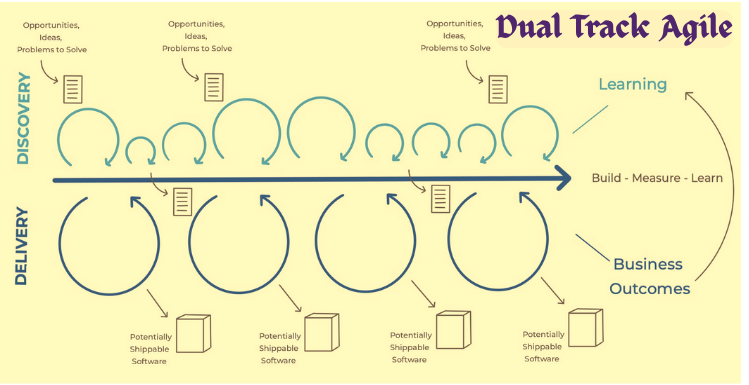
This approach separates discovery (finding out what to build) from delivery (building it) but runs them in parallel across the same cross-functional team. The approach ensures that engineering perspectives inform product decisions right from the early days.
2. Product Trios
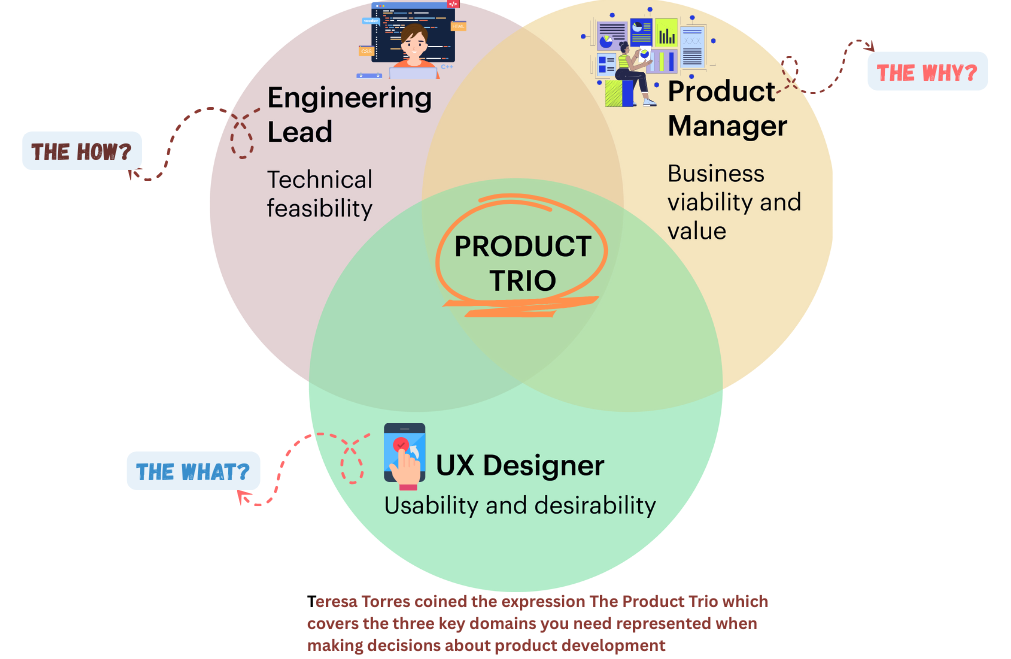
Several companies have made explicit a "product trio" leadership model—a product manager, engineering lead, and design lead who share responsibility for outcomes across rather than merely their areas. This triad of leaders makes decisions collectively, establishing alignment and shared accountability.
3. DORA Metrics as a Common Language
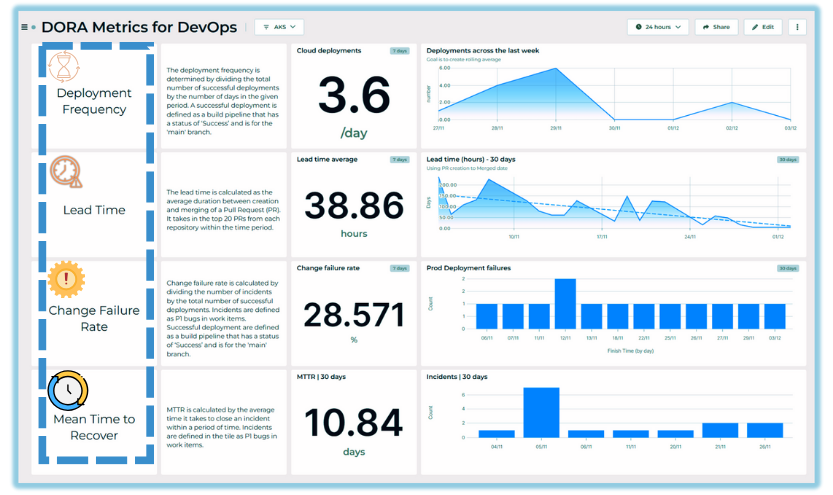
The DORA (DevOps Research and Assessment) metrics framework is now critical to gauge success across four fundamental metrics: deployment frequency, lead time for changes, change failure rate, and time to restore service. These measurements cut across technical and business interests, giving product and engineering teams a shared lexicon for performance.
4. Platform Engineering
The 2024 DORA report observed that one striking trend is the proliferation of platform engineering—managing and creating in-house development platforms—is on the rise, especially among bigger enterprises. The platforms streamline processes and enhance efficiency but must be used carefully, employing human-centered design patterns.
However, the report warns that platform engineering tends to postpone delivery initially before positive impacts are achieved as the platform matures. Organizations have to weigh such trade-offs when spending on platforms.
Cultural Transformation
Structures alone are insufficient. The most effective companies are undergoing cultural changes that redefine product and engineering teams' interactions:
Common Goals and Metrics
One communications-services company solved cross-functional problems by creating breakthrough goals that aligned different teams, such as cutting in half customer support calls following new installations. By creating cross-functional teams that were responsible for the entire process from initial order through after-sales service, they forced collaboration across traditional silos.
T-Shaped Skills
Organizations are increasingly valuing "T-shaped" professionals, those with concentrated knowledge in one field but sufficient knowledge of related fields. Product managers would need to be familiar with technical details, while engineers would need business and user experience sensitivity.
Psychological Safety
Research consistently demonstrates that team performance hinges largely on psychological safety—the ability to experiment and share thoughts without fear of reprisal or humiliation. The 2023 DORA report found that building a generative culture centered on belonging drives a 30% boost in organizational performance.
The AI Inflection Point
The advent of AI tools is creating yet another inflection point in the product-engineering equilibrium. The 2024 DORA report reveals that AI enhances the productivity of individuals but hurts software delivery performance and quality measures. Organizations are still learning to take advantage of the strengths of AI while not exposing themselves to its weaknesses.
Some are applying AI to automate mundane tasks, liberating products, and engineering to concentrate on more value-added collaboration. Others are looking at how AI can facilitate communication across disciplines by explaining technical ideas to product teams and business needs to engineers.
Measuring Success
Organizations require concrete means of measuring the success of product-engineering collaboration. In addition to the DORA metrics, innovative companies are monitoring:
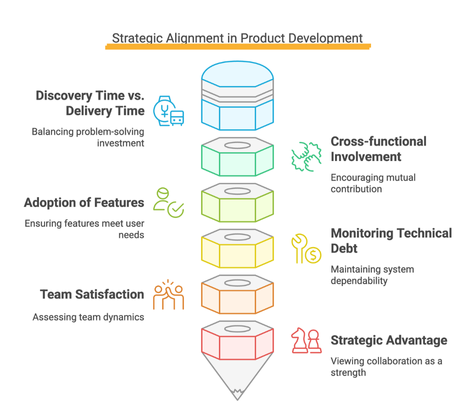
1. Discovery time vs. delivery time: Having enough investment in solving problems before delivering solutions
2. Cross-functional involvement: Keeping an eye on how often engineers contribute to product decisions and vice versa
3. Adoption of features: Pay attention to both delivery and if features ultimately resolve actual user issues.
4. Monitoring technological debt and system dependability as markers of sustainable development is the fourth aspect of technical health.
5. Team satisfaction: Periodically assessing the working relationship between members of the engineering and product teams
6. Moving Forward The relationship between product and engineering is viewed as a strategic advantage rather than an operational necessity by the majority of successful businesses.
That is no slight shift. It requires investing in organizational design, talent management, and cultural change. Firms are reshaping team structures, career paths, and compensation systems to support collaborative behaviors and shared results.
The interaction between manufacturers and product visionaries will become ever more important as software takes over the globe. When the old disciplines collapse in the name of value creation, the companies that master this interaction will not only create better software, but they will also reshape the possibilities.
Opinions expressed by DZone contributors are their own.
Comments