

Agile and Quality Engineering: Building a Culture of Excellence Through a Holistic Approach
By Daniil Blinov
 ·
·
Join the DZone community and get the full member experience.
Join For FreeIntroduction
In the age of digital disruption, organizations face relentless pressure to deliver value faster, reduce time-to-market, and exceed user expectations. Agile methodologies emerged as a response to these challenges, promoting flexibility, collaboration, and continuous delivery. However, agility without quality is a recipe for technical debt, customer dissatisfaction, and inefficiency.
That’s where quality engineering (QE) steps in — not as a post-development gatekeeper, but as an integral part of the Agile life cycle.
This article explores a holistic approach that fuses Agile principles with modern QE practices to create a high-performing, quality-centric delivery ecosystem.
From Quality Assurance to Quality Engineering
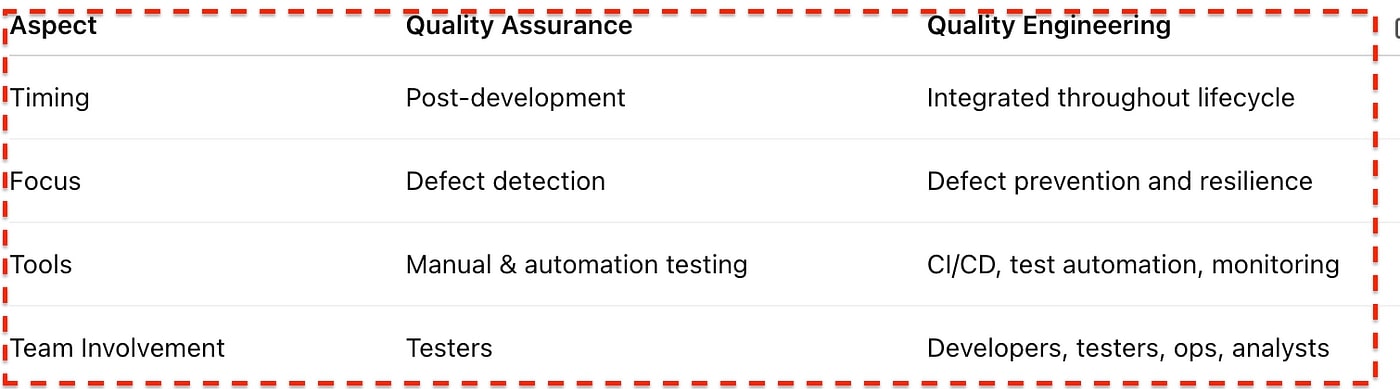
Traditionally, quality assurance (QA) focused on defect detection at the end of the development cycle. In contrast, quality engineering is a proactive, full–life cycle discipline that incorporates quality practices from the earliest stages — requirements gathering to production deployment.
Key differences include:
Agile + QE: Why Integration Matters
Agile thrives on speed and adaptability, but without quality checks baked in, frequent releases can introduce instability. QE complements Agile by ensuring reliability, scalability, and customer satisfaction are maintained across sprints.
Benefits of Integrating Quality Engineering into Agile
Integrating quality engineering (QE) into Agile methodologies brings profound and measurable benefits across the entire software development life cycle. One of the most significant advantages is the substantial reduction in rework and post-release defects. In traditional models, testing is often deferred until the final stages, which means defects are identified late — when they are more costly and complex to resolve. By embedding quality practices from the outset, QE enables teams to detect and resolve issues early, minimizing rework and improving the overall stability of each release.
Another key benefit is the acceleration of feedback loops. Agile development relies on rapid iteration and frequent delivery, and this rhythm demands fast, accurate feedback on code quality, functionality, and performance. With continuous testing integrated into automated pipelines, teams receive near real-time feedback on every code commit. This immediacy empowers developers to make informed decisions quickly, reducing delays caused by waiting for manual test cycles or late-stage QA validations.
Quality engineering also enhances collaboration between developers and testers. In a traditional setup, QA and development operate in silos, often leading to communication gaps, delays, and conflicting priorities. In contrast, QE promotes a culture of shared ownership, where developers write unit tests, testers contribute to automation frameworks, and both parties work together during planning, development, and retrospectives. This collaboration strengthens mutual accountability and leads to better alignment on requirements, acceptance criteria, and customer expectations.
Early and continuous risk mitigation is another cornerstone benefit. By incorporating practices like shift-left testing, test-driven development (TDD), and continuous integration (CI), potential issues are identified and resolved long before they escalate. Additionally, test automation ensures that quality checks are not skipped under time pressure, which helps maintain a consistent level of reliability across all iterations. QE also extends into production through observability and monitoring, allowing teams to detect anomalies, regressions, or performance bottlenecks in real time and take corrective action proactively.
Overall, integrating quality engineering into Agile development ensures that quality is not an afterthought but a continuous, embedded practice. It enhances product stability, increases team efficiency, fosters a culture of collaboration, and ultimately results in better user experiences. Organizations that adopt this integrated approach are better positioned to deliver software that is not only fast but also reliable, scalable, and aligned with business goals.
Pillars of a Holistic Agile-QE Strategy
A successful integration of quality engineering within Agile requires more than process alignment — it demands a foundational shift in mindset, practices, and tooling across the entire delivery life cycle. Several core pillars form the basis of this transformation, ensuring that quality is not treated as a destination but as a continuous journey.
Shift-Left Testing
The first foundational pillar is shift-left testing. This principle encourages the movement of testing activities to the earliest stages of the development cycle, ideally during requirements definition and system design. By validating assumptions and ensuring clarity of user stories early on, teams can prevent defects before they ever materialize. In practice, this means involving QA professionals during the grooming of user stories so that acceptance criteria are both comprehensive and testable. When developers and testers collaborate from the very beginning, it reduces ambiguity and aligns the team around quality objectives. For example, even before the coding starts, testers can begin drafting acceptance tests or automation frameworks using behavior-driven development (BDD) practices. This alignment across roles, with testers, developers, and product owners all contributing to the clarity and structure of requirements, significantly enhances the reliability of the delivered solution.
Continuous Testing
The second key pillar is continuous testing embedded within CI/CD pipelines. In high-velocity Agile environments, testing must evolve from being a standalone phase to becoming an ongoing activity. This requires integrating testing into the development pipeline so that every change, no matter how small, is automatically verified. Continuous testing ensures that new code is checked immediately for regressions or integration issues, providing developers with rapid feedback that reduces the time and cost of fixing defects. This feedback loop can be triggered within minutes of code check-ins, accelerating decision-making and safeguarding system stability. Automation plays a critical role here, covering all layers of the testing pyramid, from unit and service-level tests to full end-to-end scenarios. Tools such as Jenkins, GitHub Actions, and test frameworks like Selenium, Cypress, and JUnit enable this process and support consistent execution across environments. Continuous testing transforms quality into a living, breathing part of the delivery pipeline rather than a box to check at the end.
Strategic Automation
Another vital pillar is a well-thought-out test automation and coverage strategy. As Agile teams aim for rapid and frequent releases, manual testing becomes a bottleneck. However, automation must be approached strategically to be effective. A widely adopted model is the test automation pyramid, which emphasizes heavy reliance on unit tests at the foundation, a moderate level of integration tests, and a minimal but targeted use of UI or end-to-end tests. This approach balances speed, coverage, and maintainability. When implemented correctly, automated test suites provide a high return on investment by catching defects early, reducing repetitive manual work, and enabling confidence in continuous delivery. However, the value of automation is only realized when test scripts are fast, stable, and easy to maintain. Flaky tests and excessive reliance on brittle UI automation can undermine confidence in the system. Thus, a mature automation strategy is not only about coverage but also about the reliability and clarity of feedback.
Cross-Functional Collaboration
Equally important to the Agile-QE transformation is the development of cross-functional, empowered teams. Traditional software projects often suffer from siloed responsibilities, where developers, testers, and business analysts operate independently, leading to communication gaps and misaligned priorities. In contrast, Agile-QE encourages collective ownership of quality. Developers are expected to write and execute unit tests as part of their development workflow. Testers, meanwhile, participate in code reviews and contribute to the development of test frameworks, blurring traditional role boundaries. Product owners actively validate whether defined quality goals and acceptance criteria are being met during and after development. This collaborative model is supported by Agile ceremonies that reinforce transparency and feedback. During sprint planning sessions, teams align on quality gates for each user story. Daily standups become a space not just for status updates but for real-time discussion of blockers and quality concerns. Retrospectives, meanwhile, provide an opportunity to reflect on test effectiveness and refine quality practices based on recent experience. These routines foster a quality-first culture, where every team member feels responsible for product excellence.
Operational Observability
Finally, the holistic strategy must extend beyond the delivery phase into production with observability and post-release quality monitoring. Quality does not end with deployment; it evolves as users interact with the product in real-world scenarios. To ensure resilience and reliability in production, teams must implement robust monitoring, logging, and alerting mechanisms. Tools such as Prometheus, Grafana, the ELK stack, and Sentry enable engineering teams to visualize system performance, capture real-time anomalies, and respond quickly to unexpected behavior. Additionally, proactive practices such as chaos testing help validate how systems behave under stress, uncovering hidden failure points before they can impact users. This ongoing vigilance supports a feedback loop from production to development, reinforcing the idea that quality engineering is not confined to pre-release activities. Instead, it encompasses the entire software life cycle, from initial requirements to long-term user satisfaction.
Together, these pillars — early testing, continuous verification, strategic automation, cross-functional collaboration, and operational observability — create a strong foundation for quality in Agile environments. By institutionalizing these practices, organizations can move from reactive quality assurance to proactive quality engineering, ultimately delivering software that is not only fast and functional but also resilient, scalable, and trusted by users.
Real-World Implementation: A Case Study Example
Context: A mid-sized fintech company adopted Agile Scrum but struggled with frequent production bugs and long release cycles.
Approach
- Introduced QE champions in each team
- Built a CI/CD pipeline with Selenium and JUnit
- Replaced manual test cases with automated suites
- Adopted shift-left practices using BDD with Cucumber
Results
- Defect escape rate dropped by 60% in 3 months
- Release time reduced from 2 weeks to 2 days
- Developer satisfaction and collaboration scores increased
Metrics That Matter
To evaluate Agile-QE effectiveness, track:
- Defect escape rate: % of defects found in production
- Test automation coverage
- Mean time to detect (MTTD) and mean time to resolve (MTTR)
- Sprint defect rate
- Release cycle time
The marriage of Agile and quality engineering is not a trend — it’s a strategic imperative. Organizations that succeed in integrating QE across their Agile processes gain the ability to innovate rapidly without sacrificing reliability. It’s not just about tools or frameworks; it’s more about building a culture where everyone owns quality.
In this integrated environment, quality is no longer the responsibility of a specific department or a final step in the delivery process. It becomes a shared goal, embedded into each stage of the software life cycle. Developers write tests alongside their code. Product owners define stories with testable, value-driven acceptance criteria. Test engineers architect automation frameworks that scale with complexity. Stakeholders receive fast, reliable feedback that empowers quicker decision-making. This cultural shift, where quality is everyone’s job, marks the transition from quality assurance to quality engineering.
To stay competitive in a digital-first world, organizations must move beyond traditional QA and embrace a holistic, engineering-driven approach to quality — one that spans ideation to production and puts the customer experience at the center. The true measure of success is not defect counts or test coverage, but customer satisfaction, system resilience, and the team’s ability to adapt with confidence.
This transformation isn’t easy. It demands investment in skills, technology, and above all, mindset. But the payoff is profound: faster delivery cycles, reduced risk, improved collaboration, and software that earns trust. In an era where expectations are higher than ever, quality is not just a differentiator — it is a cornerstone of digital excellence. And it starts not at the end, but at the very beginning.
Opinions expressed by DZone contributors are their own.
Comments