

When Agile Teams Drown in Reports: How to Eliminate Noise and Build a Lean Reporting System
Agile teams often produce more reports than they need. This article explains how reporting overload happens and provides steps to build a high-value reporting system.
 ·
·
Join the DZone community and get the full member experience.
Join For FreeAgile teams rely on data to make informed decisions, improve delivery flow, and maintain transparency across roles and ceremonies. Metrics provide visibility into how work progresses, where bottlenecks emerge, and whether the team is on track to meet its goals. Yet in many organizations, teams unconsciously fall into a reporting trap: they generate far more reports than they actually need.
Dashboards, charts, spreadsheets, widgets, and analytics multiply over time: each created with good intentions, but often without clear ownership or a defined decision-making purpose. What begins as a simple attempt to track progress evolves into a sprawling reporting ecosystem that teams struggle to navigate.
The result is cognitive overload, duplicated and inconsistent metrics, conflicting interpretations, and hours spent maintaining dashboards rather than delivering value. Instead of enabling continuous improvement, reporting becomes a source of friction, confusion, and wasted effort.
This article breaks down why reporting overload happens, how it undermines Agile performance, and how to design a lean, outcome-focused reporting system that enhances clarity, accelerates decision-making, and aligns teams around the metrics that truly matter.
Too Many Reports, Too Little Alignment
Agile frameworks promote visibility, but visibility without structure becomes noise. As organizations scale, each role creates its own reports:
- Scrum Masters monitor flow efficiency and bottlenecks
- Developers track WIP, blockers, and assigned work
- QA engineers focus on defect trends and reopens
- Product Owners look at predictability, backlog health, and roadmap progress
- Stakeholders want high-level KPIs and delivery timelines
Without a reporting strategy, this leads to report sprawl: dozens of dashboards across teams and projects.
1. Duplicate and Conflicting Metrics
Teams often create multiple versions of the same metric (velocity trends, cycle time charts, workload graphs). Different dashboards show different values due to filters, time frames, or calculation differences. Decision-making becomes inconsistent.
2. Increased Cognitive Load
People spend too much time figuring out which report is "the source of truth." Meetings stall because everyone references a different chart. Teams feel overwhelmed, not empowered.
3. High Maintenance Cost
Reports require upkeep: updating filters, maintaining data ranges, modifying fields, and removing deprecated metrics. Some organizations spend entire sprint cycles simply maintaining dashboards.
4. Low Signal-to-Noise Ratio
More charts rarely mean more insight. Important trends become invisible under unnecessary details. Teams lose focus on what actually drives outcomes.
If a team needs 10 minutes to find a single metric, your reporting system is working against you.
What You Gain by Reducing Reporting Overload
A lean, intentional reporting system unlocks measurable benefits:
1. Faster Decisions
Teams move from "searching for data" to acting on insights.
2. Consistency Across Teams
Metrics like cycle time, throughput, WIP, and lead time become unified, allowing multi-team alignment.
3. Lower Operational and Cognitive Cost
Less manual updating, fewer dashboards, fewer inconsistencies.
4. Clear Ownership
Each report has a defined purpose, audience, and update cycle.
5. Better Transparency for Stakeholders
Executives see clean, standardized metrics rather than a jungle of charts.
How to Build a Lean, High-Value Reporting System
Below are technical, practical steps applicable to any Agile tool: Jira, Azure DevOps, YouTrack, Linear, ClickUp, or custom systems.
1. Audit All Existing Reports
Create an inventory of all dashboards and reports currently in use. For each report, document:
- What decision does it support?
- Who uses it?
- How often?
- Is there a duplicate?
- Does it reflect accurate, updated data?
In most organizations, 30–60% of reports provide no meaningful value or duplicate existing metrics.
2. Define Reporting Requirements by Role
Different roles require different depth. Align metrics to decision-makers:
|
Role |
Key Metrics |
Recommended Report Types |
|---|---|---|
|
Scrum Master |
WIP, flow efficiency, blockers, cycle time |
Flow charts, bottleneck indicators |
|
Developers |
workload, blockers, review latency |
Work-in-progress dashboards |
|
QA Engineers |
defect leakage, reopens, test trends |
Defect funnels, re-open analysis |
|
Product Owners |
predictability, backlog health |
Burn-up charts, forecast reports |
|
Stakeholders |
delivery progress, risks, ROI |
High-level KPI views |
Clear ownership removes the temptation to create "one dashboard for everyone," which is the most common anti-pattern.
3. Consolidate Dashboards
Instead of 10+ dashboards per team, consolidate into:
- Team operations dashboard – real-time operational metrics
- Iteration/Sprint dashboard – predictability, progress, cycle time
- Leadership dashboard – business outcomes and delivery timelines
Each dashboard should contain 6–8 essential metrics. Anything beyond that dilutes focus.
4. Implement Metric Quality Standards
Every metric should satisfy four conditions:
- Actionable – leads to a decision
- Comparable – has historical context
- Consistent – is calculated the same way across all teams
- Understandable – so anyone can interpret it correctly
Metrics failing one or more criteria are likely noise.
5. Use Tools That Reduce Noise
Modern analytical platforms consolidate data and eliminate redundant reports by:
- Merging metrics into a single dashboard
- Providing clear filtering
- Offering cross-team and cross-project visibility
- Reducing manual configuration work
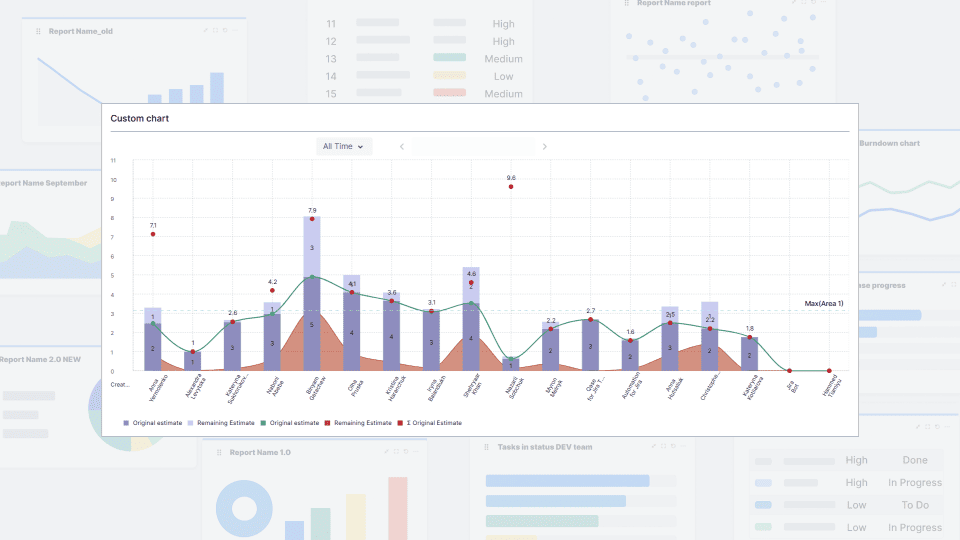
Teams working in Jira Cloud often benefit from tools such as Report Hub, which centralizes Agile analytics into clean, curated dashboards and eliminates the need for redundant reports.
6. Document Your Reporting System
A lean reporting ecosystem requires documentation:
- List of official reports
- Metric definitions
- Owners
- Update frequency
- Data sources
- Correct interpretation examples
Conclusion
Agile teams fail because they have too much unstructured data. Noise kills clarity; clarity drives action. A lean reporting system gives teams:
- Faster decision cycles
- Reliable and consistent metrics
- Reduced operational overhead
- Transparency for every role
- More time to focus on delivering value
When teams stop drowning in dashboards and start focusing on the few metrics that truly matter, they work smarter, collaborate better, and deliver outcomes with confidence. And, obviously, achieve better results for the company.
Opinions expressed by DZone contributors are their own.
Comments