

Agility Office: The Backbone of Any Transformation
Driving Enterprise Agility through Agility Office.
Introduction
In the traditional world of Project and Program Management, Project Management Office (PMO) played a very crucial way in standardizing and unifying the various Project Management processes and activities. With the software industry transforming its working into an Agile Way of Working, one gets a sense that the PMO has become anachronistic and is more or less become extinct. However, that's not the case and we have many organizations creating Agility Office / Agile Program Office / Agile Transformation Office / Agile Orchestration Office to name a few.
In this article, we will use the word Agility Office to represent the above nomenclatures. While many might think it's just a christening from PMO to the above names, the reality is that Agility Office is the Key driver of Agility across organizations Transformation journey.
The right candidate to head an Agility Office should be a senior-level coach who has worked on successful transformations in the past.
A few Acronyms used in the article are mentioned below:
Acronym |
Description |
PO |
Product Owner |
SM |
Scrum Master |
AO |
Agility Office |
ATO |
Agile Transformation Office |
Alignment of Agility Office with Agile Manifesto
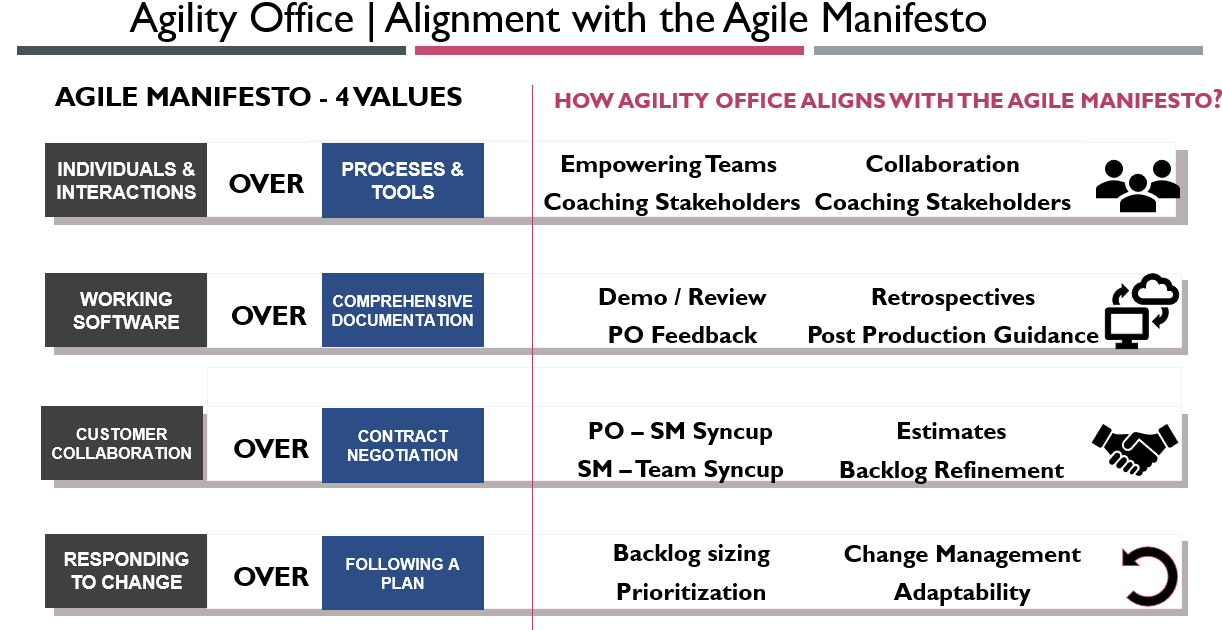
One of the prerequisites for Agility Office is to ensure that the activities undertaken and driven by it are in alignment with the Agile Manifesto values. Above is an indicative diagram that mentions the key activities performed by Agility Office in alignment with the Agile Manifesto.
Core Objectives
The following are the core objectives of establishing an Agility Office.
Chief Orchestration Office |
6 Core Levers |
Enabler for Driving Enterprise Agility |
Outside In / Inside Out Perspective |
Focused Group for interacting with multiple Stakeholders |
Standardization of Practices |
As mentioned above the purpose it to drive in Agility Transformation across its Business Unit / Organizational Unit
Agility Office as an Enterprise Transformation Engine
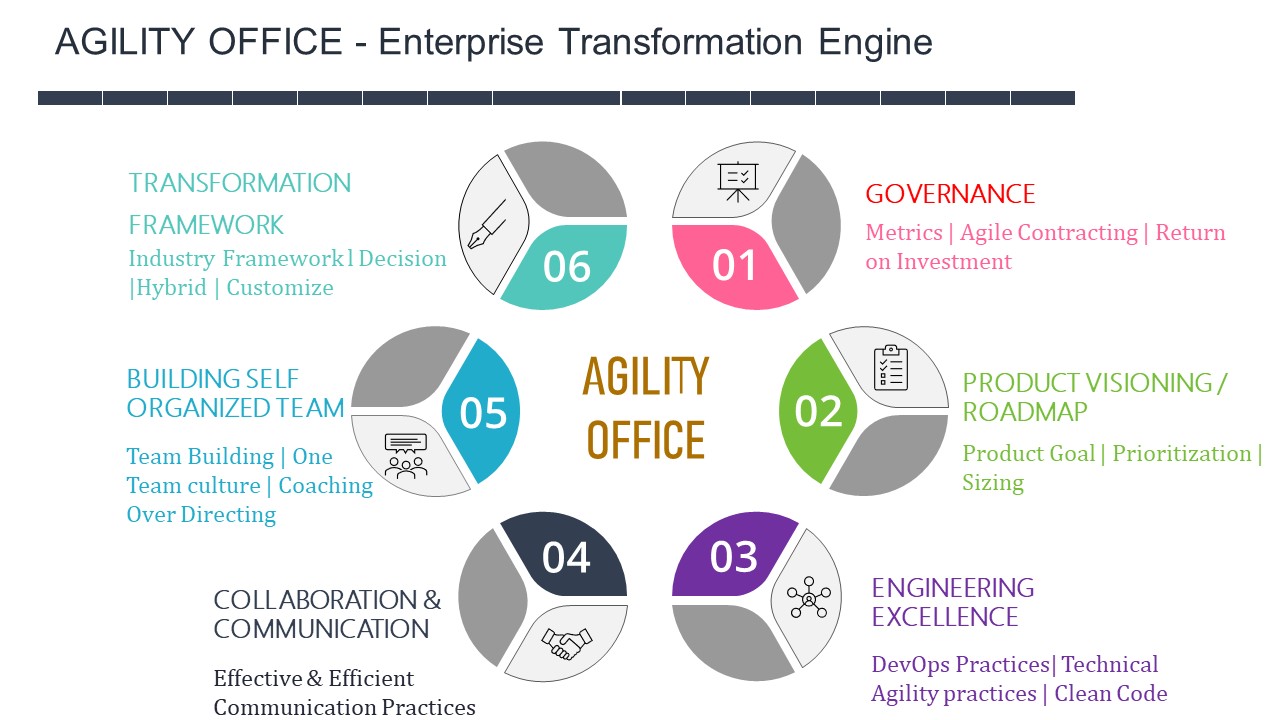
The above is a 6 layered model which highlights the core activities to be performed as a part of Agility Office.
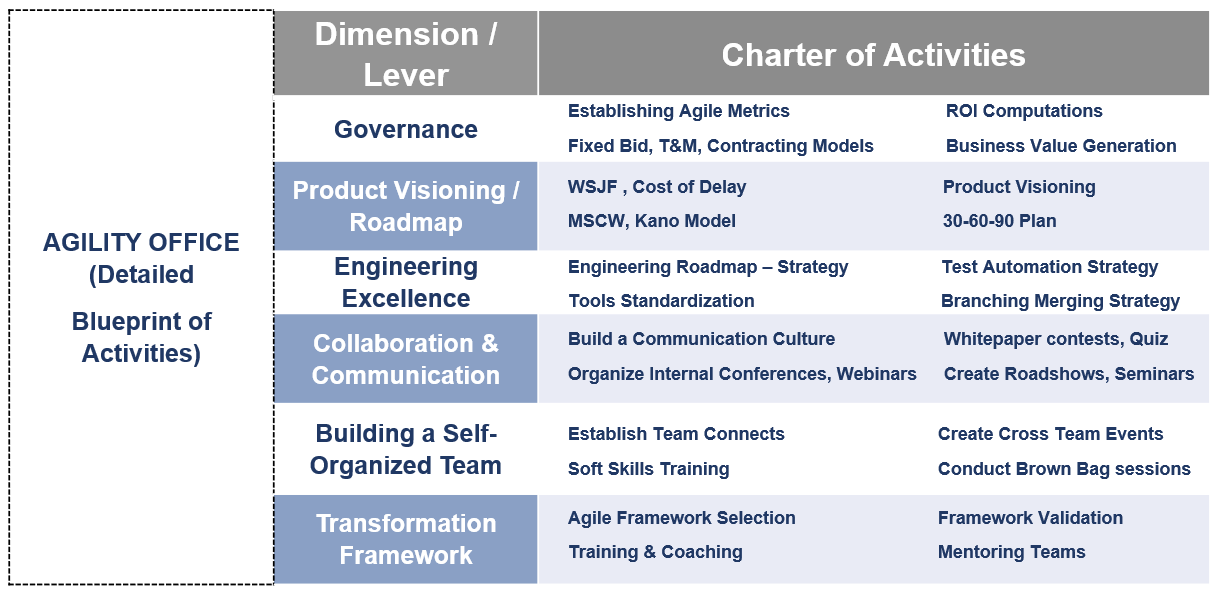
Agility Office: Detailed Blueprint
The below table describes the activities performed by Agility Office across the 6 layered model in detail
Conclusion
Agility Office is the key engine for any organization's Enterprise Agility journey. Many organizations, in their journey towards agility, are doing good work at the individual project level. These individual project initiatives either get forgotten, ignored, or do not get an opportunity for a credit due to which many good practices are lost in the woods.
Agility Office comes in here and builds a perfect symphony amongst the individual notes by sewing an agility story at the business unit/organizational unit level, thereby performing the role of a Chief Orchestration Office.
Many of us think creating this structure is a Cost center, however over the long run this is the Profit center of an organization's journey towards Agility.
Opinions expressed by DZone contributors are their own.