

AI-Driven Threat Hunting: Catching Zero Day Exploits Before They Strike
Zero-day exploits hide in plain sight. Learn how AI detects them, see real-world use cases, and build your own Python threat hunter to catch anomalies fast.
 ·
·
Join the DZone community and get the full member experience.
Join For FreePicture this: you're a cybersecurity pro up against an invisible enemy. Hidden in your network are zero-day exploits, which represent unknown vulnerabilities that await their moment to strike. The time you spend examining logs becomes pointless because the attack might already be causing harm. AI-driven threat hunting emerges as your most valuable new ally. Your network receives a real-time protection system through AI, which functions like a super-intelligent guard dog that detects threats. The following article explains how AI detects hard-to-find threats while demonstrating its real-world impact and providing Python-based instructions to create your own threat-hunting tool. Buckle up, let’s go!

Why AI Matters in the Fight Against Zero Days
Cybersecurity has come a long way from the days of simple virus scanners and static firewalls. Signature-based defenses were sufficient to detect known malware during the past era. Zero-day exploits operate as unpredictable threats that traditional security tools fail to detect. The technology sector saw Microsoft and Google rush to fix more than dozens of zero day vulnerabilities which attackers used in the wild during 2023. The consequences reach extreme levels because a single security breach results in major financial losses and immediate destruction of corporate reputation.
AI functions as a protective measure that addresses weaknesses in human capabilities and outdated system limitations. The system analyzes enormous amounts of data from network traffic and timestamps and IP logs, and other inputs to detect security risks. The system functions like an investigative detective who possesses X-ray vision to identify threats before they receive their names. The implementation of this technology enables organizations to respond quickly to threats and reduces the number of security breaches while providing protection against continuous criminal activity.
How It Works: The AI Detective at Play
So how does AI pull this off? It’s all about finding the weird stuff. Network traffic packets follow regular patterns, but zero-day exploits cause packet size fluctuations and timing irregularities. AI detects anomalies by comparing data against its knowledge base of typical behavior patterns. Autoencoders function as neural networks that learn to recreate data during operation. When an autoencoder fails to rebuild data, it automatically identifies the suspicious activity.
Real-world example? A hacker uses oversized packets to crash servers through this classic zero-day tactic during system probing. The artificial intelligence system detects security threats immediately although human operators would probably overlook this threat in the data noise. You’ll now find this tech guarding everything from corporate servers to national defense systems.
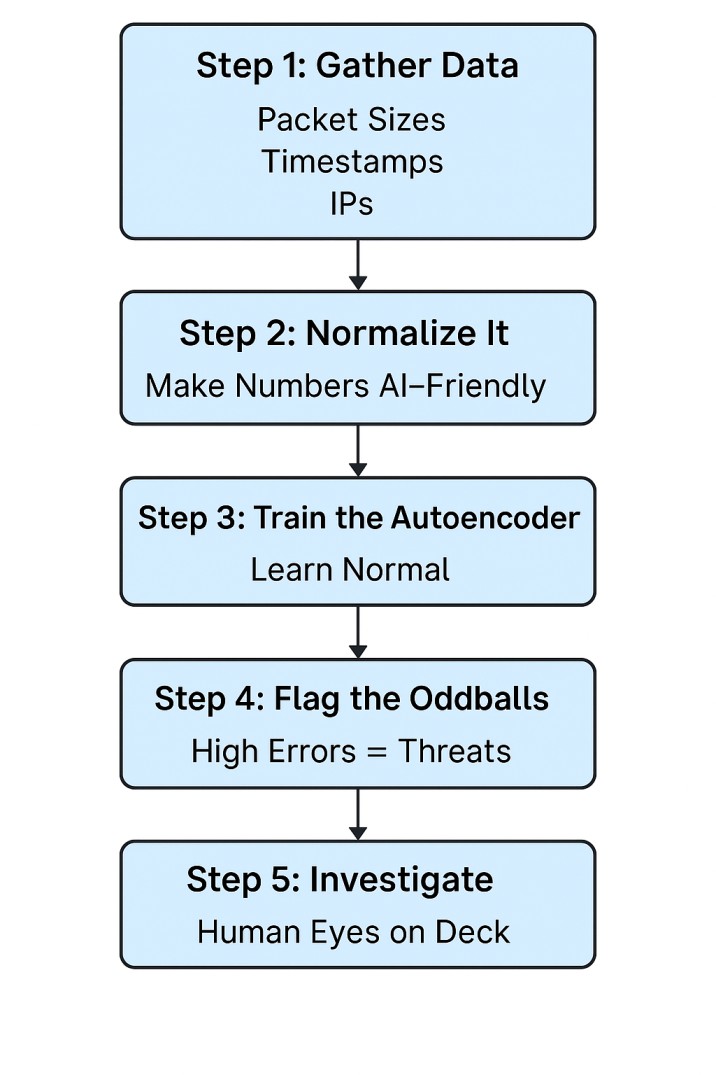
AI Threat Hunting Process
Let’s Build It: Hands-On Threat Hunting
Enough of the talk and let’s code now! We will create a mini threat hunter using Python, TensorFlow, and some dummy network data below. This script generates traffic with hidden anomalies, trains an AI to spot them, and even plots the results. It’s a taste of what pros use to protect real networks.
import numpy as np
import pandas as pd
import tensorflow as tf
from sklearn.preprocessing import StandardScaler
from datetime import datetime, timedelta
import matplotlib.pyplot as plt
Now we create 1000 rows of artificial network traffic which begins on March 31, 2025. The majority of packets remain standard but we introduce 50 abnormal packets with large sizes and irregular timestamps to simulate exploit attempts.
np.random.seed(42)
n_samples = 1000
packet_sizes = np.random.normal(loc=500, scale=100, size=n_samples)
timestamps = [datetime(2025, 3, 31, 0, 0) + timedelta(seconds=i) for i in range(n_samples)]
source_ips = [f"192.168.1.{np.random.randint(1, 255)}" for _ in range(n_samples)]

n_anomalies = 50
anomaly_indices = np.random.choice(n_samples, n_anomalies, replace=False)
packet_sizes[anomaly_indices] = np.random.uniform(2000, 5000, n_anomalies)
timestamps = [t + timedelta(seconds=np.random.randint(1000, 5000)) if i in anomaly_indices.tolist() else t for i, t in enumerate(timestamps)]
We tweak the data so the AI can handle it: timestamps become seconds, IPs get simplified.
start_time = min(timestamps)
timestamps_numeric = [(t - start_time).total_seconds() for t in timestamps]
source_ips_numeric = [int(ip.split(".")[-1]) for ip in source_ips]

data = pd.DataFrame({
"packet_size": packet_sizes,
"timestamp": timestamps_numeric,
"source_ip": source_ips_numeric
})
Next, we prep and train the autoencoder:
features = data[["packet_size", "timestamp", "source_ip"]].values
scaler = StandardScaler()
normalized_data = scaler.fit_transform(features)

model = tf.keras.Sequential([
tf.keras.layers.Input(shape=(3,)),
tf.keras.layers.Dense(16, activation="relu"),
tf.keras.layers.Dense(8, activation="relu"),
tf.keras.layers.Dense(16, activation="relu"),
tf.keras.layers.Dense(3, activation="linear")
])

model.compile(optimizer="adam", loss="mse")
model.fit(normalized_data, normalized_data, epochs=50, batch_size=32, verbose=1)
Finally, we hunt for anomalies and visualize them:
reconstructions = model.predict(normalized_data)
errors = np.mean(np.square(normalized_data - reconstructions), axis=1)
threshold = np.percentile(errors, 95)
anomalies = data[errors > threshold]

print(f"Found {len(anomalies)} potential threats!")
print(anomalies.head())

plt.figure(figsize=(10, 6))
plt.plot(errors, label="Reconstruction Error")
plt.axhline(y=threshold, color="r", linestyle="--", label="Threshold")
plt.scatter(anomaly_indices, errors[anomaly_indices], color="red", label="Anomalies")
plt.xlabel("Sample Index")
plt.ylabel("Error")
plt.legend()
plt.title("Reconstruction Errors with Anomalies")
plt.show()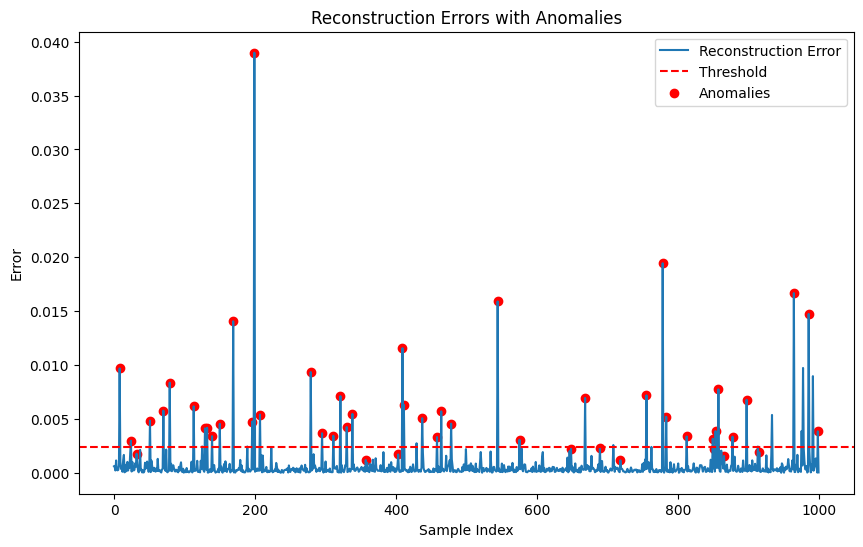
Run this code and you’ll see something like “Found 50 potential threats!” plus a graph plot like above. Those red dots? You have caught anomalies!
Why This Rocks in Real Life
So why does any of this matter? Because real-world networks are under siege 24/7 in the real world. The 2021 SolarWinds attack became possible because hackers used a zero-day exploit to infiltrate thousands of systems without detection. AI would have detected unusual network traffic before manual hunting systems could have reacted. The technology now protects all types of infrastructure, including bank servers and IoT devices for companies. The purpose extends beyond threat detection because it enables organizations to lead security efforts while reducing response time and financial losses.
This represents pure gold to developers. Developers can enhance this script by adding real data from Wireshark or SIEM tools to create an organizational-specific shield. The system demonstrates practicality and scalability while providing a satisfying experience for building.
The Catch: It’s Not Perfect
AI’s awesome, but it’s got quirks. You could end up chasing 50 ghosts a day if false positives send you junk alerts. Smart attackers can use tricks like data poisoning to evade the system. Training on big datasets requires juice, think cloud GPUs, not your old laptop. Still, the trade-off? A tool that catches what humans can’t, fast.
What’s Next?
The current situation represents only a small fraction of what is possible. AI systems have the potential to exchange threat intelligence across networks while working with quantum technology to achieve advanced detection capabilities. The responsibility rests with you for now. You should modify the code base and integrate it with real-time traffic data.
Opinions expressed by DZone contributors are their own.
Comments