

The AI4Agile Practitioners Report 2026
The AI4Agile Practitioners Report 2026: 83% of Agile practitioners use AI, but most spend 10% or less of their time with AI.
 CORE
·
CORE
·
Join the DZone community and get the full member experience.
Join For FreeTL;DR: The AI4Agile Practitioners Report 2026
83% of Agile practitioners use AI, but most spend 10% or less of their time with it because they do not know where it fits. Our survey of 289 Agile practitioners identifies the real adoption barriers and shows where AI creates value you can act on.
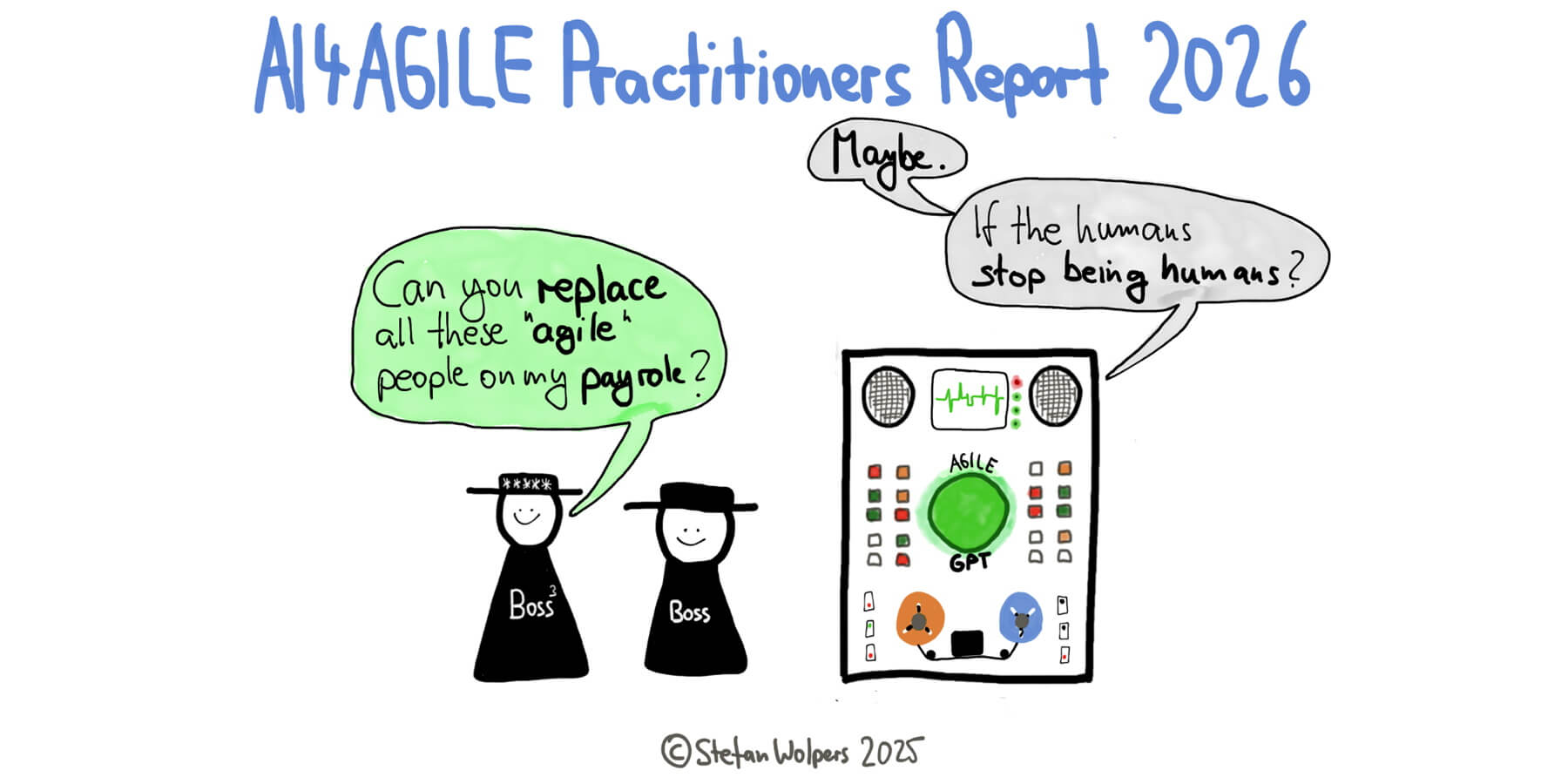
We asked 289 Agile practitioners how they use AI. Most of them barely do.
We surveyed 289 Agile practitioners, including Scrum Masters, Agile Coaches, Product Owners, Product Managers, and others, across more than 20 countries and a broad range of industries. We asked them how they use AI, what they expect from it, and what concerns them. The data tells a clear story:
Broad Adoption, Shallow Integration
83% of respondents use AI tools. That number sounds impressive until you look closer: 55% spend 10% or less of their work time with AI. Only 9% exceed 25%. And just 15% have received any formal training on using AI in Agile contexts.
67% of organizations already provide access to AI tools, and 45% have strategic AI initiatives. But access without competence produces shallow adoption. Most gile practitioners experiment with AI the way most organizations “do Agile”: they go through the motions without changing how they think or work.
Confusion Beats Resistance as the Primary Barrier
When we asked about the biggest challenges in adopting AI, one item dominated everything else: integration uncertainty, at 54.3%. That is 18 percentage points ahead of the next item on the list.
Practitioners do not reject AI. They do not know where it fits. How does AI integrate into Sprint Planning, into Refinement, into a Retrospective? The tooling exists, but the workflow logic does not. Training resources lacking (35.6%), ethical concerns (35.3%), and not knowing where to start (31.1%) cluster right behind. Only 1% consider AI irrelevant to their role. Willingness is not the problem, but knowing what to do with AI is.
Practitioners Fear Erosion, Not Replacement
The finding that surprised us most: threat perception is low. On a 7-point scale from 0-6, where “0” meant “no threat,” the average score for “AI as a threat to my role” is 2.75. More than half of the respondents scored 1 or 2. Only 7.6% see AI as a significant threat.
However, the open-ended responses tell a different story. Agile practitioners are not worried about losing their jobs. They are worried about losing what makes their work meaningful. The most frequently mentioned concerns are the erosion of Agile values and principles, the loss of human-centered collaboration, and reduced critical thinking. Respondents repeatedly flag that AI might optimize delivery while weakening the spirit of agility:
- Efficiency at the cost of reflection,
- Convenience at the expense of competence;
- AI as a supercharged way into the feature factory.
Given that practitioners care about collaboration, shared understanding, and professional judgment, this is not technophobia, but a principled position. They see AI making it easy to skip the hard conversations. That is the threat.
AI Creates Value by Reducing Overhead
The top three benefits practitioners report form a tight cluster: increased productivity (73.7%), reduced cognitive load (71.6%), and greater focus (71.6%). These three stand apart from everything else on the list. Better decision-making (55.7%) and enhanced code quality (48.8%) trail well behind.
The pattern is consistent across every section of the report. AI is most valued when it handles the work nobody wants to do: drafting, summarizing, preparing, and documenting. Agile practitioners use AI to create space for facilitation, dialogue, and decision-making, not to replace them.
The success stories reinforce this. The strongest use cases are bounded and low-risk: preparing for Retrospectives, simplifying complex requirements for different audiences, clustering qualitative feedback, and generating first drafts. No respondent reports AI making a strategic product decision. The consistent theme: AI saves 30 minutes of documentation so practitioners can spend that time on conversations that matter.
What Practitioners Actually Want From AI
When we asked what they would improve if they could, respondents did not ask for smarter models. They asked for better-fitting ones. The most frequently mentioned wishes: context-aware outputs that understand their specific team and domain, stronger data protection without bureaucratic overhead, and AI embedded directly into existing toolchains without context switching.
The “magic wand” respondents describe does not produce a more powerful AI. It makes one that fits into their Sprint without friction.
This pragmatic perspective is reflected in the five-year outlook. Agile practitioners expect AI to become invisible infrastructure in Agile tooling, to improve context awareness over time, and to reduce administrative overhead. They also expect, and demand, clearer governance, ethical guardrails, and organizational standards.
Agile practitioners do not expect AI to redefine Agile. They expect it to remove the friction that currently buries teams in overhead.
Published at DZone with permission of Stefan Wolpers. See the original article here.
Opinions expressed by DZone contributors are their own.
Comments