

Breaking the Chains of the GIL in Python 3.14
Python 3.14 officially makes the GIL optional. This deep dive explores the free-threaded architecture, performance trade-offs, and practical migration strategies.
 ·
·
Join the DZone community and get the full member experience.
Join For FreeFor years, developers working in Python have wrestled with a strange paradox: great productivity and ecosystem breadth, but limited multicore throughput in many scenarios. The culprit? The Global Interpreter Lock (GIL). Put simply: in CPython, only one native thread may execute Python bytecode at a time. For IO-bound tasks, this is often fine, but for CPU-bound or highly concurrent workflows, this constraint has been a persistent bottleneck.
I have experienced this frustration many times - you design a multithreaded service, spin up 16 threads on a 32-core machine expecting massive throughput, and then watch in horror as CPU utilization flatlines at 100% (effectively one core). You are then forced to switch to multiprocessing, pay the heavy overhead of inter-process communication, or rewrite critical paths in Rust or C++. All this complexity just to get true parallelism.
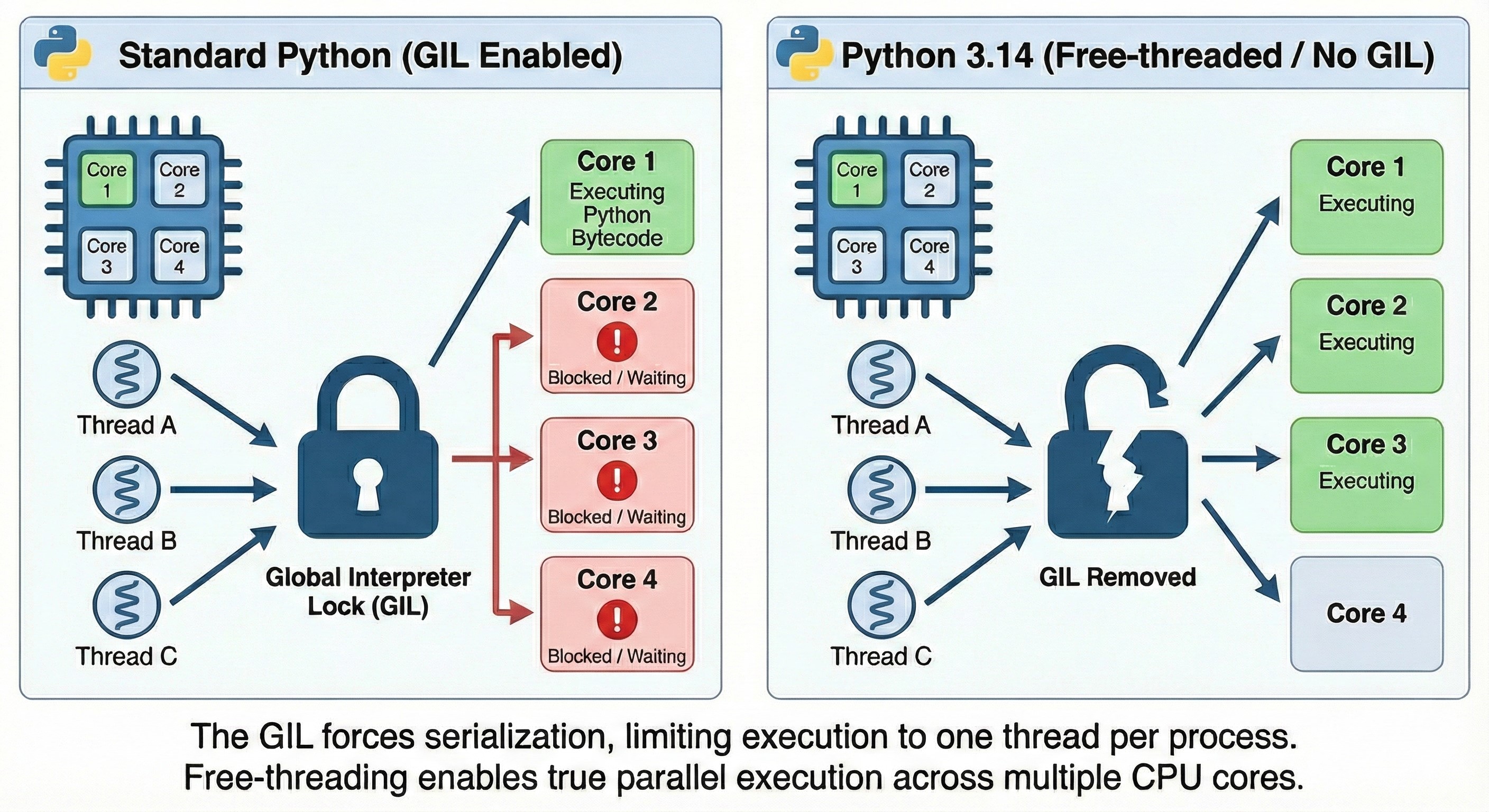
Why the GIL Was the "Elephant in the Room"
The GIL did not exist to annoy us. It originated in the early days of CPython to solve a specific memory management problem: reference counting. In Python, every single object (a number, a string, a list) tracks how many variables are pointing to it. This is its "reference count." When that count drops to zero, Python frees the memory.
If two threads try to update the same object's count simultaneously without protection, they could overwrite each other. The result? Memory leaks (count never hits zero) or segmentation faults (memory freed while still in use).
To prevent this, CPython took a "brute force" approach: a single Global Interpreter Lock that ensures only one thread can interact with Python objects at a time. As PEP 703 summarizes the result:
“The GIL prevents multiple threads from executing Python code at the same time.”
In my experience, the GIL bites in three key areas:
-
CPU-bound computation: Heavy numeric loops, graph processing, or image manipulation. If you try to run these across threads, they end up fighting for the lock, often running slower than a single thread.
-
High-throughput data processing: Think of a web service handling thousands of requests per second. While the network I/O is fine, the serialization (JSON/Protobuf) and business logic are CPU-bound. The GIL forces you to spin up heavy separate processes just to utilize more than one core for parsing JSON.
-
Ecosystem constraint: Because threads historically didn't scale, the ecosystem fragmented. We have excellent tools for processes (like Celery or
multiprocessing), but we lack the rich, shared-memory concurrency patterns common in languages like Go or Java.
The Architecture: How Python Removed the Lock
Removing the GIL was not a simple deletion. It required a foundational reconstruction of the interpreter. The GIL provided implicit thread safety for internal C structures, which allowed CPython to assume that memory operations were safe by default. To remove the lock without crashing the interpreter, the CPython team had to solve two massive concurrency problems. Python 3.13 introduced the solution, and Python 3.14 optimized it for production.
1. Biased Reference Counting (The 3.13 Foundation)
The most significant challenge was reference counting. If the interpreter used standard atomic operations for every single variable access, the CPU cache contention would make Python significantly slower.
The solution introduced in Python 3.13 is biased reference counting. Every object tracks which thread created it.
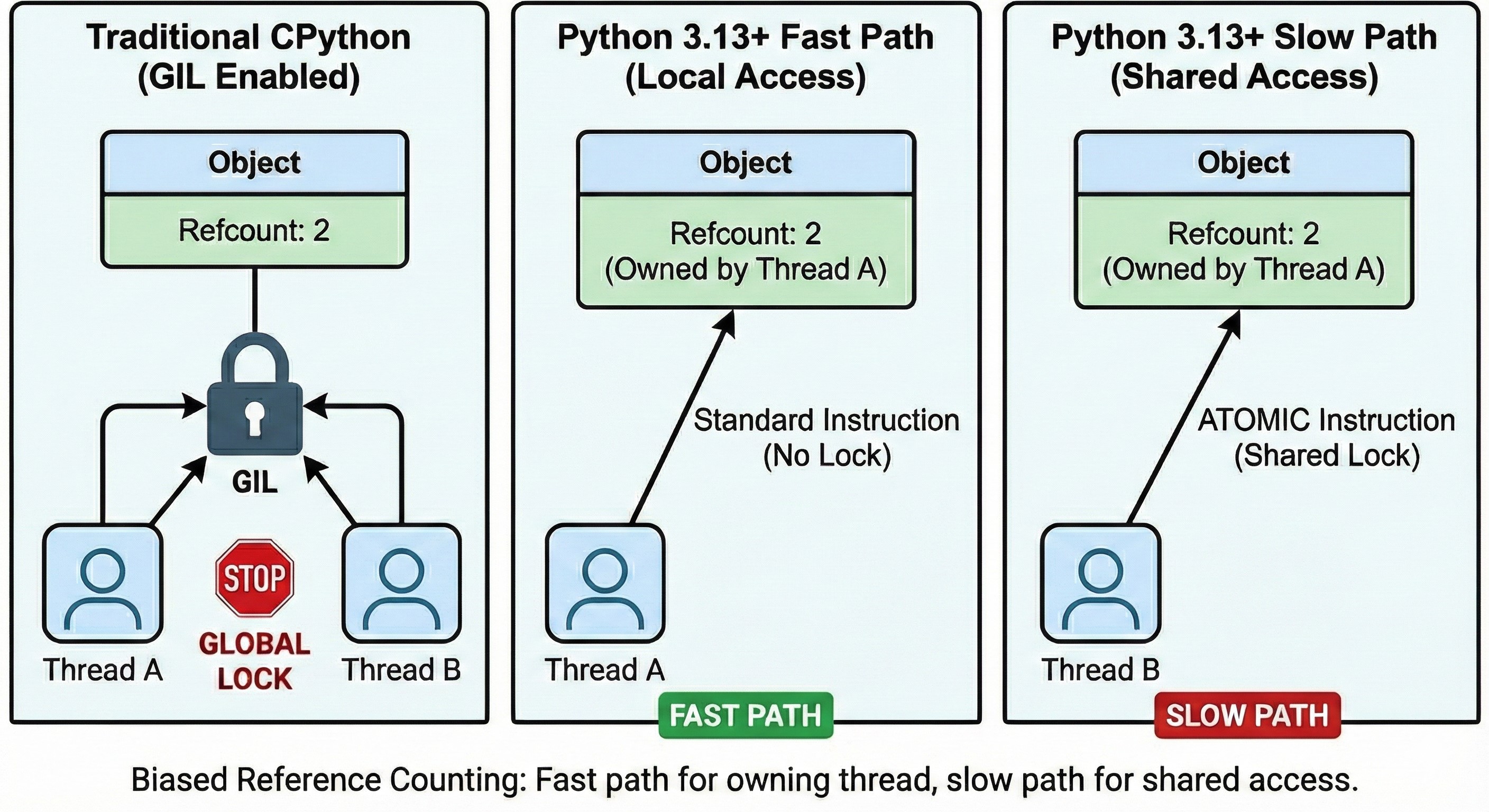
- Fast path: As long as the "owning" thread is the one modifying the reference count, it uses standard, fast non-atomic instructions. This approach covers the vast majority of local variable usage.
- Slow path: If a different thread tries to access the object, the interpreter marks the object as "shared." From that moment on, all threads typically switch to using safer but slower atomic operations for that specific object.
2. Mimalloc and The GC Upgrade (The 3.14 Refinement)
Managing memory across threads is notoriously difficult. The free-threaded build replaces the old pymalloc allocator with Mimalloc, which is a thread-safe allocator developed by Microsoft. This change allows memory to be allocated in parallel without a global lock.
While Python 3.13 introduced Mimalloc, Python 3.14 introduced a critical upgrade to the Garbage Collector. In the initial 3.13 experiment, the Garbage Collector had to pause all threads to scan the entire memory heap to find reference cycles. This resulted in noticeable latency spikes. Python 3.14 solves this with a thread-safe Incremental Garbage Collector. It breaks the heap into generations and scans them in small bursts. This approach keeps your multi-threaded application responsive even under heavy load.
The Reality Check: The Cost of Scalability
Before you adopt free-threading, you must understand that removing the GIL is a trade-off, not a magical optimization. You are exchanging single-threaded raw speed for the ability to scale across cores.
1. The Single-Threaded Tax
There is a cost to thread safety. When the interpreter cannot rely on a global lock, it must perform more bookkeeping for every operation.
- In Python 3.13, enabling free-threading caused single-threaded code to run approximately 40% slower than the standard build. This was the overhead of the new memory management safeguards.
- The Python 3.14 Improvement: In Python 3.14, the new Tier 2 Just-In-Time (JIT) compiler drastically reduces this penalty. The JIT is intelligent enough to identify when data is not being shared across threads. It can then optimize away the expensive thread-safety checks for those specific code paths.
While a standard GIL-enabled build is still slightly faster for purely single-threaded tasks, the gap in Python 3.14 has narrowed significantly. This makes the free-threaded build a viable default for general-purpose applications.
2. Logical vs. Interpreter Safety
The GIL had an unintended benefit. It made non-thread-safe code safe by accident. It serialized access so that only one thread could modify a generic object at a time.
In the free-threaded world, CPython protects itself, but it cannot protect your logic.
- Interpreter safety: CPython adds internal locks to built-in types like lists and dictionaries. You will not crash the interpreter or cause a segmentation fault by accessing a list from multiple threads.
- Data safety: You absolutely can corrupt your data. Race conditions, lost updates, and non-atomic read-modify-write operations will surface immediately if you are not careful.
The action plan: You must be rigorous about using threading.Lock around shared state. Additionally, you must ensure your C-extension dependencies (like NumPy or Pandas) have explicitly opted into free-threading. If a library has not been updated, the interpreter will automatically re-enable the GIL while that specific module runs to prevent crashes.
How to Approach Adoption
Adopting free-threaded Python is not a binary switch; it is a migration. Here is how to navigate it.
1. Try it Today
Testing is easier than ever. Modern package managers like uv support free-threaded builds out of the box.
# Install the free-threaded version of Python 3.14
uv python install 3.14timport sys
def check_status():
# Available in Python 3.13+
if hasattr(sys, "_is_gil_enabled"):
status = "ENABLED" if sys._is_gil_enabled() else "DISABLED (Free-Threaded)"
print(f"Current GIL Status: {status}")
else:
print("Legacy Python: GIL is always ENABLED")
if __name__ == '__main__':
check_status()2. For Greenfield Projects
-
The advantage: You avoid the serialization overhead of
multiprocessingand the memory duplication of forking processes. -
The requirement: You must design for thread safety from day one. Use
threading.Lockaggressively around mutable state and prefer immutable data structures where possible.
3. For Existing Codebases
Py_mod_gil slot), the interpreter may pause execution and re-enable the GIL to prevent that module from crashing. You might think you are running free-threaded, but a single legacy dependency could be serializing your entire application.
Migration checklist:
-
Audit wheels: check your
requirements.txt. Are your critical heavy-lifters (NumPy, asyncpg, Pydantic) installing wheels with thecp314tABI tag? -
Isolate concurrency: If you have a mix of safe and unsafe libraries, consider moving the safe, CPU-heavy logic into a specific thread pool, while keeping legacy I/O logic separate.
-
Profile, don't guess: Run your workload and measure CPU utilization. If you see utilization capped at 100% (1 core) despite using 3.14t, a legacy dependency is likely holding the GIL.
Conclusion
Opinions expressed by DZone contributors are their own.
Comments