

How to Build a Scalable SaaS Product Architecture
Start with a modular monolith, enforce tenant isolation, and build security in early. Scale infrastructure as demand grows instead of adding unnecessary complexity.
Most of the SaaS teams get the scaling question backward. They spend around six months debating Kubernetes clusters and microservices for a product that has limited customers. And when the same team gets an enterprise client and suddenly has 500 concurrent users, the database falls. This is because no one thought about connection pooling.
The architecture decisions that actually matter for a SaaS product aren't about picking the trendiest stack. They're about sequencing. Which parts of the system need to scale on day one, and which parts can wait until there's real traffic to justify the complexity. A payments startup I've seen referenced in postmortems rebuilt its entire auth layer twice in eighteen months, first to add multi-tenancy, then again to fix a data leak between tenant accounts that never should have been possible in the first place.
This piece walks through the architectural decisions that hold up as a SaaS product goes from ten users to ten thousand: how to structure the application layer, what multi-tenancy actually requires, and where security has to be built in rather than patched on later.
What SaaS Architecture Actually Means
SaaS architecture is the technical blueprint for how a product gets built, deployed, and shared across every customer using it. A desktop app or an internal company tool typically serves one user or one organization. SaaS application architecture is different because it needs to run different customer accounts on the same codebase and the same database.
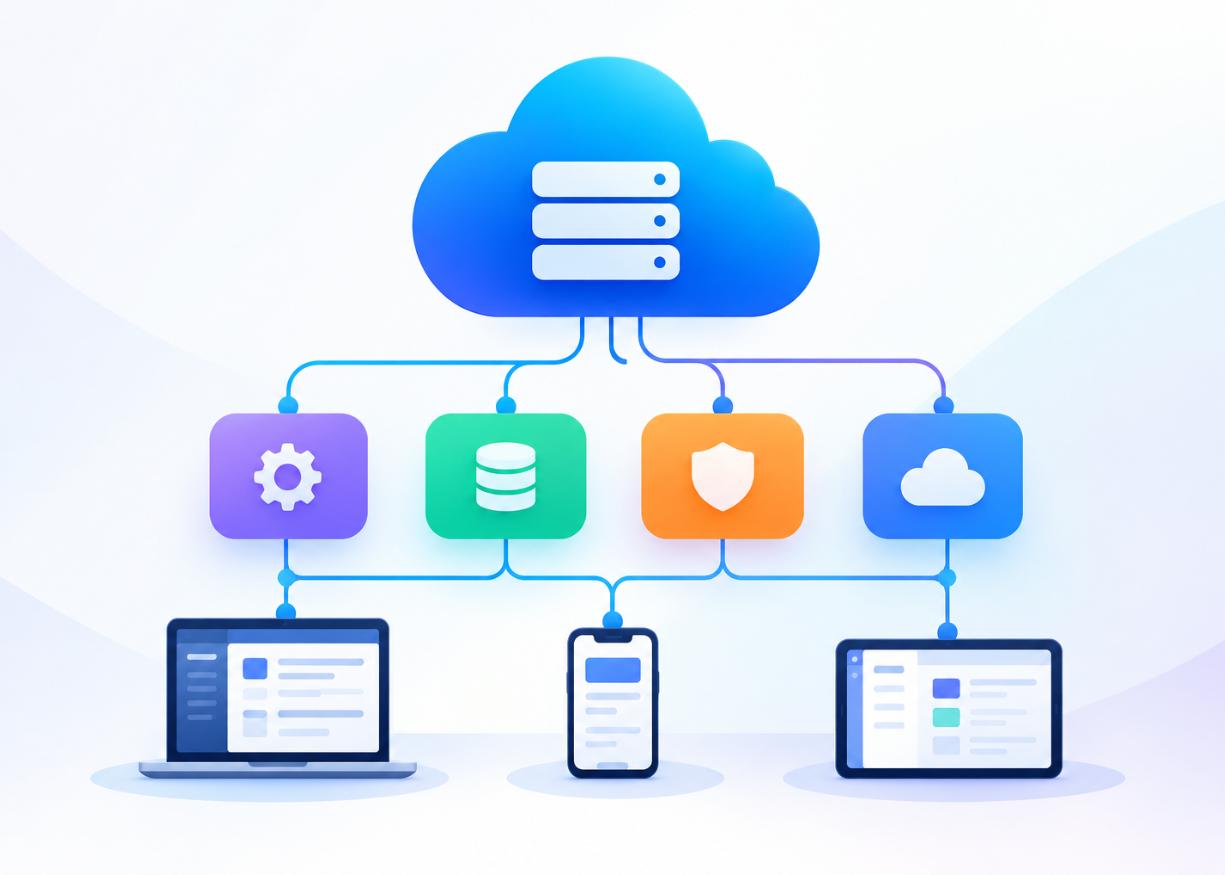
It has a shared setup, and that is the reason SaaS works as a business model. One codebase, sold repeatedly, instead of a fresh install for every buyer. But it changes what a bad query or a bad index actually costs you. On a single-tenant system, a slow query is one customer's problem. On a multi-tenant platform, that same query can drag down everyone who happens to be logged in when it runs.
Solid saas architecture plans for this early. Teams need to figure out how many concurrent users the system can handle, how tenant data stays separated on shared infrastructure, and how new capacity gets added as signups grow. Updates need a path to production that doesn't take the whole platform offline. None of this requires unusual technology. It requires making these calls while the codebase is still small enough to change your mind cheaply.
Start With a Modular Monolith, Not Microservices
The architecture decision that shapes everything downstream is whether to start with microservices or keep things simple. Most teams get this wrong in the same direction.
The Cost of Splitting Too Early
A lot of SaaS product development advice treats microservices as step one, and that's backward for most teams. Once you split a product into a dozen independently deployed services, someone has to manage network calls between them, handle service discovery, and debug failures that span multiple systems. A five-person engineering team rarely has the bandwidth for that on top of building the actual product.
What a Modular Monolith Looks Like
Most SaaS teams don't need thirty microservices. They need one codebase that's organized well. A modular monolith ships as a single app, but internally, billing code lives in a billing module, user accounts live in their own module, and the core product logic stays separate from both. Each piece owns its own data and only talks to the others through a defined interface.
Splitting things out later isn't painful if you set it up this way. Say billing starts getting heavier traffic than the rest of the app. You already have a clean boundary around it, so turning it into its own service is a deployment problem, not a rewrite.
Real Companies That Stayed Monolithic
Basecamp built on Rails and stayed on a monolith for over twenty years while serving millions of users. Shopify did the same thing on a modular Rails codebase, well past the point where a lot of engineering blogs said they should have moved to microservices. They eventually split off specific pieces, but only once those pieces had scaling needs the rest of the platform didn't.
When Splitting Actually Makes Sense
Forget team size or how much funding you've raised. Look at whether different parts of your SaaS application architecture need separate scaling, separate release schedules, or separate infrastructure. If billing and your core product feature grow together and the same engineers maintain both, there's no reason to pull them apart.
Microservices fix a coordination problem. That problem shows up once a system gets big. Building for it before you're big just adds latency and more moving parts to maintain.
What Is Multi-Tenant Architecture in SaaS
Basic Definition
Multi-tenant architecture in SaaS means multiple customers, or tenants, share the same application and often the same database, but each tenant's data stays walled off from the others. One codebase, one running instance, thousands of accounts on it. Nobody sees anyone else's data.
That's different from giving each customer their own separate deployment, which is still how a fair amount of older enterprise software works. Multi-tenancy is what makes it possible to support a few thousand customers without babysitting a few thousand installations.
The Three Isolation Models
There are three common ways teams set up tenant isolation, and I've watched companies pick the wrong one for their stage more than once.
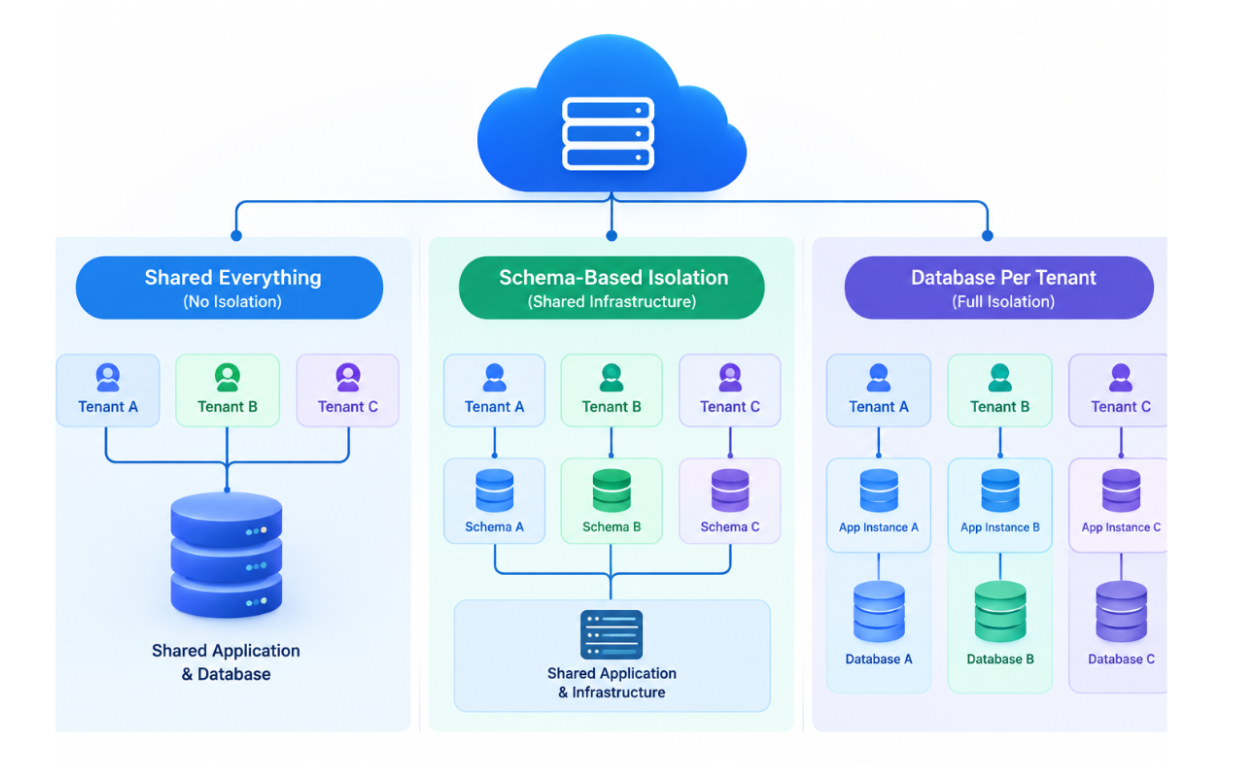
Siloed isolation gives each tenant a fully separate database. It's the safest option and the easiest one to explain to a security auditor. It's also expensive past a certain point. I know a healthcare SaaS company that ran siloed databases for its first 40 enterprise clients and then spent three months just automating the database provisioning process because doing it by hand had become a full-time job for someone.
Pooled isolation is the opposite extreme. Every tenant lives in the same tables, tagged with a tenant ID column. Cheap, scales fine, and it puts nearly all the isolation burden on your application code getting every single query right. Forget a WHERE clause once, and you've leaked another company's data. This is where most of the ugly security incidents in SaaS come from, not from hackers, but from a developer who missed a filter on a Tuesday afternoon.
Bridge isolation, also called schema-per-tenant, splits the difference. Same database, separate schemas per tenant. Costs less than siloing, still gives you a real boundary instead of relying purely on application logic.
Most products that get past a few hundred customers land on pooled or bridge, then add row-level security at the database level as a backstop, so a missed query filter doesn't turn into a headline.
Multi-Tenant SaaS Architecture Best Practices
Picking an isolation model is step one. Making it actually hold up under real traffic is a different problem, and it's the one that bites teams later.
1. Enforce Isolation at the Database Layer
Row-level security should sit at the database layer, not just in your application code. Postgres has native RLS policies for exactly this reason. Enforce tenant filtering at the query engine, and even a buggy application query can't accidentally cross tenant lines. Relying on application code alone means every engineer who ever touches the codebase has to remember the tenant filter, on every query, indefinitely. Sooner or later somebody forgets.
2. Watch for Noisy Neighbors
One tenant running a bulk export or a heavy report can drag down query times for everyone else sharing that database. I've seen a single client's 2-million-row export slow the whole platform to a crawl during business hours. Connection pooling limits per tenant help. So does routing heavy jobs like exports and report generation into a separate queue, away from regular user traffic.
3. Tag Every Cache Key With a Tenant ID
Caching gets trickier with multiple tenants sharing infrastructure. A cache key without a tenant identifier baked into it is a bug waiting to happen. I've seen a caching layer serve Tenant A's dashboard data to Tenant B because the cache key was just dashboard_summary instead of dashboard_summary:tenant_492. Every cache key, every session token, every background job payload needs the tenant ID attached, no exceptions.
4. Automate Tenant Provisioning Before You Need To
Tenant provisioning also needs to be automated early, even if the first version is a single script. Manually setting up a new tenant's schema or database entry works fine for your first ten customers. It falls apart around customer thirty, and by then you're doing it under pressure because sales already promised a launch date.
The Core Infrastructure Layers
Once the application logic and tenant model are settled, the rest of the system comes down to a few layers that each need to do one job well, without leaning on each other to cover for gaps.
1. Application Layer
Session data goes into Redis, not local server memory. This is what makes horizontal scaling actually work. When sessions live centrally, a load balancer can route a user's next request to any server in the pool, and it doesn't matter which one handled their login. Skip this step, and users get logged out at random whenever a server gets cycled out during autoscaling. Kubernetes and ECS solve the scaling mechanics. They don't fix a stateful app.
2. Data and Queue Layer
PostgreSQL or Aurora with read replicas is the standard setup past a few thousand users. Writes go to the primary, reads spread across replicas, and dashboard queries stop competing with transactional writes for the same connections.
Queues handle everything that doesn't need to finish before a response goes back to the user. Sending an email, generating a PDF, processing an uploaded file. Drop these into SQS or a Redis-backed job runner, return the response immediately, and let a background worker pick it up. Report generation is the classic case where teams skip this early and pay for it later, since a report that takes eight seconds to build will tie up a web server for eight seconds per request if it's running inline.
3. Automation and Observability
Terraform for infrastructure, CI/CD for deployments, Grafana or Datadog for monitoring. Set these up from the start rather than after the first outage. Dashboards catch a database running near capacity days before it turns into customer complaints about slow page loads.
Security Considerations for SaaS Architecture
Security in a multi-tenant system isn't a feature you bolt on before a compliance audit. It's a property of the architecture itself, and it either works because of how the system is built or fails because of how it wasn't.
1. Tenant Data Isolation Under Load
Every isolation model discussed earlier, siloed, pooled, or bridge, needs isolation enforced at more than one layer. Application-level checks catch most mistakes. Database-level row security catches the ones that slip through code review. Relying on a single layer means one bug becomes a breach instead of a near miss.
2. Authentication and Authorization at Scale
Auth gets more complicated once you're dealing with tenant-level roles on top of user-level permissions. A user might be an admin for one tenant and a regular user on a different account if your product allows multi-org membership. Token scopes need to carry tenant context, not just user identity, or a valid session for one account can end up touching data in another.
3. Encryption Boundaries
Data needs encryption at rest and in transit, but the boundary that actually matters for SaaS is key management per tenant, particularly for enterprise customers who ask about it directly during procurement. Some products use a shared encryption key across all tenants. Others generate a unique key per tenant so a compromised key doesn't expose the whole customer base at once. The second approach costs more engineering time up front and saves you from a much worse conversation later.
4. Compliance Triggers as You Grow
SOC 2 and GDPR requirements don't show up on day one, but the architectural decisions that make compliance possible do. Audit logging, data retention controls, and the ability to fully delete a tenant's data on request are much easier to build in from the start than to retrofit once an enterprise prospect asks for a SOC 2 report during contract negotiation. I've watched a sales cycle stall for two months while an engineering team scrambled to add audit logs that should have existed already.
Common Scaling Mistakes to Avoid Before Building a SaaS Architecture
Most of the problems that show up later trace back to a handful of decisions made early, usually for reasonable-sounding reasons at the time.
1. Splitting Into Microservices Before There's a Reason To
This one keeps coming up because it's the most common piece of bad advice in SaaS engineering circles. A team with six engineers and no paying customers yet decides to build fifteen microservices because that's what they read scales. Then they spend more time debugging service-to-service network calls than building the product features that would actually get them customers.
2. Storing Session State on the Application Server
Local session storage feels harmless until you try to scale horizontally and discover half your users are getting logged out every time a server restarts. This is usually caught late, often during the first real traffic spike, because it works fine at low volume and only breaks once load balancing starts routing users unpredictably across servers.
3. Skipping Read Replicas Until the Database Is Already Struggling
Adding a read replica takes an afternoon when your database is healthy. It takes a stressful weekend when your primary database is already choking under load, and every dashboard query is competing with checkout transactions. Teams tend to wait until performance is visibly bad before setting this up, which is exactly backward.
4. Treating Security as Something to Add Before the Compliance Deadline
Row-level security, audit logging, and tenant-scoped encryption keys are all much cheaper to build into the initial schema than to retrofit onto a database with millions of existing rows. I've seen a data migration to add proper tenant isolation take longer than the original feature that needed it.
When to Bring in Outside Architecture Expertise
Not every team needs to hire this out or figure it out alone. The right software development team structure can provide the expertise needed to scale efficiently.
1. Signs You Need Outside Help
A saas architecture consultant earns their fee when a team is making irreversible decisions without the experience to know which ones are irreversible. Choosing a multi-tenant isolation model is one of those. So is picking a database that can't handle your projected write volume two years out. If nobody on the team has taken a SaaS product through a scaling event before, an outside consultant who has seen the same mistakes across a dozen other companies can save months of rebuilding.
The opposite signal matters too. If your team already has someone who's built multi-tenant systems before, bringing in a consultant to re-litigate decisions that person already knows how to make just slows things down and adds a layer of translation between the person with the answer and the person implementing it.
2. Build In-House vs. Bring in Specialized Support
Full SaaS product development makes more sense when a company needs to move fast on a product with no existing engineering team, not when an established team needs a second opinion on one architectural decision. Hiring a fractional consultant for a two-week architecture review costs a fraction of what a bad multi-tenancy decision costs to unwind eighteen months later, after customer data is already sitting in the wrong shape across a production database.
The decision comes down to a specific question, not a general one: is the problem "we don't know what to build" or "we don't have enough hands to build it"? Those need different kinds of outside help, and a lot of engagements go sideways because a team hired for one problem while actually having the other.
Conclusion
Building a SaaS product that holds up under real usage comes down to sequencing decisions correctly, not chasing the most sophisticated stack available. Start with a modular monolith. Get multi-tenant isolation right at the database layer, not just in application code. Keep application servers stateless so horizontal scaling actually works when you need it.
None of this is exotic engineering. It's a set of ordinary decisions made at the right time, before the codebase gets big enough that reversing course means months of migration work instead of an afternoon of refactoring. If you're mapping out architecture for a new SaaS product, it's worth getting a second set of eyes on the isolation model and data layer decisions before they're locked into a production schema.
Opinions expressed by DZone contributors are their own.