

Build Software Faster With Three Simple Principles
Reduce rework with three practical habits: concise feature documentation, technical refinement, and API contracts that let teams develop in parallel.
Join the DZone community and get the full member experience.
Join For FreeDevelopment in small companies and startups often slows down at the boundaries between people and teams. A developer waits for a product decision. Frontend work stalls because the API response is unclear. QA discovers that two teams interpreted the same requirement differently.
Three practical habits can reduce these delays: document the feature, discuss its technical risks, and agree on interface contracts before dependent implementations diverge. Keep each step proportional to the size and uncertainty of the task.
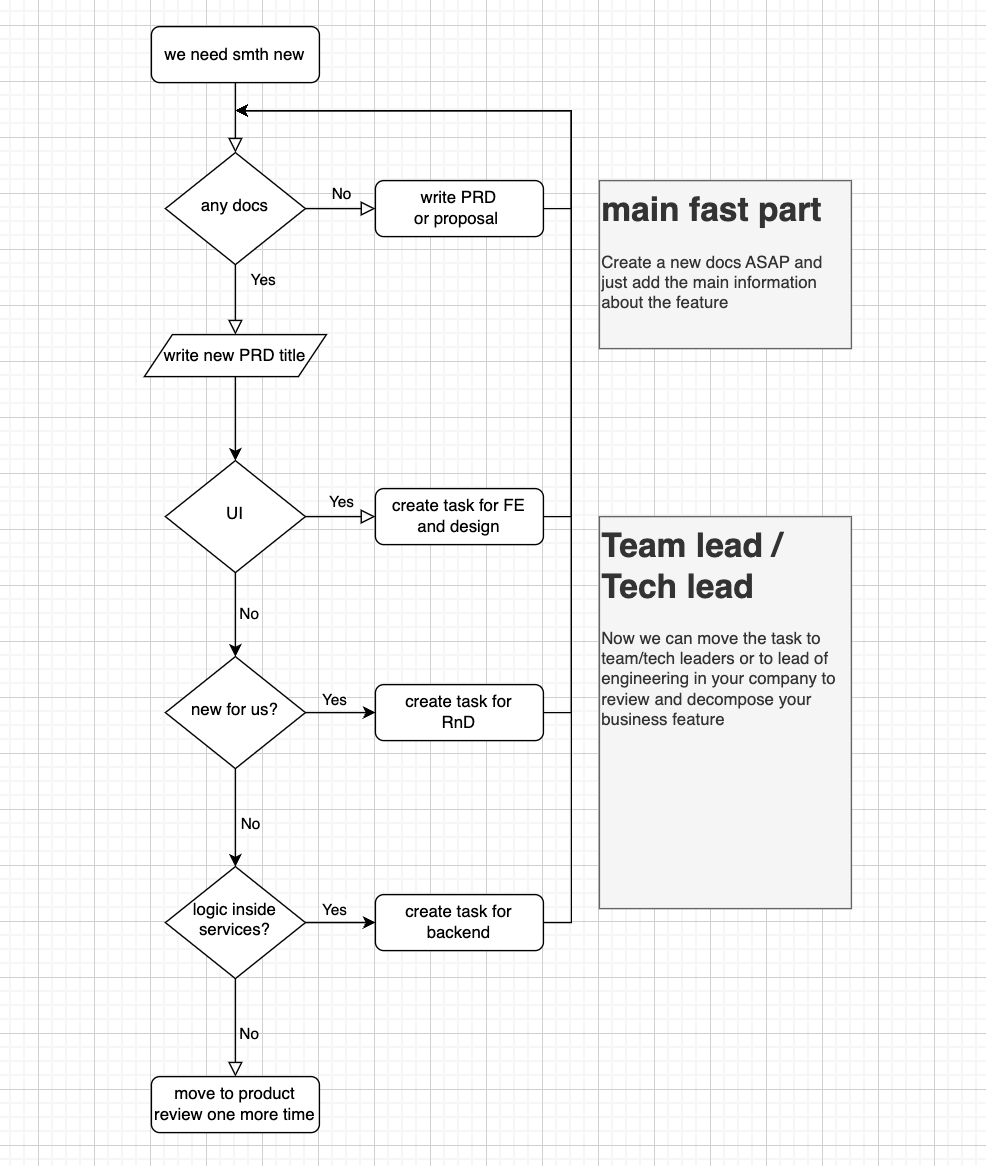
Start With the Biggest Uncertainty
Before distributing work, identify what the team needs to learn first.
- Unclear user experience? Start with a UI prototype. Frontend developers can use mocks to explore the flow while the team clarifies requirements.
- Uncertain business logic, performance, or integration? Start with a focused backend investigation or technical prototype.
- Unclear user problem or business value? Start with product discovery, involving users, product stakeholders, and technical specialists as needed.
Having a UI does not automatically make frontend work the first priority. Choose the starting point that resolves the most important uncertainty, then agree on enough shared detail to let work proceed in parallel.
1. Maintain Feature Documentation and Define Responsibilities
A concise Product Requirements Document (PRD) gives the team a shared explanation of what to build, why it matters, and how to evaluate it. For a small feature, a short page may be enough.
| Question | What to record |
|---|---|
| What are we building? | The intended behavior, MVP scope, and explicit exclusions. |
| Who is it for? | The users and the problem they face. |
| Why is it needed? | The expected benefit to users and the business. |
| How will we evaluate it? | Acceptance criteria, success metrics, a baseline or comparison group, and a measurement period. |
Name the person responsible for product decisions and identify the people needed to implement and validate the feature. These are responsibilities; a small team may combine several of them in one role.
| Responsibility | Typical owner |
|---|---|
| Set goals, decide scope, and resolve product questions | Product owner |
| Assess feasibility, design interfaces, and implement the feature | Developers and technical lead |
| Define test scenarios and verify behavior | QA and developers |
| Design the user experience | Designer, where needed |
| Define instrumentation and evaluate impact | Analyst or another explicitly assigned team member |
Example: A Post Recommendation System
The following is an illustrative PRD. Its numerical targets are examples to agree on for a particular product, rather than measured results or universal benchmarks.
| Section | Example |
|---|---|
| Problem and hypothesis | Users may struggle to find relevant posts in a chronological feed. We expect recommendations based on their interests to improve content discovery. |
| Users | Readers discovering posts; creators whose eligible posts can be recommended. |
| MVP behavior | Return up to 20 eligible posts, ranked by popularity within topics inferred from likes and subscriptions. Recompute lists every 24 hours. Exclude deleted posts and posts the requesting user cannot access when serving the response. Use a general popularity list when there is insufficient interest history. |
| Experiment support | Assign eligible users to stable control and treatment groups and record recommendation impressions and clicks. Include this in the MVP so the first version can be evaluated. |
| Out of scope | ML models, similarity between users, and advertising recommendations. Decide whether to add these after evaluating the MVP. |
| Performance | Illustrative target: server-side p95 response time below 200 ms for serving precomputed lists at 1,000 requests per second on a representative test dataset. Measure the batch recomputation job separately and require it to finish within the 24-hour refresh window. |
| Acceptance criteria | Tests verify ranking on a fixed dataset, the popularity fallback, access filtering, and feedback recording. Likes and subscription changes affect the next scheduled recomputation. Load tests meet the stated latency target. |
| Success measurement | Illustrative primary target: a 10% relative increase in recommendation CTR versus the control group. Define CTR as clicks divided by recorded impressions. Plan an initial two-week experiment; estimate sample size before launch and report uncertainty if the result is inconclusive. Monitor seven-day retention and API error rate as guardrails, with acceptable thresholds agreed before launch. |
| Risks | Weak relevance, overexposure of already popular posts, and load spikes. Inspect recommendation diversity, provide a fallback, and test capacity before rollout. |
Technical notes can accompany the PRD, with implementation decisions reviewed during technical refinement. For example, a Go service could use PostgreSQL for source data and Redis for precomputed lists. A draft API might expose GET /recommendations for the authenticated user and POST /feedback for interactions. The team still needs to define schemas, error responses, authorization behavior, and pagination before implementation.
Keep release acceptance separate from business success. A correctly implemented feature can fail to improve the chosen metric. That result should inform the next product decision.
What if the Product Has No Documentation?
Start with the workflow you are changing and the business rules most likely to be misunderstood. Link the relevant code, record open questions, and expand the documentation as the team learns. Documenting the entire system does not need to become a prerequisite for the next useful change.
After release, compare outcomes with the original hypothesis. A weak result is a reason to investigate the feature, measurement, and assumptions. Some work provides value through reliability, lower operating costs, or reduced risk, and its evaluation should reflect that purpose.

2. Conduct Technical Refinement
Technical refinement, sometimes called technical grooming, connects product expectations with implementation decisions. Its output should be a workable approach and a clear record of remaining questions.
Ask a developer or technical lead to review the PRD and identify:
- Existing constraints and integration dependencies.
- Performance, security, and operational risks relevant to the change.
- Decisions that require input from product or another team.
- Unknowns that need a short investigation or prototype.
Bring the relevant people together to resolve those questions. If the implementation cost changes the original assumptions, revisit the scope with the product owner.
Keep the Process Proportional
Agree on a timebox based on scope and uncertainty. For example, a modest feature might receive two days of initial technical analysis, with a named owner and deadline for each product question. A complex migration may require several investigations. These are planning choices to review as new information appears.
Record decisions, tradeoffs, unresolved questions, and owners. There is usually no need to transcribe every discussion. Finish with a small implementation plan: what can run in parallel, what must happen first, and what evidence will show that a risky assumption holds.
This process can reduce avoidable rework. It does not guarantee that every issue will be discovered in advance, so leave room to revise the plan during development.
3. Develop Using the Specification-First Principle
For work that crosses an API boundary, agree on the contract early. An OpenAPI description can capture HTTP operations, request and response schemas, and other interface details. The contract should also be supported by examples and documented behavior where a schema alone is insufficient.

- Backend and frontend engineers review the contract together, including empty states, errors, and compatibility expectations.
- Frontend developers build against mocks that reflect the agreed contract.
- Backend developers implement the API and verify that its behavior matches the contract.
- QA and developers prepare API contract checks and derive end-to-end scenarios from the PRD, user flows, and business rules.
API contract checks and end-to-end tests serve different purposes. Matching a response schema does not establish that a complete user journey works correctly.
How This Reduces Waiting
Consider an illustrative recommendation feature. If frontend developers invent a response shape while waiting for the backend, they may need to rewrite rendering and error handling during integration. Agreeing on the response schema, empty-list behavior, and refresh semantics first lets both sides work against the same assumptions.
Mocks still need to match the implementation. Run compatibility checks in CI and update the specification, mocks, and tests together when the contract changes. Integrate early enough to expose mismatches before release.
Specification-first development also leaves room for exploratory code. A short prototype may be necessary to discover whether a proposed interface is feasible. The aim is to agree on the contract before teams invest heavily in dependent implementations.
For more on the approach, see Boost Efficiency With the Specification-First Principle.
Keep Documentation Useful as the Project Evolves

Documentation helps future team members understand behavior and the reasons behind earlier decisions. DORA's research on documentation quality links high-quality internal documentation with organizational performance and finds that it strengthens the impact of technical practices.
Keep a small set of maintained resources close to the work:
- The PRD and the results of the feature's evaluation.
- Architecture decisions, API contracts, and relevant data models.
- Deployment and recovery instructions.
- Links to changes and the decisions behind them, in GitLab, a README, or another shared system.
- Test scenarios and acceptance checklists.
Assign ownership and update these resources when behavior changes. Outdated documentation can mislead the next person just as missing documentation can leave them guessing.
Conclusion
These three habits address common sources of delay:
- Concise feature documentation gives the team a shared goal, scope, and definition of success.
- Technical refinement surfaces constraints and assigns owners to unresolved questions.
- Agreed API contracts support parallel development and reduce integration rework.
Try them on one feature. Track time spent waiting for decisions, integration rework, and time from an agreed scope to release, alongside quality and product outcomes. Use what you learn to adjust the process.
The practical goal is a team that can make decisions, build, and validate changes with less avoidable waiting.
Opinions expressed by DZone contributors are their own.
Comments