

Architecting Compound AI Systems for Scalable Enterprise Workflows
Learn how to architect modular and secure agentic workflows using compound AI systems for scalable enterprise automation.
Join the DZone community and get the full member experience.
Join For FreeThe convergence of generative AI, large language models (LLMs), and multi-agent orchestration has given rise to a transformative concept: compound AI systems. These architectures extend beyond individual models or assistants, representing ecosystems of intelligent agents that collaborate to deliver business outcomes at scale. As enterprises pursue hyperautomation, continuous optimization, and personalized engagement, designing agentic workflows becomes a critical differentiator.
This article examines the design of compound AI systems with an emphasis on modular AI agents, secure orchestration, real-time data integration, and enterprise governance. The aim is to provide solution architects, engineering leaders, and digital transformation executives with a practical blueprint for building and scaling intelligent agent ecosystems across various domains, including customer service, IT operations, marketing, and field automation.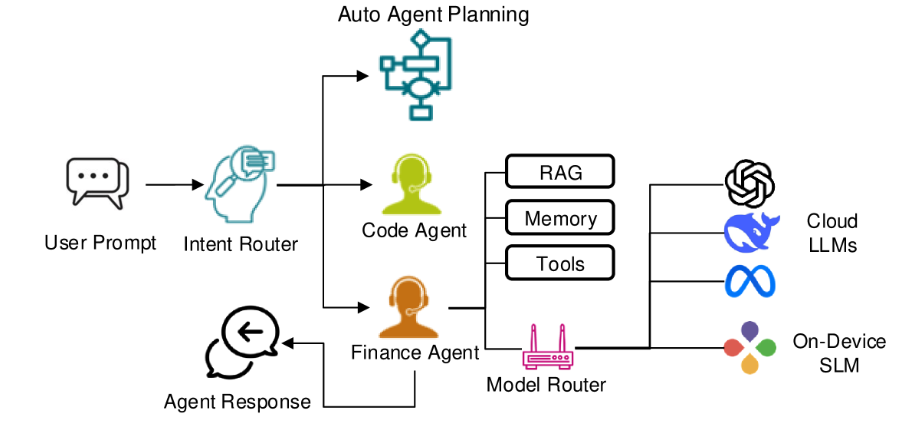
Image Source: Arvix
The Rise of Compound AI
Traditional AI applications were often isolated, with one bot dedicated to service, another focused on analytics, and yet another for marketing. However, real-world workflows are interconnected, requiring the sharing of context, handoff of intent, and adaptive collaboration. Compound AI systems address this by:
- Enabling autonomous, yet cooperative agents (e.g., Planner, Retriever, Executor)
- Facilitating multi-modal interactions (text, voice, events)
- Supporting enterprise-level guidelines for explainability, privacy, and control
This reflects how complex systems operate in human organizations: each unit (agent) has a role, but together they create a value chain.
Design Principles for Enterprise-Grade Agentic Workflows
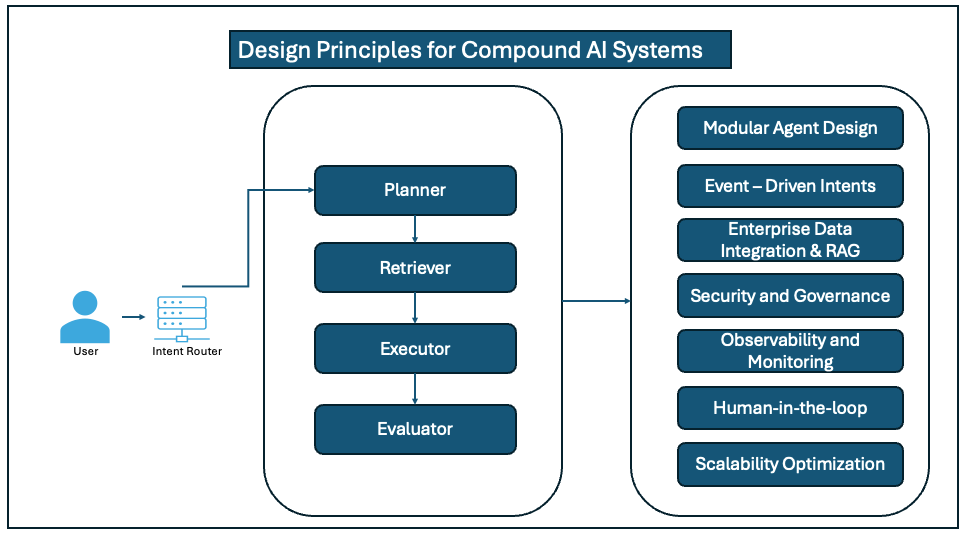
Designing effective compound AI systems requires a thoughtful approach to ensure modularity, scalability, and alignment with enterprise goals. Below are key principles to guide the development of agentic workflows:
1. Modular Agent Design
Each AI agent should be designed with a specific, well-defined responsibility, following the single responsibility principle. This modularity makes maintenance, testing, and scalability easier. For instance:
- Planner Agent: Breaks down overarching goals into manageable sub-tasks.
- Retriever Agent: Retrieves and collects pertinent data from diverse sources.
- Executor Agent: Executes actions according to the planner's directives.
- Evaluator Agent: Evaluates outcomes and offers feedback for ongoing improvement.
By clearly defining responsibilities, agents can operate independently while working together cohesively within the system.
2. Event-Driven and Intent-Centric Architecture
Transitioning from static, synchronous workflows to dynamic, event-driven architectures enhances responsiveness and adaptability. Implementing intent-centric designs enables the system to effectively interpret and act on user or system intents. Key components include:
- Intent Routers: Classify and direct intents to the appropriate agents.
- Event Brokers facilitate communication among agents via event messaging.
- Memory Modules: Preserve context over time, allowing agents to make informed decisions based on historical data.
This architecture enables scalability and resilience, which are essential for enterprise environments.
3. Enterprise Data Integration and Retrieval-Augmented Generation (RAG)
Integrating both structured and unstructured data sources ensures AI agents operate with a comprehensive context. Utilizing Retrieval-Augmented Generation techniques enables agents to access external knowledge bases, improving their decision-making abilities. Strategies include:
- Data Connectors: Create secure connections to enterprise databases and APIs.
- Vector Databases: Enhance semantic search and retrieval of pertinent information.
- Knowledge Graphs: Offer structured representations of relationships among data entities.
This integration ensures that agents are informed, context-aware, and able to deliver accurate outcomes.
4. Security and Governance Framework
Ensuring the security and compliance of agentic systems is crucial. Implementing robust governance frameworks helps maintain trust and accountability. Key practices include:
- Access Controls: Establish and enforce permissions for data and agent interactions.
- Audit Trails: Keep records of agent activities for transparency and compliance.
- Compliance Checks: Regularly evaluate systems against regulatory standards such as GDPR and HIPAA.
A well-structured governance model protects against risks and ensures the ethical deployment of AI.
5. Observability and Continuous Monitoring
Implementing observability practices enables real-time monitoring and diagnostics of agent behaviors and system performance. Key components include:
- Logging: Record comprehensive logs of agent actions and decisions.
- Metrics Collection: Collect performance indicators such as response times and error rates.
- Alerting Systems: Promptly notify stakeholders of anomalies or system failures.
Continuous monitoring allows for proactive maintenance and ongoing improvements.
6. Human-in-the-Loop (HITL) Mechanisms
Incorporating human oversight ensures that AI agents operate within acceptable boundaries and adapt to nuanced scenarios. HITL approaches consist of:
- Approval Workflows: Ensure human validation for critical decisions or actions.
- Feedback Loops: Enable users to give input on agent performance, guiding future behavior.
- Intervention Protocols: Allow humans to modify or adjust agent actions when necessary.
Balancing automation and human judgment enhances system reliability and builds user trust.
7. Scalability and Performance Optimization
Designing systems that can scale effectively to manage growing workloads is essential. Strategies to achieve this include:
- Load Balancing: Distribute workloads uniformly among agents and resources.
- Asynchronous Processing: Enable agents to function independently, minimizing bottlenecks.
- Resource Management: Effectively monitor and allocate computational resources to maintain performance.
Optimizing for scalability guarantees that the system stays responsive and effective as demand increases.
By following these design principles, businesses can create robust, efficient, and reliable agentic workflows that align with their organizational objectives and adapt to evolving challenges.
Real-World Use Case: Field Service Agent Mesh
Scenario: A utilities organization can enhance field response operations using a trio of specialized AI agents:
- Planner Agent: Assesses incoming user complaints and defines a resolution plan.
- Retriever Agent: Fetches asset location, historical ticket data, and compliance checklists.
- Executor Agent: Schedules technicians and sends alerts to mobile service teams.
Impact: Improves task assignment efficiency, faster resolution cycles, and higher technician productivity.
Conclusion
Compound AI systems are transforming enterprise architecture by facilitating intelligent, adaptable, and scalable workflows. Designing modular, orchestrated agentic systems assists organizations:
- Accelerate AI-driven transformation
- Enhance operational resilience and flexibility
- Deliver improved results for both customer and employee experiences
The future lies in transitioning from isolated AI tasks to compound ecosystems of agents, a strategy that combines innovation with strong governance and domain relevance.
Opinions expressed by DZone contributors are their own.
Comments