

Cracking the Innovation Code: Design Thinking Explained
Design Thinking for engineers: reframe assumptions, prototype fast, validate with users — and turn constraints into meaningful solutions.
 CORE
·
CORE
·
Join the DZone community and get the full member experience.
Join For FreeIn both personal and professional life, we regularly face problems that are new, ambiguous, or unusually complex. Quick fixes sometimes work, but arriving at a simple, creative, and robust solution usually requires a different approach.
Traditional problem solving often relies on familiar patterns and past experience, which can constrain options and stifle innovation when the context has changed or the problem is not yet fully understood.
Design thinking shifts the focus — it helps surface user needs, challenge assumptions, and reframe problems so that natural, innovative, and practical solutions emerge.
In this article, we explore how design thinking applies to everyday tasks, including engineering and architecture challenges, and offer concrete techniques leaders and practitioners can use to make better decisions faster.
What is Design Thinking
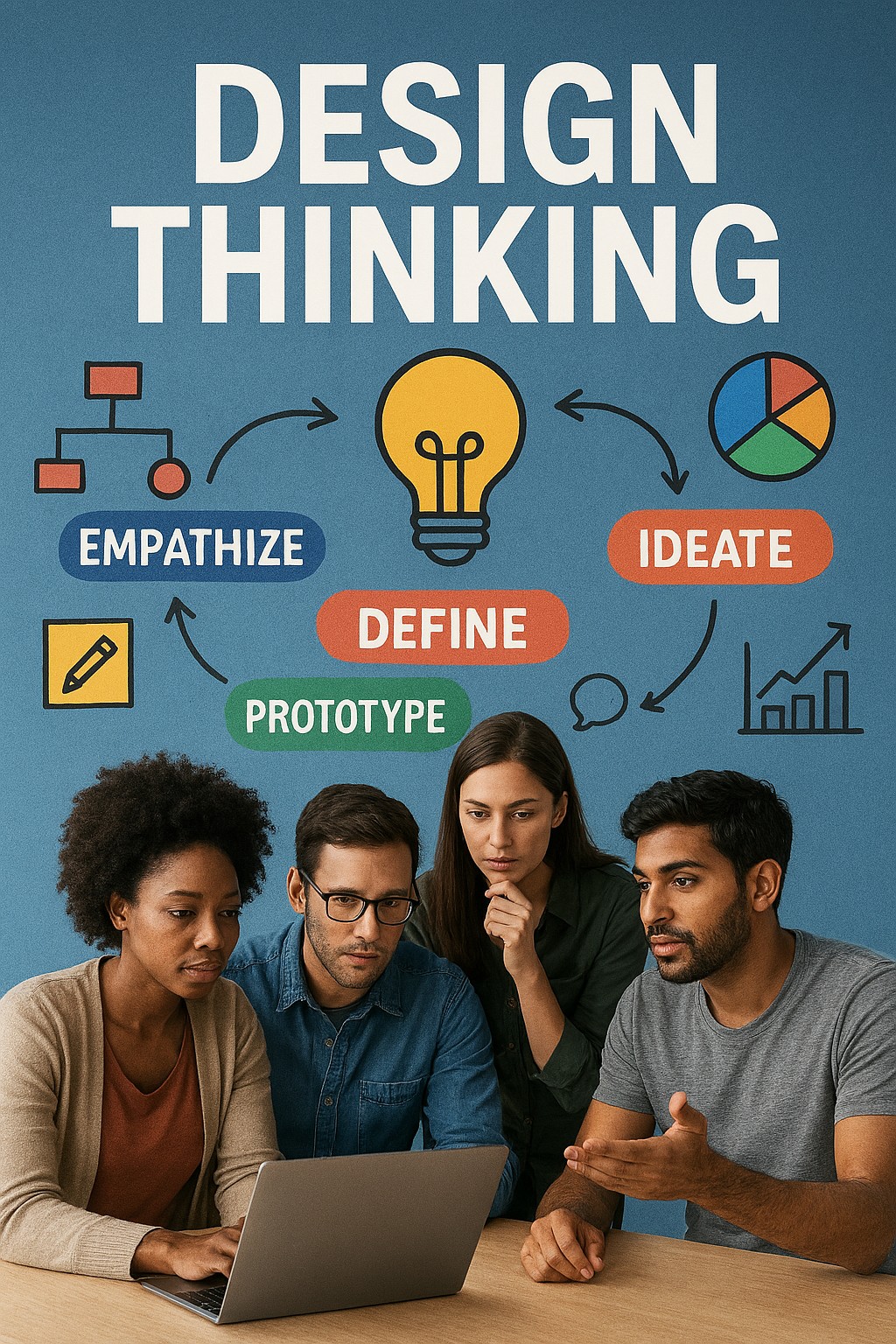
Design thinking is an approach to problem solving used when we don’t fully understand what the problem is and we can’t anticipate what the solution might look like in advance.Simply put, design thinking helps us adopt a non-linear approach to problem solving by iterating over the following steps:
- Understand the problem fully (within its context)
- Empathize with end users’ needs and feedback
- Ideate
- Prototype and validate
- Iterate
Understand the Problem Fully
Whenever a problem presents itself, its natural for us to get into solution space without exploring the problem space fully — which happens mostly due to our preconceptions or disconnect from end users. The solutions arising out may be suboptimal or at worse may not address the problem at all!
Thus, the very first step in design thinking is to understand the problem fully before exploring the solutions. Most of the times the problem we need to tackle is not the one which we originally think of. The actual problem is always broader, more nuanced, or different than we originally assume.
Involving users and gathering feedback via surveys or interviewing users, to understand their pain points helps in drafting the problems. Immersing yourself as an end user reaps multifold benefits.
Once context and problem details are available & understood, we could either focus on a particular problem or distribute set of problem among focused groups.
This step may be iterated as many times until we believe enough context & details are available to start exploring the solutions.
Ideate
While ideating, engage in creative brainstorming. Except for criticism, nothing should be held back during this step. Even if a solution demands getting uncomfortable or venturing into unfamiliar territory, embrace it to learn and apply. Infeasible ideas may still lead to useful solutions — unless they are discarded at the very beginning itself.
During brainstorming, alternate between divergent and convergent thinking. Divergent thinking helps generate a wide range of ideas, while convergent thinking helps narrow them down to the most promising ones, allowing the design thinking process to move forward.
Its imperative to note that during ideation co-evolution of problem and solution spaces occurs. New solution ideas can lead to a deeper or alternative understanding of the problem context, which in turn triggers more solution ideas.
Moreover, beware of analysis paralysis, which can slow down or halt the entire problem solving process.
Prototype and Validate
The less obtrusive a solution is, the more natural it feels — and the more powerful it can be. Such solutions are ideal candidates for initial prototypes.
Even low-fidelity, unpolished prototypes can communicate ideas to users and help gather valuable feedback. Avoid adding too much detail during early prototyping so that thinking remains at a high level.
While prototyping, empathize with users and gather feedback. Iterate to understand what works and what needs improvement. The best way to learn about the design process is to do it, then step back and reflect — not just on what went wrong, but also on why it went wrong.
Iterate
No one arrives at a perfect solution that meets all users’ expectations on the first attempt. This is why iteration is essential in design thinking.
As mentioned earlier, design thinking is inherently non-linear. Iteration is not limited to a particular step or even a single pass through the process. Any step can be revisited as many times as needed to achieve optimal results, or the entire approach can be restarted from scratch if the solution fails to deliver.
Case Studies
- How design thinking saved babies’ lives by keeping them warm → Jane Chen addressed the problem of newborn hypothermia in low-resource settings where incubators are scarce and existing solutions aren’t mother-friendly. She developed the low-cost Embrace baby warmer — a simple, portable wrap that keeps babies warm. It was refined with mothers in mind and scaled to save lives in communities without access to incubators.
- How a Danish municipality improved food service for elderly citizens through design thinking → Good Kitchen struggled because its service didn’t match customer needs, its value proposition was unclear, and operations couldn’t deliver consistently. The team used design thinking — talking to users, prototyping service changes, and fixing operational gaps — to make the offering clearer and easier to use. As a result, adoption improved and Good Kitchen met its goals.
- Airbnb’s transformation through design thinking → In 2009, Airbnb was near collapse, with stalled revenue and poor product–market fit, largely because listings were low quality and users lacked trust. The founders applied Design Thinking—personally visiting hosts, taking professional photos, rewriting listings, and testing manual fixes—which immediately boosted bookings and revenue. These insights were later turned into scalable product features that helped Airbnb grow into a billion-dollar company.
- The rise and fall of Design Thinking at Oticon → Oticon’s Centre for Design Thinking (CDT), launched in 2007 to drive user-centered innovation, faced strong organizational resistance, a cultural mismatch with existing processes, and poor integration of its insights into product decision timelines. As a result, its exploratory work appeared to lack measurable ROI during the post-2008 crisis. The CDT was dissolved in 2010. Although some of its findings were later adopted and a smaller discovery function re-emerged, much of the original capability and momentum were lost when responsibilities shifted to marketing and key team members left.
Limitations and Criticism
Design Thinking helps explore new problems, but it has limitations. It can feel vague and produce many ideas without clear methods for testing feasibility. In engineering contexts, it may overlook performance, security, or regulatory requirements.
User research can be shallow or biased if not conducted carefully, leading to incorrect conclusions and failed solutions.
Teams sometimes treat the process as a ritual, creating quick prototypes that aren’t properly validated. It can also be time-consuming, which is a challenge when rapid delivery is required.
Conclusion
Design thinking is highly contextual — its value depends on the problem domain, team makeup, timelines, and constraints. It is not a recipe book to be followed step by step; rather, it is a toolkit that helps teams tackle ill-structured problems by reframing questions, surfacing assumptions, and exploring alternatives.
In a world dominated by AI hype, design thinking remains relevant because it centers on human needs and judgment — AI can generate options, but people decide which trade-offs matter.
For practical impact, pair design thinking with clear success metrics, technical checks, and engineering practices: define measurable outcomes, validate feasibility early, and keep safety as a primary consideration.
When combined with disciplined measurement and governance, design thinking becomes a pragmatic way to reduce risk, accelerate learning, and build solutions that are both useful and sound.
Published at DZone with permission of Ammar Husain. See the original article here.
Opinions expressed by DZone contributors are their own.
Comments