

DZone
Thanks for visiting DZone today,
Edit Profile
  • Manage Email Subscriptions
  • How to Post to DZone
  • Article Submission Guidelines
Sign Out View Profile
  • Post an Article
  • Manage My Drafts
Over 2 million developers have joined DZone.
Log In / Join
Refcards Trend Reports
Events Video Library
Refcards
Trend Reports

Events

View Events Video Library

Related

  • The Curious Case of Dead-End-Lock(Deadlock) | MySql
  • Deadlock-Free Synchronization in Java
  • When Snowflake Lies to You: Understanding False Failures in dbt Pipelines
  • Master-Class: Understanding Database Replication (Single, Multi, and Leaderless)

Trending

  • Build Self-Managing Data Pipelines With an LLM Agent
  • Visualizing Matrix Multiplication as a Linear Combination
  • AWS Managed Database Observability: Monitoring DynamoDB, ElastiCache, and Redshift Beyond CloudWatch
  • Detecting Advanced Persistent Threats Using Behavioral Analytics and Log Correlation
  1. DZone
  2. Data Engineering
  3. Databases
  4. Deadlock in Databases

Deadlock in Databases

Here's why you need to avoid database deadlock.

By 
Anghel Leonard user avatar
Anghel Leonard
DZone Core CORE ·
May. 28, 19 · Presentation
Likes (4)
Comment
Save
Tweet
Share
8.4K Views

Join the DZone community and get the full member experience.

Join For Free

From databases perspective, a deadlock is a phenomenon that occurs when two transactions are blocking each other.
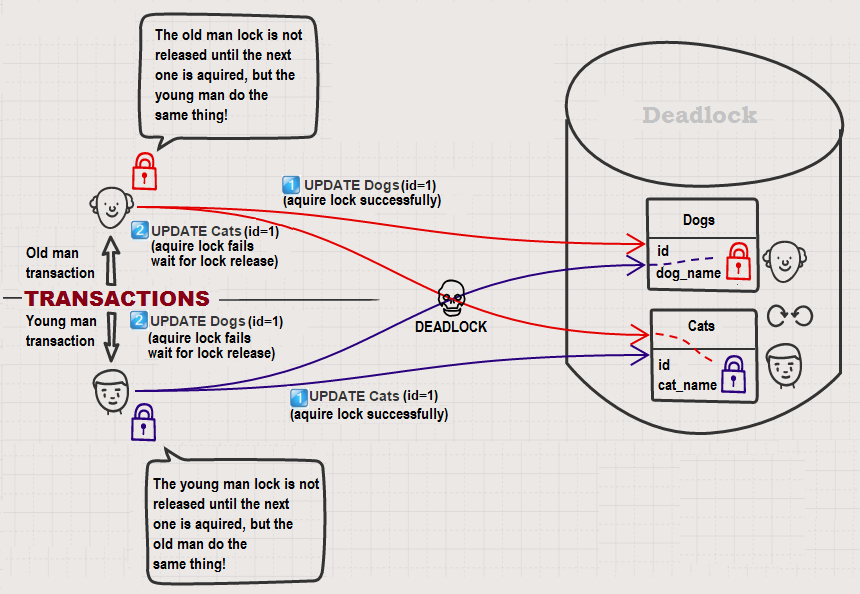
Image title

In the figure above, we have a classic deadlock situation. Transaction A (old man transaction) holds a lock to resource A (Dogs), but it doesn't release it until it will acquire a lock to resource B (Cats) that is currently locked by transaction B (young man transaction). In the same time, transaction B (young man transaction) holds a lock to resource B (Cats), but it doesn't release it until it will acquire a lock to resource A (Dogs) that is currently locked by transaction A (old man transaction).

The application (data access layer) is responsible for managing the acquisition of the lock/release in order to avoid deadlocks, and implicitly performance issues. Without application support, you need to rely on the database capability of detecting and solving deadlocks (commonly, by aborting one of the transactions involved in a deadlock).

You may also like Java Persistence Performance Illustrated Guide.

Database Threading

Opinions expressed by DZone contributors are their own.

Related

  • The Curious Case of Dead-End-Lock(Deadlock) | MySql
  • Deadlock-Free Synchronization in Java
  • When Snowflake Lies to You: Understanding False Failures in dbt Pipelines
  • Master-Class: Understanding Database Replication (Single, Multi, and Leaderless)

Partner Resources

×

Comments

The likes didn't load as expected. Please refresh the page and try again.

  • RSS
  • X
  • Facebook

ABOUT US

  • About DZone
  • Support and feedback
  • Community research

ADVERTISE

  • Advertise with DZone

CONTRIBUTE ON DZONE

  • Article Submission Guidelines
  • Become a Contributor
  • Core Program
  • Visit the Writers' Zone

LEGAL

  • Terms of Service
  • Privacy Policy

CONTACT US

  • 3343 Perimeter Hill Drive
  • Suite 215
  • Nashville, TN 37211
  • [email protected]

Let's be friends:

  • RSS
  • X
  • Facebook