

Feature Flag Patterns: From Release Control to Runtime Resilience
A practical taxonomy of feature flag patterns for safer releases, experiments, resilience, access, migration, and runtime control.
 CORE
·
CORE
·
Join the DZone community and get the full member experience.
Join For FreeFeature flags are widely used in modern software delivery to control how and when functionality is exposed to users. They allow teams to deploy code independently of releasing features, reducing the risk associated with large or tightly coupled releases.
But feature flags are not limited to simple on/off switches. They can support gradual rollouts, experimentation, access control, operational safeguards, and runtime configuration. Each of these use cases has a different purpose and requires a different way of designing and managing flags.
This is where feature flag patterns become useful. Instead of treating every flag the same way, teams can classify them based on the problem they are intended to solve.
Feature Flags as a Runtime Control Plane
Feature flags can be viewed as more than switches embedded in application code. Collectively, they form a lightweight runtime control plane that allows teams to influence application behavior without changing or redeploying the underlying software.
In a traditional deployment model, changing application behavior usually requires modifying code, rebuilding the application, and deploying a new version. Feature flags introduce a layer of indirection between the deployed code and the behavior that users experience. The code may already be running in production, while the flag determines whether a particular capability is enabled, who can access it, or under what conditions it should execute.
This separation creates two distinct concerns:
- Deployment plane: Controls what code and artifacts are deployed into an environment.
- Feature control plane: Controls how the deployed application behaves at runtime.
For example, the same deployed version of an application could expose a new feature to internal users, 5% of production traffic, customers in a specific region, or no users at all — simply by changing flag configuration.
This makes feature flags useful control points for several software delivery decisions, including release management, progressive delivery, experimentation, operational protection, access control, and runtime configuration.
However, these controls do not all serve the same purpose. A flag controlling a canary rollout has different characteristics and lifecycle requirements from an emergency kill switch or an experimentation flag. Understanding these differences provides the basis for organizing feature flags into distinct patterns.
A Taxonomy of Feature Flag Patterns
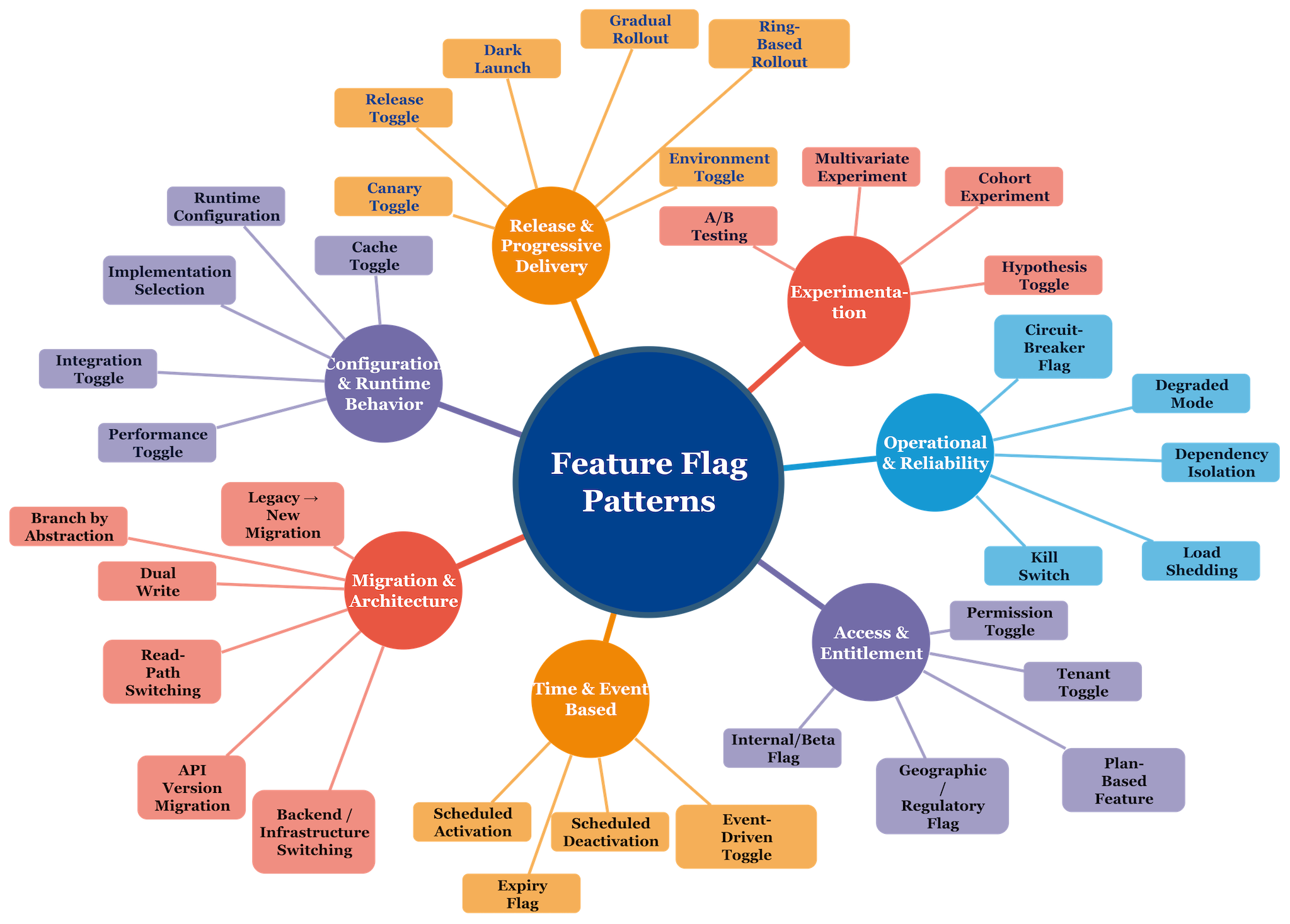
Feature flags are used for different purposes across the software delivery lifecycle. Grouping them into patterns helps teams understand why a flag exists, how long it should live, who owns it, and what risks it introduces.
A practical taxonomy can organize feature flag patterns into five broad categories. These categories often overlap in implementation, but their intent and lifecycle are different. An operational kill switch may need strict access controls and rapid propagation, whereas an experimentation flag may prioritize accurate audience segmentation and metric collection.
Release Management Patterns
Release management flags separate code deployment from feature release. Teams can deploy code safely while deciding independently when and to whom the new functionality becomes available.
Characteristics of Release Management Flags
Release management flags are designed to separate deployment from feature availability. Their main characteristics include:
- Usually temporary: Most release flags should be removed after the feature reaches full production availability.
- Progressive exposure: Features can be introduced gradually by percentage, release ring, environment, tenant, or user group.
- Rapid rollback: A problematic feature or implementation can be disabled without rebuilding or redeploying the application.
- Stable targeting: Users should consistently receive the same experience during a staged rollout.
- Production validation: Teams can evaluate new functionality under real-world workloads before complete release.
- Deployment independence: Code can be deployed even when the associated functionality is not yet ready for users.
- Short lifecycle: Each flag should have an owner, release criteria, expiration date, and removal plan.
- Controlled permissions: Only authorized release owners or operators should be able to change production rollout settings.
- Low-latency evaluation: Flag evaluation should not introduce noticeable latency into the application request path.
Release management flags should have clearly defined rollout stages and rollback thresholds. Once the feature is stable and available to its intended population, the flag and obsolete code paths should be removed.
Release Toggle
A release toggle hides incomplete or unapproved functionality while allowing the underlying code to be deployed to production.
For example, a new checkout workflow may be included in the production build but remain disabled until testing and business approval are complete. Once the feature is ready, the flag is enabled without requiring another deployment.
Dark Launch
A dark launch deploys a new capability into production while keeping it invisible to end users. The system may execute the new functionality in the background to validate its performance, scalability, and integration behavior using real production traffic.
For example, requests may be sent to both an existing recommendation engine and a new engine, while only the existing engine’s response is returned to the customer. The new engine’s results and performance can then be evaluated safely.
Dark launches are especially useful for validating infrastructure-intensive services, machine-learning models, search engines, and new backend architectures.
Percentage or Gradual Rollout
A percentage rollout enables a feature for a controlled percentage of the user population. Exposure can gradually increase—for example, from 1% to 5%, 25%, 50%, and finally 100%.
The rollout may be based on users, sessions, devices, tenants, or requests. Stable targeting is important: the same user should normally receive the same flag variation throughout the rollout.
This pattern limits the impact of defects and provides an opportunity to monitor errors, latency, customer behavior, and business metrics before wider adoption.
Ring-Based Rollout
A ring-based rollout releases functionality to predefined groups in increasing order of risk. A typical sequence may include:
- Development and test users
- Internal employees
- Selected beta customers
- Low-risk production tenants
- The general customer population
Unlike a purely percentage-based rollout, rings are defined by user or organizational characteristics. Each ring acts as a validation stage, and promotion to the next ring occurs only after the required technical and business criteria are satisfied.
Canary Release Toggle
A canary release toggle directs a small amount of production traffic to a new application version or implementation. The behavior of the canary is compared with the stable version before the rollout expands.
This pattern is commonly used with microservices, Kubernetes deployments, API gateways, and service mesh. Although it resembles a gradual rollout, the focus of a canary release is typically the validation of a new software version or deployment rather than the exposure of an individual user-facing feature.
If the canary shows elevated latency, errors, or resource consumption, the flag can immediately redirect traffic to the stable version.
Environment-Based Toggle
An environment-based toggle enables different functionality across development, testing, staging, and production environments.
For example, diagnostic features may be enabled in development but disabled in production, while a new integration may be enabled only in staging until certification is complete.
Environment flags are useful when deployment environments require different behavior, but they should not become a substitute for proper environment configuration. Security-sensitive settings such as secrets, access policies, and credentials should remain in dedicated configuration and secret-management systems.
Experimentation Patterns
Experimentation flags help teams evaluate product ideas using measurable evidence. Unlike release flags, their primary purpose is not simply to control availability but to compare outcomes across different user groups or system variations.
Characteristics of Experimentation Flags
Experimentation flags are intended to generate evidence about user behavior, product decisions, or technical alternatives. Their main characteristics include:
- Hypothesis-driven: Every experiment should begin with a clear and testable assumption.
- Multiple variations: The flag commonly returns values such as control, treatment A, or treatment B rather than a simple Boolean result.
- Consistent assignment: A participant should remain in the same experiment group throughout the experiment.
- Randomized allocation: Where appropriate, participants should be assigned randomly to minimize selection bias.
- Measurable outcomes: Each experiment should define primary metrics, secondary metrics, and guardrail metrics.
- Time-bound execution: The experiment should have specified start and end dates or statistically justified stopping conditions.
- Statistical evaluation: Results should be assessed using appropriate statistical methods rather than informal observation.
- Mutual-exclusion awareness: Overlapping experiments should be controlled when they could influence one another.
- Privacy-conscious: Experiment attributes and behavioral data should be collected and processed according to privacy requirements.
- Decision-oriented: The experiment should conclude with a decision to adopt, modify, reject, or investigate the variation further.
- Temporary lifecycle: Once the experiment concludes, the winning variation should become the default, and the flag should normally be retired.
An experimentation flag is not simply a mechanism for showing different experiences. It should be connected to experiment metadata, participant assignment, telemetry collection, statistical analysis, and a documented final decision.
A/B Testing
An A/B testing flag divides users into two groups. The control group receives the existing experience, while the treatment group receives a new variation.
For example, an online platform may compare two registration pages and measure their completion rates. Users must be assigned consistently to avoid switching between variations during the experiment.
A/B tests should be associated with a defined hypothesis, target population, success metric, experiment duration, and stopping criteria. Without these elements, a feature flag only creates different experiences—it does not constitute a controlled experiment.
Multivariate Experimentation
Multivariate experimentation evaluates several variations or combinations of variables simultaneously.
For example, a page may test different combinations of headings, button colors, and recommendation layouts. This can reveal not only which individual variation performs well but also how different variables interact.
Because the number of possible combinations can grow quickly, multivariate experiments require sufficient traffic and careful statistical design. They are therefore best suited to platforms with mature experimentation capabilities.
Cohort-Based Flags
A cohort-based flag provides different functionality to groups that share defined characteristics. Cohorts may be based on account age, usage behavior, industry, geography, device type, or participation in a previous experiment.
For example, a simplified onboarding flow may be shown only to first-time users, while existing customers continue to use the established process.
Cohort flags are useful for both product learning and targeted delivery. However, cohort definitions should be documented and governed to prevent unintended discrimination or inconsistent customer experiences.
Hypothesis or Experiment Toggle
A hypothesis toggle represents a specific product or technical assumption that the organization wants to validate.
For example: Providing automated remediation recommendations will reduce the average time required to resolve an incident. The flag enables the proposed capability for the selected treatment group, while telemetry measures resolution time, adoption, accuracy, and user feedback.
This pattern connects flag configuration to the broader experiment lifecycle. The flag should record the hypothesis, owner, metrics, start and end dates, and final decision. Once the hypothesis has been accepted or rejected, the experiment flag should be retired.
Operational and Reliability Patterns
Operational flags allow teams to change system behavior quickly without modifying or redeploying code. They are particularly valuable during incidents, traffic spikes, dependency failures, and other production events.
Characteristics of Operational and Reliability Flags
Operational and reliability flags allow teams to alter production behavior quickly in response to incidents, dependency failures, capacity constraints, or changing operating conditions. Their main characteristics include:
- Immediate effect: Changes should propagate quickly enough to support incident response.
- Safe defaults: The default and fallback values should preserve critical services and minimize potential harm.
- High availability: Flag evaluation should continue working even when the central flag-management service is unavailable.
- Fail-safe behavior: The application should use a predefined safe value when it cannot retrieve the latest configuration.
- Restricted access: Only authorized operational personnel should be able to modify high-impact flags.
- Strong auditability: Every change should record who changed the flag, when it changed, why it changed, and its previous value.
- Runtime control: Operators can change system behavior without modifying code or initiating a deployment.
- Incident readiness: Flags should be documented in operational runbooks and tested before an actual emergency.
- Observability integration: Changes should be correlated with service-level indicators, logs, traces, alerts, and incident timelines.
- Dependency awareness: Teams must understand which services, workflows, and customer capabilities will be affected.
- Reversibility: Operators should be able to restore normal behavior safely when the incident is resolved.
- Variable lifetime: Some operational flags, such as kill switches, may remain permanently available, while incident-specific flags should be retired.
These flags are part of the production control plane and should be treated with the same care as other operational mechanisms. An incorrectly configured reliability flag can itself become a source of widespread failure.
Kill Switch
A kill switch immediately disables a feature or operation that is causing serious problems.
For example, if a newly introduced payment integration begins creating duplicate transactions, operators can disable it while leaving the rest of the application available.
Kill switches must be easy to find, fast to evaluate, and restricted to authorized personnel. Their safe state should be determined in advance, and the switch should be tested regularly. A kill switch that has never been exercised may fail when it is most urgently needed.
Circuit-Breaker Flag
A circuit-breaker flag prevents calls to a failing or unstable dependency. It allows operators to open or close the circuit manually or override an automated circuit breaker.
For example, if an external credit-check service becomes slow, the flag can temporarily stop outgoing calls and redirect requests to an alternative workflow.
This flag should complement — not replace — automatic timeout, retry, and circuit-breaker mechanisms. It provides an operational override for situations that automated policies do not handle correctly.
Degraded-Mode Toggle
A degraded-mode toggle moves the application into a reduced-functionality state so that essential services remain available.
For example, an e-commerce system may disable personalized recommendations and advanced search filters while continuing to support product browsing and checkout. A monitoring platform may suspend historical analytics while preserving real-time alerting.
This pattern supports graceful degradation. Teams should define which functions are essential, which can be temporarily disabled, and what users should see when degraded mode is active.
Dependency Isolation Flag
A dependency isolation flag disconnects a specific internal or external dependency without shutting down the entire feature.
For example, an application may isolate a failing notification provider while continuing to process the underlying business transaction. Notifications can be queued and delivered after the dependency recovers.
This pattern limits cascading failures and is especially useful in microservice architectures, where a problem in one service can otherwise propagate across the system.
Load-Shedding or Capacity Flag
A load-shedding flag reduces non-essential work when the system approaches its capacity limits. It may reject, delay, sample, or deprioritize selected requests.
For example, during a traffic surge, a platform might disable report generation, reduce recommendation depth, limit expensive queries, or accept only high-priority requests.
Load shedding differs from general degraded mode because it is directly concerned with protecting finite resources such as CPU, memory, database connections, thread pools, and inference capacity. It should be connected to clearly defined capacity signals and service-level objectives.
Entitlement and Access-Control Patterns
Entitlement flags determine which users, organizations, or regions can access a capability. Unlike short-lived release flags, these flags may remain in the system for an extended period because they represent business rules or access policies.
Characteristics of Entitlement and Access-Control Flags
Entitlement and access-control flags determine whether a capability is available to a particular user, role, customer, subscription, tenant, or jurisdiction. Their main characteristics include:
- Identity-aware evaluation: Decisions depend on trusted attributes such as user identity, role, tenant, subscription, or contractual region.
- Fine-grained targeting: Access may vary across users, organizations, plans, regions, or memberships.
- Potentially long-lived: Unlike release flags, entitlement flags may represent permanent product or contractual rules.
- Deterministic behavior: The same valid identity and entitlement context should produce a consistent decision.
- Backend enforcement: Server-side authorization must enforce access even when the user interface hides a feature.
- Integration with authoritative systems: Subscription and entitlement decisions should use reliable sources such as identity, billing, licensing, and policy systems.
- Security-sensitive configuration: Changes require strong authentication, role-based access control, and separation of duties where necessary.
- Auditable decisions: Organizations should be able to determine why access was granted or denied.
- Privacy-conscious targeting: Only necessary attributes should be used, stored, and transmitted during evaluation.
- Regulatory awareness: Geographic or compliance rules should be reviewed and approved by appropriate legal and compliance stakeholders.
- Correct revocation: Access should be removed promptly when a role, subscription, consent status, or contractual condition changes.
- Failure-safe behavior: If the entitlement cannot be verified, security-sensitive features should normally remain inaccessible.
Feature flags can support entitlement decisions, but they should not replace a dedicated authentication and authorization system. They determine feature availability, whereas security controls must protect the underlying data and operations.
Permission Toggle
A permission toggle enables functionality according to a user’s role or authorized actions.
For example, only administrators may be allowed to delete resources, view audit logs, or change organization-wide settings.
Feature flags can help expose or hide the relevant user interface, but they must not be the only security control. The backend must independently enforce authentication and authorization. Hiding a button does not prevent an unauthorized user from calling the underlying API.
Subscription or Plan-Based Feature
A subscription-based flag enables functionality according to a customer’s purchased plan.
For example, advanced analytics may be available only in an enterprise tier, while basic reporting is available to all customers. The flag evaluation may use attributes such as product edition, subscription status, licensed capacity, or purchased add-ons.
Because these flags affect billing and contractual obligations, their configuration should be integrated with the organization’s entitlement system and protected by strong audit controls.
Tenant-Specific Toggle
A tenant-specific toggle enables or disables a capability for an individual customer organization.
This pattern is valuable in multi-tenant platforms where customers may have different configurations, integration requirements, or adoption schedules. For example, a new data-retention workflow may be enabled for one enterprise tenant after its administrators complete the necessary migration.
Tenant-specific flags should be managed carefully. Many ad hoc exceptions can create configuration sprawl and make system behavior difficult to understand.
Internal or Beta User Flag
An internal or beta-user flag makes early functionality available to employees, testers, design partners, or customers enrolled in a preview program.
This allows the organization to collect feedback and identify problems before general release. Beta targeting may use user IDs, email domains, account attributes, or explicit programmed membership.
The beta experience should be clearly identified, and users should understand that the feature may change or be withdrawn. Sensitive or unstable functionality may also require explicit consent.
Geographic or Regulatory Flag
A geographic or regulatory flag controls functionality according to a user’s country, region, legal jurisdiction, or data-residency requirement.
For example, biometric authentication may be disabled in regions where regulatory approval has not been obtained. A data-processing feature may be enabled only when the required regional infrastructure is available.
Location must be determined using reliable attributes such as the customer’s contractual region or account configuration. IP-based geolocation alone may be inaccurate. Because regulatory decisions carry legal risk, the rules should be reviewed by the appropriate compliance and legal teams.
Migration and Architecture Patterns
Migration flags allow teams to introduce large technical changes incrementally. They support coexistence between old and new implementations, making it possible to validate behavior, limit risk, and reverse the transition when necessary.
Characteristics of Migration and Architecture Flags
Migration and architecture flags support the controlled transition between implementations, services, data stores, APIs, infrastructure components, or system architectures. Their main characteristics include:
- Coexistence of implementations: Old and new components may operate simultaneously during the migration period.
- Incremental cutover: Traffic, users, tenants, reads, or writes can move gradually to the new implementation.
- Reversible routing: Workloads can be returned to the previous implementation if the new component fails.
- Compatibility requirements: Both paths may need to support compatible interfaces, schemas, and operational behavior.
- State-awareness: Data migrations must account for consistency, ordering, synchronization, and the authoritative source of truth.
- Comparison capability: Shadow execution, dual writes, or result comparison may be used to validate the new implementation.
- Strong observability: Teams should compare errors, latency, output correctness, resource consumption, and business results across both paths.
- Idempotency and reconciliation: Data operations must tolerate retries, duplicates, partial failures, and divergence between systems.
- Longer but finite lifecycle: Architectural migrations may take months, but their flags should still have completion criteria and removal plans.
- Broader impact: These flags can affect several services, data flows, or infrastructure components simultaneously.
- Carefully controlled changes: Flag updates should be reviewed, authorized, audited, and coordinated across responsible teams.
- Explicit rollback limits: Teams must identify the point after which rollback is unsafe — for example, after an irreversible schema or data-format change.
- Technical-debt risk: Leaving old and new paths active indefinitely increases maintenance, testing, and operational complexity.
Migration flags should be supported by a defined transition plan covering validation, reconciliation, rollback, ownership, cutover criteria, and eventual removal of the legacy implementation.
Branch-by-Abstraction
Branch-by-abstraction introduces an abstraction layer between the application and an implementation that needs to change. A feature flag selects either the old or new implementation behind that abstraction.
For example, an application may define a common storage interface implemented by both a legacy database and a new cloud-native data store. The flag decides which implementation handles a request.
This pattern allows teams to perform long-running architectural work in the main codebase without maintaining a separate development branch. After the new implementation is fully adopted, the flag and legacy implementation should be removed.
Legacy-to-New-System Migration
This pattern routes selected users, tenants, or transactions from a legacy system to its replacement.
Migration can proceed incrementally, beginning with internal users or low-risk tenants and expanding after validation. If problems occur, traffic can be returned to the legacy system.
Unlike branch-by-abstraction, which describes a code-structuring technique, this pattern describes the operational transition between two complete systems or services.
Dual-Write Toggle
A dual-write toggle sends updates to both the existing data store and the new one during a migration.
For example, when moving customer profiles to a new database, the application may continue writing to the legacy database while also writing the same changes to the new database. The outputs can then be compared for consistency.
Dual writes introduce risks such as partial failure, ordering differences, retries, and duplicate operations. The design should include idempotency, reconciliation, observability, and a clearly defined source of truth.
Read-Path Switching
A read-path flag determines whether data is retrieved from the old system or the new system.
The migration may initially write to both systems while continuing to read from the old one. After the new store has been validated and reconciled, a small portion of read traffic can be directed to it. The percentage can then increase gradually.
Read switching should account for differences in data freshness, schema, caching, consistency, and error handling. Shadow reads may also be used to compare results without returning the new system’s response to users.
API Version Migration
An API version migration flag routes requests between different versions of an API, protocol, or service contract.
For example, selected clients may be routed from version 1 to version 2 while other consumers remain on the original version. This supports progressive compatibility testing and reduces the risk of a single cutover.
The flag should not hide permanent incompatibilities indefinitely. API ownership, deprecation deadlines, consumer migration, and contract testing are still required.
Infrastructure or Configuration Toggle
An infrastructure or configuration toggle controls the adoption of a new infrastructure component or runtime configuration.
Examples include switching between message brokers, selecting a new cache cluster, enabling a new autoscaling policy, changing an observability pipeline, or routing workloads to a different cloud region.
These flags require stronger governance than ordinary user-interface flags because an incorrect change can affect the entire platform. Access should be restricted, changes audited, dependencies validated, and rollback behavior tested before production use.
Choosing the Appropriate Pattern
The correct pattern depends on the intent of the flag:
|
Primary objective |
Suitable pattern |
|
Hide unfinished functionality |
Release toggle |
|
Validate a backend capability invisibly |
Dark launch |
|
Limit initial user exposure |
Percentage rollout |
|
Release through controlled user groups |
Ring-based rollout |
|
Compare a new deployment with a stable version |
Canary release toggle |
|
Test a product hypothesis |
A/B or experiment toggle |
|
Stop harmful functionality during an incident |
Kill switch |
|
Preserve essential functionality during failure |
Degraded-mode toggle |
|
Protect the system during excess demand |
Load-shedding flag |
|
Control commercial availability |
Subscription-based flag |
|
Enable functionality for selected customers |
Tenant-specific toggle |
|
Move safely between implementations |
Branch-by-abstraction |
|
Validate a new data store |
Dual-write and read-path flags |
|
Transition consumers to a new contract |
API version migration |
The most important distinction is not how a flag is implemented, but why it exists. Its purpose determines its owner, expected lifetime, targeting rules, monitoring requirements, security controls, and retirement process. Treating every flag as the same kind of Boolean switch leads to unmanaged dependencies and technical debt. Treating flags as explicit architectural and operational patterns makes them safer and easier to govern.
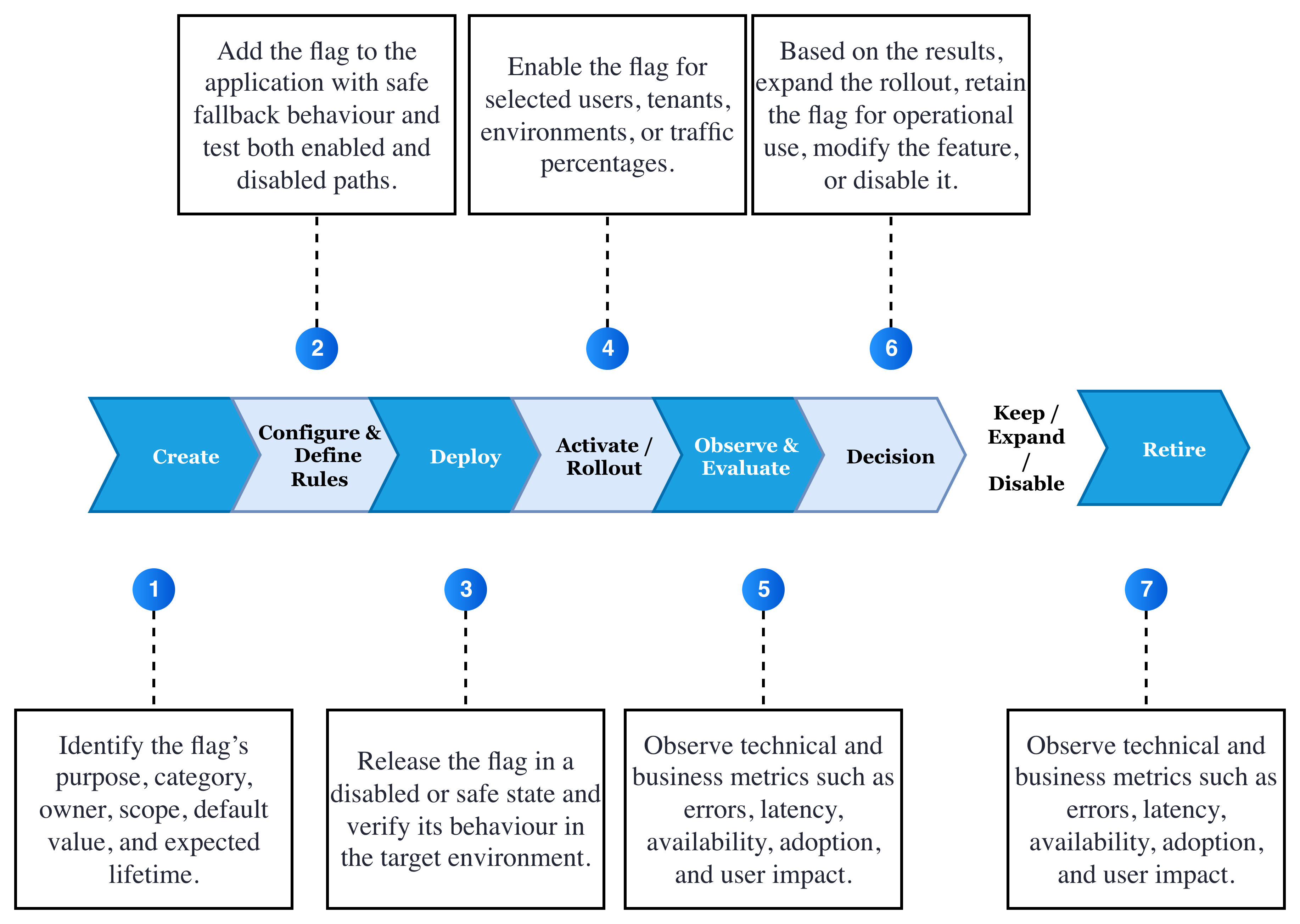
Feature Flag Lifecycle
A feature flag should be managed from creation to removal. Without a defined lifecycle, temporary flags can remain in the codebase, increase complexity, and create technical debt.
Feature Flag Anti-Patterns
Feature flags provide flexibility and reduce deployment risk, but poor implementation can introduce technical debt, inconsistent behavior, security vulnerabilities, and operational failures. The following anti-patterns should be avoided.
- Permanent temporary flags: Release, experiment, and migration flags remain in the system long after their purpose has been completed. These stale flags increase conditional logic, complicate testing, and make the codebase harder to understand. Avoidance: Assign every temporary flag an owner, expiration date, and removal criteria when it is created.
- Excessive flag dependencies: One flag’s behavior depends on several other flags, creating complex combinations and unexpected outcomes. Developers and testers may be unable to determine which feature state is active. Avoidance: Keep flags independent where possible. Document unavoidable dependencies and validate permitted combinations.
- Deeply nested flag logic: Multiple flag checks are nested throughout the code, producing difficult-to-follow execution paths. Avoidance: Centralize flag decisions, use clear abstractions, and select the required implementation near the system boundary.
- Reusing a flag for multiple purposes: A single flag is reused across unrelated features, experiments, or operational controls. Changing it for one reason may unintentionally affect another part of the system. Avoidance: Each flag should have one clearly defined purpose, owner, and lifecycle.
- Using flags as a substitute for configuration: Feature flags are used to manage every application setting, including database connections, credentials, and static environment properties. Avoidance: Use feature flags for runtime behavioral decisions. Store secrets in secret-management systems and stable settings in appropriate configuration systems.
- Treating flags as security controls: A feature is hidden in the user interface through a flag, but its backend API remains accessible. An unauthorized user may bypass the interface and call the API directly. Avoidance: Enforce authentication and authorization independently on the server. Feature flags may control availability, but they must not replace security controls.
- Unsafe default or fallback values: The application uses an arbitrary value when the flag service is unavailable. This can expose unfinished features, block critical operations, or amplify an incident. Avoidance: Define and test a safe fallback for every flag based on its purpose and risk.
- Remote evaluation on every request: The application contacts the flag-management service synchronously for every evaluation. Network latency or a service outage can then affect the application’s availability. Avoidance: Use local evaluation, cached configurations, asynchronous updates, and predefined fallback values where appropriate.
- Unstable user assignment: Users move between enabled and disabled variations across sessions or requests. This creates an inconsistent experience and invalidates experiment results. Avoidance: Use deterministic targeting based on stable identifiers and consistent hashing.
- Uncontrolled percentage rollouts: Traffic exposure is increased without health checks, approval gates, rollback thresholds, or sufficient observation time. Avoidance: Define staged rollout steps and measurable promotion and rollback criteria before activation.
- Missing ownership and documentation: No team or individual is responsible for a flag, and its purpose, dependencies, or expected lifetime are unclear. Avoidance: Record the flag’s owner, category, description, creation date, affected services, and review or expiration date.
- Inadequate testing of flag states: Only the default flag value is tested. The alternate path — or interactions with other important flags — may fail when enabled in production. Avoidance: Test enabled, disabled, fallback, and transition behavior. Test critical supported combinations without attempting every theoretical combination.
- Direct production changes without governance: Anyone can change a high-impact flag in production without approval, audit records, or change validation. Avoidance: Apply role-based access control, audit logging, peer approval, and separation of duties according to the flag’s risk.
- Missing observability: A flag is enabled without recording evaluation results or correlating the change with application and business metrics. Teams may not recognize when the rollout causes harm. Avoidance: Track flag changes and variations alongside errors, latency, resource usage, user outcomes, and service-level indicators.
- Flag naming and semantic confusion: Names such as disable_new_flow=false use negative logic and make the effective behavior difficult to interpret. Avoidance: Use clear, positive, purpose-specific names such as new_checkout_enabled, together with documented variation meanings.
- Flags at the wrong granularity: A flag controls too much functionality, making rollback disruptive, or controls tiny implementation details, causing flag proliferation. Avoidance: Choose boundaries that represent independently releasable, operable, or measurable capabilities.
- Indefinite dual paths: Old and new implementations continue running long after migration or release. Both paths must then be maintained, secured, and tested indefinitely. Avoidance: Define completion criteria, a cutover date, and tasks for removing the legacy path and associated flag.
- Emergency flags that are never tested: Kill switches and degraded-mode flags exist but have never been exercised. During an incident, they may fail, propagate too slowly, or cause unexpected side effects. Avoidance: Test operational flags through scheduled drills and include their activation and recovery procedures in runbooks.
- Sensitive data in targeting rules: Personally identifiable or confidential data is embedded directly in flag rules, logs, or evaluation contexts. Avoidance: Minimize targeting attributes, use opaque identifiers where possible, restrict access, and apply appropriate retention and privacy controls.
- Making irreversible operations reversible in appearance only: A flag suggests that a change can be rolled back even after irreversible actions — such as destructive schema changes or incompatible data writes — have occurred. Avoidance: Define the rollback boundary before activation and use staged migrations, compatibility layers, backups, reconciliation, and forward-recovery plans.
A sound feature-flag practice therefore requires more than adding conditional statements. Flags should be purpose-specific, observable, securely governed, thoroughly tested, and removed when they no longer provide value.
Conclusion
Feature flags are more than on/off switches. When applied through the right patterns, they enable safer releases, controlled experimentation, rapid incident response, targeted access, and gradual system migrations.
Their value depends on disciplined management. Every flag should have a clear purpose, owner, safe default, monitoring strategy, and retirement plan. The goal is not to create more flags, but to use the right flag pattern for the right problem.
Deploy with confidence, release with control, and let feature flags make the difference.
Opinions expressed by DZone contributors are their own.
Comments