

From Chaos to Control: Tackling Salesforce Technical Debt
A practical guide to Salesforce technical debt: assessment, governance, refactoring, and tools to transform fragile orgs into scalable platforms.
 ·
·
Join the DZone community and get the full member experience.
Join For FreeIntroduction
Salesforce technical debt doesn’t just slow you down—it compounds until it breaks your ability to scale.
Salesforce implementations often start small—built by lean teams with tight focus. But over the years, as multiple teams add features, projects rush to meet deadlines, and business units demand quick customizations, even the best-designed orgs can become unwieldy.
The result? Technical debt—hidden complexity that makes the platform fragile, expensive to maintain, and difficult to scale.
I’ve faced this problem head-on as a Salesforce Architect at large global enterprises with thousands of licensed users. In multiple cases, I led major remediation initiatives to restore architectural integrity, reintroduce governance, and prepare the org for global scale.
This article outlines the approach we used, the governance structures we built, the tools that helped, and the lessons learned—all with the goal of helping other architects avoid (or recover from) the same pitfalls.
The Context: When Debt Takes Over
At first glance, these orgs seemed successful — they were live, growing, and mission-critical. But underneath, cracks were showing:
- Scale: 6,000+ licensed users across Sales, Service, CPQ, and Field Service
- Growth: An upcoming Experience Cloud rollout with 50,000+ partner users
- Accumulated Debt included:
- Apex code ballooning into tens of millions of characters
- Workflows with no standards—often conflicting on the same object
- Hundreds of unused fields and duplicate data models
- Duplicate Opportunity and Case objects, splitting reporting and processes
- Overly complex validation rules
- Non-standard integration patterns
- Role hierarchies exceeding eight levels
- Thousands of unused reports, templates, and profiles
- No trigger framework; multiple triggers per object, no exception handling
- Sharing rules breaching Salesforce limits
- Impact:
- Frequent performance degradation
- Deployments are breaking existing functionality
- Inability to scale for new initiatives
- Frustrated users due to inconsistent behavior
- Mission-critical outages requiring emergency hotfixes
The business message was clear: fix this or risk Salesforce's credibility as a platform.
Mapping the Debt: Heatmap Analysis
We began by conducting a technical debt audit and mapping pain points into categories. Tools like Salesforce Inspector and Field Trip were invaluable in surfacing unused fields, duplicate objects, and metadata bloat.
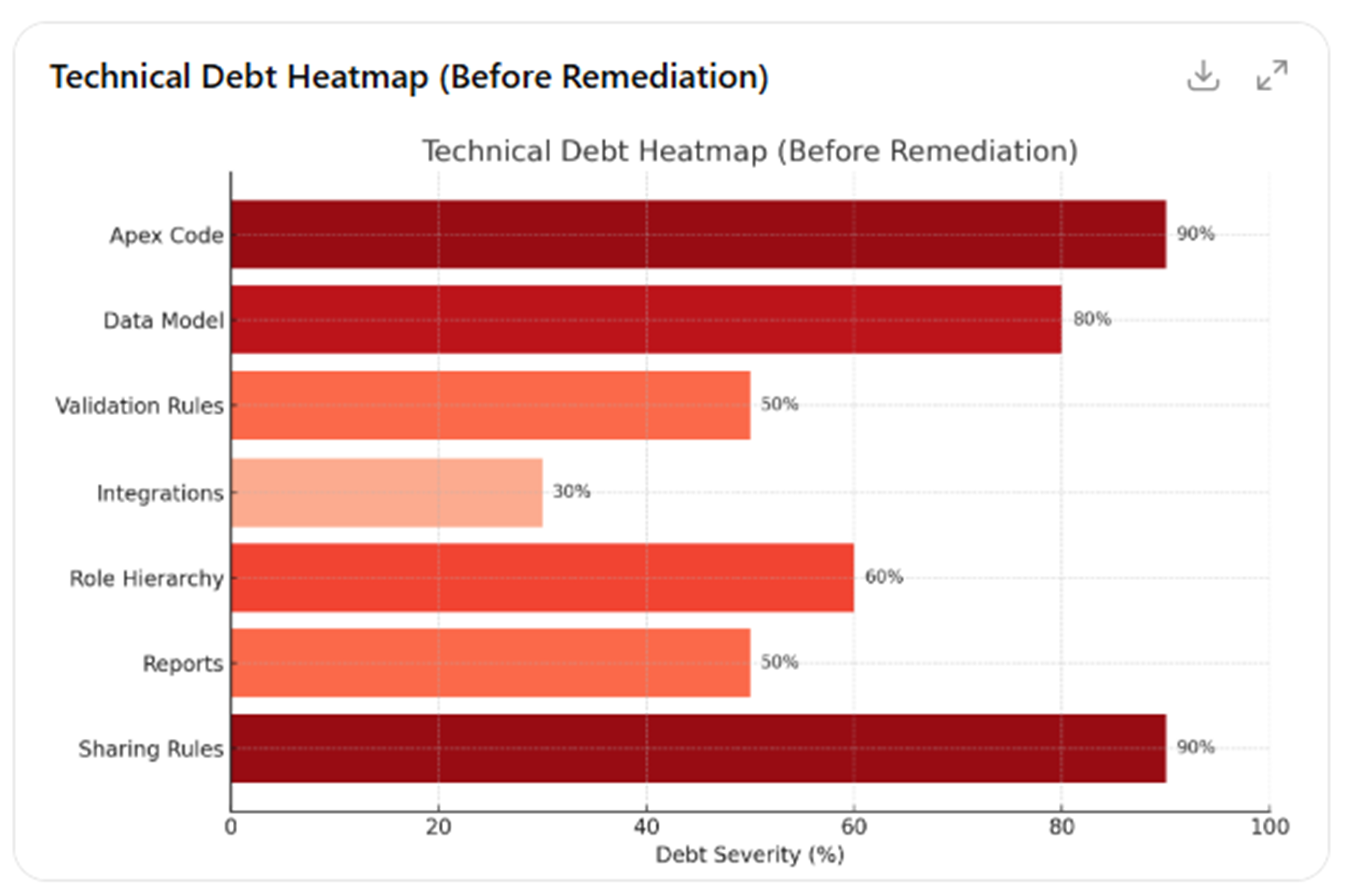
The heatmap made the challenge visible: Apex Code and Sharing Rules were critical hotspots, while Data Models and Role Hierarchies also demanded attention.
The Remediation Approach
1. Assessment: Expose the Debt
We conducted a technical debt audit using:
- Salesforce Optimizer Report → surfaced unused fields, reports, and dashboards
- Field Trip → analyzed field usage across key objects
- Salesforce Inspector → quickly exported metadata and identified redundancies
- Metazoa Snapshot → audited profiles, permission sets, workflows, and unused metadata at scale
When we first ran these tools/reports, we were shocked to see thousands of unused fields across core objects like Account and Opportunity. That report alone convinced leadership that cleanup was urgent. Engaged business stakeholders needed to prioritize must-fix vs. nice-to-fix issues.
2. Governance: Rebuilding Trust in Architecture
Without governance, debt creeps in silently. We introduced structure:
- Architecture Review Board: oversaw design standards.
- Technical Review Board: enforced coding practices.
- Copado (or similar DevOps tools): implemented for CI/CD pipelines, release automation, and sandbox management.
- Best Practices: naming conventions, peer reviews, and high test coverage.
Convincing teams to adopt the Architecture Review Board wasn’t easy at first — developers saw it as bureaucracy. But within two releases, they started to appreciate how much fewer deployment failures we had.
We thought of this as a layered governance framework: standards at the base, review boards in the middle, continuous monitoring above that, and business alignment at the top.
3. Refactoring & Redesign: Cutting the Rot
- Rebuilt high-risk Apex into modular, reusable classes with logging and error handling.
- Introduced a trigger framework to eliminate recursion and duplication.
- Consolidated duplicate data models into a single source of truth.
- Redesigned integration patterns with APIs and middleware.
- Simplified validation rules and consolidated sharing rules.
- Retired unused templates, profiles, queues, and workflows.
One of the most frustrating problems was duplicate Opportunity objects — reporting was a nightmare. Consolidating them into a single model was tough, but it immediately simplified dashboards and improved adoption.
The mantra was simple: remove, simplify, standardize.
4. Future-Proofing: Debt Prevention as a Culture
- A living governance document (wiki) accessible to all developers.
- Training and knowledge-sharing sessions for architects and developers.
- Copado dashboards for deployment success rates and technical debt backlog visibility.
- Weekly reporting to Salesforce IT leadership ensured transparency and accountability.
Lessons Learned
“Governance isn’t bureaucracy—it’s insurance against chaos.”
From these projects, four key lessons stand out:
- Governance is not optional: Debt grows exponentially without oversight.
- Refactoring is an investment: Framed as cost savings, not cleanup.
- Business alignment is essential: Prioritize remediation by business value.
- Remediation ≠ cleanup: It’s about future-proofing Salesforce to support global scale.
Results of Remediation
The results of remediation were tangible:
- Performance gains: faster page loads, fewer timeouts.
- Deployment stability: fewer failed releases, faster recovery.
- Scalability: readiness for 50,000+ partner users.
- Cultural shift: developers embraced standards and governance.
Most importantly, Salesforce regained trust from leadership and business users alike.
Conclusion
Salesforce remediation isn’t just about fixing messy code—it’s about restoring architectural discipline to environments that have grown complex over years of rapid growth.
At large global enterprises, these initiatives transformed debt-heavy Salesforce orgs into scalable, resilient platforms that now support core business processes.
For enterprise architects, the takeaway is clear:
- Invest early in governance — it’s cheaper than paying the debt later with accumulated interest.
- Leverage proven tools like Salesforce Optimizer, Field Trip, Inspector, Metazoa, and Copado to make debt visible and manageable.
- Treat remediation as a strategy, not a chore — because at enterprise scale, it’s the difference between Salesforce being a bottleneck and Salesforce being a backbone.
Toolbox: Tools for Tackling Salesforce Technical Debt
When facing large-scale remediation, the right tools can save weeks of manual effort. Here are some of the most effective ones we used:
- Salesforce Optimizer Report – comprehensive analysis of unused fields, reports, and workflows.
- Field Trip – AppExchange package for object-level field usage analysis.
- Salesforce Inspector – Chrome extension for quick metadata exploration.
- Metazoa Snapshot – org cleanup across profiles, permissions, and metadata.
- Copado (or similar DevOps platforms) – automates CI/CD pipelines, sandbox management, and release governance.
- Logging & Error Handling Frameworks – custom-built for stabilization and proactive issue detection.
Pro Tip
Start with Optimizer Report and Field Trip for quick wins—business stakeholders love clear data showing what’s unused.
Opinions expressed by DZone contributors are their own.
Comments