

The Future of AI Integration: Why Model Context Protocol Is the New API
A deep dive into how the Model Context Protocol (MCP) redefines AI interoperability by standardizing the way agents connect to tools and data sources.
Join the DZone community and get the full member experience.
Join For Free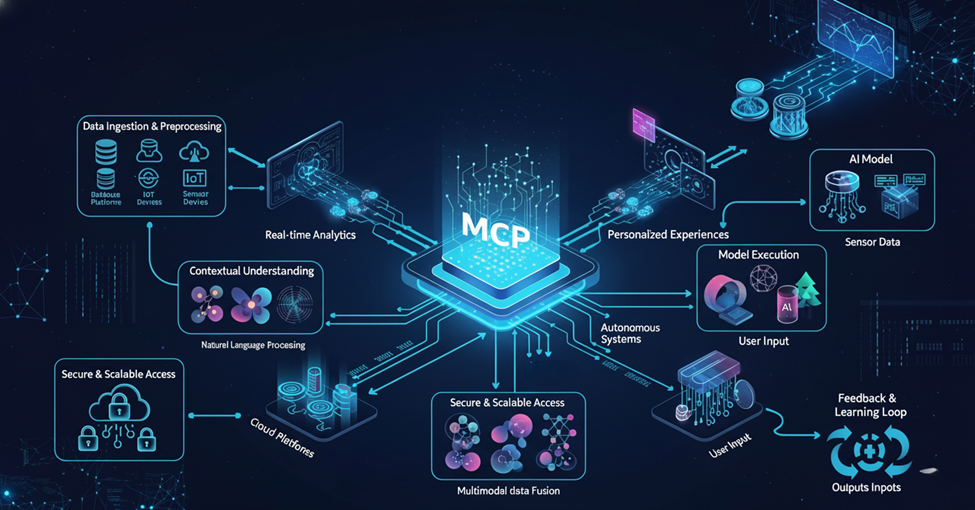 Introduction: From Custom-Code Chaos to Connection Harmony
For decades, connecting software systems meant one thing: custom code.
Every new integration required a new connector, another adapter, and a fresh set of maintenance nightmares. The same pain has now reached the world of AI. Developers are writing endless glue code to make large language models (LLMs) talk to databases, APIs, and business tools, and every integration is slightly different.
Enter the Model Context Protocol (MCP), a new open standard that promises to bring order to this chaos. Its philosophy is simple yet powerful:
“Build once. Connect anywhere.”
Just as APIs standardized how web applications communicate with back-ends and databases, MCP standardizes how AI applications and agents connect to data and tools.
In other words, if APIs unlocked the web revolution, MCP may be the key that unlocks the AI revolution.
What Is MCP and Why It Matters
At its core, MCP (Model Context Protocol) is an open protocol that defines how AI systems can securely and consistently access external data, tools, and APIs. It acts as the transport layer between your AI model and the enterprise world, providing a universal bridge that is structured, secure, and reusable.
Modern AI agents increasingly need context beyond what’s in their model weights: CRM records, sales data, sensor readings, document repositories, or even REST endpoints. Without a consistent interface, these integrations become brittle and expensive. MCP eliminates that friction.
Think of MCP as doing for AI what HTTP and REST did for the web. It’s not another proprietary plugin system or SDK; it’s a standard communication layer that makes AI interoperable across ecosystems.
The Architecture of MCP
The beauty of MCP lies in its simplicity. The architecture follows a client–host–server pattern that scales elegantly across applications.
- MCP Client: The client is where your AI application or agent lives. It can be a chatbot, an AI-powered web app, a mobile assistant, or even a background automation worker. The client sends and receives requests using MCP’s standardized message format.
- MCP Host: The host acts as the runtime container that carries the client. It’s similar to how a web server hosts a web application, managing lifecycle, permissions, and runtime execution. The host ensures the client adheres to the MCP specification when communicating with servers.
- MCP Servers: An MCP environment can have multiple servers, each connecting to a distinct external system:
- A database connector server might retrieve enterprise data from Postgres or BigQuery.
- An API connector could communicate with Salesforce, ServiceNow, or SAP.
- A file system server might access document repositories or local files.
Each server exposes its data and functionality through the MCP standard, meaning the AI client doesn’t need to know whether it’s talking to SQL, REST, or a CSV file; it just speaks MCP.
- The Protocol Layer : Between clients and servers sits the MCP protocol layer, the glue that defines how they communicate. This layer handles message routing, schema validation, authentication, and error handling. Because it’s protocol-driven, it ensures that all data exchanges follow a consistent structure, regardless of vendor or platform.
The Three Core Interfaces of MCP
MCP defines three major interfaces that make this interoperability possible:
- Tools: These are model-invoked functions that the AI can execute. Think “search the knowledge base,” “send an email,” or “update the database.”
- Resources: These represent the data objects accessible to the AI: files, API resources, or database records.
- Prompts: These are user-defined templates or triggers that help guide the AI’s reasoning and responses in context.
Together, these interfaces enable the LLM to act, access, and reason through standardized interfaces rather than through hardcoded integrations.
How MCP Works: A Real-World Example
Let’s make this concrete with an example: an AI-powered travel assistant built on MCP.
- The MCP Client is your travel booking app; it could be web-, mobile-, or chat-based.
- Inside the client runs an LLM, which interprets user requests and plans itineraries.
- The client connects to multiple MCP Servers:
- One connects to a Flight Booking API to retrieve schedules and fares.
- Another connects to a Hotel Reservation System.
- A third links to a Weather API for forecasts.
- Yet another connects to an Attractions Database for activities.
When a user says, “Plan a seven-day family trip to Japan in April with outdoor and cultural activities,” the client sends that request to the LLM. The model analyzes it and identifies the data it needs: flights, hotels, weather, and attractions, then instructs the client to fetch that information.
The MCP client makes standardized requests to each server, collects the responses, and packages them in a uniform format. The LLM synthesizes these results and returns a single, coherent itinerary that includes flights, hotels, weather insights, and personalized recommendations.
If the user confirms, the same protocol can trigger bookings across MCP without adding a single line of custom glue code.
Why MCP Is a Game-Changer
- Real-Time Data Access: MCP enables AI systems to pull fresh, accurate information from multiple external sources instantly and securely. No more stale embeddings or outdated context windows.
- Personalization and Context: Because MCP merges live data streams from various sources, it lets AI systems create deeply personalized, context-aware experiences for every user.
- Comprehensive Automation: An MCP-enabled agent can orchestrate multi-system workflows — flights, hotels, calendars, or finance systems in one seamless process.
- Adaptability and Extensibility: Need to add restaurant reservations tomorrow? Just plug in a new MCP server. No refactoring, no new SDKs. The protocol handles it all through its standardized schema.
- Enterprise-Ready Security: MCP is built on principles of permissioned access, data provenance, and auditability critical for regulated enterprises that can’t risk arbitrary data calls.
The Future of AI Interoperability
MCP represents more than a new protocol; it’s the foundation of context-aware, multi-agent AI ecosystems. As more tools, databases, and APIs adopt MCP, developers will spend less time writing integration glue and more time designing intelligent behavior.
Just as APIs once connected the web, MCP will connect the world of AI.
Conclusion
The Model Context Protocol is redefining how AI agents interact with the world, turning fragmented, custom integrations into clean, scalable, and reusable connections. It's the interoperability standard that will shape the next generation of intelligent systems.
So the next time you think about connecting your AI to enterprise data, remember:
“Don’t hardcode it. MCP it.”
Opinions expressed by DZone contributors are their own.
Comments