

Google Cloud AI Agents With Gemini 3: Building Multi-Agent Systems That Actually Work
Build and scale multi-agent systems using Gemini 3 on Google Cloud Vertex AI, featuring code and architecture for technical experts.
 CORE
·
CORE
·
Join the DZone community and get the full member experience.
Join For FreeThe transition from large language models (LLMs) as simple chat interfaces to autonomous AI agents represents the most significant shift in enterprise software since the move to microservices. With the release of Gemini 3, Google Cloud has provided the foundational model capable of long-context reasoning and low-latency decision-making required for sophisticated multi-agent systems (MAS).
However, building an agent that "actually works" — one that is reliable, observable, and capable of handling edge cases — requires more than a prompt and an API key. It requires a robust architectural framework, a deep understanding of tool use, and a structured approach to agent orchestration.
The Architecture of a Modern AI Agent
At its core, an AI agent is a loop. Unlike a standard LLM call, which is a single input-output transaction, an agent uses the model's reasoning capabilities to interact with its environment. In the context of Gemini 3 on Google Cloud, this environment is managed through Vertex AI Agent Builder.
The Agentic Loop: Perception, Reasoning, and Action
- Perception: The agent receives a goal from the user and context from its internal memory or external data sources.
- Reasoning: Using Gemini 3's advanced reasoning capabilities (such as Chain of Thought or ReAct), the agent breaks the goal into sub-tasks.
- Action: The agent selects a tool (a function call, an API, or a search) to execute a sub-task.
- Observation: The agent evaluates the output of the action and decides whether to continue or finish.
System Architecture
To build a multi-agent system, we must move away from a monolithic agent. Instead, we use a modular approach where a "Manager" or "Orchestrator" agent delegates tasks to specialized "Worker" agents.

In this architecture, the Manager Orchestrator serves as the brain. It uses Gemini 3's high-reasoning threshold to determine which worker agent is best suited for the current task. This prevents "token bloat" in worker agents, as they only receive the context necessary for their specific domain.
Why Gemini 3 for Multi-Agent Systems?
Gemini 3 introduces several key advantages for agentic workflows that weren't present in previous iterations:
- Native function calling: Gemini 3 is fine-tuned to generate structured JSON tool calls with higher accuracy, reducing the "hallucination" rate during API interactions.
- Expanded context window: With a massive context window, Gemini 3 can retain the entire history of a multi-turn, multi-agent conversation without needing complex vector database retrieval for every step.
- Multimodal reasoning: Agents can now "see" and "hear," allowing them to process UI screenshots or audio logs as part of their reasoning loop.
Feature Comparison: Gemini 1.5 vs. Gemini 3 for Agents
| Feature | Gemini 1.5 Pro | Gemini 3 (Agentic) |
|---|---|---|
| Tool Call Accuracy | ~85% | >98% |
| Reasoning Latency | Moderate | Optimized Low-Latency |
| Native Memory Management | Limited | Integrated Session State |
| Multimodal Throughput | Standard | High-Speed Stream Processing |
| Task Decomposition | Manual Prompting | Native Agentic Reasoning |
Building a Multi-Agent System: Technical Implementation
Let's walk through the implementation of a multi-agent system designed for a financial analysis use case. We will use the Vertex AI Python SDK to define our agents and tools.
Step 1: Defining Tools
Tools are the "hands" of the agent. In Gemini 3, tools are defined as Python functions with clear docstrings, which the model uses to understand when and how to call them.
import vertexai
from vertexai.generative_models import GenerativeModel, Tool, FunctionDeclaration

# Initialize Vertex AI
vertexai.init(project="my-project-id", location="us-central1")

# Define a tool for fetching stock data
get_stock_price_declaration = FunctionDeclaration(
    name="get_stock_price",
    description="Fetch the current stock price for a given ticker symbol.",
    parameters={
        "type": "object",
        "properties": {
            "ticker": {"type": "string", "description": "The stock ticker (e.g., GOOG)"}
        },
        "required": ["ticker"]
    },
)

stock_tool = Tool(
    function_declarations=[get_stock_price_declaration],
Step 2: The Worker Agent
A worker agent is specialized. Below is an example of a "Data Agent" that uses the stock tool.
model = GenerativeModel("gemini-3-pro")
chat = model.start_chat(tools=[stock_tool])

def run_data_agent(prompt):
    """Handsoff logic for the data worker agent"""
    response = chat.send_message(prompt)

    # Handle function calling logic
    if response.candidates[0].content.parts[0].function_call:
        function_call = response.candidates[0].content.parts[0].function_call
        # In a real scenario, you would execute the function here
        # and send the result back to the model.
        return f"Agent wants to call: {function_call.name}"
Step 3: The Orchestration Flow
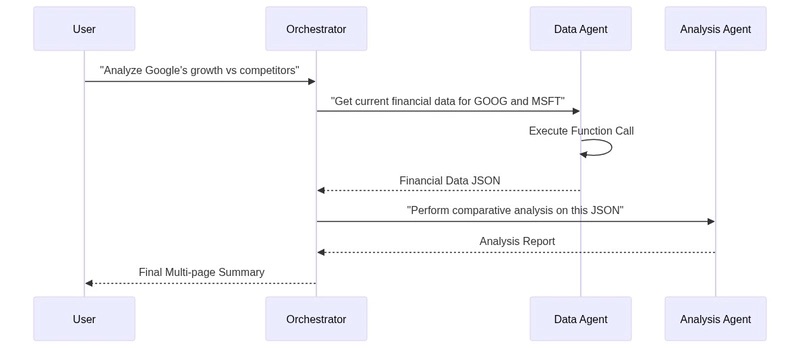
In a complex system, the data flow must be managed to ensure that Agent A's output is correctly passed to Agent B. We use a sequence diagram to visualize this interaction.
Advanced Pattern: State Management and Memory
One of the biggest challenges in multi-agent systems is "state drift," where agents lose track of the original goal during long interactions. Gemini 3 addresses this with native session state management in Vertex AI.
Instead of passing the entire conversation history back and forth (which increases cost and latency), we can use context caching. This allows the model to "freeze" the initial instructions and background data, only processing the new delta in the conversation.
Code Example: Context Caching for Efficiency
from vertexai.preview import generative_models

# Large technical manual context
long_context = "... thousands of lines of documentation ..."

# Create a cache (valid for a specific TTL)
cache = generative_models.Caching.create(
    model_name="gemini-3-pro",
    content=long_context,
    ttl_seconds=3600
)

# Initialize agent with the cached context
agent = GenerativeModel(model_name="gemini-3-pro")
# The agent now has 'memory' of the documentation without re-sending it
Challenges in Multi-Agent Systems
Building these systems isn't without hurdles. Here are the three most common technical challenges and how to solve them:
1. The "Infinite Loop" Problem
Agents can sometimes get stuck in a loop, repeatedly calling the same tool or asking the same question.
Solution: Implement a max_iterations counter in your Python controller and use an "Observer" pattern where a separate model monitors the agentic loop for redundancy.
2. Tool Output Ambiguity
If a tool returns an error or unexpected JSON, the agent might hallucinate a solution.
Solution: Use strict Pydantic models for function outputs and feed the validation error back into the agent's context, allowing it to self-correct.
3. Context Overflow
Despite Gemini 3's large window, multi-agent systems can produce massive amounts of logs.
Solution: Use an "Information Bottleneck" strategy. The Orchestrator should summarize the output of each worker before passing it to the next agent, ensuring only high-signal data moves forward.
Testing and Evaluation (LLM-as-a-Judge)
Traditional unit tests are insufficient for agents. You must evaluate the reasoning path. Google Cloud's Vertex AI Rapid Evaluation allows you to use Gemini 3 as a judge to grade the performance of your agents based on criteria like:
- Helpfulness: Did the agent fulfill the intent?
- Tool efficiency: Did it use the minimum number of tool calls?
- Safety: Did it adhere to the defined system instructions?
| Evaluation Metric | Description | Target Score |
|---|---|---|
| Faithfulness | How well the agent sticks to retrieved data. | > 0.90 |
| Task Completion | Success rate of complex multi-step goals. | > 0.85 |
| Latency per Step | Time taken for a single reasoning loop. | < 2.0s |
Conclusion
Gemini 3 and Vertex AI Agent Builder have fundamentally changed the barrier to entry for building intelligent, autonomous systems. By utilizing a modular multi-agent architecture, leveraging native function calling, and implementing rigorous evaluation cycles, developers can move past the prototype stage and build production-ready AI systems.
The key to success lies not in the size of the prompt, but in the elegance of the orchestration and the reliability of the tools provided to the agents. As we move into the era of agentic software, the role of the developer shifts from writing logic to designing ecosystems where agents can collaborate effectively.=
Opinions expressed by DZone contributors are their own.
Comments