

MCP vs A2A vs ACP: How AI Agents Talk to Each Other
Compare MCP, A2A, and ACP to understand how AI agents access tools, delegate work, manage tasks, and communicate securely in production systems.
Join the DZone community and get the full member experience.
Join For FreeMost protocol diagrams put Model Context Protocol (MCP), Agent2Agent (A2A) protocol, and Agent Communication Protocol (ACP) in three equal columns. I think that framing causes half the confusion. They aren't three interchangeable ways for agents to chat.
MCP solves a capability-access problem. A2A solves a delegation problem. ACP explored a REST-first version of agent communication. Once those boundaries are separated, the architecture becomes much easier to reason about.
An AI application may need to read a document, query a database, or trigger a build. Those are tool and context operations. The same application may also ask a security agent to assess a release, wait while that agent works, answer a clarification question, and collect a report. That is a different interaction, even if both flows happen inside the same user request.
Practical rule of thumb: Use MCP when the caller needs a capability. Use A2A when the caller is handing responsibility for an outcome to another agent. Treat ACP as migration context, not a new third choice.
At a Glance
|
Protocol |
Boundary |
Discovery |
Work Unit |
Use It For |
|
MCP |
AI host/client to an MCP server |
Server capability negotiation and lists |
Tool call, resource read, prompt, or protocol request |
Tools, data, and reusable context |
|
A2A |
Client agent to remote agent |
Agent Card, registry, or private configuration |
Message or stateful Task with Artifacts |
Delegation and cross-agent collaboration |
|
ACP |
Application/agent to remote agent over REST |
Agent Manifest |
Run, message, session, and await flow |
Existing ACP integrations and migration |
1. MCP: Give an Agent Access to Capabilities
I find the Model Context Protocol (MCP) easiest to understand when I temporarily ignore the word agent. MCP is an integration contract between an AI host and external capability providers.
The host might be a chat application, an IDE, or a larger agent runtime. It creates an MCP client for each MCP server it connects to. The server advertises what it offers: tools that perform actions, resources that provide context, and prompts that package reusable interaction patterns.
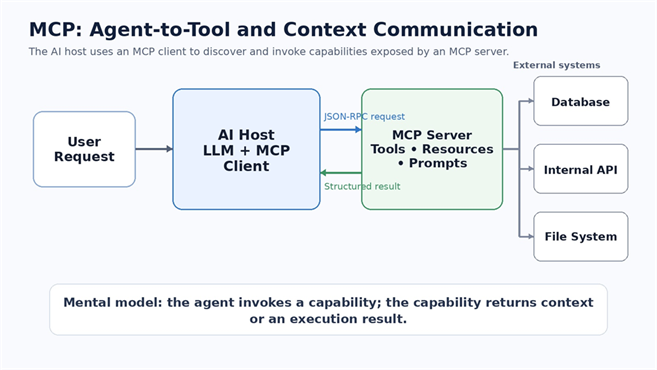
Figure 1. MCP standardizes the connection between an AI host and external capabilities.
A basic request is straightforward:
- The host decides that outside data or an action is needed.
- Its MCP client selects a discovered capability and sends a JSON-RPC request.
- The server validates the arguments, executes the operation, and returns structured content.
- The host gives that result back to the model or workflow so it can continue.
MCP uses JSON-RPC 2.0 as its message protocol and supports both local communication over standard input/output (stdio) and remote communication over Streamable HTTP. It also covers initialization, capability negotiation, progress, cancellation, and errors. In other words, it is more than a convenient wrapper around function calling.
A database query is not another agent. Neither is a file read, a ticket update, or a call to an internal pricing API. Modeling every capability as an agent adds identity, state, and orchestration overhead where a direct tool contract would be clearer.
A practical MCP design check: Use synchronous MCP tool calls for fast, interactive, user-facing operations. For workflows that are long-running, require approvals, or need to continue independently of the client connection, use an asynchronous job or agent-based workflow instead.
2. A2A: Hand Work to Another Agent
With Agent2Agent (A2A), the remote participant is an independent agent. It may use a different model, framework, programming language, cloud, memory system, or tool stack. The caller should not need access to those internals. It needs a stable contract for discovering the agent, authenticating, sending work, and receiving results.
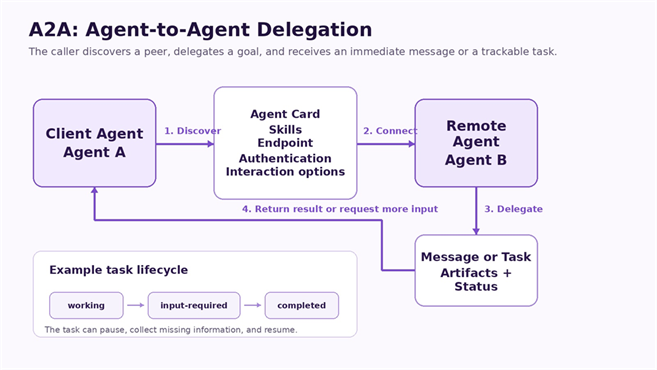
Figure 2. A2A adds discovery, delegation, task state, and structured deliverables.
Discovery starts with an Agent Card. A public deployment can expose it at the well-known URI below; a private enterprise deployment may use a registry or direct configuration instead.
/.well-known/agent-card.jsonThe card tells a client which skills the agent advertises, where its interfaces are, which protocol version they support, and how authentication works. In A2A 1.0, the core bindings are JSON-RPC, HTTP+JSON, and gRPC.
The interaction can return a Message immediately, but the more interesting object is a Task. A Task has an ID, status, history, and output Artifacts. It may be working, waiting for more input, completed, failed, canceled, or rejected. That input-required state is what makes the protocol useful for real delegation: the remote agent can pause, ask a question, and resume without pretending the entire job was one function call.
A2A also gives the caller choices for result delivery. It can wait, poll, stream ordered task events, or register a push-notification endpoint for longer work. If I expect a remote agent to exceed a five-to-ten-second interactive budget, I'd use a Task and expose progress rather than holding one opaque HTTP request open. Again, that timing is a design preference, not a protocol rule.
3. ACP: Important History, but Not a New Default
The Agent Communication Protocol (ACP) took a REST-first approach. Agents published an Agent Manifest, clients submitted Runs, and the protocol supported synchronous responses, asynchronous processing, streaming, sessions, multimodal messages, and an await mechanism for missing input. It was appealing because ordinary HTTP tooling could inspect and operate the interface.
In August 2025, ACP officially merged with A2A under the Linux Foundation. The ACP team announced that active development would wind down and that migration support would move users toward A2A. The REST-first idea did not disappear: A2A 1.0 includes an HTTP+JSON binding alongside JSON-RPC and gRPC.
I wouldn't start a new ACP integration in 2026 unless an existing platform or partner requires it. I'd maintain a working ACP path, put a migration boundary around it, and make new agent contracts A2A-compatible.
A Production Pattern
Here is a small but realistic starting point: one coordinator agent, two specialist agents, and four MCP servers. The coordinator delegates test analysis to one specialist and security analysis to another. Each specialist has only the tools it needs.
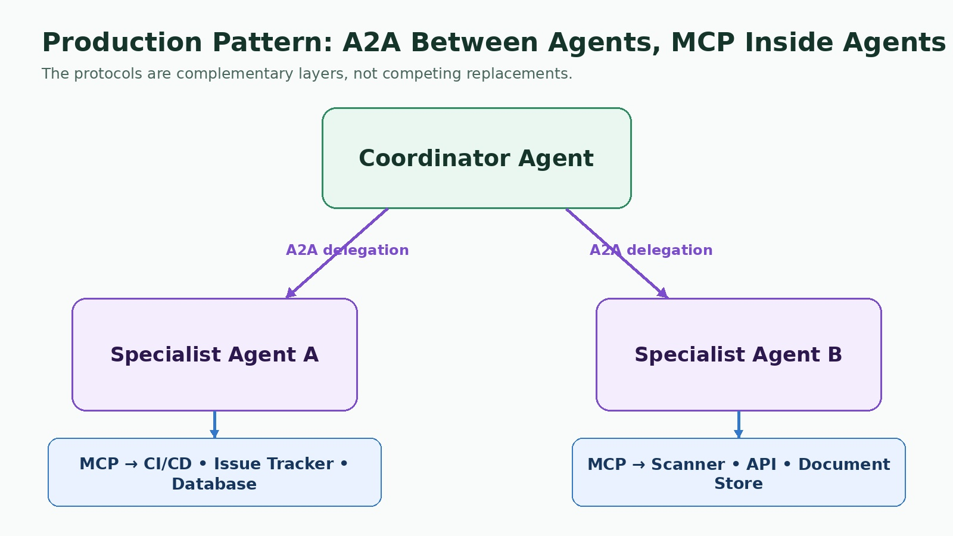
Figure 3. A2A coordinates independent agents; MCP gives agent-controlled access to tools and data.
Example request path:
|
Step |
Protocol |
Example |
Control |
|
1 |
A2A |
Coordinator sends a release-readiness Task to the test agent |
Task ID, 30-second synchronous window, then stream or poll |
|
2 |
MCP |
Test agent reads pipeline status and open defects |
Read-only credentials; two-second per-call starting timeout |
|
3 |
A2A |
Security agent requests missing release scope |
Task moves to input-required; coordinator supplies context |
|
4 |
MCP |
Security agent reads scanner findings and policy documents |
Separate scopes for scanner and document store |
|
5 |
A2A |
Both agents return Artifacts to the coordinator |
Persist final artifact, status transitions, and trace ID |
Those numbers are not standards. They are the kind of explicit starting points that stop a prototype from turning into a chain of requests with no timeout, no owner, and no observable state.
What the Protocols Do Not Solve for You
Interoperability is useful. It isn't an operating model.
Identity: Pass the user or workload identity across the boundary. Do not let every MCP call run as one all-powerful agent service account.
Authorization: Authorize the exact tool, resource, skill, and tenant. A trusted agent should not automatically inherit access to every downstream system.
Retries: Retry reads and explicitly idempotent writes. A blind retry of a payment, deletion, or ticket creation can duplicate real-world actions.
Observability: Log the trace ID, calling agent, remote agent, tool name, task ID, status transition, duration, and final error category. Without those fields, a multi-agent failure becomes guesswork.
Human approval: Require confirmation for destructive changes, external communication, privileged access, or decisions with material business impact.
So Which One Should You Use?
- For tool and context access: MCP.
- For responsibility handoff between independent agents: A2A.
- For an existing ACP estate: keep it stable, then plan the move to A2A.
Most serious agent platforms will use both MCP and A2A. The coordinator talks to specialist agents through A2A. Each specialist reaches its approved systems through MCP. That split is not as visually symmetrical as three protocols in parallel columns, but it matches the real engineering boundaries much better.
Opinions expressed by DZone contributors are their own.
Comments