

How an AI Software Factory Works: From Developer Intent to Production
Learn how a developer's intent moves through AI agents that plan, code, review, test, deploy, and monitor software, through the concept of software factory.
 CORE
·
Join the DZone community and get the full member experience.
Join For FreeI got interested in the AI Software Factory concept because it asks a much bigger question than “How can I write code faster?” It asks how AI agents can help move an idea through the entire software development lifecycle, from planning and implementation to testing, deployment, monitoring, and learning.
That difference matters. Coding assistants are already useful, but generating code is only one part of building software. I still need to understand the service, validate the change, get the right approvals, and keep production healthy.
When I started researching how companies like Uber approach agent-driven development, the infrastructure behind the agents fascinated me more than the code generation itself. The real opportunity is not a collection of clever tools working independently. It is a coordinated system that gives those tools context, boundaries, and a reliable path to production.
What I Mean by an AI Software Factory
I think of an AI Software Factory as an assembly line for software, with specialized agents handling different jobs and humans controlling the decisions that carry meaningful risk. The factory starts with developer intent and ends with verified software running in production, with operational feedback returning to the beginning.
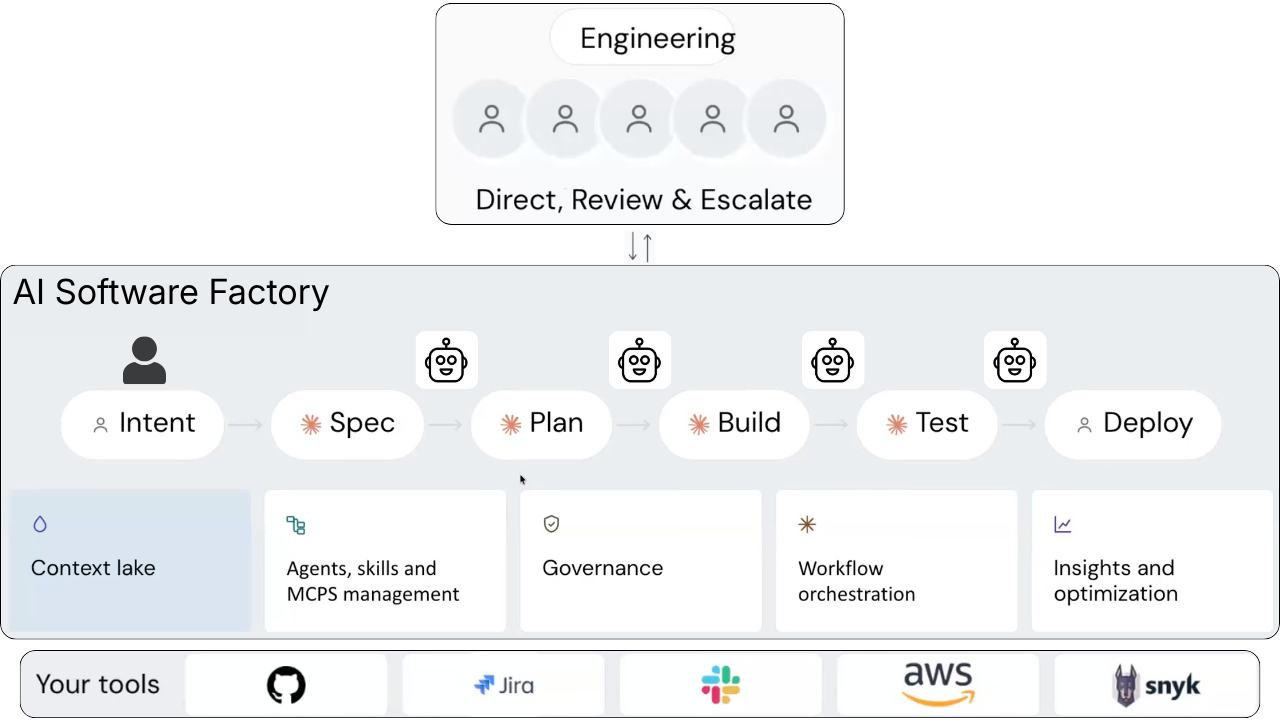
The manufacturing analogy helps me explain it. A car factory does not rely on one machine to perform every task. Different stations have specific responsibilities, and the assembly line determines how work moves between them. Software needs the same kind of coordination.
An AI Software Factory can include agents for planning, coding, review, testing, security, release verification, deployment, and monitoring. But the agents alone do not make it a factory. The operating layer needs to connect their work, enforce policies, and expose what happened at each stage.
Uber was one of the examples that drew me into this topic. The research I explored described agents handling more than 70% of the company’s pull requests. What interested me most was the supporting infrastructure: agents need to understand systems, run validation, and help maintain software at scale, not simply produce changes.
That is the distinction I keep coming back to. The factory is the system around the agents, not just the agents themselves.
Faster Coding Does Not Automatically Mean Faster Delivery
I am excited about tools like GitHub Copilot and Cursor, but I do not confuse faster syntax generation with faster software delivery. If coding gets dramatically faster while everything after it stays the same, the bottleneck simply moves downstream.
More code arrives in testing. More pull requests land in review queues. Senior engineers spend more time evaluating changes, and deployment processes still have the same constraints. The team can feel incredibly productive while the amount of reliable software reaching production barely changes.
This is the problem an AI Software Factory is supposed to address. Optimizing one stage is not enough when delivery depends on the whole pipeline.
I find it useful to separate two questions:
- How quickly can I generate a change? Coding assistants can help significantly here.
- How reliably can I deliver that change? This depends on context, testing, review, approvals, deployment, and operations.
The second question is where the broader architecture becomes important. A bigger pile of generated code is not the outcome I want. I want useful changes that pass validation, fit the system, and reach production safely.
For me, the value of an AI Software Factory lies in improving that complete flow rather than celebrating raw code volume.
Governance Is What Separates a Factory from Agentic Chaos
There is a risky version of this story: I add several autonomous agents to the development lifecycle, give them access to tools, and assume the result will be efficient. Without a common operating layer, that can become agentic chaos.
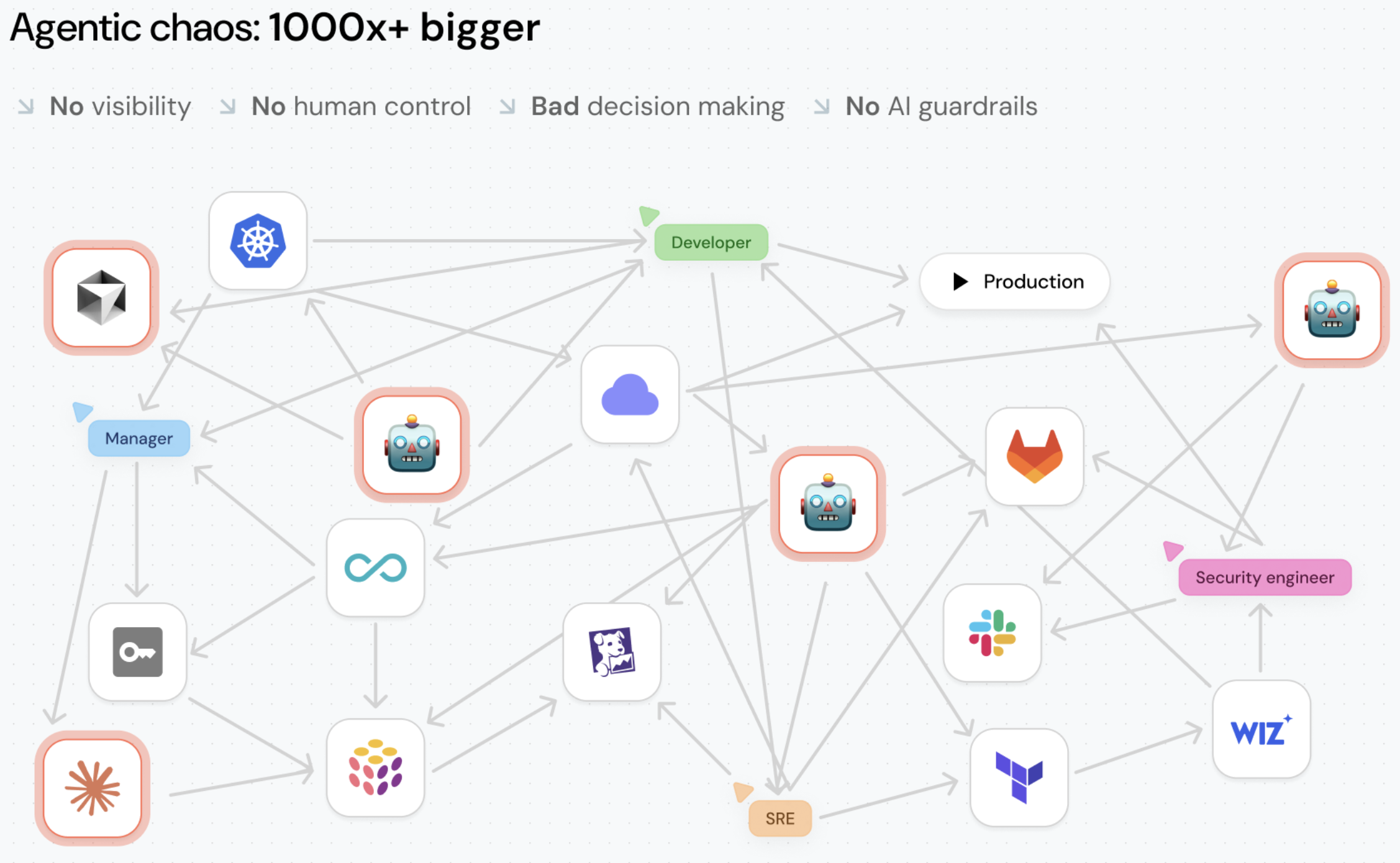
When something breaks, I need answers. Which agent changed the service? What requirements and business context did it use? Which checks passed? Who approved the release? If those answers are missing, faster execution has made the system harder to control.
A governed AI Software Factory makes that information visible and makes its boundaries enforceable. I want explicit inputs, defined output destinations, security rules, and approval gates that agents cannot quietly bypass.
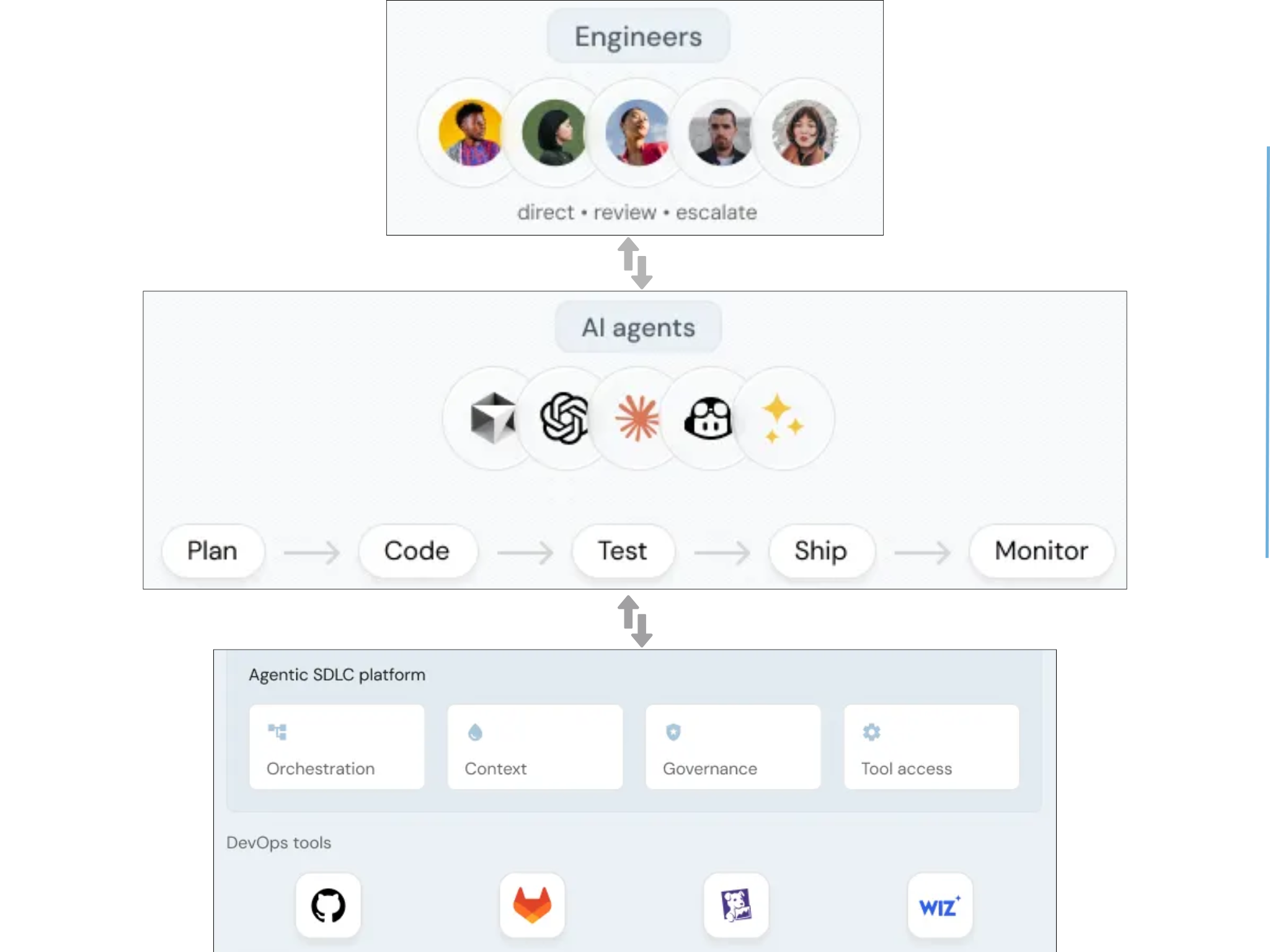
Earlier approaches such as infrastructure as code and GitOps helped automate infrastructure and deployment workflows. Agent-driven development extends automation into planning and implementation, which makes governance across the lifecycle even more important.
My preferred division of responsibility is straightforward: agents perform focused work, while humans define the rules and authorize consequential decisions. An agent should not decide what business risk is acceptable.
That is why I do not see human governance as the opposite of automation. In an AI Software Factory, governance is what makes broader automation usable.
I Start with Service Context, Then Route Work to Specialists
Before generating a single line of code, I want the factory to fetch the service context. That means knowing who owns the service, which systems it depends on, what requirements apply, and which policies govern the change.
Without that foundation, an agent can produce an implementation that looks reasonable in isolation but does not fit the organization’s actual system. The initial context is not administrative overhead. It is part of the engineering input.
I also would not hand an entire feature request to one giant prompt and ask a single model to do everything. Planning, implementation, review, and operations are different responsibilities. Mixing them together makes it harder to isolate mistakes and understand the output.
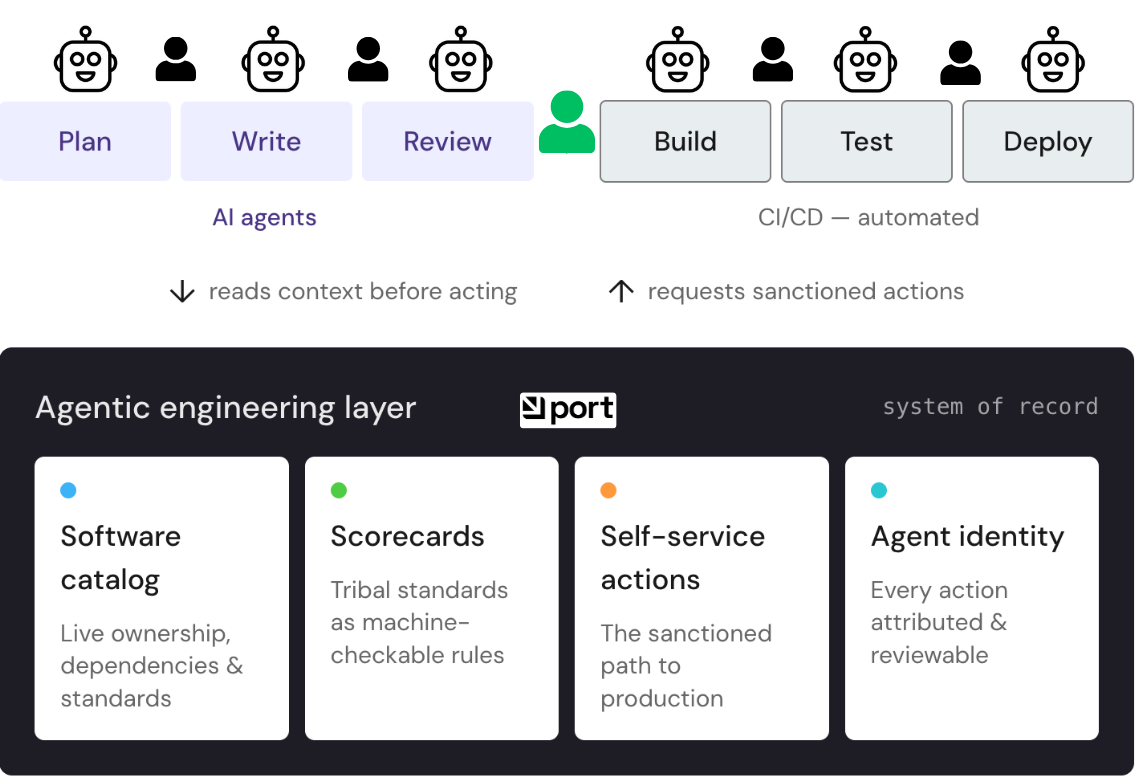
In an AI Software Factory, I prefer a constrained handoff:
- Gather context: Resolve ownership, dependencies, requirements, and applicable rules.
- Create a plan: A planning agent maps the architecture and implementation approach.
- Approve the plan: A human checks the proposed direction before implementation begins.
- Build the change: A coding agent executes the approved, bounded plan.
- Validate the output: Review, testing, and security responsibilities follow through their own stages.
These boundaries help contain errors rather than allowing an unsupported assumption to travel unchecked through every phase. They do not make hallucinations impossible, but they create clearer places to detect and stop them.
That narrow division of labor is one of the most useful design ideas in the AI Software Factory model.
CI and Human Approval Must Be Real Gates
Once generated code moves forward, I still want the traditional continuous integration machinery to do its job. AI does not remove the need for builds, automated tests, or security validation.
My rule is simple: a failed CI build blocks progression toward deployment. It should not become an advisory message that an agent can ignore because it thinks the change is probably fine.
An AI Software Factory needs those checks wired into workflow control. For background on the underlying practice, GitHub’s continuous integration documentation explains how automated builds and tests support validation of repository changes.
Passing CI is necessary, but it is not the same as permission to release. After automated validation, the workflow reaches a human review gate and pauses until someone explicitly authorizes the next step.
At that gate, I want to evaluate architectural integrity, release readiness, and acceptable risk. The emphasis shifts away from spending all my attention on routine syntax checks and toward the questions that require engineering judgment.
That does not mean I stop examining code when necessary. It means the factory should handle repetitive validation so that my review can focus on whether the change belongs in the system and whether it is safe to proceed.
For me, an AI Software Factory protects speed by putting human judgment exactly where the stakes justify it.
The Factory Continues After Deployment
I do not consider deployment the finish line. Once a human approves the release, a delivery agent can move the change into production, but the workflow needs to continue into operations.
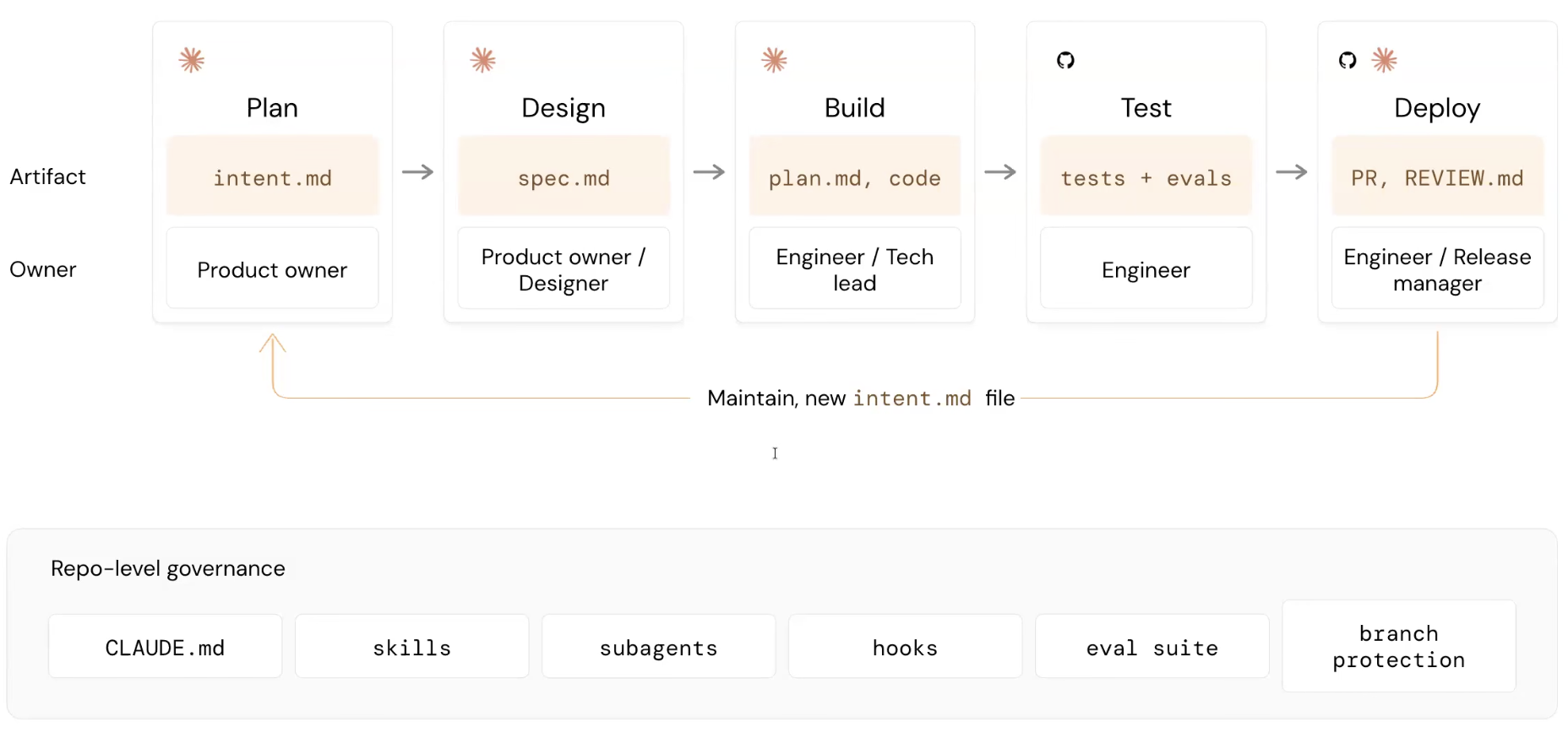
A monitoring agent then checks live service health and looks for degradation after deployment. If health drops, incident response should follow predefined rules rather than depend on an agent improvising a recovery strategy.
In the AI Software Factory model I explored, those responses include creating incident tickets, notifying the responsible team in Slack, and triggering predefined rollbacks. Service ownership and incident policies matter here just as much as they did during planning.
The final piece is the feedback loop. Production signals and deployment outcomes need to flow back into the service context used for future work.
I find this especially important because a pipeline that only moves forward is still largely a static automation sequence. A pipeline that brings operational results back to its starting point can improve the information available for the next plan.
When I describe an AI Software Factory as learning, this is what I mean: deployment results and live system behavior inform subsequent work. I am not suggesting that agents should rewrite their own policies or expand their authority.
The feedback improves context. Humans still own the boundaries.
A Practical AI Software Factory Playground With Port
To make the architecture concrete, I used a playground built around a customer support API. The developer intent was to build an API that summarizes tickets, stores conversation history, exposes REST endpoints, and can be safely deployed to production.
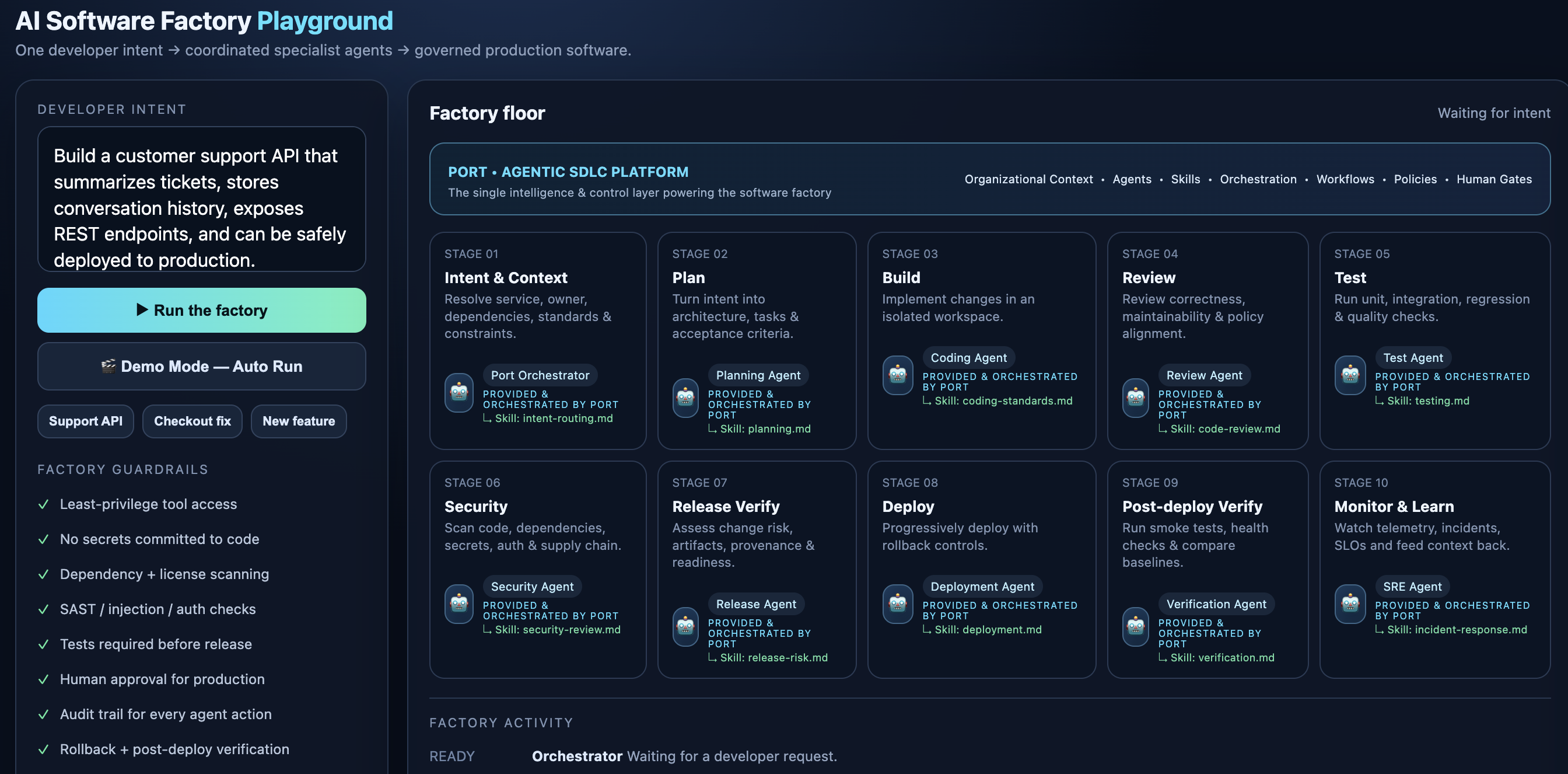
I like this example because the request is more than a coding task. It includes functionality, persistence, an interface, and a delivery expectation. An AI Software Factory has to carry all of that intent through the lifecycle.
In the playground, Port sits above the factory floor as the agentic SDLC layer. It supplies organizational context and connects agent and skill registries, workflows, policies, guardrails, and human gates.
The visible stages run from intent and context through planning, building, reviewing, testing, security, release verification, deployment, post-deployment verification, and monitoring. An agent console and activity log expose the sequence of actions.
When I ran the demo, the workflow encountered a human gate after planning and another before deployment. After approval, it continued through post-deployment verification and monitoring. The completed run showed 10 agents completed, 13 checks passed, two human gates, and a low release-risk indicator.
I treat those numbers as the outcome of that illustrative run, not evidence that every release will be low risk. The playground demonstrates the coordination pattern; it is not proof that a real customer support API has been built and validated in a production environment.
What I find useful is the visibility. I can see which specialist acted, where approval happened, and how work progressed through the AI Software Factory.
The Guardrails I Want Before Giving Agents More Authority
The factory floor is interesting, but I pay just as much attention to its guardrails. A workflow can look beautifully organized and still be unsafe if its permissions and release conditions are too loose.
The playground’s AI Software Factory includes a concrete set of controls:
- Least privilege access to tools
- No secrets committed to code
- Dependency and license scanning
- Static application security testing and injection-related checks
- Required tests before release
- Human approval for production
- An audit trail for every agent action
- Rollback support and post-deployment verification
I do not think of these as decorations around the workflow. They determine what an agent may do, what evidence is required, and when work must stop.
Least privilege limits tool access. Secret and dependency checks constrain what can enter the codebase. Audit trails help explain actions later. Production approval keeps release authority with a human, while rollback and verification extend safety beyond the initial deployment.
For an AI Software Factory to be useful, these controls need to participate in execution, not just appear in a checklist. I want the orchestrator to enforce them consistently across stages.
That is also why centralized service context matters. The factory needs to know the service owner, its policies, and the expected incident response before it can route work responsibly.
How I Would Start Without Automating Everything on Day One
My instinct as a developer is to connect the entire pipeline immediately. Planning agents, coding agents, deployment agents, monitoring agents: the possibilities are exciting. But I would resist that instinct when introducing an AI Software Factory to a team.
I would begin with one small, reliable path: requirements, coding, CI, and a human review gate. The initial workflow should stop there. Before adding deployment authority, I want confidence that the inputs are clear, the checks block failures, and the approval boundary behaves as expected.
Only after that loop is stable would I expand into deployment and monitoring orchestration. The point is not to have the most agents on day one. It is to establish a trustworthy handoff and then extend it.
This changes how I think about the developer’s role. I am not just writing implementation details. I am defining system rules, approval criteria, service context, and the structure through which automated work moves.
That is what excites me most about an AI Software Factory. The goal is not to remove engineering judgment. It is to free more of my time for that judgment by coordinating repetitive work around it.
I want a factory that ships reliable software, explains its actions, and keeps meaningful decisions accountable to people. Faster code generation is useful. A governed delivery system is the bigger opportunity.
Opinions expressed by DZone contributors are their own.
Comments