

The Battle of the Frameworks: Choosing the Right Tech Stack
Discover key factors to consider, common mistakes to avoid, and leading tech stack options to make a smart, scalable, and future-proof decision.
Join the DZone community and get the full member experience.
Join For FreeWhen Twitter (now X) was launched in 2006, it was built using Ruby on Rails, a framework known for its rapid development capabilities. At the time, this choice allowed Twitter to quickly scale and expand during its early days. However, as the platform's user base grew exponentially, its initial tech stack began to show limitations. By 2008, Twitter's architecture was struggling to keep pace with the increasing volume of users, tweets, and data.
The result? Frequent outages and performance issues that hindered user experience and stifled growth.
Does this mean Ruby on Rails is an inherently poor framework? Not at all. However, it wasn’t the right fit as the platform's needs evolved. What worked for early-stage development couldn't support the scale, real-time demands, and high concurrency Twitter required as it grew.
In this article, we will explore how tech stack selection should be done with careful consideration of all relevant factors — scalability, performance, total cost of ownership, long-term support, and more.
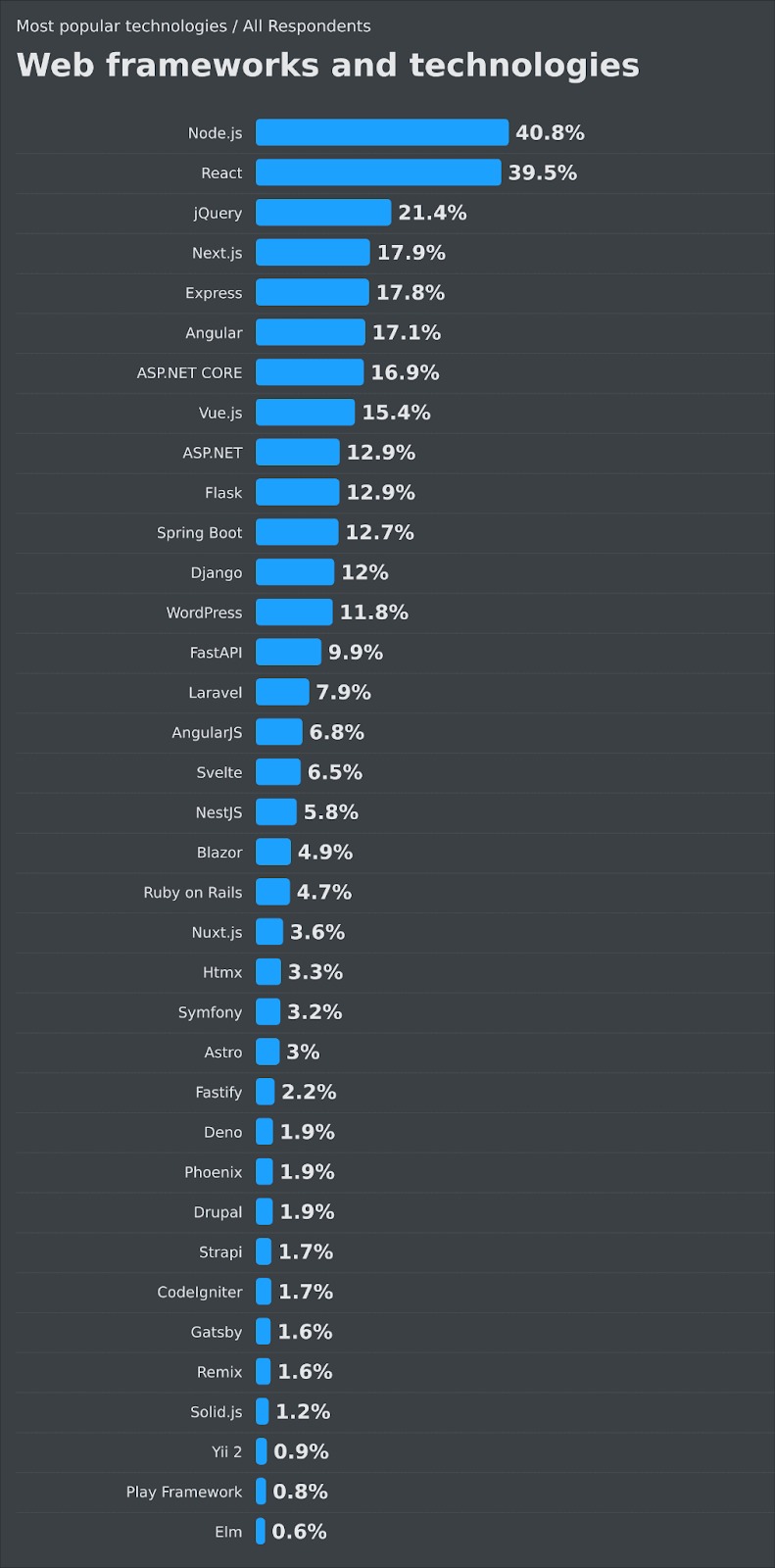
Web Frameworks and Technologies (2024 Developer Survey, n.d.)
The Long-Term Impact of an Incompatible Tech Stack
Ending up with the wrong app development framework can cause silent but serious damage to your project. This damage and its corresponding risks extend beyond technical aspects, impacting business performance and growth at multiple levels. Here is why tech stack matters in application success:
Migration Challenges
An impulsively chosen app development framework often pushes for migration(s) later. And regardless of how seamlessly you migrate, there are several risks: data loss, system downtime, and service interruptions. Rebuilding features and updating code might also cause your teams to lose their momentum.
Increased Maintenance Costs
Mistakenly choosing inflexible frameworks adds to long-term maintenance burdens. In the long term, your teams spend more time fixing recurring bugs, managing complex patches, and addressing compatibility issues.
Talent Scarcity
Specialized or outdated frameworks, such as Ember.js, Backbone.js, or older versions of AngularJS (1.x), have a limited talent pool. Finding developers skilled in these technologies becomes difficult and expensive, resulting in higher onboarding costs and lower ROI.
Missed Market Opportunities
Tech stacks that turn out to be slow and unscalable for your business can significantly delay product launches. As a result, you may miss critical windows to enter the market or capture user demand.
Compliance Risks
Choosing or sticking to a framework without evaluating its compatibility with security and regulatory needs can create hidden vulnerabilities. You may have to manually customize workflows, introducing higher risks of non-compliance, audits, and penalties.
The Psychology Behind Selecting a Tech Stack
Tech stack decisions are not just technical choices; they are critical business decisions. Organizations face multiple challenges when selecting app development frameworks. In addition to financial considerations, resource availability, and scalability, there are several other factors that complicate the decision-making process:
The Trend vs. Tradition Paradox
The choice between a newer or proven tech stack often reflects an organization’s risk tolerance and project priorities.
- Emerging startups and innovation-driven teams often turn to newer frameworks like Svelte (for front-end development) and Flutter (for cross-platform development).
- Conversely, proven tech stacks based on technologies like React, Angular, and .NET Core remain the preferred choice for stable businesses that prioritize compliance and long-term support.
|
|
Proven App Development Tech Stacks are Safer when:
|
Performance vs. Developer Experience (DevEx)
According to a study conducted by Microsoft Azure, "DevEx in Action: A Study of its Tangible Impacts," an optimized DevEx is an investment that improves engineering experience at three levels: individual, team, and organization.
- At an individual level, it translates to better job performance, higher productivity, and effective learning.
- At a team level, it improves overall code quality and reduces technical debt.
- At an organizational level, it results in higher retention, profitability, and more innovation.
Often, many organizations fail to achieve the above results as they largely evaluate their tech stacks and development frameworks through performance metrics such as deployment frequency, lead time for changes, mean time to recovery (MTTR), and change failure rate.
Complex, performance-tuned stacks that optimize these metrics may slow your teams down, might be harder to modify, and might be less maintainable. This can offset the initial performance gains by reducing overall team agility, hampering the developer experience.
Common Mistakes in Tech Stack Selection
Below are some common mistakes that organizations often make during the tech stack selection process:
- Overlooking Long-Term Scalability: What works for a small project today may not be able to handle significant user growth or future feature additions.
- Not Evaluating Team Expertise: It can result in prolonged (and costly) onboarding cycles, slower development cycles, and potential quality issues.
- Underestimating Maintenance and TCO: While some frameworks may offer fast development cycles, they may come with a higher total cost of ownership (TCO) due to frequent updates, security patches, or complex configuration needs.
Neglecting Security and Compliance Needs: This can lead to costly security breaches, non-compliance penalties, and reputation damage, especially if the app handles sensitive user data.
Factors to Consider When Choosing a Tech Stack
To avoid the costly tech stack selection mistakes we've discussed above, it's important to evaluate certain factors before making a decision.
1. Application Type
The type of application you want to build (e.g., web app, mobile app, an MVP, or an enterprise solution) greatly influences the stack you choose. For example, React or Vue.js are ideal for dynamic, interactive UIs, while Angular might be preferred for large-scale enterprise applications.
2. Performance Benchmarks
Based on your requirements, determine performance benchmarks- load times, app crashing rate, engagement, etc. Some tech stacks, like Node.js, excel in performance-heavy applications requiring fast response times.
3. Hiring Talent Based on Framework
Widely used app development frameworks like React or Node.js have large talent pools, making recruitment easier and more cost-effective. Conversely, selecting a less common or niche framework may increase hiring difficulties and associated costs.
4. Framework Lifespan and Long-Term Support
Make sure to select tech stacks with long-term support (LTS), such as Flutter, Angular, or .NET Core. This will ensure your app will get regular security patches and software updates for extended periods.
5. Total Cost of Ownership (TCO)
Choose tech stacks known for balancing initial development costs with future maintenance. The MEAN and MERN stacks are famous for this balance. On the other hand, web app development frameworks like Laravel may be faster for development, but the long-term costs of scaling can be higher.
Top App Development Tech Stacks and Their Strengths
React + Node.js (MERN Stack)
The MERN stack combines React for the front-end, Node.js for the back-end, MongoDB as the database, and Express.js for the web server. This stack is completely JavaScript-based, offering a unified development experience.
- Strength: The full-stack JavaScript environment allows for seamless integration and faster development cycles.
- Commonly Used For: Single-page applications (SPAs), dynamic web apps, eCommerce platforms, real-time applications like chat apps and social networks.
Angular + Node.js (MEAN Stack)
The MEAN stack includes Angular for the front-end, Node.js for the back-end, MongoDB for the database, and Express.js for the server-side framework. This stack uses JavaScript (and TypeScript in the rewritten Angular framework) for both client-side and server-side development.
- Strength: The structured Angular framework, combined with the scalability of Node.js, makes it an excellent choice for enterprise-level applications.
- Commonly Used For: Enterprise apps (CRMs, ERPs, finance management tools), multi-user dashboards, project management tools, and more.
LAMP Stack
The LAMP stack is based on the Linux operating system, Apache for the web server, MySQL for the database, and PHP for server-side scripting. It is an open-source, widely used web development framework that is used for building stable applications.
- Strength: It has a mature ecosystem and widespread community support via the Linux Foundation (having over 777K developers contributing to code).
- Commonly Used For: CMS, blogs, small to medium-sized websites, eCommerce platforms, and more.
Vue.js + Laravel
Vue.js is a highly flexible and reactive front-end development framework, admired by over 60% of developers as their preferred web development framework. On the other hand, Laravel is a PHP-based back-end framework that handles database management, routing, and security.
- Strength: Combining them simplifies full-stack development with Vue.js-based rapid UIs and Laravel’s back-end power.
- Commonly Used For: SPAs, data dashboards, and admin panels.
Flutter + Firebase
Flutter is a renowned cross-platform app development framework that offers a UI toolkit for building natively compiled applications for mobile, web, and desktop from a single codebase. On the other hand, Firebase offers cloud-based back-end services- APIs, real-time databases, routing, authentication, etc.
- Strength: Fast cross-platform mobile app development with a highly customizable UI, paired with Firebase’s easy-to-integrate back-end services.
- Commonly Used For: Mobile apps (iOS and Android), MVPs, real-time applications like messaging apps, social apps, and media-heavy apps.
.NET Stack
It is a highly reliable tech stack based on the C# programming language and the .NET community toolkit (.NET Core, ASP.NET, Entity Framework (EF) Core, Blazor for front-end development, and MAUI) for building enterprise-grade applications. It is often utilized with SQL Server for efficient database management.
Strength: A mature ecosystem with strong tooling, built-in security features, and enterprise-level support, making it ideal for mission-critical applications.
Commonly Used For: Enterprise applications, cloud apps based on Azure, internal collaboration tools, and web applications requiring robust security.
Spring Boot + React
Spring Boot is another Java-based framework for building back-end services. React is another prominent front-end framework known for creating dynamic, high-performance UIs.
- Strength: Spring Boot’s microservice architecture, paired with React’s lightweight and reactive front-end, enables the development of easily scalable and maintainable applications.
- Commonly Used For: Business process automation (BPA), document management systems, healthcare management systems, content distribution networks (CDNs).
Django + React (or Vue.js)
Django is a Python-based back-end framework that is often paired with React or Vue.js for the front-end, creating a full-stack application with powerful back-end management and dynamic front-end capabilities.
- Strength: Rapid and flexible development for fast-moving projects. Moreover, with Python’s native support for AI/ML capabilities, it is an ideal tech stack for modern apps.
- Commonly Used For: AI-integrated web applications, social media platforms, content-heavy websites, SaaS platforms, and APIs.
Golang + Vue.js (or React)
Golang (Go) is a famous open-source programming language known for its high-performance back-end capabilities and a lightweight concurrency model, while Vue.js or React handles the front-end.
- Strength: Their combination provides a balanced approach to full-stack development.
- Commonly Used For: High-performance APIs, real-time apps, cloud-native apps, and systems requiring concurrency and scalability.
Svelte + Node.js
Svelte offers a new, compile-time approach to front-end development, while Node.js is used for server-side logic and APIs.
- Strength: Svelte’s efficient approach leads to smaller bundles and faster load times, while Node.js allows for fast, scalable back-end development.
- Commonly Used For: Lightweight web applications, SPAs, chat apps.
Putting It All Together: Make the Right Choice
|
Scenario
|
Recommended Tech Stack |
Why Choose This Stack |
|
Need rapid development |
React + Node.js (MERN Stack) |
Fast development with JavaScript for both front-end and back-end. Great for fast-moving teams. |
|
Building large-scale applications |
Angular + Node.js (MEAN Stack) |
Robust, scalable, and structured, perfect for large-scale apps with complex requirements. |
|
Performance-critical, high-concurrency app |
Golang + React/Vue.js |
High performance and scalability, with Golang’s concurrency and React/Vue’s dynamic UI. |
|
Cross-platform mobile app with back-end services |
Flutter + Firebase |
Quick development for mobile apps with rich UI, backed by Firebase for real-time data sync. |
|
Need strong security, Azure cloud integration, and compliance |
.NET Stack |
Built-in security features and compliance support, ideal for regulated industries. |
|
Dynamic, data-heavy web apps |
Vue.js + Laravel |
Fast front-end with Vue and a powerful back-end framework in Laravel, ideal for web apps. |
|
Real-time updates and collaboration |
Spring Boot + React |
Excellent for building real-time features, such as messaging or collaborative platforms. |
|
Quick iteration with flexibility |
Ruby on Rails + React |
Rapid prototyping and flexible front-end development for quickly evolving projects. |
|
Modern web apps with lightweight, fast UIs |
Svelte + Node.js |
Efficient, minimal overhead, ideal for performance-focused single-page applications. |
|
Large-scale database-driven web app |
LAMP Stack (Linux, Apache, MySQL, PHP) |
Mature, stable, and widely used for data-driven applications with reliable database support. |
A Real-World Glance at Tech Stack Selection
|
|
Google Ads Tech Stack: Flutter + Firebase Why it Worked: A single codebase for both iOS and Android apps, with features like user authentication, real-time data synchronization, and cloud-based analytics. |

|
Netflix Tech Stack: Node.js, Java, React, AWS Cloud, Golang Why it Worked: For real-time streaming, high-concurrency data services, and global scaling via AWS cloud. |
|
|
|
Uber Tech Stack: MERN Stack, Golang, Redis Why it Worked: For real-time communication, an interactive web interface, fast caching, and low latency for its ride-sharing service. |

|
Tech Stack: Python (Django), JavaScript (React), MySQL, AWS, Redis Why it Worked: To handle high traffic and rapid scaling, relational data storage, and a responsive user experience when managing billions of pins. |
|

|
|
Tech Stack: Java, Python (Django), React, PostgreSQL Why it Worked: For rapid development and scalability with a growing user base. |

|
GoDaddy Tech Stack: Multi-stack approach including Node.js, React, jQuery, Java, PHP, and ASP.NET. Why it Worked: Robust security, easy Azure cloud integration, and cost efficiency with built-in .NET tooling. |
|

Checklist: How to Select the Right Tech Stack for Your App?
Now that we've established why choosing the right tech stack is critical to your project's success, it's time to evaluate the key factors that will guide your decision. Make the final call once you have answers to the following questions:
- What type of application are we building? Is it a web app, mobile app, enterprise software, or a microservices-based system?
- What are the performance goals of this app? Real-time data processing, high concurrency, or heavy data computation?
- How quickly do we need to go to market?
- Do we have the necessary in-house skills? Or will we have to hire dedicated software developers (mobile app developers, web app developers, front or back-end developers, or full-stack developers)?
- What are the scalability and growth expectations? Do we need long-term support?
- What is the cost of maintenance and operational overhead?
- How important is security and compliance for this app?
- What kind of community and ecosystem support does the stack have?
- How easy will it be to integrate with other tools and platforms?
- How long will this technology remain relevant and supported?
If you’re still unsure about the best stack for your application, don’t hesitate to seek expert guidance. Experienced professionals can help you make an informed choice based on your specific needs and goals.
References
1. 2024 Developer Survey. (n.d.). https://survey.stackoverflow.co/2024/. https://survey.stackoverflow.co/2024/technology#most-popular-technologies-webframe
Opinions expressed by DZone contributors are their own.
Comments