

Not only AI: What Else Drives Team Performance Today?
Learn how a GenAI team improved performance by 20% in 3 months—without more tools or pressure, but with systems, clarity, and smarter product decisions.
Join the DZone community and get the full member experience.
Join For FreeToday’s world is obsessed with AI, and performance conversations often center on models, automation, and tooling. But when it comes to real, sustainable productivity gains, it’s not just about adding more AI. It's about designing better systems. In high-speed product environments (whether driven by AI or not) execution is urgent, but effectiveness depends on how you enable people.
At GlobalLogic, I joined an early-stage GenAI product team. The stakes were high, timelines were tight, and yet, within three months, we boosted team performance by 20%. But we didn’t get there by chasing every shiny AI solution. We got there by doing the basics right: building clarity, creating smart feedback loops, and empowering decision-makers.
This article breaks down the non-obvious, non-hyped ways we accelerated performance—lessons any product leader can apply, whether you’re working with AI or not.
Setting the Stage: The Right Balance of Structure, Autonomy, and Clarity
When performance lags, the problem is often misdiagnosed. Many assume it’s about individual productivity. In my experience, it’s more often a lack of systemic clarity: teams don’t understand what they’re building, why it matters, or how their decisions impact business goals.
The first step was creating just enough structure to reduce chaos, while leaving space for autonomy in problem-solving. We implemented Agile with intentional guardrails, not rigidity. Daily standups, weekly priorities, and roadmap checkpoints gave the team a cadence. But we also empowered them to challenge backlog items, rethink delivery approaches, and own outcomes, not just outputs.
This balance helped establish psychological safety without sacrificing velocity. People were more likely to surface blockers early, propose alternatives, and engage with strategic decisions.
Left-Shifting Requirements: Bringing Engineers into Discovery
One of the first changes I introduced was a shift-left approach to requirements. Traditionally, discovery is handled by product and design, with engineering brought in after scope is set. That creates a waterfall mindset disguised as Agile.
We flipped that. Engineers participated in early-stage workshops, mock reviews, and feasibility assessments. They co-designed solutions. A key partner in this process was the product architect, who played a critical role in connecting business goals with system-level constraints and enabling structured technical discussions early on.
Based on these collaborative sessions, we created visual diagrams, mapping architecture options, data flows, and technical dependencies, which served as working artifacts for both decision-making and alignment across teams. As a result, we got faster alignment, fewer misunderstood requirements, and a significant reduction in rework. Developers gained context behind user needs, and designers could iterate faster with grounded technical input.
Visualizing Strategy: Layered Roadmaps & Journey Maps
One of the most effective alignment tools I introduced was a layered roadmap model. Instead of one static Gantt-style plan, we created visual artifacts that showed:
- User-facing service (top layer) - what the end user ultimately receives and experiences
- Customer journey mapping and service blueprinting - how the user interacts with the product and what happens in the background to deliver that experience (including backend logic, integrations, and internal processes, mapped to specific developer tasks)
- Product lifecycle stages - for AI, this included model exploration, training, tuning, and inference; for other products, this layer may reflect frontend/backend development, integration workflows, or regulatory milestones, depending on architecture
- Backend implementation (bottom layer) - technical delivery, infrastructure, and internal system dependencies
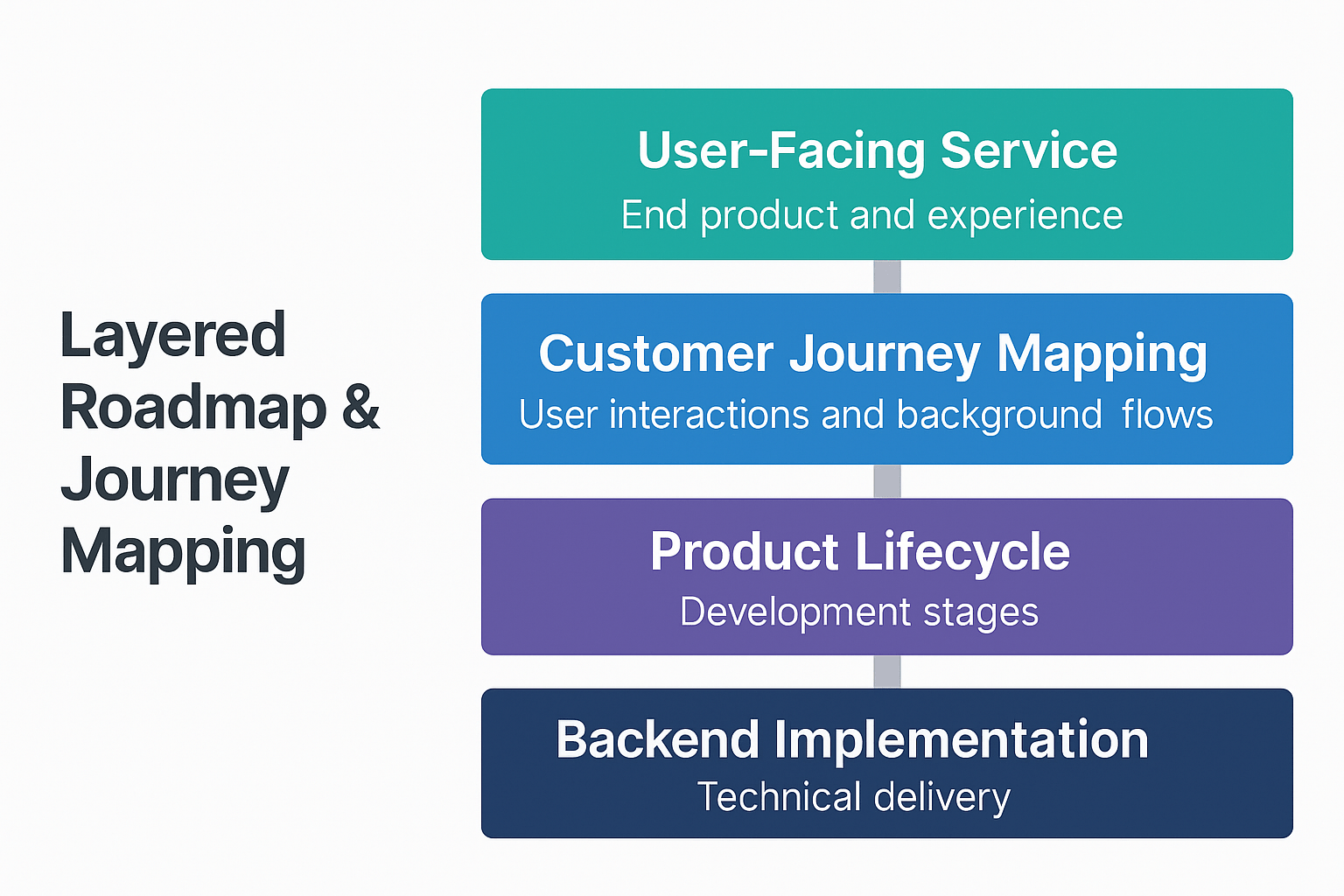
This multi-level view helped every stakeholder - from engineers to executives - understand the full picture without getting lost in details.
We complemented this with customer journey maps tailored to our users. These maps clarified not just what to build, but why it mattered to real users.
Defining MVP by Outcomes, Not Features
A common trap for modern teams, especially in AI-heavy contexts, is over-engineering. With so much possible, it’s easy to lose focus. We reframed MVP not as the smallest set of features, but the fastest path to validating our core value hypothesis.
To do that, we ran outcome-mapping workshops:
- What’s the business goal?
- What user behavior signals that goal is being met?
- What’s the smallest experiment we can build to measure it?
But just as important was what came after: reviewing the scope against those outcomes and re-prioritizing ruthlessly. We aligned delivery with strategic goals, not just feature delivery. This helped reduce scope creep and avoid unnecessary functionality.
Our MVP became a tool for learning—focused, measurable, and tightly scoped, which is critical for any team trying to move fast without compromising quality. This reframing also gave the team more purpose. Rather than checking boxes, they understood the impact of their work in business terms.
Mentoring Product Owners: Scaling Decision-Making
As our initiative grew, I noticed a recurring bottleneck: too many decisions flowing through one or two people. To scale effectively, we needed empowered Product Owners who could make trade-offs, manage ambiguity, and drive iteration.
So I shifted part of my focus to mentoring POs. We ran weekly syncs where we:
- Reviewed story slicing techniques
- Debriefed sprint planning retros
- Identified and removed anti-patterns like over-grooming or lack of user insight
The effect was measurable: backlog quality improved, sprint goals became more achievable, and overall delivery pace increased.
Measuring Performance: What 20% Really Looked Like
We didn’t guess. We measured. Our key indicators included:
- Sprint velocity (story points completed)
- Bug rates post-release
- Cycle time for critical user stories
- Cross-team dependency resolution speed
In addition to a 20% performance improvement in velocity, we observed significant gains in delivery predictability and quality, including fewer bugs reported in late-stage QA and smoother cross-team coordination. Within just 1.5 months (roughly three sprints), post-QA bug reports dropped by 50%, and after the initial release, we had zero bugs reported—a result of tighter discovery and better engineering alignment.
Final Thoughts: High Performance is Designed, Not Demanded
Product teams don’t become high-performing through pressure or tools alone—and certainly not through AI by default. They get there through clear goals, smart systems, and the right balance of autonomy and support.
If you’re leading a team under pressure, I encourage you to ask not what your team is doing, but what’s getting in their way. The answers might surprise you.
Opinions expressed by DZone contributors are their own.
Comments