

Beyond the Glass Slab: How AI Voice Assistants are Morphing Into Our Real-Life JARVIS
Jarvis-like AI agents are becoming real. As someone building them at Alexa, I see Agentic AI handling tasks, making decisions, and more, reshaping how we live and work.
Join the DZone community and get the full member experience.
Join For FreeRemember JARVIS? Tony Stark's ever-present, hyper-intelligent AI, seamlessly managing his life, his suits, and even his quips. For years, it felt like a distant sci-fi fantasy. But here's the thing—as someone who's been building the future of voice AI as a Software Development Manager on the Alexa team, I can tell you we're closer than you might think. If you're like me, constantly tapping and swiping your phone, you've probably caught yourself wondering: are we on the cusp of AI voice assistants becoming our JARVIS, so much so that they might just make our beloved mobile phones obsolete?
It's a bold claim, I know. Our smartphones are basically extensions of ourselves at this point, right? Indispensable tools for communication, information, and let's face it—endless scrolling. But what if the next leap isn't just better smartphones, but something entirely different? I'm talking about a paradigm shift where the interface melts away, and truly intelligent, proactive AI becomes our primary digital companion.
The Smartphone's Stranglehold: A Love-Hate Relationship
Let's be real here—we're completely tethered to our phones. From that first bleary-eyed notification check in the morning to the last doom scroll before bed, they pretty much dictate how we interact with the digital world. And look, for good reason: they're powerful, versatile, and ridiculously convenient. We've seen some incredible advancements in mobile hardware and software, from cameras that rival professional equipment to processors that would've been supercomputers not long ago.
But there's this growing undercurrent of dissatisfaction, y'know? The constant pings, the endless scrolling, this glass slab constantly demanding our attention—it's exhausting. We're looking at our phones, not through them. The whole human-computer interaction thing, while advanced, still basically revolves around poking at a screen.
This is where the JARVIS vision, and the potential for advanced AI voice assistants, truly shines. Imagine a world where your digital assistant isn't just responding to commands, but anticipating your needs, understanding context, and proactively managing your environment – all through natural language, without you ever having to pull out a device.
From Siri to Sentient: The Evolution of Voice AI
Current voice assistants like Siri, Google Assistant, and Alexa are pretty impressive, no doubt. They can set alarms, play music, answer basic questions, and control smart home devices. But let's be honest—they're still mostly reactive. You ask, they (usually) respond. The "brain" behind them is primarily cloud-based, which means latency issues and good luck when you're offline.
Having led the development of Alexa's LLM-integrated transportation domain—where we integrated real-time services like Uber and Lyft for the Alexa+ launch—I've seen firsthand the challenges and crazy possibilities of making AI truly proactive.
The next generation of AI assistants is a completely different ballgame. We’re talking about:
- Hyper-Personalization & Contextual Awareness: An AI that truly learns your habits, preferences, and even your emotional state. It won't just know your calendar; it'll understand you're stressed because of that upcoming deadline and proactively suggest ordering your favorite coffee. It's about forming a dynamic, adaptive understanding of you.
- On-Device Intelligence: This is the game-changer. Powerful AI models are increasingly running directly on-device, thanks to specialized chips like Neural Processing Units (NPUs). What does this mean for the user? Blazing-fast responses, massively improved privacy (your data stays local), and—the kicker—it actually works offline. Your JARVIS won't need a constant internet connection to be brilliant.
- Proactive Problem Solving: Instead of waiting for a command, these assistants will anticipate needs. Imagine your car is low on fuel. Your AI assistant, knowing your schedule and route, proactively finds the best-priced gas station, navigates you there, and authorizes payment—all without a single tap. This is the kind of seamless integration we've been building at Alexa; true intelligence is about understanding intent, not just parsing commands.
The Rise of Agentic AI: From Assistant to Active Agent
Okay, here's where things get truly mind-blowing. The next evolution isn't just about AI understanding and responding—it's about AI actually doing stuff as your agent. Having worked extensively with GenAI and Agentic AI at Amazon, I've seen firsthand how we're moving from passive assistants to active agents that can handle complex, multi-step tasks all by themselves.
Autonomous Task Execution
Picture this: You tell your AI, "Book my business trip to Seattle next month." Instead of just setting a reminder like current assistants, your AI agent would:
- Check your calendar for available dates
- Hunt down optimal flights based on your preferences
- Find hotels near your meeting locations
- Book everything within your budget
- Add all the details to your calendar
- Even submit the expense report pre-filled
This isn't pie-in-the-sky stuff—we're literally building these capabilities today. The AI acts as your personal agent, handling the entire workflow while you focus on, well, actual work.
Multi-System Orchestration
Modern Agentic AI can navigate multiple systems and services on your behalf. During my work integrating transportation services into Alexa+, I witnessed how AI can seamlessly coordinate between different platforms. Your future AI agent will:
- Negotiate with other AI agents (imagine your AI haggling with an airline's AI for better prices)
- Manage complex workflows across dozens of services
- Handle authentication and permissions securely
- Complete transactions with your pre-authorized approval
Technical Architecture: From Cloud to Edge
Here's how the architecture is evolving from today's assistants to tomorrow's agents:
| Component | Current Architecture | JARVIS-like Future |
|---|---|---|
| Processing | Phone → Cloud API → Response | Local NPU → Agent Framework → Multi-system orchestration |
| Intelligence | Cloud-dependent, 100-500ms latency | Edge AI with <10ms response time |
| Actions | Single-task execution | Multi-step autonomous workflows |
| Context | Session-based memory | Persistent, learning context |
| Integration | Limited API connections | Universal agent-to-agent protocols |
| Privacy | Data processed in cloud | On-device processing, encrypted agent communications |
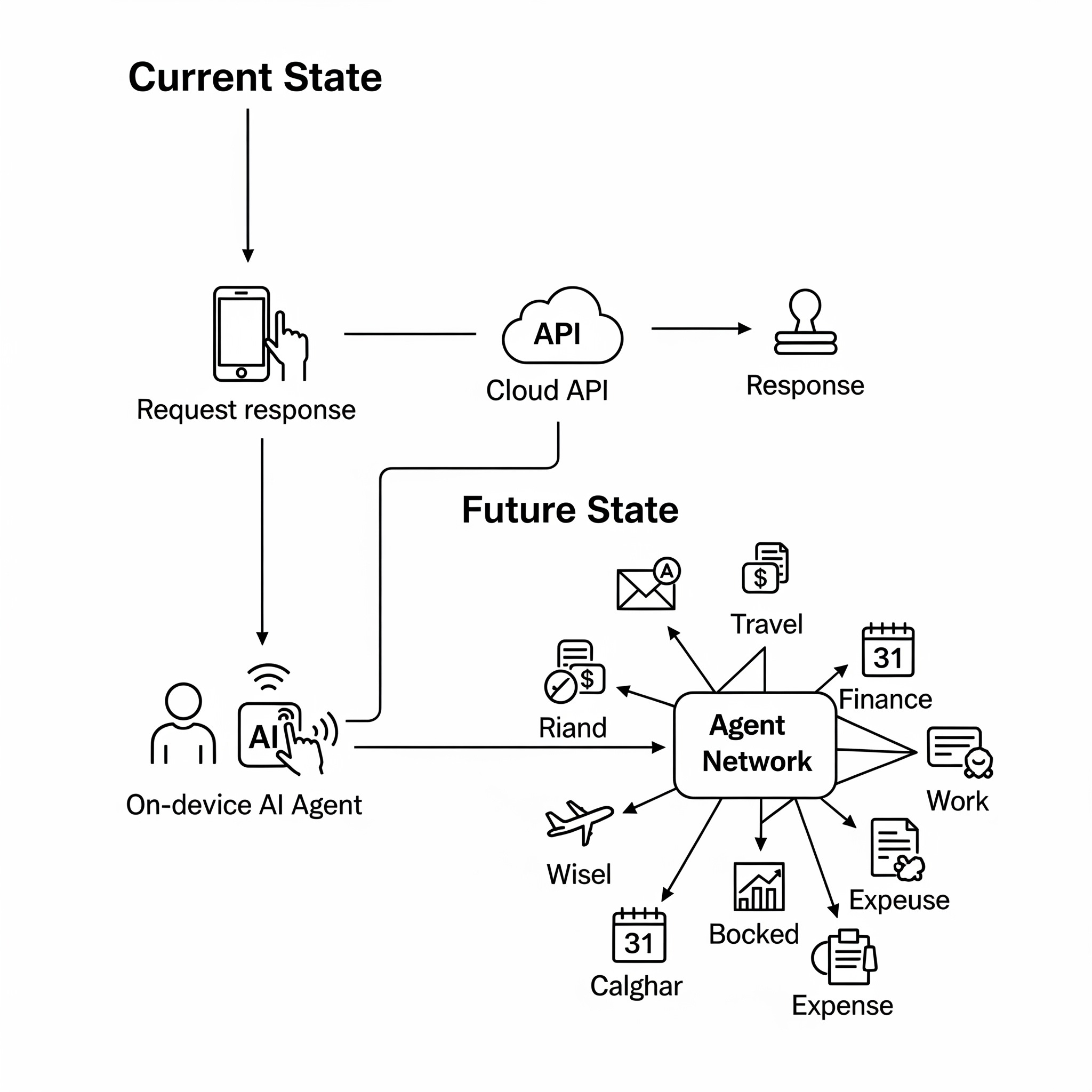
This shift represents a fundamental change in how we interact with AI. Instead of request-response patterns, we're moving to intention-execution frameworks where AI understands goals and autonomously determines the best path to achieve them.
Intelligent Delegation and Learning
These agents don't just execute—they learn and improve. They'll understand your decision patterns and preferences, gradually requiring less explicit instruction. Here's a real example from our Alexa development:
pseudocode

// Current Assistant Logic
User: "Book me a ride to the airport"
Assistant:
  - Parse intent
  - Request ride details
  - Show options
  - Wait for selection
  - Execute single booking

// Future Agent Logic
User: "I have a flight tomorrow"
Agent:
  - Check calendar for flight time
  - Calculate optimal departure (traffic patterns + user preferences)
  - Compare ride services (price, availability, user history)
  - Pre-book preferred option
  - Set reminders based on real-time conditions
  - Arrange return trip if round-trip detected
  - Add expense to travel budget tracker
The evolution from command-based to context-aware autonomous action represents a massive leap in capability.
The Phone's Diminishing Role: A Gradual Eclipse
How does this all translate to the smartphone? It won't be an overnight vanishing act. Instead, I see a gradual eclipse of the smartphone's core functions. According to Gartner research, by 2028, 70% of white-collar workers will interact with conversational AI platforms daily, up from less than 5% in 2024.
Communication Beyond the Screen
Why type when your AI can compose and send messages, understanding your tone and intent from spoken thoughts? We're already testing this at scale—imagine real-time translation during conversations without touching your phone.
Information Access and Entertainment
Need info? Just ask. Your AI provides instant answers, projecting visually through AR if needed. Entertainment becomes immersive—AI curates experiences based on mood, creates interactive narratives, all delivered seamlessly.
Productivity Without Distraction
With Agentic AI, your assistant doesn't just draft presentations—it researches topics, pulls data from multiple sources, creates visualizations, and even rehearses key points with you. The smartphone becomes just one of many possible interfaces, not the primary one.
The Agent Economy: Real-World Example
Let me paint you a picture of how this actually works. Last month, while building a demo for our team, I created an agent workflow that blew my mind:
Scenario: Planning a Team Offsite
Human: "We need to plan our Q3 offsite for 15 people"

Agent Actions (Autonomous):
1. Calendar Analysis
   - Scanned 15 calendars for common availability
   - Identified 3 potential date ranges

2. Venue Negotiation
   - Contacted 12 venue AIs simultaneously
   - Negotiated rates based on our budget parameters
   - Scored options on proximity, amenities, reviews

3. Travel Coordination
   - Checked flight prices for remote team members
   - Found group rate with airline AI
   - Arranged airport transfers

4. Agenda Optimization
   - Analyzed team's recent work patterns
   - Suggested focus areas based on project data
   - Built draft schedule with breaks aligned to team energy patterns

Total Time: 3 minutes
Human Time Saved: ~8 hours
The entire process took the agent three minutes. The estimated human time for a project manager to do this? At least eight hours of tedious coordination. This agent-to-agent economy isn't theoretical; it's the next logical step in distributed systems.
The "Third Device" and Beyond: A Glimpse into the Near Future
We're already seeing companies like OpenAI and Jony Ive's LoveFrom exploring a "third device"—AI hardware designed to complement or replace smartphones. The principle is clear: break free from screen-centric interaction.
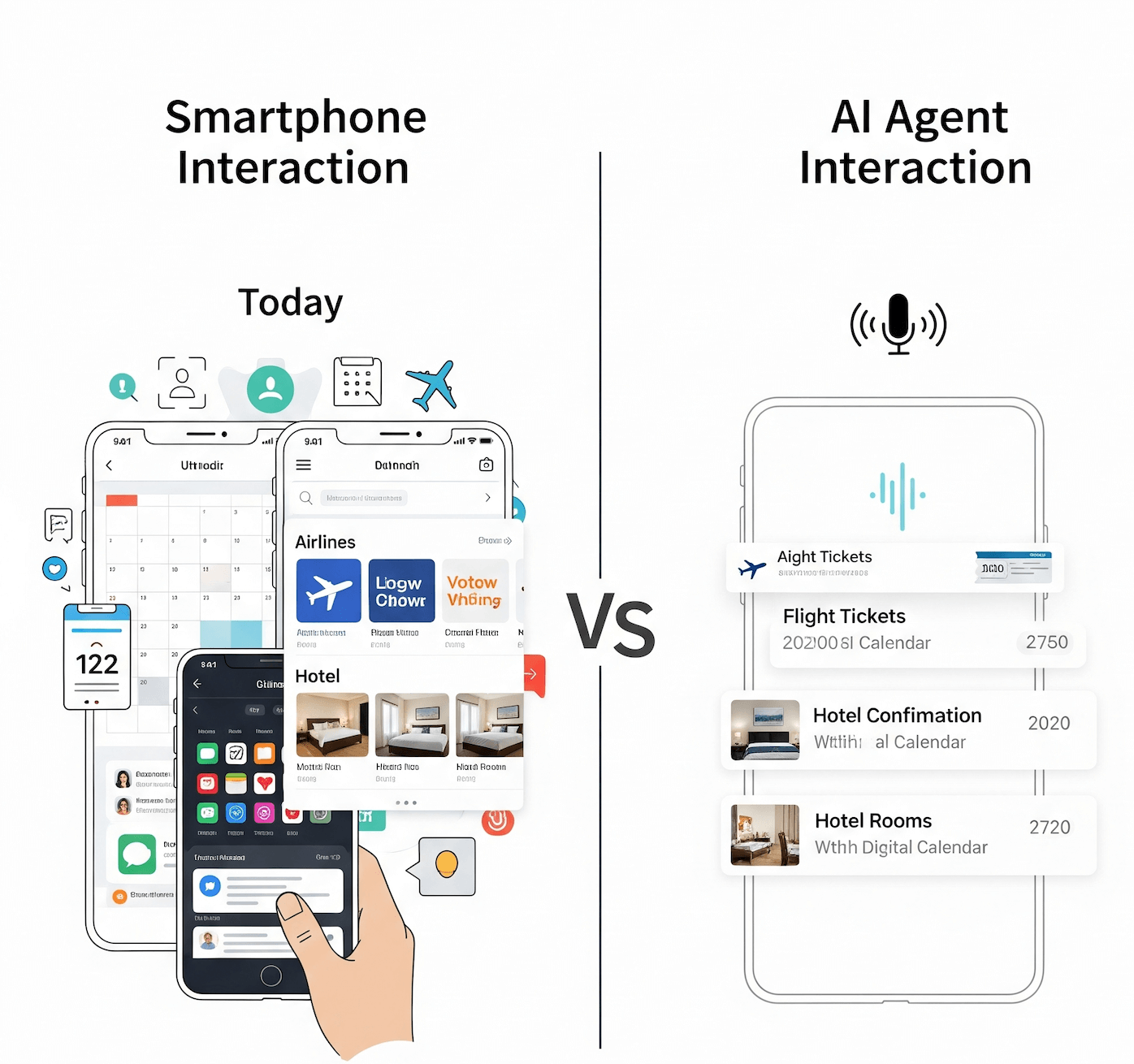
We're already seeing companies like OpenAI and Jony Ive's LoveFrom exploring a "third device"—AI hardware designed to complement or replace smartphones. The principle is clear: break free from screen-centric interaction.
From my experience leading the Alexa Certification team—where we pioneered tools adopted by 2,500+ international partners across everything from smart speakers to Alexa-enabled cars—I've seen how AI is embedding itself everywhere. The infrastructure for a JARVIS-like future is being built today.
Market projections paint a striking picture:
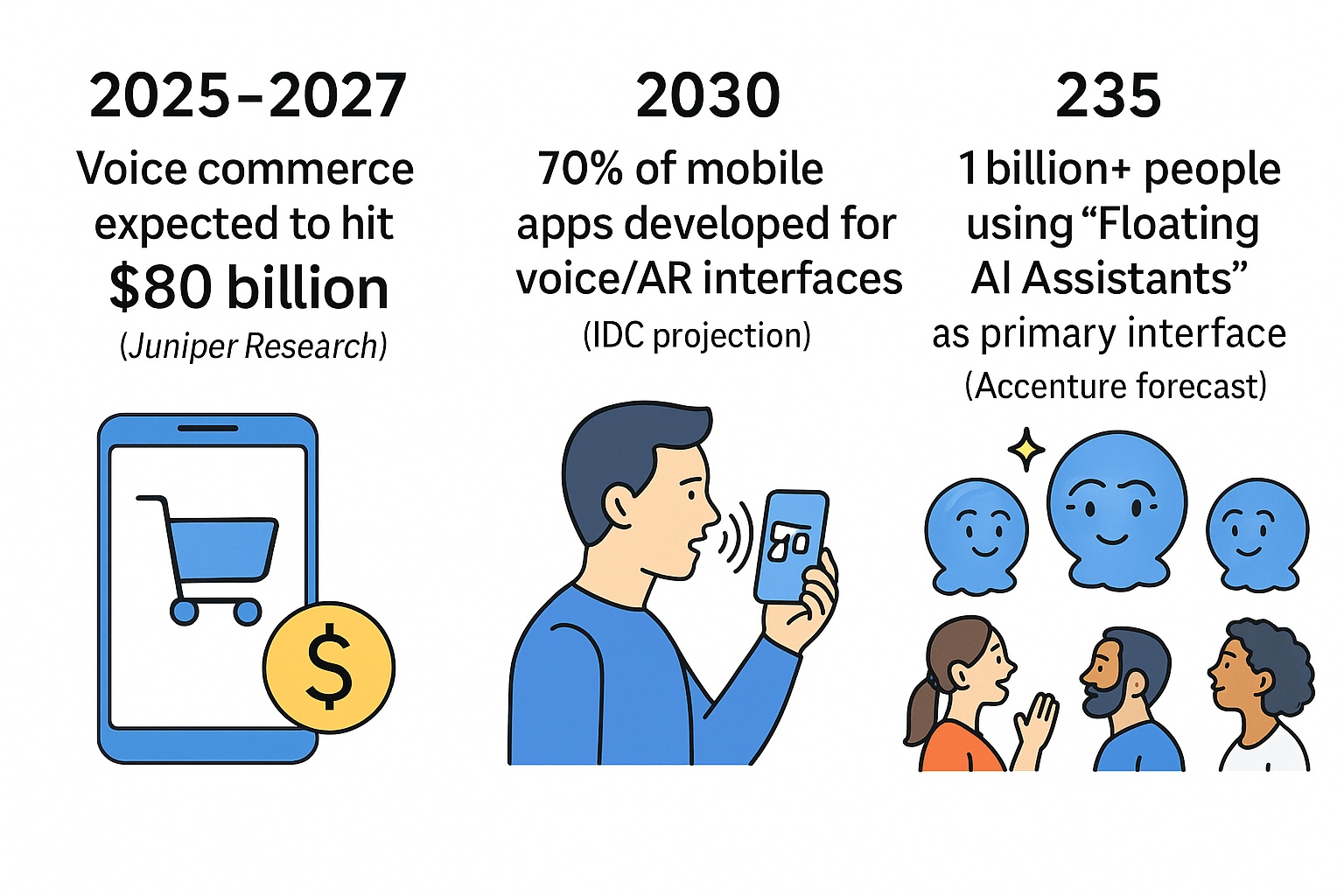
- 2025-2027: Voice commerce expected to hit $80 billion (Juniper Research)
- 2030: 70% of mobile apps developed for voice/AR interfaces (IDC projection)
- 2035: 1 billion+ people using "Floating AI Assistants" as primary interface (Accenture forecast)
This isn't incremental change—it's a fundamental reimagining of human-computer interaction.
Challenges and the Human Element
Now, I'm not gonna sugarcoat this—there are serious challenges ahead. Privacy concerns will escalate as AI integrates deeper into our lives. With Agentic AI, we face new complexities:
Trust and Verification: At Amazon, we've implemented multiple verification layers, but the challenge scales exponentially when AI operates autonomously across your entire life. We need bulletproof systems to ensure agents act in our interests.
Digital Identity: When AI agents act as you, authentication becomes critical. We're developing new frameworks that can't be spoofed or hijacked—think biometric-backed agent certificates.
Accountability: If your AI agent makes a mistake, who's responsible? We're actively working on audit trails and rollback mechanisms for agent actions.
The big thing? Making sure this tech enhances human connection instead of replacing it. In my experience—from cutting healthcare service times by 28% at Deloitte to streamlining Alexa certification from 4 weeks to 1 week—the best AI makes humans more capable, not obsolete.
Current voice assistants can be frustrating, I get it. But having watched this evolution from basic commands to LLM-powered assistants, and now to Agentic AI? The pace is absolutely bonkers. What took decades in computing is happening in years with AI.
The Echo of JARVIS: A Human-Centric Future?
So, will AI voice assistants replace mobile phones like JARVIS replaced manual controls for Tony Stark? Not exactly carbon-copy style, but the essence—a truly intelligent, proactive digital companion—is totally within reach. With Agentic AI, we're actually going beyond JARVIS. Tony still commanded; our future AI agents anticipate and act.
Phones won't vanish entirely (let's be real), but they'll shrink to relay stations for this pervasive AI experience. The real transformation: AI agents adapting to us, not vice versa, handling modern life's complexity in the background.
Having spent 13+ years building distributed systems and now leading AI touching millions daily, the trajectory is clear. It's not about faster chips or better cameras—it's about AI agents genuinely working for us: negotiating, creating, solving problems across our entire lives.
The JARVIS dream isn't sci-fi anymore—it's being built globally. But we're creating something more powerful: AI that anticipates and acts, turning intentions into reality before you finish the thought.
Ready to ditch the glass slab for an intelligent companion that gets things done? How comfortable are you with AI agents acting autonomously? Drop your thoughts below—I'd love to hear your take!
Opinions expressed by DZone contributors are their own.
Comments