

Gatherers in Java: What They Are and Why They Matter
With Stream API, developers could only customize terminal operations using Collector. Stream Gatherers allow developers to define custom intermediate operations.
 CORE
·
CORE
·
Join the DZone community and get the full member experience.
Join For FreeJava 8, released more than a decade ago, is a major milestone. With this version, Java brought a fundamental shift from only being an object-oriented programming (OOP) to a combination of OOP and functional programming (FP) as well. To achieve this, Java 8 came in with support of lambdas, stream APIs, etc., as core language features.
Stream API is influenced and modeled after the collection pipeline. A typical stream has three stages, viz., source, intermediate operations, and terminal operations.
- A source is something that either already has or generates the elements for consumption. It could be a prepopulated collection like
Listor aSet. Alternatively, a stream can be generated vizStream.oforStream.generatefactory methods. - Intermediate operations are APIs that transform or filter the elements supplied via the source. E.g.,
filter,map,sort,distinctetc. It could either be stateless or stateful, depending upon the nature of operations it performs. - Terminal operation is the final stage of a stream pipeline, which concludes the processing by producing the final results or side effects. Once invoked, the terminal operation closes the stream and prevents reuse. E.g.,
reduce,collect,count,min/max, etc.
While powerful, the Stream API has long had a limitation — developers could only customize terminal operations using Collector. Intermediate operations were fixed — until now.
With Java 24, stream gatherers arrive as a game-changing addition. They allow developers to define custom intermediate operations, enabling more expressive, reusable, and efficient stream pipelines. Previously, such custom logic required imperative workarounds or post-processing — often clunky and inefficient. Gatherer bridge this gap, offering a first-class, composable way to extend the stream model without compromising readability or performance.
Gatherers
Definition
From the docs themselves, a Gatherer is defined as:
A gatherer is an intermediate operation that transforms a stream of input elements into a stream of output elements, optionally applying a final action when it reaches the end of the stream of input elements.
At its core Gatherer can do the following:
- Transform elements in a one-to-one, one-to-many, many-to-one, or many-to-many fashion.
- Track previously seen elements to influence the transformation of later elements.
- Short-circuit, or stop processing input elements to transform infinite streams to finite ones.
- Process a stream in parallel.
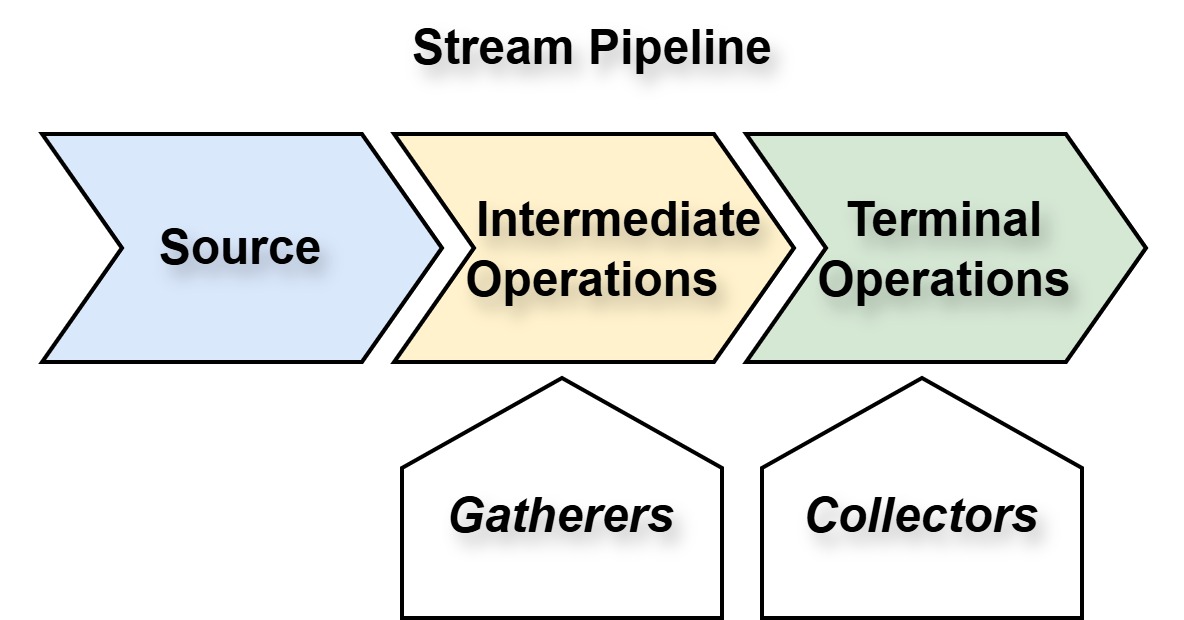
Simply put, a Gatherer is same as to intermediate operations what a Collector is for terminal operations.
Details
Suppose we need to slice a stream with a fixed size of 3 and limit the output to maximum of 2 slices.
Input  => 0, 1, 2, 3, 4, 5, 6, 7, 8, 9
Output => [0, 1, 2], [3, 4, 5]
With existing stream APIs, one way to achieve it is to slice the stream during post processing, i.e., collect all the stream elements, keep a track of previous elements and windows and generate the output. The resultant code, as seen below, is fairly complicated, unintuitive and difficult to understand or maintain.
IntStream.range(0, 10)
         .boxed()
         .limit(3 * 2) // window size * number of windows
         .collect(Collector.of(
                        () -> new ArrayList<ArrayList<Integer>>(),
                        (groups, element) -> {
                            if (groups.isEmpty() || groups.getLast().size() == 3) {
                                var current = new ArrayList<Integer>();
                                current.add(element);
                                groups.addLast(current);
                            } else {
                                groups.getLast().add(element);
                            }
                        },
                        (left, right) -> {
                            throw new UnsupportedOperationException("Cannot be parallelized");
                        }
                ))
          .forEach(System.out::println);
With built-in Gatheres.windowFixed the same can be achieved with clean, concise, intuitive and maintainable code as seen below.
IntStream.range(0, 10)
         .boxed()
         .gather(Gatherers.windowFixed(3))
         .limit(2)
         .forEach(System.out::println);
Built-In Gatherers
Since not all use cases can be added as stream APIs to maintain learnability and API discovery, Java comes in with below built-in Gatherers to address common use cases.
Fixed Window
As seen in previous section, this gathers elements into windows of a fixed size. If the stream is empty then no window will be produced. The last window may contain fewer elements than the supplied window size. The window maintains the encountered order of elements.
Sliding Window
This gathers elements into windows of a given size, where each subsequent window includes all elements of the previous window except for the least recent, and adds the next element in the stream. If the stream is empty then no window will be produced. If the size of the stream is smaller than the window size then only one window will be produced, containing all elements in the stream. The window maintains the encountered order of elements.
Input  => 0, 1, 2, 3, 4, 5

Gatherers.windowSliding(3)

Output => [0, 1, 2], [1, 2, 3], [2, 3, 4], [3, 4, 5]
Fold
This performs an ordered, reduction-like, transformation on top of terminal operations; with no intermediate results. Useful if intermediate reduce is required and need to continue with stream computations.
For e.g., to concatenate stream of characters and convert them to uppercase, it can be achieved as seen below →
List.of("a", "b", "c", "d", "e")
    .stream()
    .gather(Gatherers.fold(() -> "", String::concat))
    .map(String::toUpperCase)
    .forEach(System.out::println);

Output => ABCDE
Note:
- Since a
stream.gatherreturns astreamitself, it can be further operated upon until a terminal operation is invoked. Unlike a reduce operation which is terminal and closes the stream. - Semantically this example can be achieved via existing stream APIs as below — but is inefficient.
List.of("a", "b", "c", "d", "e")
    .stream()
    .map(String::toUpperCase) // operates on each element
    .reduce(String::concat)
    .ifPresent(System.out::println);

Output => ABCDE
Scan
This performs a Prefix Scan (an incremental accumulation) using the provided functions. Starting with an initial value, each subsequent value is obtained by accumulating the current value and the next input element. scan differs with fold in the sense scan produces an intermediate reduced results.
For e.g., to concatenate stream of characters and convert them to uppercase can be achieved as below (with intermediate results too):
List.of("a", "b", "c", "d", "e")
    .stream()
    .gather(Gatherers.scan(() -> "", String::concat))
    .map(String::toUpperCase)
    .forEach(System.out::println);

Output => A, AB, ABC, ABCD, ABCDE
This is typically useful, for any processing where intermediate results are required too. E.g., for a bank statement to reflect the account balance after each transactions.
Map Concurrent
Similar to map operation, but with concurrent execution at specified maximum concurrency level while maintaining the stream order. Do note in case of any exception encountered or early stream termination, the ongoing mapping tasks are cancelled on best-effort basis. Thus, the mapper supplied should be resilient towards cancellations.
Moreover, while parallelStream utilizes common fork join pool, mapConcurrent uses virtual threads for execution. Thus, it is typically useful in case the mapper involves I/O calls for which usage of virtual threads can benefit a lot.
Custom Gatherers
Just like Collector interface is available for any custom terminal operations, Gatherer interface too can be implemented for any custom intermediate operations.
However, before implementing any custom Gatherer consider below →
- Most of the use cases are already available via existing intermediate stream operations, try attempting a solution utilizing them first — with considering various aspects viz. readability, ease of understanding and maintenance, performance etc.
- In case above doesn’t suffice then check the built-in
GatherersAPIs. - Still if custom
Gathererneed is felt, pause and think how many times did we actually used a customCollectorever!
In short — use a custom Gatherer as last resort only and with utmost caution. Remember — just because we can, we shouldn’t!
Fundamentals
Below are few fundamentals which a developer should be aware before customizing a Gatherer →
Flow
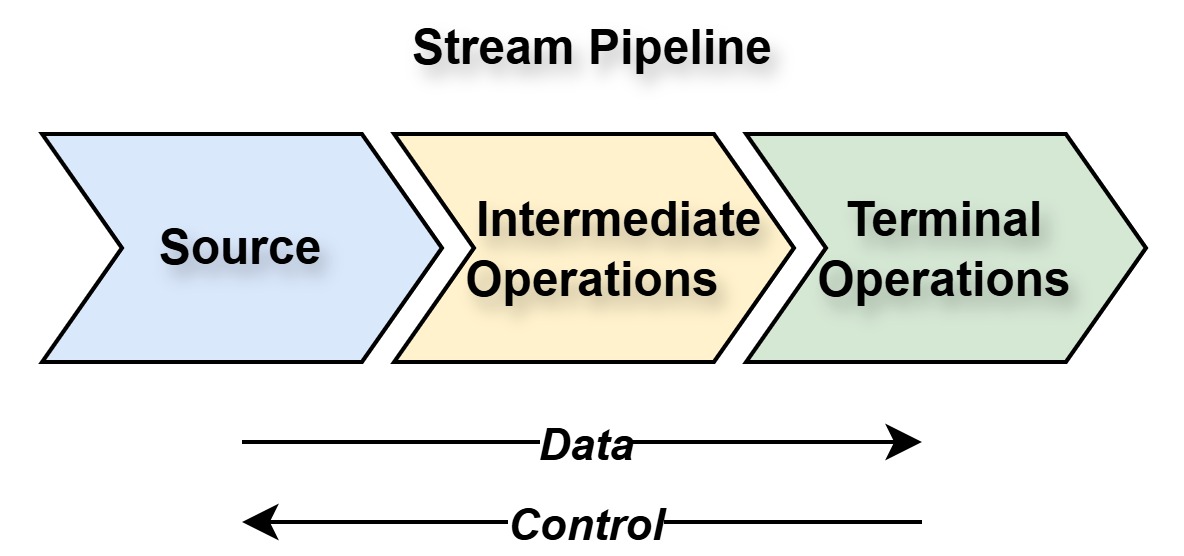
In a stream data flows down while control flows up. I.e., once the intermediate/terminal operation satisfies any optional conditions then it signals upstream to stop pushing more data. E.g., limit, findFirst, findAny, takeWhile, dropWhileetc. signals the upstream to stop sending more elements once the specified conditions are met. These could be stateful or stateless operations too.
Stage: Each Gatherer represents a pipeline stage which should achieve following
- Receive elements (data) to process.
- Process elements.
- Optionally transform and push elements to downstream.
- Ask downstream if it requires more elements and pass this details to upstream (control).
Characteristics:
Gatherer.of(..)means the stream runs sequential or parallel respectively — as characterized while instantiated.Gatherer.ofSequential(..)means the stream runs sequential in parallel stream — essential to enforce the processing especially when its stateful. E.g.,distinct,sortedetc.- A
Gatherercould be characterized as either of four below, depending upon the complexity of processing. The leftmost is easiest with gradual increase in difficulty as moved towards right. Thus, prefer aGathererwith characteristics towards left as much as possible.

Contract:
A Gatherer is composed of four functions →
- Initializer (optional) — Provides a private state object used during stream processing to remember the previous element for comparison.
- Integrator (required) — Processes each input element which can emit zero or more output elements via a
Downstreamobject. It can also short-circuit the stream by returningfalse. - Combiner (optional) — Supports parallel stream processing by merging state objects. If omitted, the gatherer runs sequentially even in a parallel stream. Useful for associative operations like summing or collecting.
- Finisher (optional) — Called after all elements are processed. It can emit final results or perform cleanup.
Its imperative to know how a call to Stream.gather(gatherer) works stepwise →
- A
Downstreamobject is created to pass output to the next stage. - The
initializercreates a state object. - The
integratorprocesses each input element, possibly emitting output. - If the
integratorreturnsfalse, the stream terminates immediately. - After all elements, the
finisher(if present) is invoked.
Example
Suppose, for a list of integers, only increasing numbers should be retained. A custom Gatherer should be stateful and sequential to achieve it.
Stateful — as only integer greater than previous should be retained.
Sequential — as it should maintain the order of elements. In case of parallel processing the result will be indeterministic.
Gatherer<Integer, int[], Integer> INCREASING_ONLY =
            Gatherer.ofSequential( // enfore sequential processing for deterministic processing
                    () -> new int[1], // state - maintain last seen value
                    (state, input, downstream) -> {
                        if (input > state[0]) {
                            state[0] = input; // update current as now last seen
                            downstream.push(input); // emit the element to downstream
                        }
                        return true; // continue execution
                    }
            );

List.of(1, 3, 2, 5, 4, 6, 8, 7, 9)
    .stream()
    .gather(INCREASING_ONLY)
    .forEach(System.out::println);


Output => 1, 3, 5, 6, 8, 9
Every standard stream operation can be expressed as a gatherer, it would be a good exercise to attempt implement them as custom Gatherer. For e.g.,
map— stateless one-to-one gatherer transforming elements.filter— stateless gatherer emitting only if condition istrueflatMap— stateless one-to-many gatherer transforming and emitting all elements.distinct— stateful gatherer tracking seen elements.
Conclusion
Stream Gatherers in Java 24 mark a pivotal evolution in the Stream API, empowering developers with customizable intermediate operations that were previously out of reach. By bridging the gap between rigid pipelines and expressive transformations, Gatherers unlock new possibilities for clean, efficient, and reusable stream logic. While built-in Gatherers cover common patterns, custom implementations should be approached with care to preserve readability and performance. For engineers and architects, mastering Gatherers means gaining finer control over data flow and pipeline behavior — an essential skill as Java continues its journey into more functional and declarative paradigms.
References and Further Reads
Published at DZone with permission of Ammar Husain. See the original article here.
Opinions expressed by DZone contributors are their own.
Comments