

The Java Story: The Official Documentary Is Here
This traces Java’s evolution from Oak to a global software platform, revealing its impact on open source, standards, engineering, and the community behind it.
 CORE
·
CORE
·
Join the DZone community and get the full member experience.
Join For FreeThe Java Story | The Official Documentary provides more than a retrospective on one of the most influential programming languages. Tracing Java’s journey from the Oak project at Sun Microsystems to its widespread adoption in enterprise systems, embedded devices, and global platforms, the documentary highlights how technical constraints, strategic decisions, and architectural choices shaped its evolution. For those interested in technology history, it serves as a valuable case study of how software transitions from experimentation to infrastructure, and how early engineering decisions continue to impact modern systems.
The documentary’s significance reaches beyond the Java community. It examines enduring themes in software engineering, including portability, backward compatibility, platform design, ecosystem governance, standardization, and the interplay between technology and community. It also reframes innovation as an ongoing process of adaptation, compromise, and collaboration, rather than a single breakthrough. As such, The Java Story is recommended viewing for anyone interested in how technologies endure, evolve, and become foundational to entire industries.
From Oak to Open Source
Java originated in 1991 as Oak, a component of Sun Microsystems’ Green Project. Initially intended for consumer electronics, it was redirected to the emerging Web when that market did not materialize. Its promise of portability, later described as “Write Once, Run Anywhere,” challenged the idea that software must be tied to a specific operating system.
Java’s growth coincided with the browser wars. Netscape partnered with Sun to integrate Java into its browser, while its own scripting language, first called Mocha and later LiveScript, was renamed JavaScript to leverage Java’s popularity. Although the two languages were not technically related, their names reflected strategic alliances as Sun and Netscape sought to limit Microsoft’s influence over desktop software and the Web. The unofficial phrase “In a world without fences, who needs Gates?” captured the spirit of this competition.
Java was not initially open source by today’s licensing standards. The term open source was coined in 1998, three years after Java’s public release. However, Java introduced concepts aligned with the movement, including portability, publicly available specifications, shared implementations, and an ecosystem beyond a single vendor.
Over time, the Java community became a leading force in open source. Projects such as Tomcat, Maven, Eclipse, Hibernate, and Spring demonstrated that open collaboration could include individual developers, universities, foundations, startups, and global companies. The release of OpenJDK under the GNU General Public License in 2006 completed this transition, establishing Java as both an open-source platform and a model for long-term collaboration among competing organizations.
What Makes Java, Java
Open source is no longer unique among programming languages, as many now publish their source code and accept community contributions. Java distinguishes itself by combining open-source implementation with open standards. This means Java is not only modifiable code, but also a platform defined by public specifications, compatibility requirements, and shared governance.
This model supports a broad vendor ecosystem. Java enables multiple Java Virtual Machine implementations, development tools, distributions, cloud platforms, and enterprise runtimes. The same approach applies to Java EE and Jakarta EE, where independent vendors implement shared specifications. As a result, Java is not tied to the priorities or decisions of a single company.
The Java Community Process is central to this structure. Through Java Specification Requests, the JCP offers a formal process for proposing, reviewing, and standardizing platform changes. While this approach may be slower than single-organization models, it ensures transparency, compatibility, and long-term stability.
The combination of open source and open standards is a key strength of Java. It enables companies to compete through their implementations while collaborating on the platform. More broadly, the JCP serves as a model for technologies and organizations aiming to balance innovation, governance, vendor diversity, and sustainable evolution.
Java’s Impact on the Software Industry
Java did not invent the virtual machine, garbage collection, or object-oriented programming, but it helped introduce these concepts to mainstream commercial software development. Previously, programming languages were closely tied to specific operating systems and hardware. Java shifted this paradigm by making the Java Virtual Machine the primary execution target and promoting the promise of “Write Once, Run Anywhere.”
This model showed that a virtual machine could deliver portability while still allowing ongoing performance improvements. Innovations like just-in-time compilation, adaptive optimization, and advanced garbage collectors made the JVM a highly optimized runtime. Java’s success also encouraged languages such as Kotlin, Scala, Clojure, and Groovy to adopt the JVM as their execution platform.
Java also shaped software design, testing, and documentation practices. JUnit established automated unit testing as a standard and inspired the broader xUnit framework family. JavaDoc made generating reference documentation from source code routine. Additionally, Java books, design patterns, and community practices promoted object-oriented principles to a generation of software engineers.
While Java was initially associated with object-oriented programming, the platform expanded to support multiple paradigms. Features such as generics, annotations, lambda expressions, functional-style streams, reflection, and concurrency APIs enabled developers to use object-oriented, functional, declarative, and metaprogramming techniques. Java’s broader impact lies not only in its features but also in how it reshaped expectations for portability, managed runtimes, testing, documentation, and language evolution.
Becoming Part of the Java Story
Being included in the documentary, even briefly, is deeply meaningful to me. The footage is from when I received a JCP Award, but the moment’s significance extends well beyond the award itself. Since Java 8, I have served on the JCP Executive Committee, participated in several Java Specification Requests, and contributed to discussions that shaped the evolution of the Java platform.
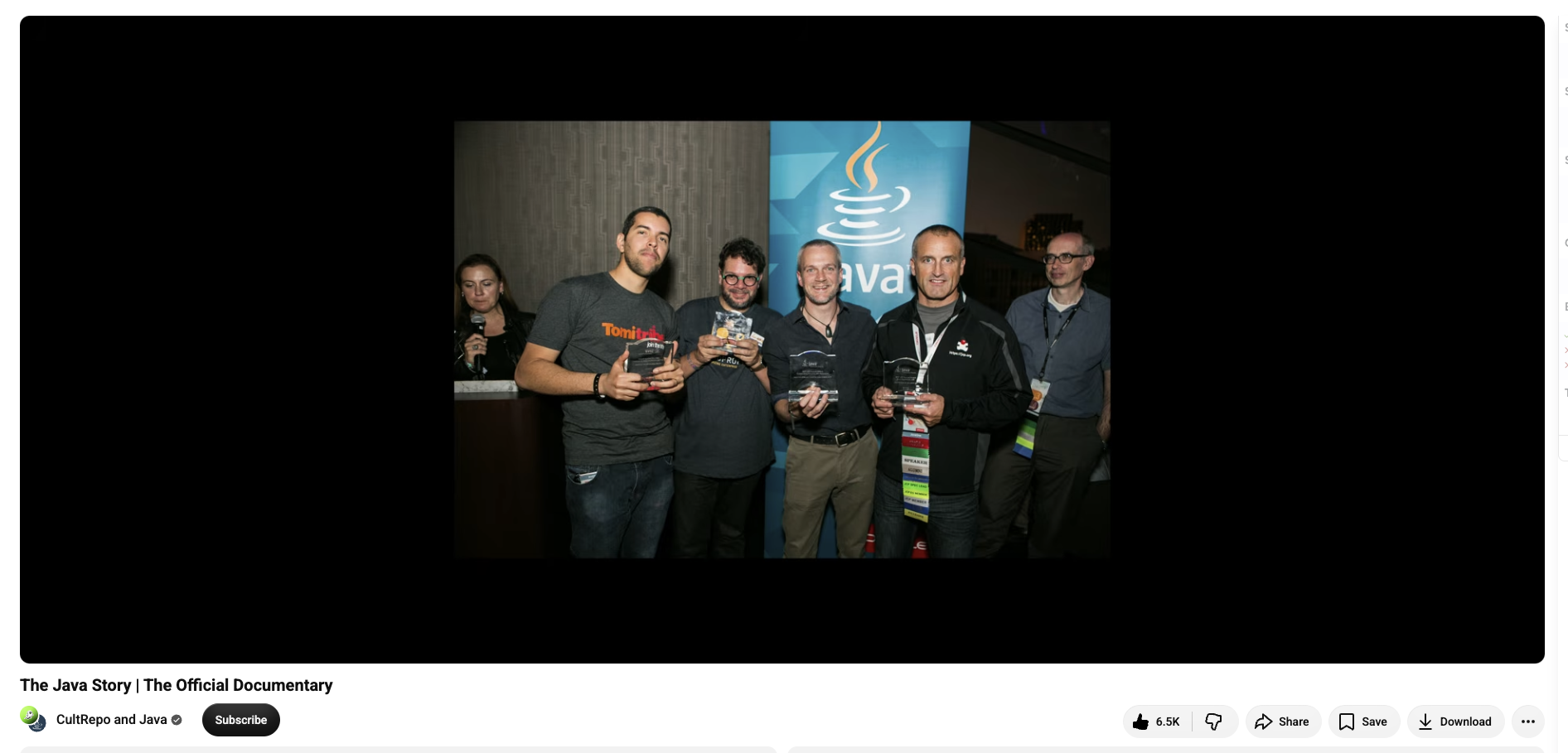
Open source and Java transformed my understanding of software, community, and the possibilities of a technical career. Through the Java community, I learned from those who created and shaped the platform. I improved my software design and implementation skills, expanded my professional network, accessed opportunities beyond my local market, and built an international career. I also contributed to the transformation of enterprise Java into Jakarta EE, helping to shape the next generation of specifications for cloud-native and enterprise applications.
This journey developed more than just my technical skills. Community participation taught me to communicate complex ideas, write clearly, speak publicly, collaborate across cultures, and contribute constructively amid differing opinions and interests. These skills enabled me to participate in both implementation work and in technology boards and strategic discussions that shape the future of platforms and standards. Open source also encouraged me to improve my English, learn new languages, and build friendships that have become like family.
I encourage you to watch the documentary, but do not stop there. Join a Java user group, attend a conference, contribute to an open-source project, participate in a specification, or start a conversation with someone in the community. Java’s story was built by those who chose to participate, and its next chapter will be written the same way.
Conclusion
Studying Java’s history offers insight into how software has transformed society. Java shaped not only programming languages and enterprise systems, but also the infrastructure supporting business, government, communication, finance, education, and daily digital services. Its story shows that software engineers do more than write code. By building systems, standards, and communities, they help shape how the world functions.
I hope this documentary inspires you as it did me. My journey with Java began around Java 8, when I joined the JCP Executive Committee and learned firsthand about the decisions, people, and challenges that shaped the platform before my involvement. I am grateful this history is now shared in such an engaging way. Watch the documentary, explore the community, and consider joining us — not only to understand Java’s history, but to help shape its future.
Opinions expressed by DZone contributors are their own.
Comments