

Orchestrating Edge Computing with Kubernetes: Architectures, Challenges, and Emerging Solutions
Learn about orchestrating edge computing with Kubernetes, its architectural frameworks, operational challenges, and state-of-the-art solutions.
Edge computing has emerged as a transformative approach to handle data processing closer to the data source rather than relying on centralized cloud infrastructures. This is particularly important for real-time applications that demand low latency, higher bandwidth efficiency, and more autonomy in operations.
Kubernetes, an open-source container orchestration platform, has revolutionized how applications are deployed and managed across distributed systems. Its powerful orchestration capabilities make it an ideal solution for managing workloads in edge computing environments, where resources are often constrained, and the system architecture is highly decentralized.
Architecture of Edge Computing With Kubernetes
Edge computing typically involves three main layers: the cloud layer, the edge layer, and the device layer. Kubernetes, when deployed in such environments, operates at each of these layers to ensure efficient management and scaling of containerized applications. 
1. Cloud Layer
The cloud layer is the central management point of the edge infrastructure. Here, Kubernetes serves as the orchestrator, ensuring the configuration, management, and monitoring of workloads distributed across multiple edge nodes. The key components in the cloud layer include:
- Kubernetes Master: This includes the API server, scheduler, and controller manager that command the lifecycle of workloads deployed at the edge.
- Container Registry: Docker Hub, Harbor, or other private registries are used for storing container images that edge nodes pull during deployments.
- Centralized Logging and Monitoring: Tools such as Prometheus and Grafana collect metrics from edge nodes and monitor the health and performance of containers and edge workloads.
- CI/CD Pipelines: Continuous Integration and Continuous Deployment (CI/CD) pipelines help automate application updates, ensuring that changes are rolled out efficiently across the edge.
2. Edge Layer
The edge layer is where computing happens closer to the data source. Kubernetes can run on lightweight distributions like K3s or MicroK8s, which are optimized for low-resource environments like edge devices. Key components here include:
- Lightweight Kubernetes: K3s or MicroK8s is used to deploy a full Kubernetes cluster on edge nodes, which may be resource-constrained, providing orchestration while consuming fewer resources than a traditional Kubernetes deployment.
- Local Controllers and Custom CRDs: At the edge, custom controllers and custom resources (CRDs) are used to manage specialized workloads like IoT device management or local data processing.
- Data Preprocessing and Local Storage: Data is often pre-processed at the edge to reduce the amount of information sent to the cloud. Kubernetes can manage persistent storage on the edge node for temporary or local data.
- Message Brokers: To facilitate communication between edge devices and edge nodes, message brokers like MQTT or NATS are used.
3. Device Layer
The device layer includes all the edge devices, such as IoT sensors, cameras, or even mobile devices. These devices collect real-time data and interact with edge nodes for processing. Kubernetes can manage communication protocols and device states through integrations with platforms like KubeEdge. In this layer, the following components are often found:
- IoT Sensors and Cameras: These devices generate the data that needs to be processed and often use protocols like MQTT, CoAP, or LoRa to communicate with edge nodes.
- Edge Gateways: These devices act as a bridge between IoT devices and edge nodes, facilitating communication and data aggregation.
- Microcontrollers and Embedded Systems: Kubernetes can help manage and monitor these systems, although often in a minimalistic configuration.
Challenges in Orchestrating Edge Computing With Kubernetes
While Kubernetes offers robust tools for orchestration, edge computing presents several unique challenges. These challenges must be addressed to fully harness its potential in edge environments. 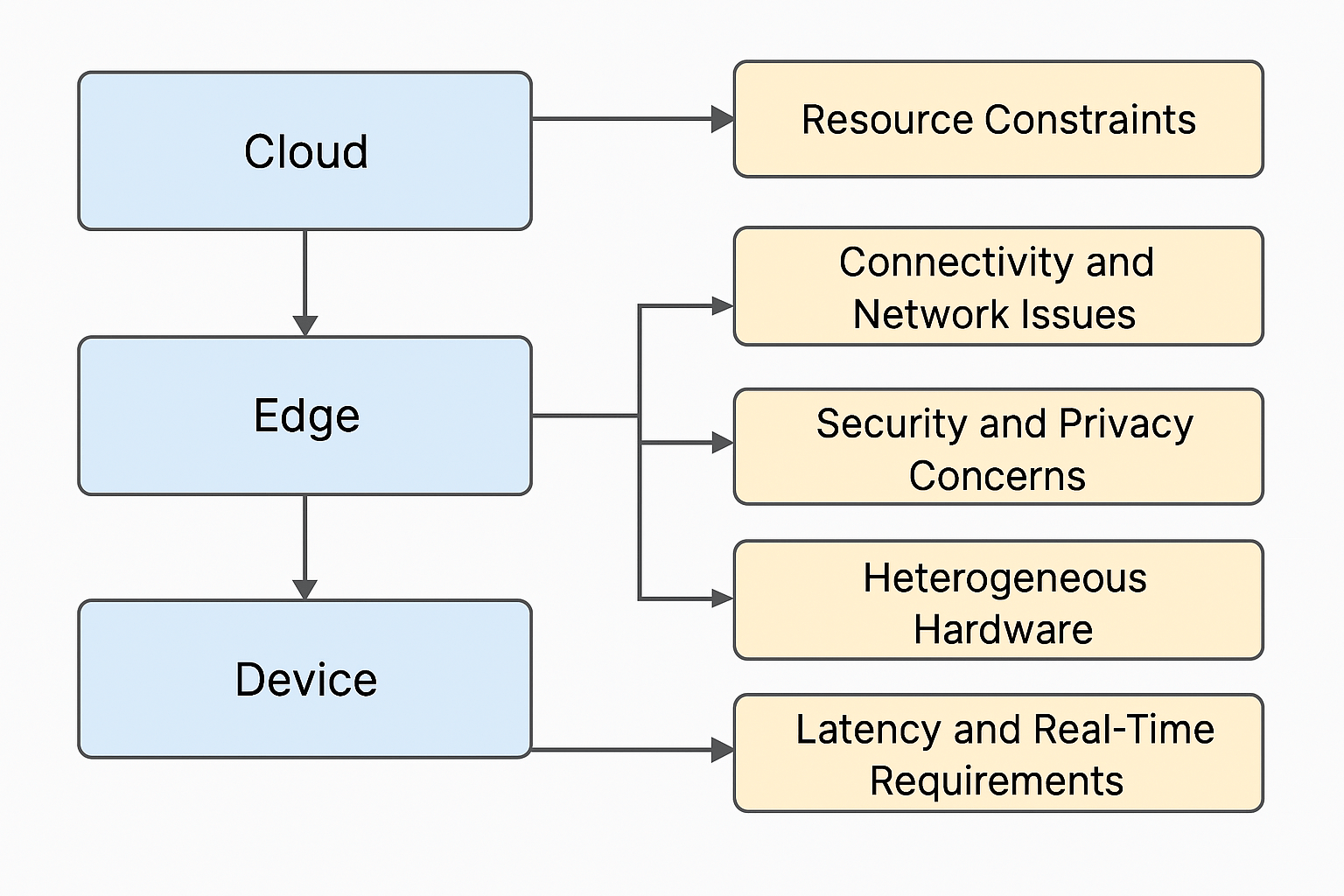
1. Resource Constraints
Edge devices, such as IoT sensors or gateways, are often limited in terms of CPU, memory, and storage. Kubernetes, known for its relatively high resource consumption, needs to be optimized for resource-constrained environments. Tools like K3s are specifically designed to address this challenge by providing a lightweight Kubernetes distribution with minimal overhead.
2. Connectivity and Network Issues
Edge devices often operate in environments with unstable or intermittent network connections. In such cases, Kubernetes clusters must be resilient and capable of functioning autonomously without a consistent connection to the central cloud. For example, KubeEdge extends Kubernetes to the edge, allowing for autonomous operation when disconnected from the cloud.
3. Security and Privacy Concerns
The distributed nature of edge computing introduces significant security risks. Kubernetes needs to be configured to secure communication and data transmission between edge nodes and the cloud. This can involve using service meshes like Istio for secure communication or incorporating encryption for sensitive data storage.
4. Heterogeneous Hardware
Edge environments often consist of diverse hardware, ranging from powerful compute nodes to small embedded systems. Kubernetes must be flexible enough to accommodate this variety. Solutions such as device plugins and custom CRDs allow Kubernetes to handle different hardware configurations effectively.
5. Latency Requirements
Many edge applications, such as autonomous vehicles or industrial IoT systems, require near-real-time data processing. Kubernetes must be able to meet these low-latency demands while ensuring high availability and reliability.
Emerging Solutions and Tools for Edge Computing
Several emerging solutions and tools have been developed to address the challenges mentioned above and enhance Kubernetes' ability to handle edge computing workloads.
1. Lightweight Kubernetes Distributions (K3s and MicroK8s)
K3s and MicroK8s are optimized versions of Kubernetes that reduce the overhead of traditional Kubernetes installations. These distributions are ideal for edge computing environments where resources are limited, providing a full Kubernetes experience with a significantly reduced memory footprint.
2. KubeEdge
KubeEdge is an open-source platform that extends Kubernetes to the edge. It provides a set of tools to manage edge devices and workloads autonomously, even when disconnected from the cloud. It helps with device management, data synchronization, and communication, making it easier to deploy Kubernetes at the edge.
3. OpenYurt
OpenYurt is an edge-native Kubernetes framework that brings native edge computing capabilities to Kubernetes. It simplifies edge node management by enabling edge nodes to run Kubernetes without needing cloud connectivity, addressing both resource constraints and network challenges.
4. Service Meshes
Istio and Linkerd are popular service mesh tools that enable secure and observable communication between microservices, including in edge environments. These tools are especially useful in securing data transmission across distributed edge networks and ensuring compliance with data privacy regulations.
5. AI at the Edge
Machine Learning models are increasingly being deployed at the edge to perform real-time inference without sending data to the cloud. Kubernetes can orchestrate the deployment of these models using tools like TensorFlow Lite and OpenVINO, which are optimized for edge devices.
Final Thoughts
Orchestrating edge computing workloads with Kubernetes presents a unique set of challenges, ranging from resource constraints and network instability to security concerns. However, with emerging tools and solutions like K3s, KubeEdge, and OpenYurt, Kubernetes has become a powerful tool for managing edge deployments. By integrating Kubernetes into edge computing environments, businesses can achieve real-time data processing, scalability, and enhanced autonomy, enabling a new wave of IoT, AI, and other edge-driven innovations.
As edge computing continues to evolve, Kubernetes will remain at the forefront, providing the scalability and flexibility needed to support a growing ecosystem of edge devices and applications.
Opinions expressed by DZone contributors are their own.
Comments