

You Don’t Need To Be a Manager To Lead: Why Leadership Matters for Software Engineers
As software engineers grow in scope, trust, influence, communication, and technical direction become essential to multiplying impact and advancing on the IC path.
 CORE
·
CORE
·
Join the DZone community and get the full member experience.
Join For FreeMany assume that leadership in software engineering starts only when you stop coding and become a manager. I once shared this belief, thinking technology would be simpler than working with people. That was an early misconception. While it is possible to focus your career on code, architecture, databases, and other technical areas, the challenges that shape your impact become less technical over time. Even the best architectural decision has little value if others do not trust, understand, or support it.
This does not mean every experienced software engineer should become a manager. Leadership is equally important on the technical track. Senior individual contributors, such as staff engineers, architects, and principal engineers, are expected to influence decisions beyond their own code. As Will Larson discusses in Staff Engineer, advancing beyond senior engineering focuses on technical leadership rather than people management. To increase your technical impact, others must listen to your ideas, trust your judgment, include you in key discussions, and act on your recommendations. You may choose not to manage people, but avoiding leadership will eventually limit your growth as a software engineer.
What Do We Mean by Leadership?
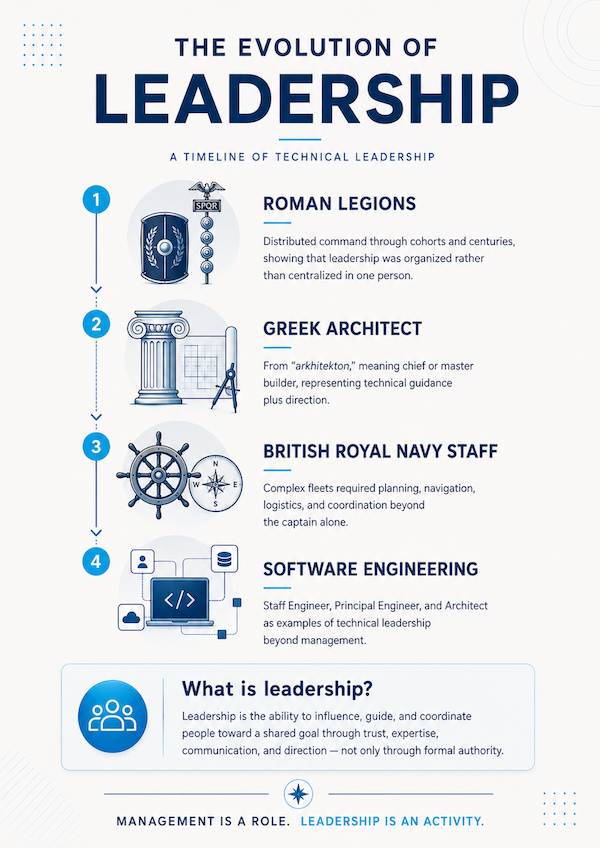
Leadership predates corporations, job titles, and management frameworks. For example, the Roman military’s success relied not only on superior weapons or armor but also on effective organization. Legions were divided into smaller units, each with defined responsibilities and led by centurions. Leadership was distributed throughout the ranks, enabling coordinated efforts toward larger objectives.
A similar concept appears in the term architect, commonly used by software engineers. Derived from the Greek arkhitekton — arkhi meaning chief and tekton meaning builder — an architect was the master builder, responsible for both understanding the craft and directing others. This role closely resembles that of an effective software architect today.
Another example comes from the nineteenth-century Prussian military, which developed its General Staff as a professional body focused on planning, coordination, and operational readiness. This approach recognized that complex organizations require skilled individuals to address critical challenges without making each one the commander. The model became influential and was adopted by other militaries.
Software engineering faced a similar challenge: how can experienced engineers expand their organizational impact without moving into people management?
An early solution appeared in the British Royal Navy, where managing large fleets required separating command authority from technical expertise. Naval operations relied on both captains and skilled officers responsible for navigation, planning, logistics, and coordination. This staff function supported fleet-level decision-making without direct command and influenced how organizations approach distributed expertise and coordination.
Modern software organizations independently adopted a similar approach. Titles such as Staff Engineer, Principal Engineer, and Distinguished Engineer now represent technical leadership roles. Will Larson highlights this distinction in his 2021 book, Staff Engineer: Leadership Beyond the Management Track, which explores Staff-plus engineering as leadership outside the traditional management ladder.
This distinction is essential: management is a role, while leadership is an activity. Managers have formal responsibilities for people, performance, hiring, priorities, and processes. Technical leaders may lack formal authority, but their influence comes from expertise, judgment, communication, trust, and guiding better technical decisions. In software engineering, leadership does not require direct reports; it often means being the trusted engineer who provides direction in complex situations.
Why Should a Software Engineer Care About Leadership?
While understanding leadership is valuable, it is even more important to consider why a Software Engineer who does not plan to become a manager should invest time in developing these skills.
As your career advances, your impact depends not only on your technical skills but also on your ability to influence decisions, collaborate effectively, and guide the organization toward better technical outcomes.
1. Software Development Is About People
Software development is inherently a social activity.
Software is built collaboratively with engineers, product managers, designers, architects, clients, managers, and other stakeholders. Even highly technical decisions must be explained, discussed, challenged, negotiated, or approved by others.
A database migration may seem purely technical until it impacts another team. An architectural decision becomes a communication challenge when multiple teams must adopt it. Even an elegant solution can fail if it does not address the client’s real needs.
While much of your day may involve working with machines, software exists for people, is created by people, and ultimately serves people. Choosing not to pursue management does not eliminate the human aspect of software engineering.
2. Technical Expertise Needs Trust, Influence, and Access
Technical correctness alone is not sufficient.
You might understand why a particular architecture will not scale, recognize that a technology introduces unnecessary complexity, identify an important security risk, or propose a significantly better design.
However, your expertise has limited impact if others do not listen. Technical expertise leads to organizational impact only when you can influence the organization’s actions. Influence rarely stems from expertise alone. People must trust your judgment, see that you understand the context, listen to opposing views, explain trade-offs clearly, and adapt your position when evidence changes.
This is also why relationships matter in a technical career. As your responsibilities increase, many key decisions occur outside the codebase, such as during architecture reviews, design discussions, planning sessions, incident reviews, roadmap meetings, and cross-team or stakeholder meetings.
If you want to influence those decisions, you need to be part of those conversations. Leadership helps you build the credibility and trust needed to participate in these discussions and ensures your voice is heard. A strong technical leader does more than provide correct answers. They create conditions where good technical decisions can be understood, challenged, accepted, and implemented.
3. If You Do Not Lead, Someone Else Will Make the Decision
When experienced engineers avoid leadership, an uncomfortable consequence arises. The decisions do not disappear. Someone else will make them.
And that person may have considerably less technical understanding of the consequences.
This can lead organizations to measure engineering productivity using questionable proxies such as lines of code, number of commits, tickets closed, or tokens consumed by AI tools. When engineers encounter such decisions, their natural reaction is often: “Who thought this was a good idea?” A better question might occasionally be: “Which experienced engineers were involved when this decision was made?”
Leadership ensures that technical knowledge is represented in decisions affecting engineering. You do not need to control every decision, but you should be willing to participate in the important ones.
4. Leadership Multiplies Your Technical Impact
There is a natural limit to how much software one person can build individually. Even exceptional engineers have limited time each day.
Leadership enables your expertise to extend beyond those limits. By helping others make better design decisions, establishing reusable architectural approaches, mentoring engineers, improving practices, or preventing costly mistakes, your impact exceeds your individual contributions.
This marks an important transition in senior technical careers. Early in your career, your value is largely based on your individual contributions. Later, your value increasingly comes from enabling other engineers and teams to succeed. Your code remains important, but it is no longer the sole measure of your contribution.
5. Leadership Becomes Part of Technical Career Progression
Leadership becomes increasingly integral to career progression beyond the Senior Software Engineer role. Staff Engineers, Principal Engineers, Distinguished Engineers, and Software Architects may remain Individual Contributors, yet their responsibilities typically extend beyond implementing individual features.
They are expected to provide technical direction, navigate ambiguity, resolve difficult trade-offs, connect teams, mentor engineers, challenge assumptions, and influence decisions whose consequences may extend across an organization.
None of those responsibilities inherently requires becoming a people manager.
But almost all of them require leadership. Treating leadership as exclusive to management can eventually limit the career growth of experienced Software Engineers.
You can choose not to manage people. You can choose to remain deeply technical. As your scope and impact grow, leadership increasingly becomes integral to technical work.
Conclusion
Leadership in software engineering does not mean leaving the technical path or becoming a manager. It means understanding that software is built by people, and that technical expertise must be paired with trust and influence to drive change. Key decisions need experienced engineers involved, and leadership enables your knowledge to reach beyond your own code.
As you advance to roles like Staff Engineer, Principal Engineer, or Software Architect, leadership becomes essential for greater impact. You can remain an Individual Contributor and stay deeply technical, but to increase your influence, you must also guide, communicate, build trust, and help others make better decisions.
Opinions expressed by DZone contributors are their own.
Comments