

Emerging Mobile Threats and Defensive Strategies for Developers
The growth of mobile tech drives innovation but also invites risks. Learn about emerging threats to mobile applications with detailed examples and insights.
Join the DZone community and get the full member experience.
Join For FreeMobile applications have become indispensable across industries, from banking to healthcare. However, their rapid growth has led to an equally fast increase in security threats. The problem lies in the increasing sophistication of attacks on mobile platforms, the rising volume of data breaches, and the inadequate implementation of security measures during app development.
Supporting Data
Global Mobile Malware
- According to Statista, the number of unique mobile malware files detected globally increased from 8.5 million in 2019 to 11.5 million in 2022.
- Over 60% of mobile users reportedly fall victim to phishing scams annually.
Financial Impact
-
The 2024 Cybersecurity Ventures Report predicts cybercrime damages could reach $10.5 trillion annually by 2025, with mobile threats constituting a significant portion.
User Behavior and Mismanagement
-
A report by Verizon (2023) highlighted that 85% of mobile apps request permissions unrelated to their functionality, increasing privacy risks.
Research shows that 70% of apps fail to encrypt sensitive data during storage or transit.
Graph Representation
Below is a proposed visualization that correlates the growth of mobile app threats with the rising number of mobile applications over recent years. I will now generate a graph to depict these trends.
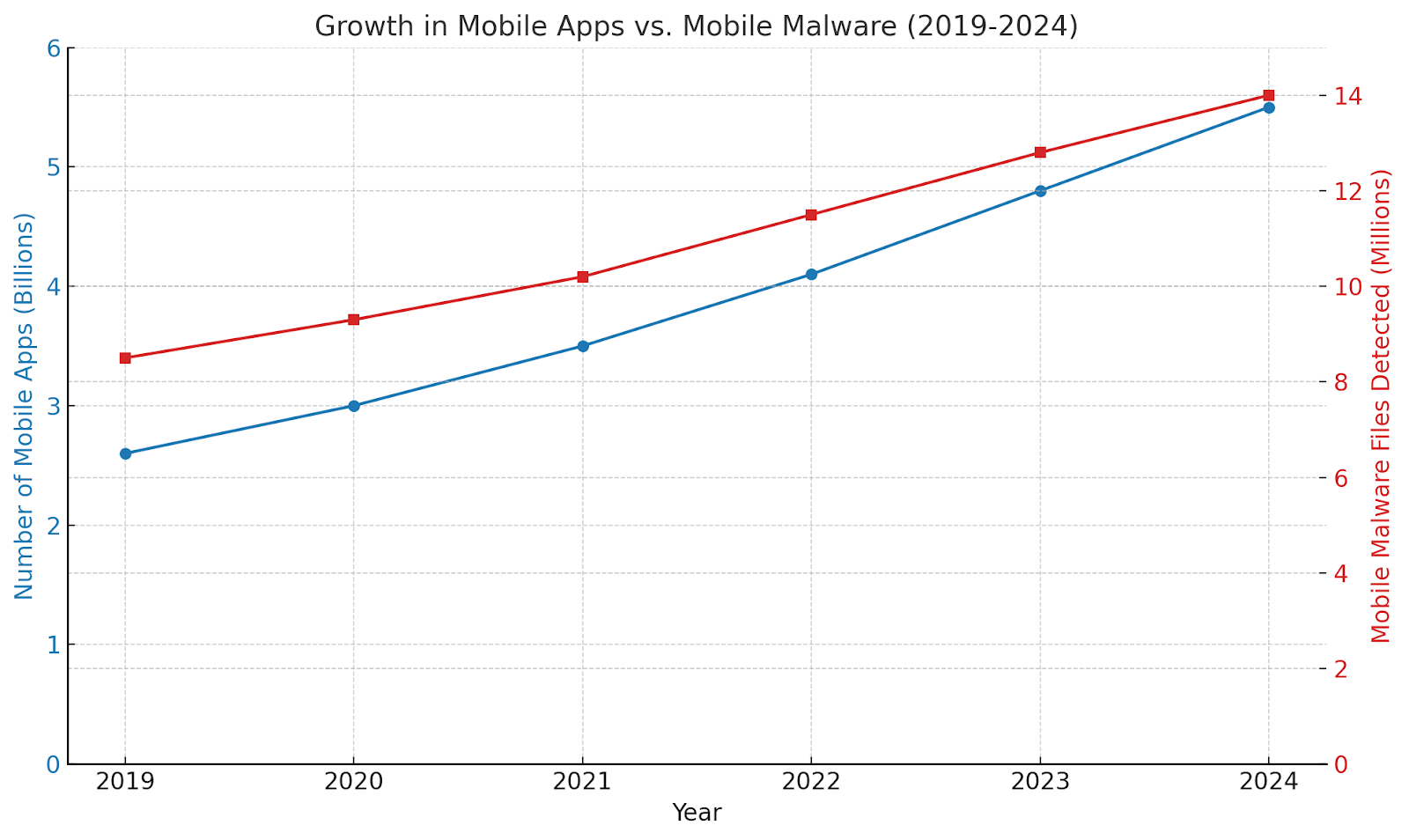
The graph illustrates the parallel growth of mobile applications and mobile malware files from 2019 to 2024:
- Blue Line: Represents the number of mobile applications, which have grown steadily from 2.6 billion in 2019 to a projected 5.5 billion in 2024.
- Red Line: Tracks the increase in mobile malware files, rising from 8.5 million in 2019 to a projected 14 million by 2024.
This correlation highlights the growing attack surface as mobile app usage surges, emphasizing the need for robust security measures.
Emerging Mobile Threats
1. Malware and Rogue Applications
Mobile malware is designed to exploit vulnerabilities in apps and devices. Often disguised as legitimate apps, rogue applications harvest sensitive information or compromise devices.
- Example: Banking Trojans like “EventBot” target financial apps, stealing passwords and intercepting two-factor authentication (2FA) messages
- Developer Impact: A poorly designed app with insufficient validation mechanisms can easily be spoofed or cloned by attackers.
2. Phishing (Smishing and Vishing)
Phishing on mobile devices often exploits SMS (smishing) or voice calls (vishing). These methods are increasingly sophisticated, targeting users with believable scenarios.
- Example: A smishing attack sends an SMS claiming to be from a bank, including a link to a fake login page to steal credentials
- Developer Impact: Without secure URL validation or detection mechanisms in apps, users can fall prey to phishing even while interacting with the app.
This table provides an overview of the phishing attack trends within the banking sector, highlighting the percentage of attacks and emerging tactics used by threat actors.
|
Year |
Phishing Attack Percentage in Financial Sector |
Notable Trends |
Sources |
|
2023 |
27.32% |
|
Zscaler (2023), ASEC (2023), Kroll (2023) |
|
2022 |
36.3% |
|
Zscaler (2023) |
3. Man-in-the-Middle (MITM) Attacks
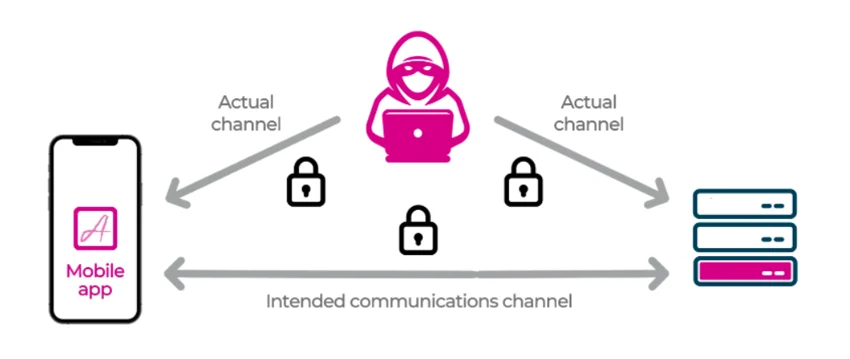
MITM attacks occur when attackers intercept communication between a mobile device and a server. These attacks are prevalent over unsecured public Wi-Fi.
- Example: An attacker captures sensitive data such as login credentials or payment details when a user accesses an HTTP-based service
- Developer Impact: Apps that do not enforce HTTPS communication leave users vulnerable.
4. Insecure Data Storage
Many apps store sensitive information, such as authentication tokens or user data, in plaintext. This data can be easily accessed if a device is compromised.
- Example: A fitness app stores unencrypted health data locally, which can be accessed during a breach or theft.
- Developer Impact: Failure to encrypt data at rest makes sensitive information a prime target.
5. Excessive Permissions and Misconfigurations
Applications requesting unnecessary permissions expose users to risks, including privacy violations. Misconfigured backend servers can also provide attackers with entry points.
- Example: A gaming app requesting access to the user’s camera, microphone, and location without a valid reason.
- Developer Impact: Improper permission management and backend security can lead to unauthorized data access.
Defensive Strategies for Developers
1. Secure Coding Practices
Adopt secure coding frameworks and regularly test applications for vulnerabilities.
- Example: Validate all user inputs to prevent injection attacks like SQL injection or cross-site scripting (XSS).
- Implementation: Use tools like OWASP Dependency-Check to identify vulnerabilities in third-party libraries.
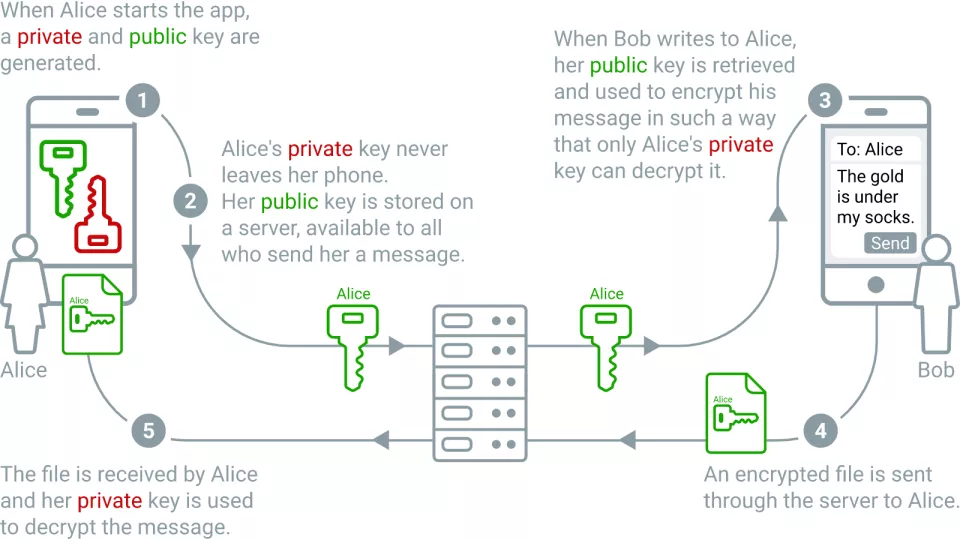
2. End-to-End Data Encryption
Encrypt sensitive information both at rest and in transit.
- Example: A healthcare app uses AES encryption to secure patient data, ensuring that even if data is stolen, it remains inaccessible without decryption keys.
- Implementation: Employ secure storage solutions like Android Keystore or iOS Keychain.
3. Multi-Factor Authentication (MFA)
Add layers of authentication to secure user accounts.
- Example: An e-commerce app uses a combination of passwords and one-time passcodes sent via SMS or email.
- Implementation: Use libraries like Google Authenticator or Duo Security to integrate MFA into apps.
4. Regular Updates and Patching
Continuously update apps to address new vulnerabilities.
- Example: A ride-sharing app regularly patches its backend API to fix security loopholes.
- Implementation: Use dependency management tools like Renovate to track and patch third-party components.
5. Secure APIs
Ensure that APIs are designed with security in mind.
- Example: Implement token-based authentication (e.g., OAuth 2.0) and rate-limiting to prevent abuse.
- Implementation: Encrypt all API communication with TLS/SSL and perform regular penetration testing.
6. Threat Detection and Runtime Protection
Incorporate real-time threat detection to identify malicious behavior during runtime.\
- Example: A social networking app uses runtime application self-protection (RASP) tools to monitor for unusual API calls or unauthorized changes in app behavior.
- Implementation: Integrate tools like Guardsquare or Appdome for runtime security.
7. User Education and Permissions Management
Educate users about security best practices and limit app permissions.
- Example: Design apps to request only necessary permissions with clear justifications, such as access to location data for a navigation app.
- Implementation: Implement a privacy dashboard within the app to allow users to manage permissions easily.
Conclusion
As mobile threats continue to evolve, developers have a crucial role in fortifying applications against malicious actors. By adopting secure coding practices, encrypting data, implementing multi-factor authentication, and keeping apps updated, developers can create secure mobile ecosystems. Security is not a one-time process but a continuous effort to adapt to emerging threats and user needs.
Opinions expressed by DZone contributors are their own.
Comments