

Revolutionizing Supply Chain Optimization with AI-Driven Constraint Programming
AI-driven constraint programming integrates machine learning with optimization to create adaptive, real-time, and efficient supply chain management.
Join the DZone community and get the full member experience.
Join For FreeOptimizing the supply chain has been no easy task. Success entails making decisions on the firm's supply, production, inventory, and logistics functions, all in the real world where demand is not fixed, suppliers are not infinite, and disturbances are not rare. Conventional optimization approaches are suitable for steady-state scenarios but fail in dynamic and complex environments.
AI and CP are the technologies that are changing the way of supply chain management and enabling organizations to build adaptive, efficient and resilient supply networks. However, in this article I will explain how AI constraint programming works, the how of it, and how AI professionals can develop high-level applications using it.
What is Constraint Programming in AI?
Constraint programming (CP) is an approach to solving constraint satisfaction and optimization problems by expressing variables, domains, and constraints. Unlike linear programming, CP does not use a brute-force approach to computation. It works by compiling a search space that encompasses all feasible solutions and, one at a time, eliminating those that do not meet the set constraints in the quest for the best solution.
The components of CP (Supply Chain):
When we talk about the components of CP, they are basically quantities that represent the critical decision variables within a network, including production schedules, levels of inventory, and distribution routes. Moreover, we can say that they are the relationships that define how these variables can and cannot be used—e.g., space in the warehouses, reliability of the suppliers, or time for delivery.
The main objectives of using these components in the supply chain are to minimize or maximize properties such as cost, time, or sustainability, respectively.
So, here’s a Python snippet I drafted Using Google OR-Tools to define a simple CP model for warehouse allocation:
This example showcases how constraints and optimization objectives can be modeled programmatically to enhance decision-making.
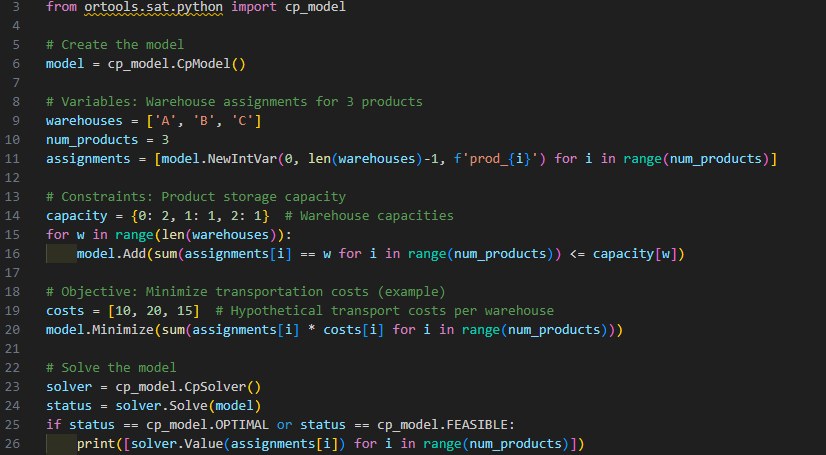
Using Google OR-Tools to define a simple CP model for warehouse allocation
AI-driven Constraint Programming: An Innovation
Classical CP models entail rigid constraint-based rules, but AI-based CP goes one step further by flexibly modifying constraints with the help of machine learning. This approach integrates predictive analysis with prescriptive optimization thus enabling supply chains to operate in real time and manage disruptions.
Deep Learning for Dynamic Constraints
One of the biggest innovations is to use deep learning models to determine and update constraints dynamically. For instance, a recurrent neural network (RNN) can use the past demand information and come up with real-time constraints for the warehouse allocation task:
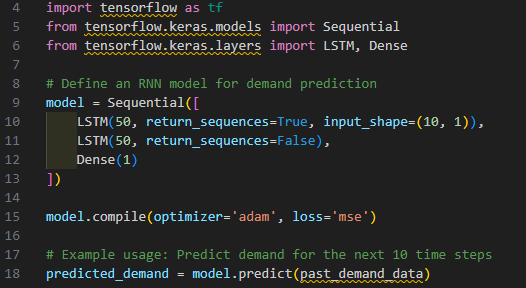
These demand predictions can then be fed into CP solvers to dynamically adjust constraints, ensuring supply chains respond proactively to market shifts.
Real World Scenarios of AI in CP Format
AI based constraint programming is already finding its place in various industries. Here are few real life examples:
- Retail Inventory Optimization: AI models forecast seasonal demand increases, thereby controlling stock levels and distribution networks.
- Smart Logistics Routing: AI constraint programming can identify the best delivery routes in real time, with consideration to weather, fuel costs, and road conditions.
- Manufacturing Scheduling: An AI is able to monitor the production scheduling and make changes to it in real time based on the availability of equipment, workforce, and supply chain disruptions.
Case Study: An Example Application of AI & ML in Supply Chain
Walmart was facing challenges in the effective utilization of its warehouses due to fluctuating order volumes. By adopting various machine learning algorithms, they were able to incorporate real-time demand forecasting into their inventory management.
What was the outcome?
The company improved forecast accuracy by 40% for seasonal products and reduced stock outs by 30% during holiday sales, thereby boosting revenue. This approach brought in millions of dollars and enhanced the quality of service by making sure that the products were available to the customers at the right time and place.
The Challenges of AI-Driven Constraint Programming
Although AI-driven CP has great potential, it is not without its problems. Large-scale CP problems are computationally intensive and often require the computing power of the cloud or quantum computers. Also, the AI models depend on the accuracy and timeliness of the data provided to them. The multi-echelon supply chains also pose complex challenges that cannot be addressed effectively without sophisticated AI frameworks.
What's Next?
The next wave of AI-powered CP models is reinforcement learning based CP models that learn the constraints from real-world data. There is a possibility of an AI that not only forecasts the demand but also learns from past experiences and gets better with time, such that the supply chain manages itself.
Conclusion
This article has discussed how adopting AI-based constraint programming can transform the field of supply chain management. The integration of deep learning, real-time analysis and combinatorial optimization makes it possible to reach a level of efficiency, flexibility, and resilience that was previously unattainable.
For AI experts and developers, the real task is to understand both the theoretical and applied aspects of CP-lifting, the control of AI intelligence, and the strict constraint management. In consequence, as the supply chain becomes more complex, those who can implement this technology will be the industry leaders.
Opinions expressed by DZone contributors are their own.
Comments