

Salesforce Einstein: You Build Your Customer Relationships, AI Helps Maintain Them Automatically
“Customer Relationship Management” (CRM) is essential for fostering organizational success in today's hyper-connected and cutthroat commercial environment.
 ·
·
Join the DZone community and get the full member experience.
Join For FreeEffective “Customer Relationship Management” (CRM) is essential for fostering organizational success in today's hyper-connected and cutthroat commercial environment. Recent developments in “Artificial Intelligence” (AI) have fundamentally changed how companies approach CRM. Salesforce Einstein, created by Salesforce, is a well-known AI-powered product. Salesforce Einstein uses AI technology to revolutionize CRM procedures by automating repetitive work and delivering individualized experiences. Salesforce Einstein provides a full range of AI capabilities, including automation, machine learning, “Natural Language Processing” (NLP), and predictive analytics. The following sections shed light on the tool's features and mechanisms and its applicability in CRM.
Overview
The salesforce analysis process is a type of method for obtaining the forecasting value based on the appropriate sales period, and the process allows for determining the performance. Salesforce was ranked as the top global CRM System provider by the Worldwide Semi-annual Software Tracker report from International Data Corporation. Salesforce offers its services using the Software as a Service (SaaS) distribution model, which allows users to gain access to all system features through an internet browser. SaaS reduces the need for handling sophisticated IT infrastructure by storing every bit of data and information within the CRM System on the provider's servers and hard drive space. According to Ciechan (2023), all updates are made remotely, typically during times when there is the least amount of traffic. This lowers maintenance costs and guarantees a level of system availability of more than 99%.

Figure 1: Architecture of Salesforce Einstein platform (Source: Akimova, 2019)
Multitenancy and metadata are the foundations of the platform's architecture. It's difficult to make sense of all of that data and find quick solutions to pressing business problems. Business executives frequently invest countless hours in spreadsheet updates or in waiting for IT support. While analytics tools have been available for a while, they are still created for analysts rather than the typical business user.
A combination of the support of Salesforce Einstein Analytics, the company can better understand its data and make informed decisions. The goal of Einstein Analytics is to overcome the difficulty of fusing all of this knowledge to analyze massive amounts of data and produce insightful findings (Humphrey Jr, 2021). Acquire real-time insights on important business metrics, assess the state of the company, and decide on the best course of action for sales and marketing efforts using data. Salesforce Einstein has the main influences on consumer behavior, customer interaction channels, and sales. This integration enables a more liberated and effective usage of all Einstein's apps in a robust Salesforce platform.
Use of Salesforce Einstein in CRM
Marketing
Over the past ten years, the world's markets have evolved into a platform that is both more competitive and sociable. Due to the growth of social channels, which allow for more flexible and convenient connections between the aforementioned parties, communication between an organization and its clientele has assumed increasing importance. As opined by Laaksonen (2020), the greater the number of individuals who use the internet, the more people are shopping online, which means more data needs to be collected every day. Marketing is a crucial component in today's competitive advantage over rivals since customer wants must be met with greater efficiency and precision. Data-driven decision-making, personalization, and automation are made possible by Salesforce Einstein for marketing (Richardson et al., 2020). According to Salesforce, using AI makes it possible to manage client data collection more effectively.
Figure 2: Salesforce CRM (Source: Damania, 2019)
AI can analyze customer behavior at a deeper level, providing knowledge of the customer base and allowing for more individualized messaging, product placement, and marketing in general. Salesforce Einstein assists companies in optimizing their sales, service, and marketing processes to strengthen client relationships and stimulate growth.
Sales
Lead Scoring, a service offered by Einstein, effectively screens out unproductive leads. Using AI, Einstein looks at both the lead's current top criteria and the company's previous sales data to determine whether a lead is evolving into an opportunity or not. It is simpler to identify the best leads and opportunities because factors and data are displayed simply to the user. The Einstein lead Scoring is a remarkable application since it continuously gets better with use. The AI becomes smarter and generates ever-improving results as it gathers and provides more data. Artificial intelligence in sales enables users to obtain a streamlined understanding of the company's leads, opportunities, and clients. Based on the comments of Chitanand (2019), allowing an AI to analyze client data saves time and money by posing the possibility of increased revenue.
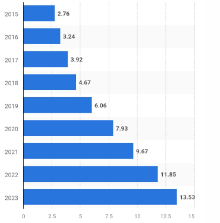
Figure 3: Invested in marketing and sales (Source: Vailshery, 2023)
Informed decision-making and achieving revenue targets are made possible by accurate forecasting for sales managers. Routine work can be automated to save time for sales representatives. Intelligent analysis of emails and calendar events improves coordination and gives interactions a top priority. Win rates are increased by opportunity rating and suggestions, and targeted tactics are developed for individual customers through account-based marketing.
Commerce
The regulations in the commercial sector have been completely transformed by electronic trade or E-commerce. Commerce has seen the cycle of being smarter, faster, more convenient, and more efficient through developing technologies, much like many other business sectors. Commerce today is more personal than ever since more personalized portals have taken the place of old trading platforms. The efficiency and reliability of trade have increased as a result of safer and more transparent transactions. Increasingly greater intelligence 1-on-1 buying experiences are offered by Salesforce's Einstein. AI improves client recommendations and categorization, which increases the likelihood that a transaction will be made. As per the view of Janakova and Sauman (2019), a big opportunity to acquire crucial customer knowledge is lost when e-commerce cannot learn from customer behavior. Limitations in information availability and interaction lead to a less customized platform for the customer and a weaker system for the business. These restrictions can be overcome by AI's capacity to deliver useful information at a faster rate.
Mechanism
Salesforce’s Einstein Analytics offers predictive analytics and data exploration based on various requirements. The tool is designed to provide answers promptly to business-related questions, which allows users to know more about their customers. The mechanism or work pattern of this tool is as follows.
- Salesforce Einstein sorts data collected from various external resources or Salesforce itself at the very beginning phase (Golovtseva, 2023). It applies lenses by defining logic based on stored data.
- A user-friendly, as well as intuitive interface is offered so that data can be explored using visual representations. Charts, reports, and dashboards are used to analyze hidden patterns, insights, and trends in the data.
- Salesforce Einstein Analytics uses its AI capabilities to improve data analysis. Salesforce Einstein's Einstein Discovery uses machine learning (ML) algorithms to find hidden patterns and offer predictive and prescriptive insights.
- The platform runs ML algorithms on previous data to find patterns, forecast future outcomes, and aid in decision-making.
- Continuous optimization and refinement are done for the developed AI models for incorporating new data based on performance metrics and feedback.
- The tool makes informed decisions driven by insights and recommendations from Artificial Intelligence (Chitanand, 2019).
Features
Salesforce Einstein is one of the most comprehensive AI tools for CRM. A wide range of features makes the tool different and more efficient than any other tool. Those features are as follows.
Features |
Functionality |
Benefits |
1.Data Preparation |
This feature ensures the accuracy of customer data along with its availability, which leads to a reduction in manual data entry. |
Up-to-date information can be gained from this feature. |
2. Modeling |
The feature improves productivity and conversion rates by assisting sales teams in prioritizing and concentrating on high-potential prospects. |
It allows AI models to be tailored to specific businesses. |
3. Production |
It enables organizations to take advantage of AI without worrying about stability or performance. |
It helps to gain high-potential leads. |
4. Analysis |
Salesforce Einstein identifies customer-related issues based on their feedback on social media platforms. |
It improves customer satisfaction, enabling prompt responses. |
Table 1: Salesforce Einstein features
Prepared Data
Users can avoid the data preparation phase while using Salesforce Einstein, as all required models, as well as data, are managed automatically. They are required to put their data for expected outcomes regarding customer relationships. The tool provides its solution based on the training provided during model creation and data preparation.
Modeling
The tool is filled with various “machine learning algorithms” so that an appropriate model can be used based on organizations. An automated and multitenant model is expected to fit into the same.
Production
Salesforce Einstein is built to manage massive amounts of data processing, intricate AI algorithms, and heavy user interaction loads without sacrificing speed (Ciechan, 2023). Salesforce makes sure that Einstein is abreast of the most recent developments in AI technology and best practices.
Feedback Analysis
Salesforce Einstein uses sentiment analysis to assess social media and consumer comments. Businesses may foresee potential problems, quickly handle complaints, and increase customer happiness and loyalty by analyzing consumer opinion.
Integration With Other CRM Tools
Salesforce Einstein is integrated seamlessly into other products of the organization. Model management, as well as pre-data preparation, is not required for its functionality. The tool helps users to predict customer behavior by analyzing all data that are put in the system. CRM integration links every application to the CRM platform so that data may move to, from, or between them. The objective of CRM integration is to hold comprehensive, precise data from business applications to provide a comprehensive picture of your company and customers.
“Application programming interfaces” (APIs) allow integration of Salesforce Einstein with other CRM products and allow for the synchronization and exchange of data. Utilizing Salesforce's development resources, such as the “Salesforce Lightning Platform” and “Salesforce AppExchange,” businesses may also create unique connectors. Furthermore, Salesforce provides integrations with services and products from outside parties through its ecosystem. Businesses may create a uniform platform for reporting and analytics while receiving thorough insights into various CRM systems through integration. Depending on the CRM products being linked with Salesforce Einstein, several integration strategies and functionalities may be used (Salesforce.com, 2023). Businesses can refer to the documentation and support resources provided by Salesforce for comprehensive instructions on connecting Salesforce Einstein with various CRM products,
Future Trends
The relevance of customer experience via Salesforce Einstein has increased to new heights, with 80% of customers valuing it as highly as the goods or services provided. A startling 64% of consumers now demand personalized experiences catered to their unique interests and needs. Salesforce's Einstein has been evolving continuously since its birth to match all the requirements of future customers (De Jong et al. 2021). It is being modified to shape the future of “Customer Relationship Management” along with “Artificial Intelligence” in numerous ways. Different companies can unlock the availability of “AI-driven insights” using “Salesforce Einstein.” It helps companies to make data-related decisions that drive the eventual growth of the business.
Organizations may predict market trends, spot opportunities, and make their strategy more effective by using predictive analytics and forecasting. The predictive analytics capabilities of Salesforce Einstein could be improved further (de Ruyter et al. 2020). This may entail better lead scoring algorithms, more precise customer behavior forecasts, and automated upselling and cross-selling opportunity detection. Salesforce Einstein is probably going to improve its ability to integrate with other CRM products, platforms, and data resources. It can enable users to make decisions based on data and prioritize work by utilizing AI-driven insights and suggestions.
Conclusion
The report focuses on Salesforce Einstein, which helps to make decisions for improving the operation using analytical tools. Concerning overview, appropriate information for maintaining CRM. Salesforce CRM and Einstein have a smooth integration. The Sales Cloud, Service Cloud, Marketing Cloud, and Commerce Cloud are just a few of the Salesforce Clouds where users can make use of its AI capabilities. Different types of key features, as well as functionalities, are involved in obtaining the forecasted outcomes. Sales, marketing, commerce, and other areas follow Salesforce Einstein to analyze the patterns for obtaining business behavior. In a nutshell, Salesforce Einstein's functionality empowers businesses with the tools they need to promote growth, provide individualized customer service, and maximize their CRM efforts. The trends of the entire process help to implement the CRM System to engage more customers based on specific operations.
References
Journals
Akimova, O., 2019. Tracking user behavior on the web for digital marketing personalization with Salesforce.
Chitanand, A., 2019. Use of Predictive Analysis and Artificial Intelligence in Sales Force Automation. Editorial Board, p.5.
Ciechan, D., 2023. Comparative analysis of frameworks and automation tools in terms of functionality and performance on the Salesforce CRM Platform. Journal of Computer Sciences Institute, 27, pp.154-161.
Damania, L., 2019. Use of AI in customer relationship management. Emerging Research, 59.
De Jong, A., De Ruyter, K., Keeling, D.I., Polyakova, A. and Ringberg, T., 2021. Key trends in business-to-business services marketing strategies: Developing a practice-based research agenda. Industrial Marketing Management, 93, pp.1-9.
de Ruyter, K., Keeling, D.I. and Yu, T., 2020. Service-sales ambidexterity: Evidence, practice, and opportunities for future research. Journal of Service Research, 23(1), pp.13-21.
Humphrey Jr, W., Laverie, D. and Muñoz, C., 2021. The use and value of badges: Leveraging salesforce trailhead badges for marketing technology education. Journal of Marketing Education, 43(1), pp.25-42.
Janakova, M. and Sauman, P., 2019. CRM and Artificial Intelligence. IT for Practice 2019, p.23.
Laaksonen, A., 2020. The use of artificial intelligence in customer relationship management.
Richardson, J., Sallam, R., Schlegel, K., Kronz, A. and Sun, J., 2020. Magic Quadrant for analytics and business intelligence platforms. Gartner ID G00386610.
Websites
Golovtseva V. (2023). Salesforce Einstein Analytics: a Complete Guide. Available at: https://revenuegrid.com/blog/einstein-analytics/#:~:text=for%20your%20business.-,How%20does%20Einstein%20Analytics%20work%3F,get%20smarter%20about%20their%20customers. [Accessed on: 14 July 2023]
Salesforce.com (2023). Grow your business with Einstein AI for Commerce. Available at: https://www.salesforce.com/in/products/commerce-cloud/commerce-cloud-einstein/?d=cta-body-promo-31 [Accessed on: 15 July 2023]
Vailshery. L (2023). Salesforce's marketing and sales expense worldwide from 2015 to 2023 fiscal year. Available at: https://www.statista.com/statistics/1114220/marketing-sales-expenditure-salesforce-worldwide/ [Accessed on: 7th July, 2023]
Published at DZone with permission of Nitin Kevadiya. See the original article here.
Opinions expressed by DZone contributors are their own.
Comments