

You Secured the Code. Did You Secure the Model?
AppSec focuses only on code, leaving AI supply chains exposed. Effective security embeds AI checks into workflows, scanning PRs and AI components continuously.
Join the DZone community and get the full member experience.
Join For FreeYour team just shipped an AI-powered feature. You scanned the code. Passed SAST. Reviewed the PR. Green across the board.
But here’s what you probably didn't scan: the model weights. The agent framework. The dataset lineage. The MCP server that your agent calls at runtime.
This is the AI supply chain — and most engineering teams have no inventory of it, no governance over it, and no tooling watching it.
The Dependency You're Not Treating Like a Dependency
Software engineering spent two decades learning that open-source dependencies aren't risk-free. You scan them. You track CVEs. You enforce version pinning. You produce SBOMs for compliance audits.
Now ask yourself: “Am I applying any of that rigor to my AI components?
Because functionally, a pre-trained model, an agent framework, a fine-tuning dataset, a prompt template embedded in your app, and an MCP server your agent connects to at runtime – they are all dependencies.
The difference is, your SCA tool knows what to do with package.json. It has no idea what to do with a GGUF file, a Hugging Face model card, or an agent config buried in YAML.
Your dependency graph has a new layer — and right now, it's almost certainly opaque.
What Model Poisoning Means at Scale?
The phrase sounds dramatic. The mechanics are not.
Imagine a popular fine-tuned code assistant with 50,000 downloads a month, where the published weights were subtly modified before distribution. Not enough to degrade benchmark performance, but just enough to introduce systematic bias: preferring insecure patterns in generated code or leaking specific types of contexts in completions.
Your team pulled this model six months ago. You measured output quality, not security posture. It passes all your benchmarks.
Research teams have already demonstrated adversarial weight manipulation that survives standard evaluation pipelines precisely because those pipelines measure accuracy, not security. And that's just one attack vector.
There are also:
- Unverified training data introducing PII or proprietary code embedded in weights
- Unpinned model versions silently swapping a different model than the one you evaluated
- Unsafe agent behaviors creating attack surfaces in autonomous systems that traditional application scanning cannot see.
These are AI-native risks. They require AI-native detection.
The Inventory Gap
Here's the conversation point now taking hold in boardrooms — and soon, in regulatory audits:
What AI are we using? Where? What are the risks?
Most engineering organizations cannot answer this. AI adoption happened fast, distributed across teams, with different choices in different repos. A different model here, a different framework there, a few MCP integrations no one documented.
Shadow AI is the new shadow IT — except it's not sitting in a SaaS app your finance team signed up for without telling anyone. It's embedded in your production codebase, making decisions, calling external services, and operating with elevated context.
That's the blind spot regulators are now targeting: The EU AI Act requires documented AI inventories. ISO 42001 requires governance over AI components. NIST AI RMF provides the framework for managing AI risk systematically. For many organizations, these aren't distant requirements — enforcement timelines are already live.
When a regulator asks for your AI-BOM — an AI Bill of Materials, analogous to the software SBOMs most enterprises already produce — what does your answer look like?
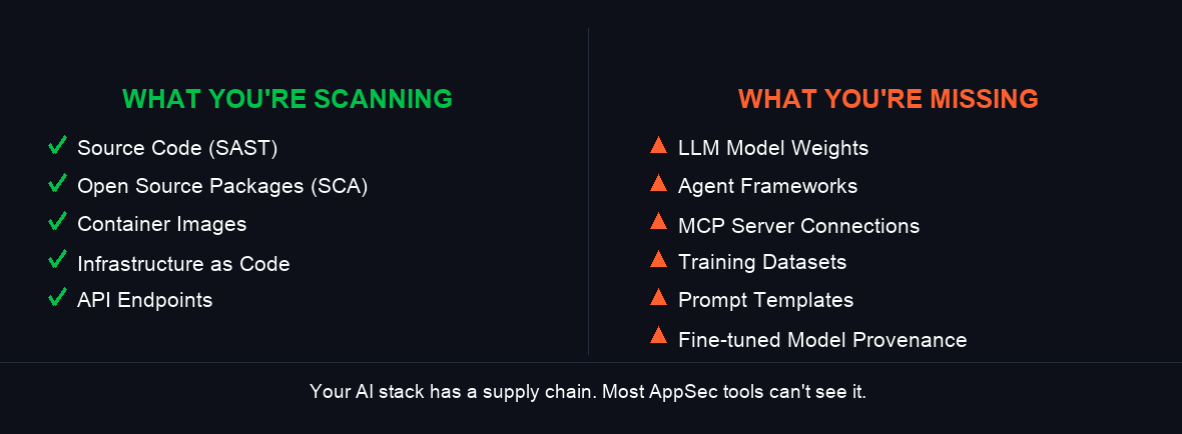
Can’t Your Existing Tools Cover This?
No, they can’t.
SAST scans source code for vulnerability patterns. It will not tell you that the model weights you're loading were tampered with.
SCA tracks CVEs in open-source packages. It has no vulnerability database for PyTorch, GGUF, H5, or Pickle model files.
DAST tests running applications for runtime behavior. It does not assess whether your multi-agent system's trust boundaries can be exploited by a malicious intermediate agent.
The tooling gap is real. And it falls squarely in the domain of AI engineers — the people who actually understand what these components are and how they behave.
What Governance Without Friction Looks Like
There's a version of this where security teams respond by slowing everything down. That version fails. Teams route around it.
The better version (and the only one that works) looks like this:
- AI component scanning embedded directly in the pull request.
- Policy checks that flag unapproved models or unpinned framework versions before merge — the same way a dependency policy blocks a package with a critical CVE.
- An AI-BOM that generates automatically in your CI/CD pipeline, updated every time a new model or framework is integrated.
- Continuous, deterministic discovery.
- Scanning source code and config files for AI assets, assessing them, enforcing policy where the code lives — not in a quarterly audit.
The engineers who build this well end up with something genuinely valuable: an inventory they can defend. When someone asks, "What AI are we running, and what are the risks?" — they answer immediately, with evidence.
The Shift That's Already Here
By 2030, organizations won't struggle because they can't generate code fast enough. They'll struggle because they can't secure, validate, and govern it fast enough.
AI engineers are the ones who understand the components entering production the fastest. They know what a fine-tuned foundation model is. What an MCP does. How an agent framework's trust model works.
That understanding is the prerequisite for securing it. Security teams that lack it are guessing. AI engineers who apply it are in a position to build the governance infrastructure their entire organization will eventually need.
The question isn't whether AI supply chain security becomes a requirement. It's whether your team owns it before a regulator, an auditor, or a post-incident review forces the conversation.
Opinions expressed by DZone contributors are their own.
Comments