

Securing Converged AI-Blockchain Systems: Introducing the MAESTRO 7-Layer Framework
Traditional security models aren’t enough: if you’re building or operating AI-blockchain platforms, you need MAESTRO’s multi-layered, adaptive security strategy to stay safe.
Join the DZone community and get the full member experience.
Join For FreeIntroduction
When an AI trading agent exploits a smart contract vulnerability, financial firms can lose millions in seconds. In 2024 alone, more than $1.42 billion vanished through smart contract exploits, with AI-enhanced systems showing particularly troubling weaknesses that traditional security frameworks simply cannot address.
As blockchain and AI technologies converge, they create entirely new attack surfaces that existing methodologies like STRIDE and MITRE ATT&CK weren’t designed to handle. Through my experience securing enterprise systems processing trillions in assets, I developed the MAESTRO framework — Multi-Agent Environment, Security, Threat, Risk, and Outcome — as a practical, seven-layer approach specifically designed for AI-blockchain convergence.
This framework addresses the unique challenges you face when securing systems where autonomous agents interact with immutable smart contracts, creating dynamic threat landscapes that evolve in real-time.
MAESTRO's Seven-Layer Architecture
Practical implementations show that blockchain-AI systems require security consideration across seven distinct layers. This layered approach is essential for managing the unique complexity introduced by the convergence of these technologies.
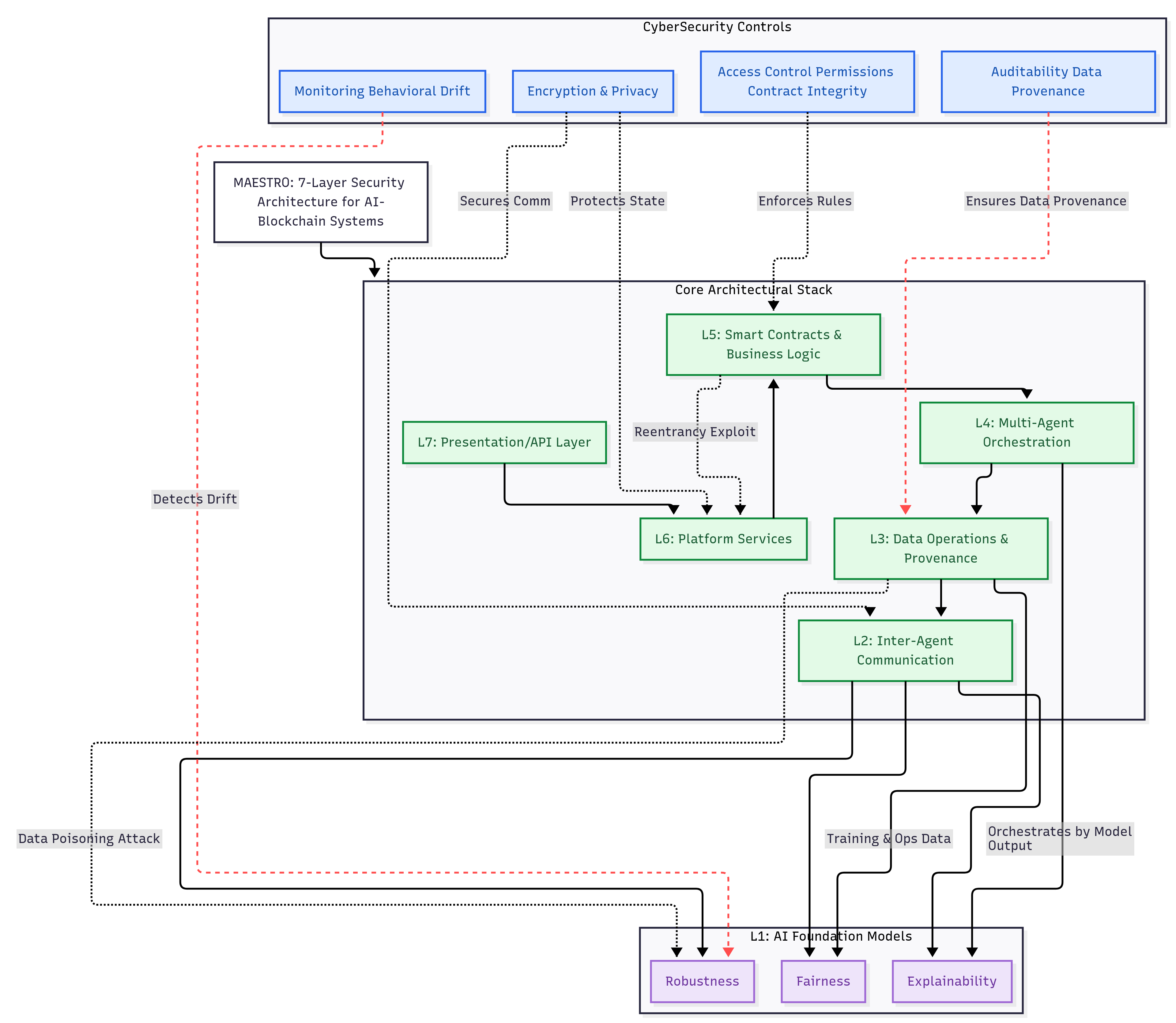
MAESTRO framework's seven layers of defense
Layer 7: Blockchain Ecosystem
- Scope: The foundational trust layer including consensus mechanisms, validators, and network economics.
- Common Threats: 51% attacks, validator collusion, eclipse attacks that isolate nodes from the broader network.
- Mitigation Strategy: Implement Resilient Consensus & Node Diversity. Choose blockchain platforms with proven economic security models and encourage geographically distributed validator sets.
|
// Example: Validator diversity check function validateConsensusHealth() { const validatorDistribution = getValidatorGeography(); const nakamotoCoefficient = calculateDecentralization(validatorDistribution);
if (nakamotoCoefficient < MINIMUM_DECENTRALIZATION_THRESHOLD) { throw new SecurityAlert("Insufficient validator diversity"); } } |
Layer 6: Smart Contract Platform
- Scope: The execution environment (EVM, Solana runtime) where your smart contracts operate.
- Common Threats: Gas manipulation attacks, platform-specific bugs, governance risks from protocol upgrades.
- Mitigation Strategy: Apply Platform Due Diligence & Secure Defaults using established patterns like Checks-Effects-Interactions.
|
// Secure pattern: Checks-Effects-Interactions function withdrawFunds(uint256 amount) external { // Checks require(balances[msg.sender] >= amount, "Insufficient balance"); require(amount > 0, "Invalid amount");
// Effects balances[msg.sender] -= amount;
// Interactions (external calls last) (bool success, ) = msg.sender.call{value: amount}(""); require(success, "Transfer failed"); } |
Layer 5: Application Logic
- Scope: Your business rules encoded in smart contracts and dApps.
- Common Threats: Business logic flaws, reentrancy attacks, integration vulnerabilities between contracts.
- Mitigation Strategy: Enforce Immutable Business Rules & Reentrancy Guards that AI agents cannot override.
|
// AI agent trading constraints contract TradingLimits { mapping(address => uint256) public dailyLimits; mapping(address => uint256) public dailySpent;
modifier enforceTradeLimit(uint256 amount) { require( dailySpent[msg.sender] + amount <= dailyLimits[msg.sender], "Daily trading limit exceeded" ); dailySpent[msg.sender] += amount; _; }
function executeTrade(uint256 amount) external enforceTradeLimit(amount) nonReentrant { // AI agent cannot bypass these limits _executeTrade(amount); } } |
Layer 4: AI Agent Framework
- Scope: Infrastructure supporting AI agent lifecycle, coordination, and model serving.
- Common Threats: Agent coordination attacks, model serving vulnerabilities, privilege escalation.
- Mitigation Strategy: Implement Agent Sandboxing & Least Privilege with dedicated resources per agent.
|
// AI agent trading constraints contract TradingLimits { mapping(address => uint256) public dailyLimits; mapping(address => uint256) public dailySpent;
modifier enforceTradeLimit(uint256 amount) { require( dailySpent[msg.sender] + amount <= dailyLimits[msg.sender], "Daily trading limit exceeded" ); dailySpent[msg.sender] += amount; _; }
function executeTrade(uint256 amount) external enforceTradeLimit(amount) nonReentrant { // AI agent cannot bypass these limits _executeTrade(amount); } } |
Layer 3: Data Operations
- Scope: Data processing and storage systems supporting both blockchain and AI functions.
- Common Threats: Data poisoning attacks, privacy leakage, data integrity compromises.
- Mitigation Strategy: Use Verifiable Data Provenance & Zero-Knowledge Proofs to ensure data integrity.
Layer 2: Communication Protocols
- Scope: Secure channels for agent-to-agent and agent-to-contract communication.
- Common Threats: Message injection, protocol manipulation, steganographic communication for covert coordination.
- Mitigation Strategy: Mandate Authenticated & Encrypted Channels for all inter-agent communication.
Layer 1: Foundation Models
- Scope: The underlying AI models powering your intelligent agents.
- Common Threats: Adversarial examples, model inversion attacks, backdoors that trigger malicious behavior.
- Mitigation Strategy: Implement Continuous Behavioral Monitoring & Model Robustness with real-time anomaly detection.
Summary and Key Architecture Principle of Each Layer
|
Layer |
Description & Scope |
Example Threats |
Key Architectural Principle/Mitigation |
|
L7: Blockchain Ecosystem |
The broader network, including consensus mechanisms, node operators, and validators. |
Consensus manipulation, Network partition attacks, Eclipse attacks. |
Resilient Consensus & Node Diversity. Select robust consensus protocols and encourage a decentralized, geographically diverse set of validators. |
|
L6: Smart Contract Platform |
The execution environment (e.g., EVM) and its platform-specific features and vulnerabilities. |
Gas manipulation attacks, Platform-specific bugs, Governance risks. |
Platform Due Diligence & Secure Defaults. Thoroughly vet the underlying platform and utilize established secure coding patterns like Checks-Effects-Interactions. |
|
L5: Application Logic |
The business logic encoded in smart contracts and dApps. |
Business logic flaws, Reentrancy attacks, Integration vulnerabilities. |
Immutable Business Rules & Reentrancy Guards. Enforce critical constraints in non-upgradable smart contracts and use reentrancy guards on all external calls. |
|
L4: AI Agent Framework |
The infrastructure supporting AI agents, including coordination protocols and model serving platforms. |
Agent coordination attacks, Model serving vulnerabilities. |
Agent Sandboxing & Least Privilege. Enforce strict isolation between agents (e.g., separate blockchain accounts, resource quotas) and limit permissions. |
|
L3: Data Operations |
Data processing and storage systems supporting both blockchain and AI operations. |
Data poisoning, Privacy leakage, Data integrity attacks. |
Verifiable Data Provenance & Zero-Knowledge Proofs. Use on-chain hashes to verify off-chain data integrity and employ privacy-preserving techniques for sensitive data. |
|
L2: Communication Protocols |
Protocols enabling interaction between agents, smart contracts, and external systems. |
Protocol manipulation, Message injection, Steganographic communication. |
Authenticated & Encrypted Channels. Mandate cryptographic signatures for all inter-agent messages and use end-to-end encryption for off-chain communication. |
|
L1: Foundation Models |
The underlying AI models (e.g., LLMs, predictive models) powering intelligent agents. |
Adversarial examples, Model inversion, Backdoor attacks. |
Continuous Behavioral Monitoring & Model Robustness. Implement real-time anomaly detection for agent outputs and use adversarial training to harden models. |
A Starting Checklist for Your Next AI-Blockchain Project
To translate theory into practice, architects and team leads can use the following questions, derived from the MAESTRO framework, to guide initial design and security reviews:
- Layer 7 (Ecosystem): Have we assessed the security guarantees and potential failure modes of the underlying consensus mechanism we are building on?
- Layer 5 (Application Logic): Are our core business logic constraints encoded in immutable smart contracts, providing stable guardrails for adaptable AI agents?
- Layer 4 (Agent Framework): Is every autonomous agent strictly sandboxed with its own credentials, resources, and the minimal necessary permissions?
- Layer 3 (Data Operations): How are we ensuring the integrity of off-chain data used by our AI models, and can we use on-chain mechanisms for verification?
- Layer 1 (Foundation Models): Do we have a continuous monitoring plan to detect AI model drift that could inadvertently open new security vulnerabilities over time?
Taking Action
The convergence of AI and blockchain technologies offers unprecedented opportunities, but it also introduces complex security challenges that traditional approaches cannot address. The MAESTRO framework provides a structured methodology for identifying and mitigating these risks across all seven layers of your system.
Start by conducting a MAESTRO-based security assessment of your current or planned AI-blockchain systems. Focus first on Layer 5 (Application Logic) and Layer 4 (Agent Framework), as these typically offer the highest return on security investment.
The systems you build today will define the security posture of tomorrow’s decentralized, intelligent infrastructure. Apply these principles in your next design review, and share your experiences with the broader development community.
What challenges have you encountered when securing AI-blockchain systems? Share your insights in the comments below.
Opinions expressed by DZone contributors are their own.
Comments