

Bridging the Divide: Tactical Security Approaches for Vendor Integration in Hybrid Architectures
Learn about real-world hybrid security use cases and learn tactical strategies for securely integrating vendor software in cloud and on-prem environments.
 ·
·
Join the DZone community and get the full member experience.
Join For FreeSecurity architecture in hybrid environments has traditionally focused on well-known concepts such as OWASP vulnerabilities, identity and access management, role-based access control, network security, and the principle of least privilege. Best practices like secure coding and incorporating SAST/DAST testing into CI/CD pipelines are also widely discussed.
However, when organizations operate in a hybrid model — running workloads both on-premises and in the cloud — while also integrating with vendor-managed cloud solutions, a different set of security design considerations comes into play. These scenarios are not uncommon, yet they are rarely highlighted in the context of secure solution implementation involving vendor software in hybrid environments.
This article highlights four real-world use cases and outlines practical architectural strategies for organizations to adopt to ensure secure integration in hybrid settings.
Acronyms
- OWASP – Open Web Application Security Project
- SAST – Static Application Security Testing
- DAST – Dynamic Application Security Testing
- CI/CD – Continuous Integration / Continuous Testing
- SaaS – Software as a Service
- UX – User Experience
- ETL – Extract, Transform, and Load
Use Cases
There are three use cases this article covers, as listed below.
- Automated software update by the vendor in the organization's managed data center
- Webhook – mismatch in verification methodology
- JavaScript embedding – monitoring mandate
Tactical Solutions
Automated Software Update by Vendor in Organization-Managed Data Center
Problem Statement
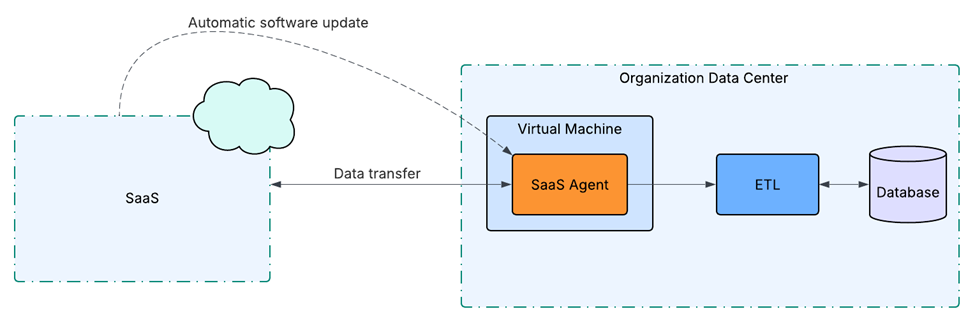
In some vendor software integrations, organizations are required to install an agent within their own data center. This agent typically acts as a bridge between the vendor’s cloud-hosted application and the organization’s on-premises systems. For example, it may facilitate data transfer between the vendor software and the organization’s on-premises database.
In many cases, the vendor’s operational architecture requires that this agent be automatically updated. While convenient, this approach introduces a significant security risk. If the vendor’s software is compromised or contains malware, the update process could infect the virtual machine or container hosting the agent. From there, the threat could propagate into other parts of the organization’s infrastructure, potentially leading to a major security incident. Figure 1 showcases the scenario.
Solution
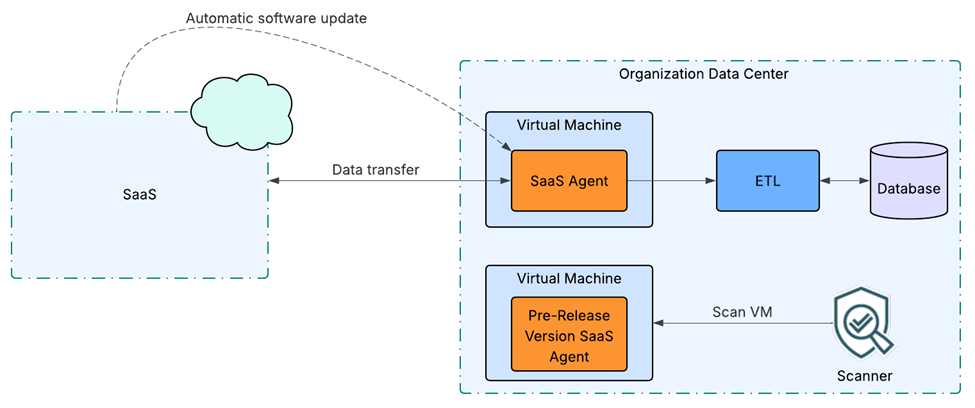
A tactical way to solve this problem is to install the future version of the agent software in a separate virtual machine or container and scan the software as well as the machine for any vulnerabilities. If the software and the deployment platform where the software is running pass all the security checks, then the vendor can be approved to install the new version of the agent software automatically. This way it can be ensured that an unverified version of the vendor software doesn’t automatically get pushed to the organization’s data center. Figure 2 demonstrates the solution.
Webhook: Mismatch in Verification Methodology
Problem Statement
This is an interesting security scenario where we often stumble. For a webhook implementation, the organization has to open up an inbound connectivity from the vendor software over the internet. As it is an inbound traffic to the organization's data center (on-prem or cloud), the inbound traffic needs to be verified from every aspect of software security, such as DDoS attack, malicious payload, etc. Organizations generally have a well-defined common security policy to verify all incoming traffic from external vendors.
On the other hand, vendor software may also have a common policy that works as a guideline for their customers to verify all aspects of security when they receive inbound traffic from the vendor webhook. It is highly unlikely that the security policy of an organization and a vendor will match, especially when both organization and vendor are major players in the industry. As the security policy doesn’t match the majority of the time, it creates a challenge to implement such webhook integration.
Solution
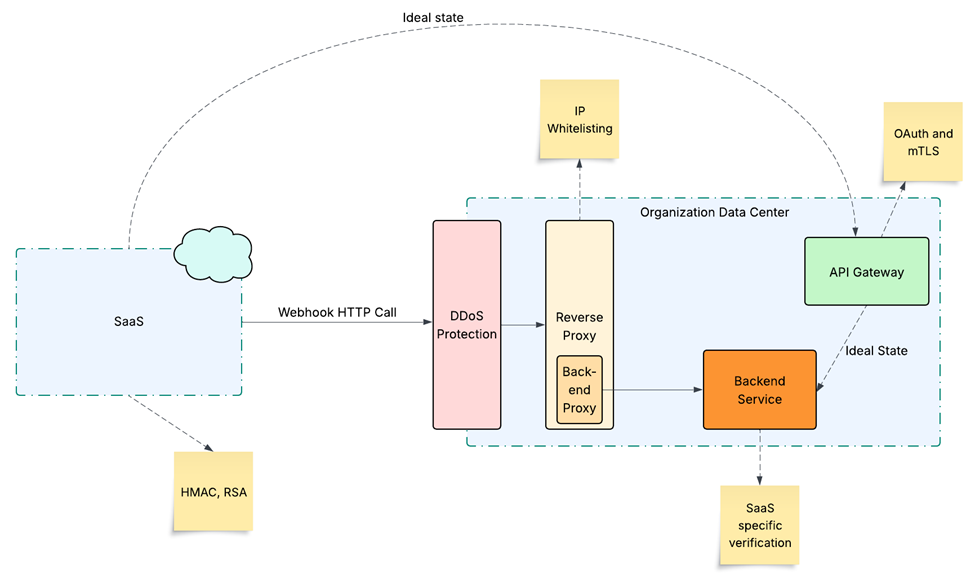
A tactical way to solve the issue is to let the incoming traffic hit a reverse proxy layer of the organization. The reverse proxy layer, which receives traffic from the internet, is generally protected by a DDoS protection layer. The reverse proxy layer can forward the incoming traffic to the backend service layer, which has the business logic to process the webhook request. The backend service layer can implement the payload and other verification of the vendor webhook incoming traffic based on the policy set up for the vendor specification. Figure 3 demonstrates the tactical solution.
JavaScript Embedding: Monitoring Mandate
Problem Statement
Some of the vendor solutions these days are JavaScript toolkits. They are typically Digital Adoption Platform (DAP) software that are used to navigate users through the UX of the web platform to make them familiar with the navigation of newly released features. The integration process often requires embedding the vendor's JavaScript toolkit within the organization's codebase. This is deemed risky due to script injection and other types of JavaScript vulnerabilities.
In addition to that, vendor software generally also has a feature to send information from a web browser to their system to capture data for analytical purposes. This analytical data capture feature adds further risk since there is a possibility of vendor software capturing unauthorized data elements about customers and applications in their system. The organization, therefore, prefers analytics traffic to flow to the vendor platform from the browser through its infrastructure. If the data flows through the organization's infrastructure, then the data that flows through the vendor platform can be monitored and actioned upon as necessary.
Solution
There are two problems to solve in this use case:
- Safely integrate the JavaScript package of the vendor into the organization's codebase
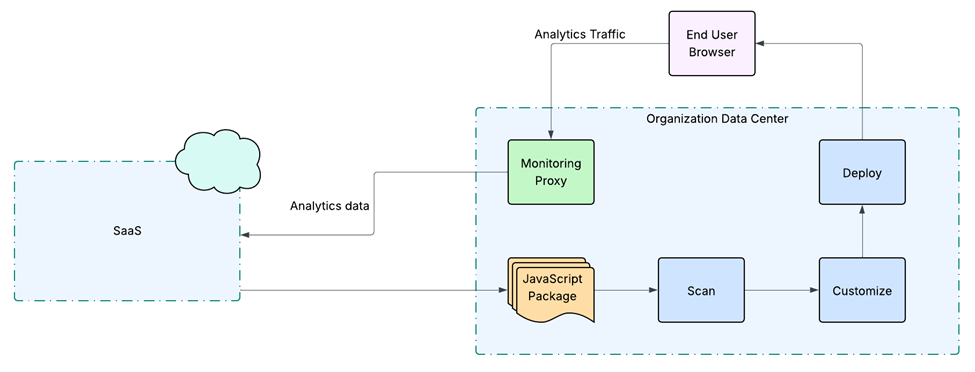
- Implement a solution to send analytics traffic from the browser to the vendor through the organization's infrastructure
To implement a secure integration solution with the vendor JavaScript tool, the script needs to be packaged as part of the CI/CD pipeline to scan and perform SAST/DAST testing before deploying. In order to route the analytics traffic to the vendor platform through the organization's infrastructure, create a proxy to the target vendor endpoint and customize the vendor JavaScript to point to the proxy. This arrangement helps in routing analytics traffic from the browser to the vendor through the organization's infrastructure.
Conclusion
This article explored three real-world scenarios that highlight the security challenges organizations face when integrating vendor software into hybrid environments. Each use case demonstrates how seemingly routine technical decisions — such as software updates, webhook validation, or JavaScript embedding — can introduce vulnerabilities if not carefully addressed. The solutions presented are not just theoretical best practices but tactical architectural choices that organizations can adopt to implement solutions in a secure way for these less talked about but common integration challenges.
Opinions expressed by DZone contributors are their own.
Comments