

Beyond Manual Annotation: Engineering Self-Correcting Pseudo-Labeling Pipelines
This article details a resilient pseudo-labeling architecture. It combines Redis ingestion, Matryoshka embeddings, XGBoost to neutralize self-training confirmation bias.
 ·
·
Join the DZone community and get the full member experience.
Join For FreeManual annotation is a massive bottleneck for multimodal inference systems in high-velocity production environments. If you want to survive catastrophic distribution shifts, you have to automate your labeling pipeline. I want to walk through a pseudo-labeling architecture we built that filters out extreme pipeline noise to hit a 0.93 F1 score using XGBoost.
Semi-supervised strategies like pseudo-labeling look great on paper but often fail in practice. They suffer from confirmation bias. The model just repeatedly overfits to its own bad predictions because it is overly confident in them. This triggers catastrophic pipeline noise and runaway concept drift (where the underlying statistical properties of your target variable change over time and destroy your predictive accuracy).
Let's tear down the architectural requirements for a resilient pseudo-labeling pipeline. We will look at stateful ingestion, Matryoshka-based feature extraction, and the algorithmic framework you need to survive the 0.8 probability noise floor.
The Labeling Bottleneck and the MLOps Mandate
Most production models do not fail gracefully. They break hard due to episodic regime changes. These are sudden, fundamental shifts in the operating environment or attack vectors rather than gradual wear and tear. A new fraud vector can emerge overnight and render a static model completely useless.
The hard part of fixing this is not automating the data flow itself. The real engineering challenge is preventing self-poisoning during the iterative self-training loop. The goal here is to architect a system that treats unlabeled data as a first-class citizen while enforcing a strict "State Gate" to prevent algorithmic collapse.
System Architecture Pipeline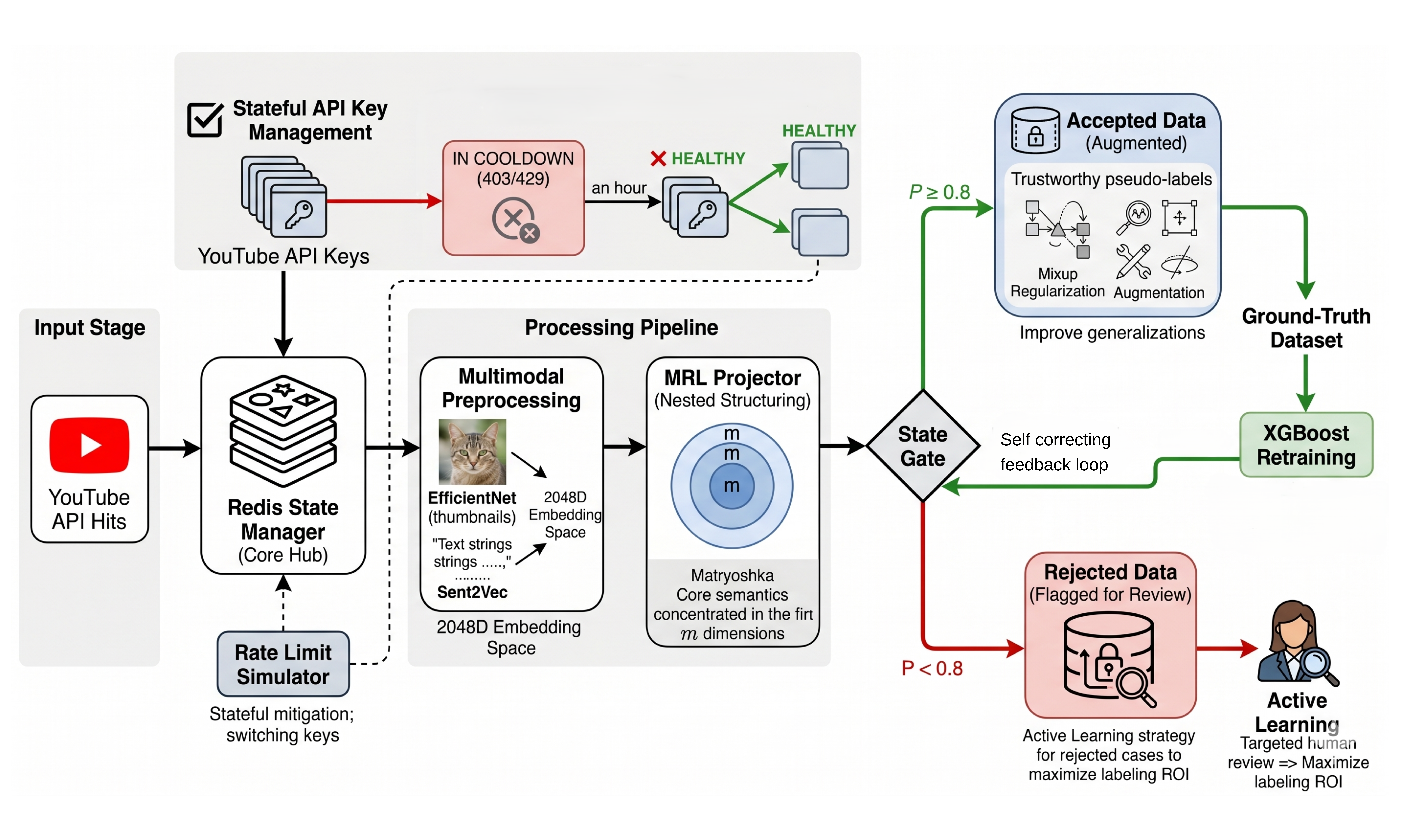
Ingestion Resilience: Stateful API Key Rotation
Your labeling pipeline is only as reliable as your raw data source. Ingesting multimodal metadata at scale means you are going to hit API quotas and Web Application Firewall (WAF) errors like HTTP 403 or 429. Naive retry logic usually just triggers retry storms that make the lockout worse. A production-grade system needs to externalize the state of your API keys to a centralized store like Redis. This lets the system track cooldown periods and usage statistics atomically across all your distributed workers.
import redis
import time
import hashlib
from typing import Optional, Tuple

# Context: Assumes a valid REDIS_URL accessible by your worker nodes
# redis_url = "redis://localhost:6379/0"

class RedisKeyManager:
    """Manages API key state and cooldowns to prevent 403/429 lockouts."""
    def __init__(self, redis_url: str):
        self.r = redis.Redis.from_url(redis_url, decode_responses=True)
        self.COOLDOWN_SEC = 3600  # 1 hour backoff for auth/rate errors

    def get_healthy_key(self) -> Tuple[Optional[str], Optional[str]]:
        """Returns the healthiest key based on error counts and cooldown status."""
        for key_name in self.r.scan_iter("apikey:meta:*"):
            state = self.r.hgetall(key_name)
            # Ensure the key is active and not currently in a cooldown window
            if state.get('active') == '1' and float(state.get('cooldown_until', 0)) < time.time():
                key_hash = key_name.split(":")[-1]
                raw_key = self.r.get(f"apikey:raw:{key_hash}")
                return raw_key, key_hash
        return None, None

    def handle_api_response(self, key_hash: str, status_code: int):
        """Statefully updates key health based on HTTP response codes."""
        if status_code in {403, 429}:
            # Apply stateful cooldown and increment failure metrics [9, 10]
            self.r.hset(f"apikey:meta:{key_hash}", "cooldown_until", time.time() + self.COOLDOWN_SEC)
            self.r.hincrby(f"apikey:meta:{key_hash}", "failure_count", 1)
        elif status_code == 401:
            # Immediate deactivation for unauthorized or invalid keys
            self.r.hset(f"apikey:meta:{key_hash}", "active", "0")
Multimodal Extraction and Matryoshka Embeddings
The ingestion layer pushes data into a feature extraction system. We process visual thumbnails using EfficientNet-B0 and text strings with Sent2Vec. EfficientNet typically spits out a 1280D vector. Sent2Vec gives you a 768D embedding. If you just naively concatenate them, you end up with a massive 2048D space. That is computationally expensive for large-scale retrieval and highly prone to overfitting.
We implemented Matryoshka Representation Learning (MRL) to fix this. MRL structures the embedding so that core semantics are concentrated in the first m dimensions. This lets the pipeline do low-latency shortlisting with a 128D prefix before executing high-precision reranking with the full 512D projected vector.
import torch
import torch.nn as nn

# Context: Simulating a batch of 32 concatenated multimodal inputs (2048D each)
# sample_batch = torch.randn(32, 2048)

class MatryoshkaProjection(nn.Module):
    """
    Fused Multimodal Projector (2048 -> 512) with MRL support.
    Encodes core semantics into the early dimensions of the latent space.
    """
    def __init__(self, input_dim: int = 2048, max_output_dim: int = 512):
        super().__init__()
        self.projector = nn.Linear(input_dim, max_output_dim)
        # Define nested dimensions for MRL loss [14]
        self.nesting_list = [128, 256, 512]

    def forward(self, x: torch.Tensor):
        full_latent = self.projector(x)
        # Return a dictionary of nested representations for multi-scale loss
        return {dim: full_latent[:, :dim] for dim in self.nesting_list}

# Example execution:
# model = MatryoshkaProjection()
# output = model(sample_batch)
The State Gate: Calibrating for Resilience
Once the MRL projector efficiently extracts and ranks those high-fidelity multimodal embeddings, the pipeline has to decide which of these new inferences are actually trustworthy enough to learn from.
This brings us to the State Gate. This is the architectural pivot point where raw predictions become pseudo-labels. We implement a strict 0.8 probability threshold for re-ingestion into the training pool.
The problem is that raw model outputs are almost always mis-calibrated. You cannot trust raw softmax scores. We use Mixup Regularization and Platt Scaling to guarantee that a 0.8 confidence score genuinely reflects an 80% likelihood of correctness. Mixup trains the model on convex combinations of sample pairs. It forces the model to learn smoother decision boundaries and strips away the overconfidence that fuels confirmation bias.
The self-training flow follows these steps:
- Inference (V_n): Predict on 100k unlabeled multimodal samples.
- Calibration: Apply Platt Scaling or Beta calibration to raw scores.
- Selection (The Gate): Quarantine samples where calibrated P < 0.8.
- Augmentation: Apply Mixup to selected pseudo-labels to improve generalization.
- Retrain (V_n+1): Combine ground-truth and pseudo-labels for a new epoch with a hard cap of 10 iterations to prevent runaway drift.
Algorithmic Resilience: XGBoost vs. Random Forest
The most critical architectural finding we had was the performance delta between bagging and boosting when you subject them to the noise of the 0.8 threshold. Random Forest is usually robust to outliers, but its bagging architecture completely fails during iterative self-training.
RF averages independent trees trained on random subsets. In pseudo-labeling, the noise is systematic because of confirmation bias. Bagging gives equal weight to every tree, which smooths the noise instead of correcting it. Eventually, the model just overfits the injected errors, and accuracy drops to around 0.80.
XGBoost handles this completely differently. It builds trees sequentially. Each subsequent tree targets the residuals or errors of the previous ensemble. That sequential nature combined with L2 regularization and shrinkage (a low learning rate) creates a natural buffer. It allows the model to learn around the pseudo-label noise and hit a 0.93 F1 score.
import xgboost as xgb
from sklearn.datasets import make_classification
from sklearn.model_selection import train_test_split

# Context: Generating a synthetic dataset to represent our extracted embeddings
# Features: [Feature_0 (increases risk), Feature_1 (decreases risk), Feature_2 (neutral)]
X, y = make_classification(n_samples=1000, n_features=3, n_informative=3, n_redundant=0, random_state=42)
X_train, X_val, y_train, y_val = train_test_split(X, y, test_size=0.2)

dtrain = xgb.DMatrix(X_train, label=y_train)
dval = xgb.DMatrix(X_val, label=y_val)

# Configuration optimized for noisy pseudo-labeling environments
xgb_params = {
    'objective': 'binary:logistic',
    'eta': 0.05,  # Low learning rate (shrinkage) is critical to buffer noise
    'max_depth': 6,
    'lambda': 1.5,  # L2 regularization on leaf weights
    'alpha': 0.5,   # L1 regularization for feature sparsity
    'subsample': 0.8,
    # Monotone constraints map to our 3 features: (1=increasing, -1=decreasing, 0=unconstrained)
    'monotone_constraints': (1, -1, 0), # Enforces business logic
    'eval_metric': 'aucpr' # PR-AUC handles imbalanced drift effectively
}

# Runnable training loop
bst = xgb.train(xgb_params, dtrain, num_boost_round=100, evals=[(dval, 'validation')])
Conclusion: Designing for Drift
Elite MLOps comes down to how a system handles the episodic regime. You have to survive environments where performance shifts abruptly due to external shocks instead of smooth decay. A resilient automated labeling pipeline demands defense in depth. Stateful key management at the ingestion layer keeps data flowing even under aggressive WAF rate limiting. Matryoshka Representation Learning gives you the flexibility to balance retrieval latency with semantic precision in the feature space. Finally, picking a boosting architecture like XGBoost acts as a mathematical buffer against the systematically noisy labels you inevitably get in self-training loops.
You still need to know when to avoid this pattern entirely. Do not use pseudo-labeling if your ground-truth seed is less than 5% of your total volume. The risk of the model drifting away from reality is too high when the initial truth is sparse. Also, avoid this approach if the cost of a False Positive is existential (like in medical diagnostics). In high-stakes environments, you cannot risk confirmation bias fitting a false negative or positive inside a fully automated loop.
Designing for drift is a massive advantage, but only when you have a solid ground-truth foundation and clear domain boundaries. Looking ahead, the next step for this design space is baking active learning heuristics directly into the State Gate. That will let the system automatically flag only the most mathematically uncertain, high-value boundary cases for human review.
Opinions expressed by DZone contributors are their own.
Comments