

The AI FOMO Paradox
The AI FOMO Paradox: Learn why knowledgeable Agile practitioners are perfectly positioned for the AI era, and the era of ‘good enough’ Agile is over.
 CORE
·
CORE
·
Join the DZone community and get the full member experience.
Join For FreeTL; DR: AI FOMO — A Paradox
AI FOMO comes from seeing everyone’s polished AI achievements while you see all your own experiments, failures, and confusion.
The constant drumbeat of AI breakthroughs triggers legitimate anxiety for Scrum Masters, Product Owners, Business Analysts, and Product Managers: “Am I falling behind? Will my role be diminished?”
But here’s the truth: You are not late. Most teams are still in their early stages and uneven. There are no “AI experts” in agile yet — only pioneers and experimenters treating AI as a drafting partner that accelerates exploration while they keep judgment, ethics, and accountability.
Disclaimer: I used a Deep Research report by Gemini 2.5 Pro to research sources for this article.
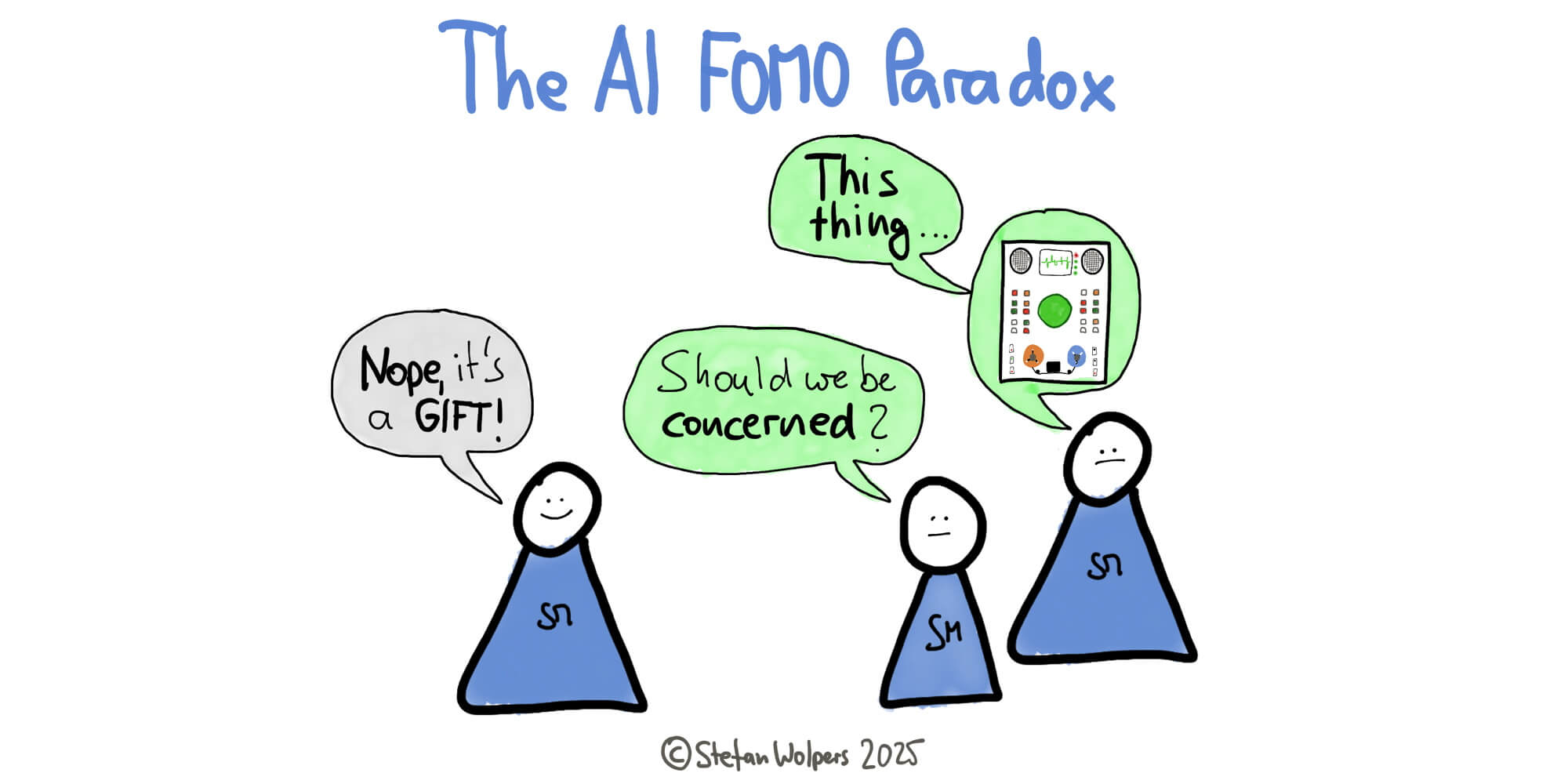
The Reality Behind the AI Success Stories
Signals are distorted: Leaders declare AI-first while data hygiene lags. Shadow AI usage inflates progress without creating stable practices. Generative AI has officially entered what Gartner calls the “Trough of Disillusionment” in 2024-2025. MIT Sloan’s research reveals only 5% of business AI initiatives generate meaningful value (Note: The MIT Sloan report needs to be handled with care due to its design.)
Companies spend an average of $1.9 million on generative AI initiatives. Yet, less than 30% of AI leaders report CEO satisfaction. Meanwhile, individual workers report saving 2.2–2.5 hours weekly — quiet, durable gains beneath the noise generated by the AI hype.
The “AI Shame” phenomenon proves the dysfunction: 62% of Gen Z workers hide their AI usage, 55% pretend to understand tools they don’t, with only a small fraction receiving adequate guidance. This isn’t progress; it’s organizational theater.
Good-Enough Agile Is Ending
AI is not replacing Agile. It’s replacing the parts that never created differentiated value. “Good-Enough Agile,” teams going through Scrum events without understanding the principles, are being exposed. Ritualized status work, generic Product Backlog clerking, and meeting transcription: all becoming cheap, better, and plentiful.
Research confirms AI as a “cybernetic teammate” amplifying genuine agile principles. The Agile Manifesto’s first value, “Individuals and interactions over processes and tools,” becomes clearer. AI is the tool. Your judgment remains irreplaceable.
The AI for Agile anti-patterns revealing shallow practice include:
- Tool tourism: Constant switching that hides a weak positioning
- Hero prompts: One person becomes the AI bottleneck instead of distributing knowledge
- Vanity dashboards: Counting prompts instead of tracking outcome-linked metrics
- Automation overreach: Brittle auto-actions that save seconds but cost days.
These patterns expose teams practicing cargo cult Agile. Career insecurity triggers documented fears of exclusion, but the real threat isn’t being excluded from AI knowledge. It’s being exposed as having practiced shallow Agile all along. (Throwing AI at a failed approach to “Agile” won’t remedy the main issue.)
The Blunt Litmus Test
If you can turn messy inputs into falsifiable hypotheses, define the smallest decisive test, and defend an ethical error budget, AI gives you lift. If you cannot, AI will do your visible tasks faster while exposing absent value and your diminished utility from an organization’s point of view.
Your expertise moves upstream to framing questions and downstream to evaluating evidence. AI handles low-leverage generation; you decide what matters, what’s safe, and what ships.
Practical Leverage Points
There are plenty of beneficial approaches to employing AI for Agile, for example:
Product Teams: Convert qualitative inputs into competing hypotheses. AI processes customer transcripts in minutes, but you determine which insights align with the product goal. Then, validate or falsify hypotheses with AI-built prototypes faster than ever before.
Scrum Masters: Auto-compile WIP ages, handoffs, interrupting flow, and PR latency to move Retrospectives from opinions to evidence. AI surfaces patterns; you guide systemic improvements. Seriously, talking to management becomes significantly easier once you transition from “we feel that…” to “we have data on…”
Developers: Generate option sketches, then design discriminating experiments. PepsiCo ran thousands of virtual trials; Wayfair evolved its tool through rapid feedback — AI accelerating empirical discovery.
Stanford and World Bank research shows a 60% time reduction on cognitive tasks. But time saved means nothing without judgment about which tasks matter. Building useless things more efficiently won’t prove your value as an agile practitioner to the organization when a serious voice questions your effectiveness.
Conclusion: From Anxiety to Outcome Literacy
The path forward isn’t frantically learning every tool. Start with one recurring problem. Form a hypothesis. Run a small experiment. Inspect results. Adapt. This is AI for Agile applied to your development.
The value for the organization shifts from execution to strategic orchestration. Your experience building self-managing teams becomes more valuable as AI exposes the difference between genuine practice and cargo cult Agile. Durable wins come from workflow redesign and sharper questions, not model tricks. If you can frame decisions crisply, choose discriminating tests, and hold ethical lines, you’re ahead where it counts.
AI FOMO recedes when you trade comparison for learning velocity. Choose an outcome that matters, add one AI-assisted step that reduces uncertainty, measure honestly, and keep what proves worth. AI won’t replace Agile; it will replace Good-Enough Agile, and outcome-literate practitioners will enjoy a massive compound advantage. It helps if you know what you are doing for what purpose.
Food for Thought on AI FOMO
- How might recognizing AI as exposing “Good-Enough Agile” rather than threatening genuine practice change your approach to both AI adoption and agile coaching in organizations that have been going through the motions?
- Given that AI makes shallow practice obvious by automating ritual work, what specific anti-patterns in your organization would become immediately visible, and how would you address the human dynamics of that exposure?
- If the differentiator is “boring excellence”—clean operational data, evaluation harnesses, and reproducible workflows—rather than AI tricks, what foundational practices need strengthening in your context before AI can actually accelerate value delivery?
Sources
- Gartner AI Hype Cycle Report
- AI FOMO, Shadow AI, and Other Business Problems
- AI Hype Cycle – Gartner Charts the Rise of Agents, HPCwire
- Impact of Generative AI on Work Productivity, Federal Reserve Bank of St. Louis
- AI Shame Grips the Present Generation, Times of India
- Generative AI & Agile: A Strategic Career Decision, Scrum.org
- Fear of Missing Out at Work, Frontiers in Organizational Psychology (link downloads as an EPUB)
- Artificial Intelligence in Agile, Sprightbulb
- AI & Agile Product Teams, Scrum.org
- Productivity Gains from Using AI, Visual Capitalist
- Human + AI: Rethinking the Roles and Skills of Knowledge Workers, AI Accelerator Institute
Published at DZone with permission of Stefan Wolpers. See the original article here.
Opinions expressed by DZone contributors are their own.
Comments