

Tuples and Records (Part 2): JavaScript Migration Guide
Learn how to migrate to JavaScript’s Tuples and Records with step-by-step guidance, compatibility tips, benchmarks, and reduced reliance on libraries.
 ·
·
Join the DZone community and get the full member experience.
Join For FreeIn Part 1 of this series, we explored JavaScript’s Tuples and Records, two immutable data structures designed to improve performance, predictability, and developer experience. We covered their purpose, syntax, key benefits, and where they fit best in modern applications.
Now, in Part 2, we’ll shift the focus to migration strategies. Transitioning from traditional objects and arrays to Tuples and Records isn’t just a syntax change. It requires careful planning to avoid unintended side effects and maximize performance gains. In this article, we’ll walk through step-by-step guidance on identifying suitable use cases, incrementally refactoring, ensuring library compatibility, and benchmarking results, so you can confidently adopt these features in production code.
Migrating Existing Codebases to Tuples and Records
Migrating from mutable objects and arrays to Tuples and Records requires a structured approach to avoid unintended side effects and maximize performance gains.
Step 1: Identify Suitable Use Cases
Before refactoring, determine where Tuples and Records offer the most benefit, such as:
- State Management: Ensure immutable updates in React/Redux.
- Configurations: Store static settings that don't change frequently.
- Data Comparisons: Use for deep equality checks.
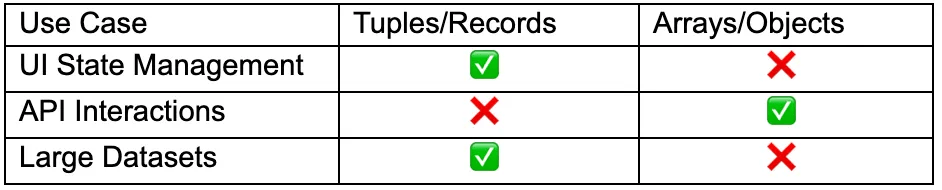
Example Decision Matrix:
Step 2: Incremental Refactoring
Instead of rewriting the entire codebase, introduce Tuples and Records gradually in isolated modules.
Example (Before — Using Mutable Objects):
const user = { name: "Alice", loggedIn: false };
user.loggedIn = true;
console.log(user.loggedIn); // true
Example (After—Using Records):
const user = #{ name: "Alice", loggedIn: false };
const updatedUser = #{ ...user, loggedIn: true };
console.log(updatedUser.loggedIn); // true
Step 3: Updating State Management Logic
If you're using Redux or React's state, migrate to Records for better immutability.
Before (Traditional Mutable State):
const initialState = { count: 0 };
function reducer(state = initialState, action) {
  if (action.type === "INCREMENT") {
    return { ...state, count: state.count + 1 };
  }
  return state;
}
After (Immutable With Records):
const initialState = #{ count: 0 };
function reducer(state = initialState, action) {
  if (action.type === "INCREMENT") {
    return #{ ...state, count: state.count + 1 };
  }
  return state;
}
Step 4: Handling Compatibility With Existing Libraries
Some libraries and frameworks may not yet support Tuples and Records, so ensure compatibility before migrating.
Example Fallback Solution
const legacyArray = [1, 2, 3];
const modernTuple = #[...legacyArray];
// Convert tuple back if needed for compatibility
const convertedArray = Array.from(modernTuple);
Step 5: Testing and Benchmarking
Before fully transitioning, test how Tuples and Records impact performance.
Example Benchmarking
console.time("Object Update");
const obj = { a: 1, b: 2 };
const newObj = { ...obj, b: 3 };

console.timeEnd("Object Update");
console.time("Record Update");

const rec = #{ a: 1, b: 2 };
const newRec = #{ ...rec, b: 3 };
console.timeEnd("Record Update");
Step 6: When to Avoid Migration
Not all cases benefit from Tuples and Records. Stick to traditional arrays/objects when:
- Frequent mutations are required.
- Compatibility with older browsers is a concern.
- Working with third-party libraries that expect mutable structures.
How JavaScript's Tuples and Records Relieve Developers from Third-Party Libraries
The introduction of Tuples and Records in JavaScript is poised to change fundamentally how developers manage immutable data. For years, developers have relied on third-party libraries like Immutable.js, Immer, and lodash to handle immutability in their applications. While these libraries are powerful, they come with challenges, such as increased bundle sizes, complex API learning curves, and potential compatibility issues.
With Tuples and Records, JavaScript now provides native immutability and value-based semantics, reducing the need for third-party libraries while maintaining simplicity and performance. However, their adoption also introduces some challenges that developers must navigate.
How Tuples and Records Reduce Reliance on Third-Party Libraries
1. Native Support for Immutability
Third-party libraries like Immutable.js were created to address JavaScript's lack of built-in immutability. Tuples and Records fill this gap natively by providing immutable structures without requiring external dependencies.
- Immutable.js Example:
import { Map } from 'immutable';

const record = Map({ name: "Alice", age: 25 });
const updated = record.set("age", 26);

console.log(record.get("age")); // 25 console.log(updated.get("age")); // 26
- With Records:
const record = #{ name: "Alice", age: 25 };
const updated = #{ ...record, age: 26 };

console.log(record.age); // 25 console.log(updated.age); // 26
Tuples and Records achieve the same functionality with less code and no dependency on external libraries.
2. Simplified State Management
React developers often use libraries like Immer to manage immutability in state updates. Tuples and Records allow developers to work directly with immutable data structures, eliminating the need for middleware or complex abstractions.
- Immer Example:
import produce from 'immer';

const state = { count: 0 };
const nextState = produce(state, draft => {   draft.count++; });
- With Records:
const state = #{ count: 0 };
const nextState = #{ ...state, count: state.count + 1 };
Tuples and Records simplify state updates without sacrificing performance by natively supporting immutability.
3. Value-Based Equality Simplifies Comparisons
Libraries like Lodash often provide deep equality checks (_.isEqualto compare complex data structures. Tuples and Records simplify this process by implementing value semantics, where equality is based on the content, not the reference.
- lodash EExample
import _ from 'lodash';
const obj1 = { a: 1, b: 2 };
const obj2 = { a: 1, b: 2 };

console.log(_.isEqual(obj1, obj2)); // true
- With Records:
const record1 = #{ a: 1, b: 2 };
const record2 = #{ a: 1, b: 2 };

console.log(record1 === record2); // true
This example behavior eliminates the need for utilities like _.isEqual.
Watch-Outs, Gotchas, and Workarounds
1. Incompatibility With Older Environments
Since Tuples and Records are relatively new features, older browsers or runtime environments may not support them yet.
Workaround: Use polyfills or transpilers like Babel with the @babel/plugin-proposal-record-and-tuple plugin to add support in legacy environments.
npm install @babel/plugin-proposal-record-and-tuple
2. Limited Ecosystem Support
Third-party libraries and frameworks may not yet support Tuples and Records directly, requiring developers to use fallback methods.
Workaround: Convert Tuples and Records to arrays and objects when necessary:
const tuple = #[1, 2, 3];
const array = Array.from(tuple); // Convert Tuple to Array

const record = #{ a: 1, b: 2 };
const object = { ...record }; // Convert Record to Object
3. Lack of Methods for Mutation
Unlike arrays and objects, Tuples and Records lack built-in methods for mutation (e.g., push, pop, splice). This can feel restrictive for developers accustomed to JavaScript's multiple structures.
Workaround: Use spread syntax or higher-order functions for immutability:
const tuple = #[1, 2, 3];
const newTuple = #[...tuple, 4]; // Add an element

const record = #{ a: 1, b: 2 };
const newRecord = #{ ...record, c: 3 }; // Add a new property
4. Verbosity With Nested Updates
Updating deeply nested data structures can still feel verbose without utilities like Immer.
Workaround: Write helper functions to simplify nested updates:
function updateNestedRecord(record, keyPath, value) {
  return keyPath.length === 1
    ? #{ ...record, [keyPath[0]]: value }
    : #{ ...record, [keyPath[0]]: updateNestedRecord(record[keyPath[0]], keyPath.slice(1), value) };
}

const record = #{ user: #{ name: "Alice", address: #{ city: "NY" } } };
const updated = updateNestedRecord(record, ['user', 'address', 'city'], "LA");
console.log(updated.user.address.city); // "LA"
Impact on Development
1. Reduced Bundle Sizes
With fewer dependencies on third-party libraries, bundle sizes shrink, leading to faster load times and better performance.
2. Improved Readability
Native support for immutability makes the code easier to read and maintain:
- No need to import utilities.
- Cleaner syntax for immutable operations.
3. Easier Debugging
Debugging third-party libraries can be difficult due to their complexity. Tuples and Records provide transparent immutability, making bugs easier to trace.
4. Consistency Across Applications
Using built-in features ensures project consistency, reducing reliance on library-specific paradigms or APIs.
Tuples and Records bring immutability into the core JavaScript language, offering developers a robust, efficient, and modern way to manage immutable data. By reducing reliance on third-party libraries, they simplify development, improve performance, and enhance code maintainability.
While some challenges exist, such as ecosystem support and the learning curve, these can be addressed with polyfills, workarounds, and thoughtful adoption. As Tuples and Records gain traction, they will likely become a cornerstone of modern JavaScript development, empowering developers to write more predictable, efficient, and robust applications.
Future Implications and Upcoming Enhancements for Tuples and Records
With the introduction of Tuples and Records, JavaScript is taking a significant step toward immutability, predictability, and performance optimization. However, the evolution of these data structures is far from complete. As the JavaScript community adopts them, we can expect further enhancements and refinements driven by developer feedback and evolving application requirements.
In the next part of this series, we'll explore potential ECMAScript proposals, speculative enhancements, and anticipated changes that could shape the future of Tuples and Records.
Opinions expressed by DZone contributors are their own.
Comments