

VL-JEPA: End of LLMs? Or the End of How We Think About Them?
Learn how Meta's VL-JEPA challenges the assumptions behind LLMs by shifting AI from next-word prediction to semantic understanding and world modeling.
 CORE
·
CORE
·
Join the DZone community and get the full member experience.
Join For FreeFor the past few years, large language models have felt unstoppable...
Every few months, a bigger model arrived. Longer context. Better fluency. Fewer hallucinations. More parameters. The message was implicit but clear. Scale is intelligence.
Then Meta released a paper in December 2025, co-authored by Yann LeCun, that quietly questioned the entire premise.
Not by proposing a bigger language model. But by asking whether predicting words should ever have been the core of intelligence in the first place.
The architecture introduced in that paper, Vision Language Joint Embedding Predictive Architecture or VL-JEPA, does not try to outdo LLMs at language. It sidesteps language entirely as the center of reasoning.
That shift matters more than it first appears.
The Hidden Assumption Behind LLMs
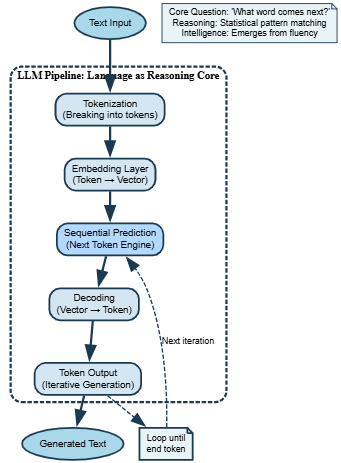
Every LLM, no matter how large or refined, is built on one simple loop. Given what came before, predict what comes next. That loop has produced impressive results, but it also hides an assumption that we rarely question: that intelligence emerges from sequence completion.
What LLMs Are Really Doing
When an LLM writes: "My name is Ram Ghadiyaram," it does not hold the idea of a person introducing themselves. It does not represent identity. It does not reason about self-reference.
It performs a statistical continuation:
"My" -> "name" -> "is" -> "Ram" -> "Ghadiyaram"
Each step is local. Each decision is linguistic. Meaning is never explicitly represented. It is inferred indirectly through correlations in text.
This works surprisingly well, until you ask the system to reason, plan, or generalize beyond familiar language patterns.
Why Scaling Language Hits a Ceiling
Adding more data and parameters improves fluency, but it does not change the nature of the reasoning.
LLMs still think left to right, depend on surface patterns, encode meaning implicitly rather than explicitly, and conflate knowing words with knowing the world.
This is the core of LeCun's critique. Intelligence is not language. Language is a compression format humans use to communicate thoughts that already exist. The thought comes first.
Recent research from OpenAI and DeepSeek (2024) documents saturation in LLM scaling laws around 10^26 compute FLOPs. This suggests we can no longer achieve intelligence gains through parameter volume alone. VL-JEPA's architectural shift promises to continue progress through representational depth instead.
VL-JEPA Starts Where LLMs End
VL-JEPA does not ask what word comes next. It asks, "what does this situation mean?" Instead of building intelligence on top of text generation, it builds text generation on top of understanding.
Here, the key idea is to predict future representations, not future words. Those representations live in a semantic embedding space where images, video, text, and actions are mapped into the same conceptual coordinate system. Meaning becomes a first-class object.
This architecture explains the human brain's convergence zones, where the visual cortex, auditory processing, and language areas integrate meaning without linguistic mediation. LeCun's self-supervised learning framework (2022,2024) provides the mathematical foundation for this biological alignment.
LLM vs. VL-JEPA Architectures
LLM architecture:
VL-JEPA architecture:
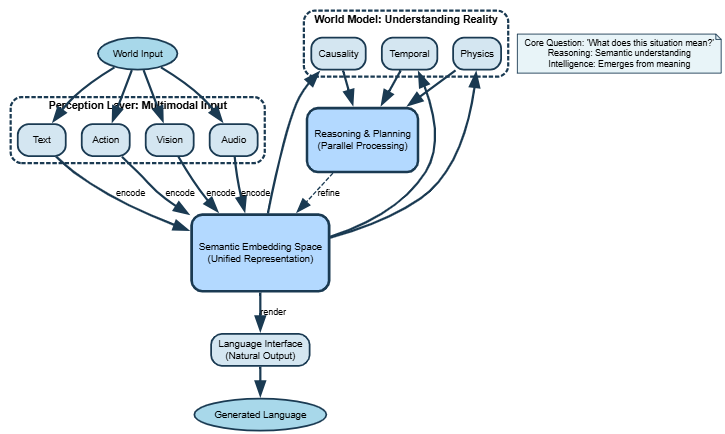
In LLMs, language is both the input and the reasoning medium. In VL-JEPA, language is just an interface.
That distinction changes everything.
Semantic Space Feels Closer to How Humans Think
Humans do not reason word by word. We recognize situations, anticipate outcomes, and understand intent without narrating it internally.
Semantic embeddings allow machines to do something similar.
"A dog is running"
"A puppy is playing"
Different words. Same concept. Same region in semantic space.
Contrast that with:
"A dog is running"
"A car is parked"
Different concepts. Distant regions. No grammar required. No syntax rules. Just meaning.
Performance and Cost
Token generation is inherently sequential. Semantic reasoning is parallel and compact.
A semantic embedding space processes information in parallel, potentially achieving 10x inference speedup compared to sequential token generation. Early benchmarks suggest VL-JEPA models with 7B parameters match LLM performance at 70B scale.
That means faster inference, lower compute cost, and smaller models doing deeper reasoning.
Robustness
Prompt wording matters less. Paraphrasing does not confuse the system. Meaning stays stable across linguistic variations because the system reasons about the concept, not the words.
Multimodal by Design
Images are not translated into captions first. Videos are not reduced to text descriptions. Everything is understood in the same representational space. This unified approach eliminates the bottleneck of forcing all information through language, which has always been AI's weakest link for real-world understanding.
LLMs Are Not Dead. They Are Demoted.
The Meta paper does not argue for abandoning LLMs. Instead, it reassigns them. LLMs become translators between humans and machines, natural language renderers, and input normalization layers. They stop being the brain. They become the voice.
World Models Are the Real Goal
VL-JEPA is part of a larger idea called world modeling.
A world model understands objects and their relationships, how actions change state, temporal continuity, and cause and effect. This is how humans plan. This is how animals navigate. This is how intelligence survives outside of text. Language alone cannot capture that.
What Engineers Should Take Away
This shift is architectural, not incremental.
It suggests that future AI systems will separate reasoning from language, treat text as one modality among many, optimize for meaning rather than fluency, and scale understanding rather than vocabulary.
Bigger prompts and longer context windows are not the endgame.
Understanding is.
The Production Timeline
While VL-JEPA represents a fundamental shift, production adoption likely spans 18 to 24 months. Organizations should begin experimenting with semantic embedding frameworks now, treating this as the next major AI infrastructure transition.
This shift does not mean abandoning LLMs, but reorganizing the AI stack. LLMs become specialized components rather than the foundation, similar to how Docker transformed container orchestration in 2012,2015. Engineers who understand both paradigms will lead this transition.
Engineer Migration Strategy
Start by understanding semantic embedding spaces in your existing toolkit. Experiment with multimodal models that blur the line between vision and language. Build prototypes that process information in parallel rather than sequentially. Most importantly, recognize that the bottleneck is no longer compute, but conceptual architecture.
The engineers who thrive in this transition will be those comfortable with architectural change, not just model scaling.
Conclusion
This is not the end of large language models. It is the end of confusing eloquence with intelligence.
The VL-JEPA paper marks a philosophical correction in AI. From words to worlds. From prediction to understanding. From language engines to cognitive systems.
AI is not failing. It is finally asking the right question.
Reference
Meta AI Research, Yann LeCun et al. Vision Language Joint Embedding Predictive Architecture, December 11, 2025
Opinions expressed by DZone contributors are their own.
Comments