

What Is Agile Testing? Life Cycle, Benefits, and Principles
In this article, we will see what is Agile testing, the stages of the Agile testing life cycle, and the principles of agile testing.
Join the DZone community and get the full member experience.
Join For FreeIn this post, we'll take a quick look at what is Agile testing, the phases of the agile testing life cycle, agile testing principles, and more.
Agile testing is an iterative and incremental process that emerges from a person's or a buyer's collaboration and builds teams.
In the context of software development, the term "Agile" refers to something that can be done quickly and all at once. Agile testing's fundamental job is to test the software application or multiple modules of software in such a way that it ensures that the software we supply fulfills the customer's expectations and is high quality and defect-free.
What Is Agile Testing?
Agile testing is effective and adheres to the principles and regulations of agile software development. It differs from the waterfall model in that testing occurs at the start of the project and the development and testing processes are continuously integrated. The agile approach is not a sequential process, but rather a continuous one.
Principles of Agile Testing
The following are some of the agile testing process's principles:
- Continuous Testing: Agile methodology adheres to the notion of continuous testing, which means that testing is carried out in a continuous manner to ensure that software or products move in a timely manner.
- Continuous Feedback: Agile testing will provide you with continuous feedback, ensuring that the software or product meets the requirements of the clients or users.
- Testing by the Whole Team: While testing is often done by the testing team in the software testing lifecycle, agile testing allows the development team and the business analyst to participate.
- Reduce Feedback Response Time: Because the business team is participating in each iteration of agile testing, they will receive feedback as soon as feasible in each iteration, reducing feedback response time.
- Simple and clean code: The bug is fixed in the same iteration in agile testing. This will aid in the creation of clear and simple code.
- Less Documentation: Instead of lengthy documentation, this testing employs a reusable checklist and concentrates on tests.
Benefits of Agile Testing
- Agile testing will reduce the documentation.
- You'll save both time and money.
- It is adaptable and versatile.
- Reduce the time it takes for you to receive feedback.
Stages of Agile Testing Life Cycle
There are 5 different phases of the Agile Testing Life Cycle:
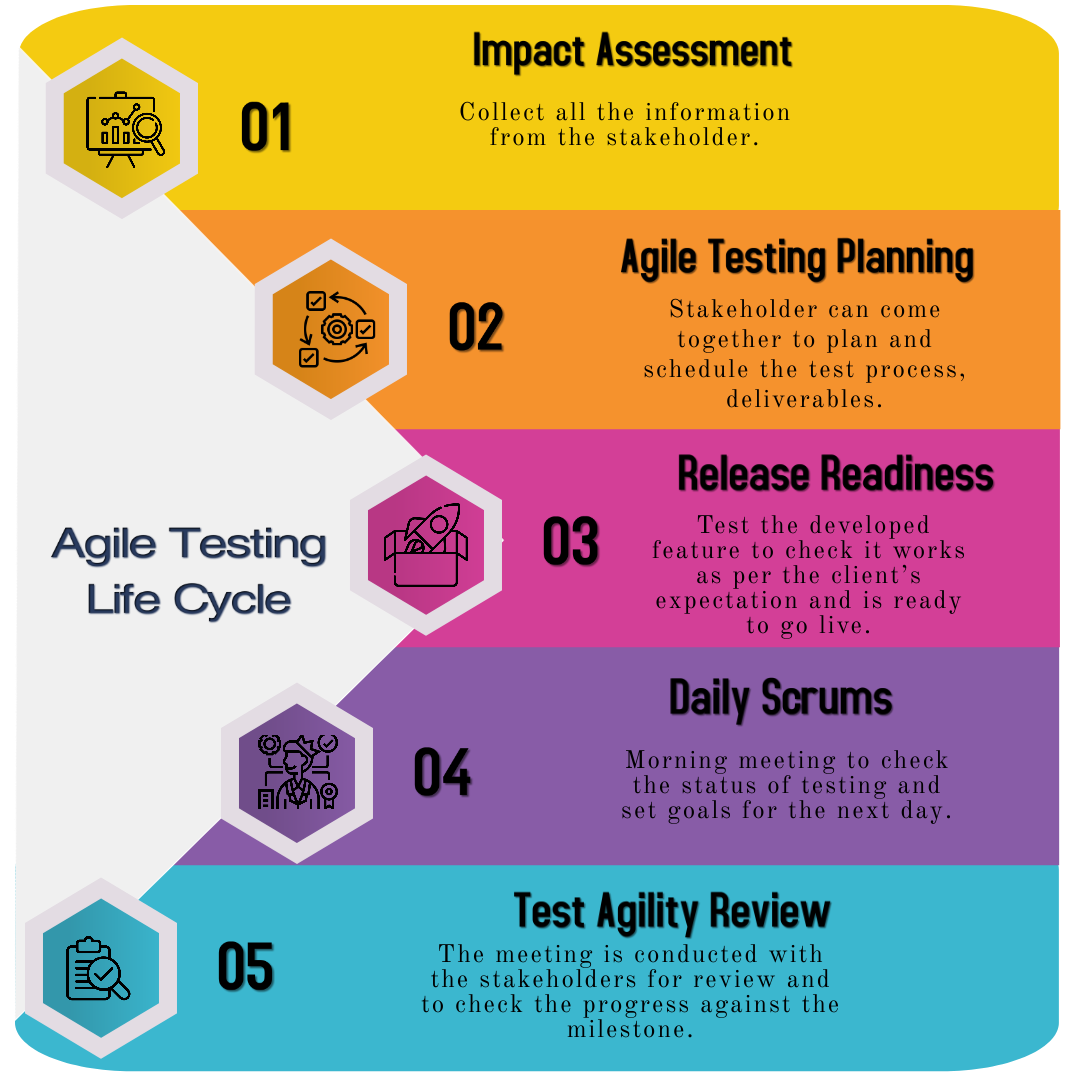
Impact Assessment: Impact Assessment is the first phase of the agile testing life cycle where we have to collect all the information from the stakeholder.
Agile Testing Planning: Stakeholders can get together in this step of the agile testing life cycle to plan and arrange the test process and deliverables.
Release Readiness: We must test the developed feature in this phase to ensure that it meets the client's expectations and is ready to go live.
Daily Scrums: This will involve a morning meeting to check on testing progress and set goals for the next day.
Test Agility Review: This is the final phase, in which the stakeholders meet for a review and to compare progress to the milestones.
Conclusion
After learning about agile testing, we can certainly state that it is one of the methods used to test software applications nowadays. It has been well-known among various firms because it has grown more customer-centric and will assure a high-quality product while also working on continuous integration.
In Agile testing, Customers must be involved in the execution, as well as a high degree of communication among the developers and test team, since they must all work together to test the software application, resulting in higher-quality software that meets the needs of the customers. Testing begins as early as feasible in the software development lifecycle in Agile methodologies. Finally, we can conclude that communication is critical when testing a software application in agile testing.
Published at DZone with permission of Deepali chadokar. See the original article here.
Opinions expressed by DZone contributors are their own.
Comments