

Why Zero Trust Is Not a Product but a Strategy You Can’t Ignore in 2025
"We recently purchased a Zero Trust solution." A statement like that makes even the most seasoned security experts cringe. There is no such thing as buying Zero Trust.
 ·
·
Join the DZone community and get the full member experience.
Join For Free"We recently purchased a Zero Trust solution." A statement like that makes even the most seasoned security experts cringe. Zero Trust is a ubiquitous notion in 2025, appearing in product packaging, seminars, and sales presentations. However, the fundamental idea is still gravely misinterpreted.
There is no such thing as buying Zero Trust. It's a way of thinking, a plan you follow, and a path you dedicate yourself to. In light of growing attack surfaces, heterogeneous workforces, and more complex threat actors, it is not only inefficient but also risky to approach Zero Trust as a checkbox.
Zero trust isn't just a concept but a security architecture through which workplace security is reinforced! With the fast-paced prevalence of remote and hybrid work styles saturating this contemporary world coupled with ever-growing and dynamic security penetrations, zero trust is an invaluable mechanism for a must-thrive organization.
While eliminating implicit access based on geography, the zero-trust approach offers the flexibility to enable suitable access methods, current business capabilities, and a hybrid workforce. It also gives the resilience to limit cyber risk. There is enough interest in it that by 2026, 10% of large businesses will have a well-developed and quantifiable zero trust program in place, compared to fewer than 1% at the moment.
Furthermore, Gartner, Inc. posited that sixty-three percent of businesses globally have either fully or partially adopted a zero-trust strategy. This investment amounts to less than 25% of the total cybersecurity budget for 78% of firms that are putting a zero-trust strategy into practice. Let's examine what Zero Trust is in more detail and why you can't afford to ignore it in 2025.
What Zero Trust Actually Means (and What It Doesn’t)
In the realm of cybersecurity, zero trust models have gained prominence due to the growth of cloud computing, remote labor, and threat actors' ongoing creativity. Modern exploits, which circumvent firewalls and pivot through compromised accounts, are too sophisticated for traditional perimeter-based protections.
From the foregoing, businesses seek Zero Trust vendors who prioritize ongoing validation of each user, device, and application session. According to SentinelOne, 63% of businesses have implemented the Zero Trust security approach in some capacity, primarily with a limited set of use cases. The "never trust, always verify" philosophy will be applied by default in these solutions.
The idea of an internal network perimeter that is trusted by default flies against the cybersecurity framework characterized as "Zero Trust." Rather, regardless of location, role, or device posture, strong authentication and authorization are used to validate each user request, device, and application session. The strategy goes beyond traditional cybersecurity tactics, which usually involve little examination after you pass the first gate.
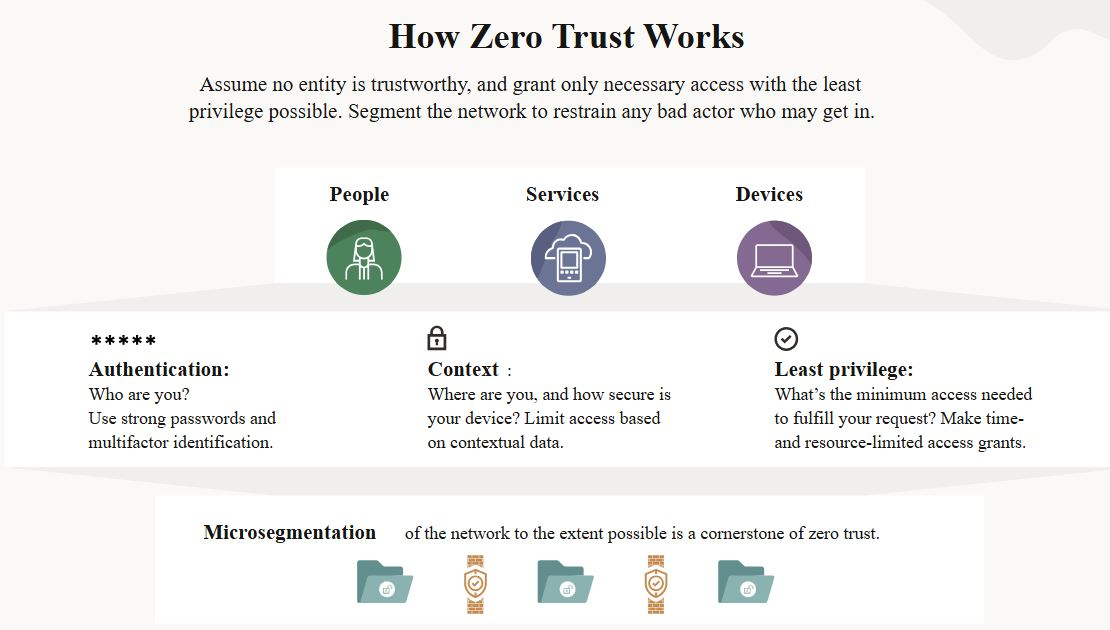
Credit: Oracle
The zero trust security model operates on the principle of continuous user verification and strict access controls to safeguard resources. Instead of relying solely on perimeter defenses, it assumes that threats may already exist within the network. Therefore, it employs layered security measures and constant monitoring to detect potential breaches. Access is tightly segmented, limiting what a user or system can reach without undergoing additional authentication steps.
According to CyberArk, Zero Trust is fundamentally a strategic cybersecurity approach designed to secure today’s evolving digital ecosystems, which often involve public and private cloud platforms, SaaS tools, DevOps practices, and robotic process automation (RPA). It serves as an essential framework that all organizations should implement and comprehend. Identity-driven Zero Trust tools, such as single sign-on (SSO) and multi-factor authentication (MFA) help ensure that only verified users, devices, and applications are granted access to corporate systems and data.
What Zero Trust Is Not
The growing misconception of zero trust is concerning. Ideally, zero trust is not one tangible product but rather a philosophy. Zero trust is basically a security ideology emphasizing “never trust, always verify” and “assuming breach.” Attempting to buy Zero Trust as a product sets organizations up for failure.
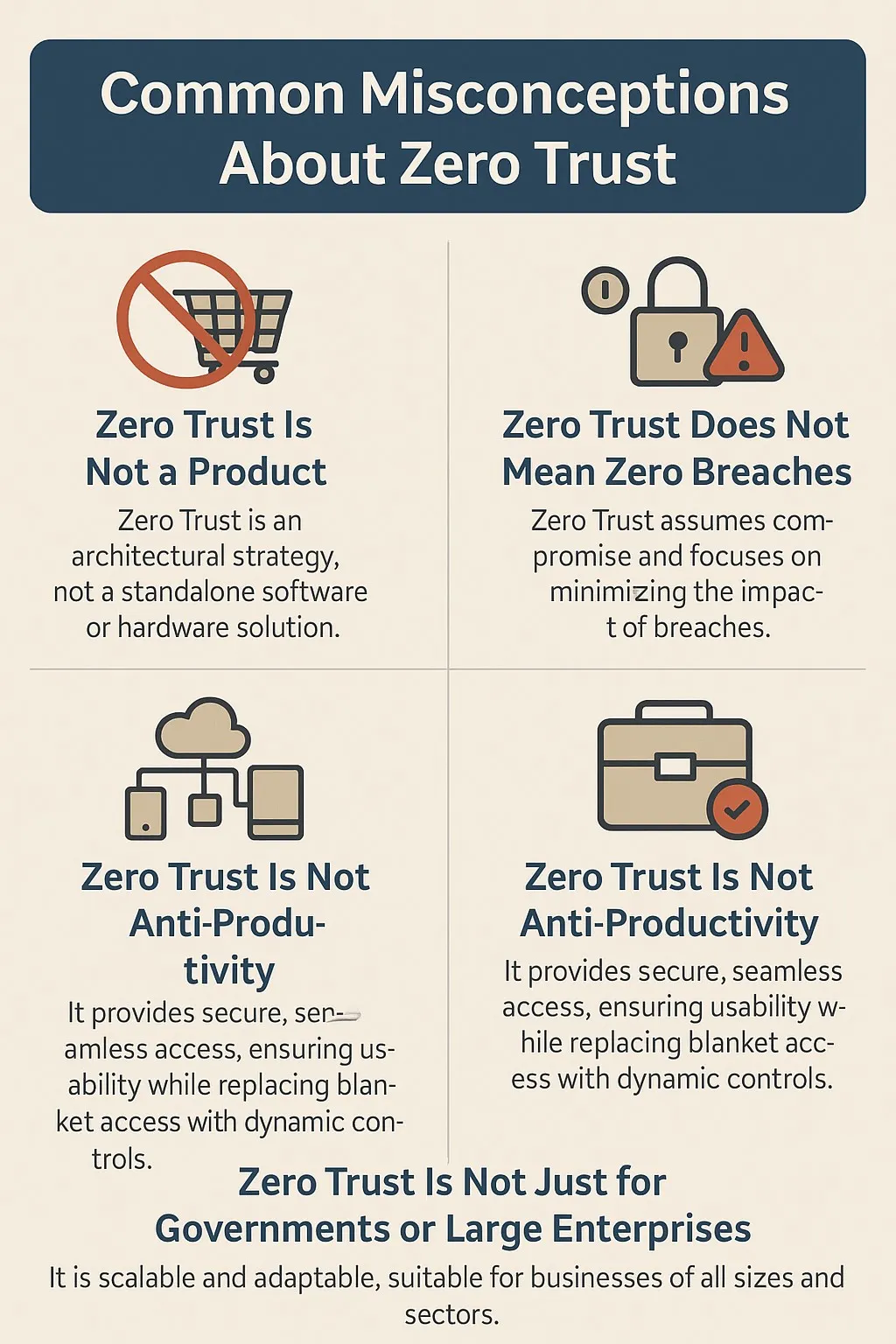
Zero Trust Is Not a Product
The majority of people wrongly believe that you can adopt Zero Trust by buying one hardware or software product. In fact, Zero Trust is a complete security design methodology and plan, not a product. According to NIST SP 800-207, the Zero Trust model is composed of principles, design patterns, and policies for identity, access control, endpoint security, network segmentation, and continuous monitoring.
Zero Trust involves bringing together a series of technologies such as single sign-on (SSO), multi-factor authentication (MFA), policy engines, encryption, and behavioral analytics. To think of Zero Trust as a product in a box leads to half-measures and typically ineffective deployments that fail to deliver on its basic promise: eliminating implicit trust at all levels of access.
Zero Trust Does Not Mean No Breaches
Another common misconception is that Zero Trust prevents all breaches. It doesn't. Zero Trust assumes breaches are inevitable or are already occurring and therefore focuses on reducing their impact. This approach is called "assume breach," and it changes the security posture from defensive to proactive. Instead of relying on perimeter security, Zero Trust depends on microsegmentation, least-privilege access, and context-based authentication. Even if an attacker achieves initial access through a stolen credential or vulnerable endpoint, damage is contained since further lateral movement and data exfiltration are greatly restricted. Thus, Zero Trust is not breach-proof but breach-resilient.
Zero Trust Does Not Stop at Network Borders
Conventionally, security has been based on the strong perimeter; once within, things were pretty much trusted. Zero Trust breaks this old philosophy. It eliminates the assumed trust within and outside the network, scrutinizing every access attempt as being possibly malicious. This is particularly important in today's cloud-first, hybrid, remote work environments where users and data exist outside the traditional enterprise boundary. Irrespective of whether a user is logging in from inside an office or a public Wi-Fi connection, they are required to go through the same stringent authentication and policy checks. Both NIST and Microsoft describe Zero Trust as extending security beyond the network to include devices, workloads, applications, and users wherever.
Zero Trust Isn't Anti-Productivity
One of the greatest concerns across organizations is that Zero Trust will slow down users or make things more difficult. The fact is that modern Zero Trust models are designed to enhance security without diminishing usability. Single Sign-On solutions remove login friction, and adaptive authentication adjusts security controls on the fly based on context (e.g., location, device, or behavior). Enacted effectively, Zero Trust actually simplifies access by automating and maximizing the authentication process, giving users safe access to just what they need, when they need it. It takes advantage of blanket access with granular, dynamic controls, limiting friction and compliance without limiting productivity.
Zero Trust Is Not Only for Governments or Large Enterprises
The perception that Zero Trust is being used for government agencies or Fortune 500 companies alone is not true. While it did originate from organizations like the U.S. Department of Defense and National Institute of Standards and Technology (NIST), Zero Trust ideas find successful application in small and medium businesses (SMBs). Cloud-native Zero Trust solutions, offered by companies like Microsoft, Google, and Okta, are now available and customizable for any-sized organizations. With the rise of ransomware and phishing attacks against small organizations, adopting Zero Trust has never been so important, regardless of organization size or industry.
Why You Can’t Ignore Zero Trust in 2025
According to CyberArk, in comparison to 2021, ransomware breaches increased by 13%, which is more than the previous five years put together. In the same vein, it was reported that in the previous years, 71% of firms experienced a successful software supply chain-related attack that compromised assets or caused data loss. Similarly, in 2022, the average cost of a data breach reached a record-breaking $4.35 million.
From the foregoing, one could adjudge the intricate role Zero Trust is playing in asset security. Similarly, the news these days is dominated by cybersecurity events, from ransomware and phishing to denial-of-service attacks. Organizations now have to link their security rules with business goals due to the rise in cloud apps, mobile devices, remote workers, and IoT-connected devices. Adopting procedures, technology, and policies that promote business agility and improve security is what it means to embrace zero trust.
The question is no longer if you need zero trust, but rather how soon you can get it, as corporate perimeters are rapidly disappearing and attackers are becoming more daring. The main forces behind the adoption of Zero Trust suppliers are listed below:
- Hybrid & Multi-Cloud: Businesses that use on-site systems, AWS, Azure, and Google Cloud build intricate networks with numerous points of entry. Users must re-authenticate for every resource and role in a Zero Trust architecture, which enforces uniform security policies across all contexts.
- Remote Workforces: Traditional VPNs don't scale well as more people work from home. After centralizing identity verification, Zero Trust grants access based on context-based parameters like device posture, geolocation, or threat intelligence. As the number of remote users rises, this method outperforms standard VPNs in terms of security and offers a smoother user experience.
- Advanced Threats: Attackers use zero-day exploits, phishing, and credential stuffing to get beyond conventional defenses. Zero trust businesses include AI-powered detection in every attack phase, which can thwart malicious lateral movement or halt the danger during the authentication stage.
- Regulatory Compliance: Strict and auditable logging and controls related to data access are required by laws including HIPAA, PCI DSS, and GDPR. Cybersecurity firms using zero-trust practices monitor simultaneously before implementing micro-segmentation. This facilitates the compliance audit, which could demonstrate the low level of data exposure.
- Supply Chain & Business-to-Business Cooperation: Businesses are integrating with suppliers, partners, and contractors more and more. A Zero Trust strategy isolates the resources and permits fine-grained role-based access to reduce supply chain risks. Excessive exposure of internal resources can be disastrous if a partner system is compromised.
- Reduced Attack Surfaces: There are a lot of trust segments in traditional networks. Numerous other segments may also be accessible after one is compromised. By limiting users or devices to just the programs and data necessary for them to perform their roles, Zero Trust eliminates wide zones of trust. By limiting the compromise to a smaller area, this lessens the impact of a possible breach.
Roadmap to Implementing Zero Trust
You can create and implement your zero trust cybersecurity framework with the aid of the following zero trust guidelines. They can assist you in creating a solid breach avoidance and data loss prevention (DLP) plan. A useful guide for implementing zero trust is provided here.
Identify the Source of Attack
Your zero trust checklist should start with defining your attack surface. You want to focus on the regions that require protection in order to do this. By doing this, you won't be overburdened with deploying tools and putting policies into place throughout your network. Pay attention to your digital assets that are most valuable.
Areas Prone to Attack
Sensitive Data: This contains employee and customer information as well as confidential data that you don't want a thief to have.
Important applications: Applications that are essential to the effective operation of your company.
Physical Assets: These can include medical equipment, Internet-of-Things (IoT) gadgets, and point-of-sale (PoS) terminals.
Corporate Services: These comprise the components of your infrastructure that help executives and staff with their daily tasks as well as those that assist customer contacts and sales.
Put Restrictions in Place for Network Traffic
The dependencies that each system needs will frequently determine how traffic moves through your network. For instance, a database containing information about customers, goods, or services must be accessed by numerous systems.
Therefore, requests don't just "go into the system." Instead, they must pass a database that contains delicate and sensitive data and architecture. You may choose which network controls to install and where to put them by being aware of these kinds of specifics.
Create a Network With No Trust
There is never a one-size-fits-all solution; instead, a zero trust network is built around your unique protect surface. A next-generation firewall (NGFW), which can serve as a tool for segmenting a portion of your network, may typically be the first component in your architecture. Multi-factor authentication (MFA) should also be implemented eventually to guarantee that users are carefully screened before being given access.
Establish a Policy of Zero Trust
Designing your zero trust policy should come after network architecture. The Kipling Method is the most efficient way to accomplish this. Every user, device, and network that wishes to have access must have their who, what, when, where, why, and how questions answered.
Network Monitoring
Network activity monitoring can help you identify any problems early and offer insightful information for improving network performance without sacrificing security.
Conclusion
Zero Trust is a process, not a task. Zero Trust is not something you do once or a security checkbox you mark in an audit. Zero Trust is a transformation process of thinking and acting differently that demands continuous iteration, refinement, and adaptation to emerging threats and technology. Organizations must understand that using Zero Trust is not about reaching some finite end state; it's about creating a security posture that is agile, relevant, and resilient.
As computer systems grow more complicated, merging cloud services, remote workers, mobile endpoints, and AI applications, the Zero Trust model must also change. We need to further develop identity and access management, network segmentation, data monitoring, and behavioral analysis to keep pace with evolving threats. We must examine policies again, update technologies, and re-analyze user behaviors.
Zero Trust also necessitates cooperation between different departments, for example, IT, security, HR, legal, and business leaders. Zero Trust is not just the responsibility of cybersecurity professionals but a shared responsibility that contributes to the trust and resiliency of an organization in the cyber world.
Lastly, adopting Zero Trust as a strategy is not a check-box exercise but a journey to be embarked upon. Each step brings visibility, reduces attack surfaces, and strengthens the ability to respond to compromise. And it is in that continuously unfolding walk that its power lies.
Published at DZone with permission of Olaitan Bada. See the original article here.
Opinions expressed by DZone contributors are their own.
Comments