

Architecting Zero-Trust Database Access in Kubernetes With Vault Dynamic Secrets
Replace static passwords with dynamic, ephemeral credentials using Vault and sidecar injection to automate database security in Kubernetes workloads.
 ·
·
Join the DZone community and get the full member experience.
Join For FreeThe Death of the Static Credential: An Operational Imperative
In modern software architecture, speed is the primary driver of innovation. We deploy faster and scale wider, yet this velocity introduces a parallel vector of risk: complexity. Amidst this, one vulnerability remains persistently simple: the static database credential.
For decades, the "database password" was a fixed artifact. In the monolithic era, this was manageable. In the era of Kubernetes and ephemeral infrastructure, it is a liability. Zero trust is now an architectural mandate: trust is never granted implicitly based on network location. In the database layer, this necessitates the elimination of "standing privileges."
1. Industry Case Studies: The Risk of Persistence
To understand the importance of dynamic secrets, we must examine historical security patterns. The common thread in many cloud security incidents is not the failure of encryption, but the persistence of leaked credentials.
- Credential lifecycle failures: Analysis of historical cloud breaches suggests that static administrative keys, once compromised, allow for persistent access. If keys are not programmatically rotated, the window of vulnerability remains open indefinitely.
- The "Secret Sprawl" phenomenon: Static secrets inevitably leak into source code repositories, logs, and developer workstations. This "sprawl" makes manual rotation nearly impossible to execute without downtime.
- Over-privileged identities: Even temporary credentials can have a high "blast radius" if they lack granular, identity-based scoping, a problem that dynamic secrets are uniquely positioned to solve.
2. The Dynamic Secret Paradigm Shift
Dynamic secret management fundamentally inverts the traditional security model. Instead of protecting a single high-value static key, the system generates a unique, ephemeral credential for every application pod that requests access.
This approach delivers three critical advantages:
- Absolute attribution: Every query in the database logs can be traced back to a specific pod and Kubernetes Service Account.
- Minimized blast radius: A stolen key is a "ticking clock," not a skeleton key.
- Surgical revocation: Security teams can revoke a specific lease instantly without requiring a database restart or a broad password rotation ceremony.
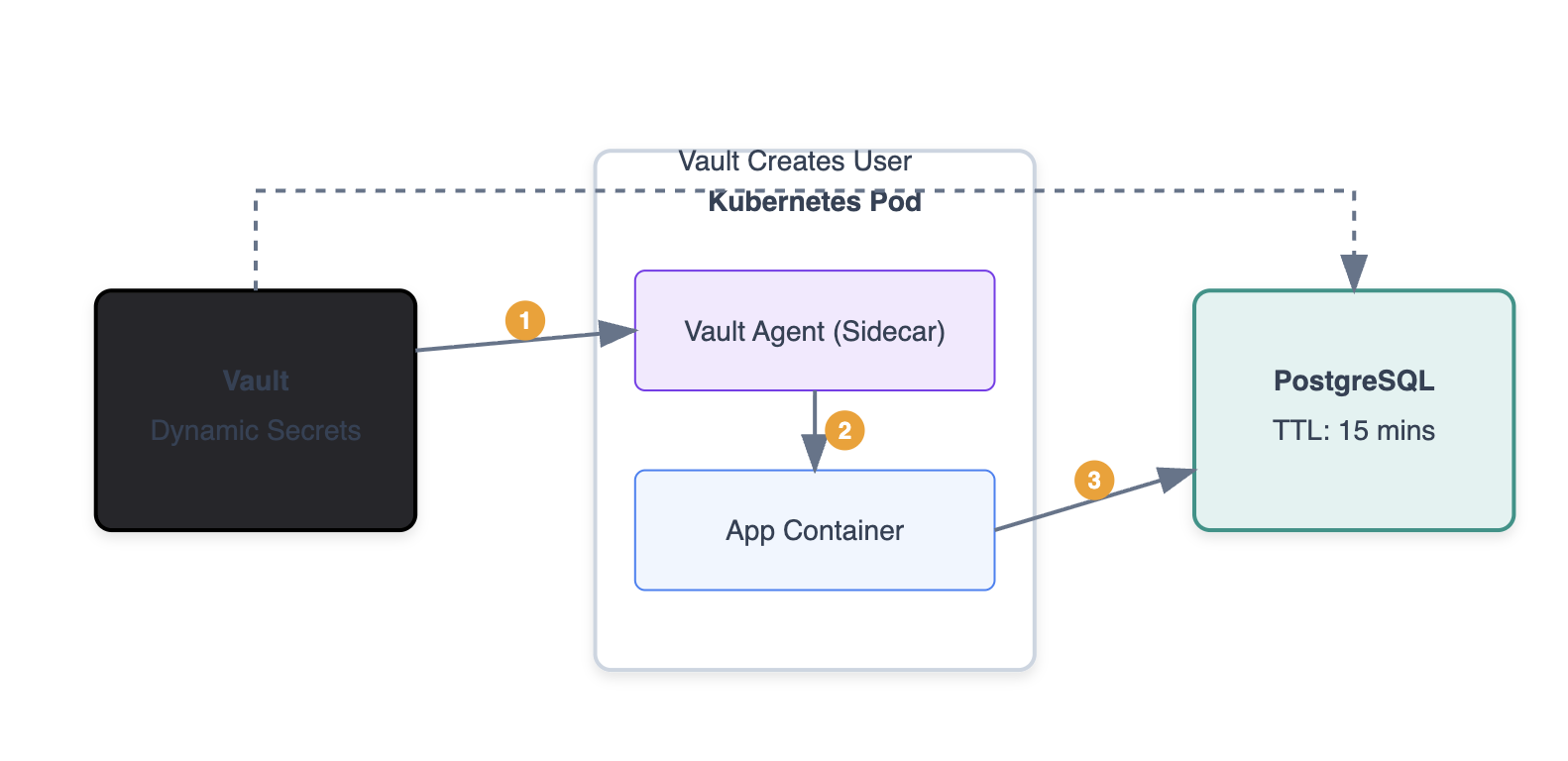 Dynamic secrets workflow with Vault
Architectural Anatomy: Vault, Kubernetes, and the Sidecar Pattern
A production-grade integration utilizes the Vault Agent Sidecar Injector and the Kubernetes Auth Method to solve the "Secret Zero" problem, how to introduce the first secret (the Vault token) without hardcoding it.
1. The Kubernetes Authentication Handshake
Vault authenticates a Kubernetes Service Account (SA) using the JSON Web Token (JWT) signed by the Kubernetes TokenRequest API.
- Agent login: The sidecar reads the JWT and sends a login request to Vault.
- Token review: Vault validates the token with the Kubernetes API to verify the identity and status of the Service Account.
- Token issuance: Vault returns a client token used for subsequent secret retrieval.
2. The Mechanics of the Sidecar Injector
The Injector operates as a Mutating Admission Webhook. If it detects specific annotations (e.g., vault.hashicorp.com/agent-inject: 'true'), it rewrites the pod specification to include two additional containers:
- The Init Container: Performs initial authentication and renders secrets to a shared memory volume (
/vault/secrets/) before the application container starts. - The Sidecar Container: A long-running process that renews the Vault token and watches the secret's Time-To-Live (TTL). When a secret is near expiration, the Agent requests a new one and rewrites the shared file in real-time.
The Engine Room: PostgreSQL Dynamic Secrets Configuration
The value of this architecture is realized in the dynamic generation of database credentials. This creates a moving target for attackers. The setup requires a privileged user on the database instance with CREATEROLE privileges.
The Role Definition
The role defines the permissions and lifespan of the ephemeral user.
vault write database/roles/app-role \
db_name=postgres \
creation_statements="CREATE ROLE \"{{name}}\" WITH LOGIN PASSWORD '{{password}}' VALID UNTIL '{{expiration}}'; \
GRANT SELECT, INSERT, UPDATE, DELETE ON ALL TABLES IN SCHEMA public TO \"{{name}}\";" \
default_ttl="1h" \
Insight: The VALID UNTIL Defense By including
VALID UNTIL '{{expiration}}', the database will independently reject the credentials even if Vault becomes unreachable and cannot execute a revocation, ensuring a "fail-secure" state.
Application Integration: The Art of the Hot Reload
Most applications cache database connections at startup. If the password changes, the cached connections become stale. We need a mechanism for "Hot Reloading" without restarting the pod.
1. The "Watch and Signal" Pattern
This language-agnostic approach uses the Vault Agent’s ability to execute a command after rendering a template.
- Enable process namespace sharing: Set
shareProcessNamespace: truein the pod spec so the sidecar can "see" the application process. - Signal the app: Use an annotation to send a
SIGHUPsignal to the app whenever the secret file is updated.
annotations:
  vault.hashicorp.com/agent-inject-command-db: "pgrep -f my-app-process | xargs kill -HUP || true"
2. Connection Draining Best Practices
To avoid transaction failures, always set your application's connection pool max-lifetime (e.g., in HikariCP) to be significantly shorter than the Vault Lease TTL.
- Vault TTL: 60 minutes
- App pool max-lifetime: 45 minutes
This ensures the application proactively retires connections while the credentials are still valid, ensuring a seamless handover.
Observability and Auditability
In a dynamic secrets environment, "silent failure" is the enemy. Rigorous observability is mandatory to ensure rotation is occurring as expected.
- Audit logs: Enable Vault Audit Logs to correlate "New Role Creation" with "Pod Startup." This provides the evidence needed for forensic attribution.
- Prometheus metrics: Monitor the Vault Agent to ensure it is successfully renewing tokens. A spike in role creation without corresponding pod scaling often indicates a "restart loop" or misconfigured TTL.
Future Trends: Toward Workload Identity
As we look toward 2026, the industry is moving toward SPIFFE/SPIRE to eliminate shared secrets entirely. While we expect more databases to support native mTLS authentication using workload identities in the future, Vault Dynamic Secrets remains the current state-of-the-art for securing the database layer in production Kubernetes environments today.
Conclusion
Implementing zero-trust access is a non-trivial investment in platform engineering. It requires moving away from the comfort of static configuration and embracing the complexity of lease lifecycles. However, the return is a resilient, self-healing architecture.
Opinions expressed by DZone contributors are their own.
Comments