A cloud-native architecture enables organizations to build and run scalable applications in a dynamic environment. However, it does come with several challenges — security, cost, governance, visibility, and more. Let us look at some of the patterns every development team working in the cloud-native space needs to embrace to secure their applications.
Zero-Trust Architecture
Zero trust is a strategic approach to rebuild and modernize security by enforcing strict access controls to protect data, applications, and networks. By inspecting and monitoring network traffic to catch any malicious activity, zero-trust architecture helps reduce the blast radius in case of a compromise. In a cloud-native architecture that uses a combination of microservices and containers, a service mesh helps reduce the surface area of attack and implement the zero-trust security model.
| Pattern |
Anti-Pattern |
| Every entity must authenticate itself, and implicit trust in data and applications is denied even within a network perimeter. |
Not monitoring workloads for misconfigurations and vulnerabilities, and lacking a least-privilege access strategy between components. |
Identity and Access Management
IAM is a core component of the security management posture within an organization that enables the proper entities to access the right resources. IAM protects against compromised access, safeguards resources within the network, and provides comprehensive security against phishing and ransomware attacks.
| Pattern |
Anti-Pattern |
| Following the zero-trust model, each entity is authenticated and authorized when logging in or accessing resources. |
Not visualizing IAM as a framework of policies and processes (SSO, MFA, etc.) to help mitigate risk. |
Principle of Least Privilege
The least-privilege policy grants permissions to only the resources required to perform the task; no other access gets assigned. Having overprivileged users and roles in an organization increases the risk factor. With an increasing number of security breaches caused by privileged credentials, it is best to always validate policies and adopt the least-privilege principle by default.
| Pattern |
Anti-Pattern |
| For IAM policies, start with a minimum set of permissions and grant additional permissions as needed. |
Providing broad permissions, increasing the blast radius and risk factor. |
Secrets Management
Cloud secrets management refers to tools and methods to securely manage secrets — passwords, certificates, SSH keys, encryption keys, and API tokens. You should have a strategy to rotate your passwords periodically. Public cloud providers offer managed services to handle secrets and their management.
| Pattern |
Anti-Pattern |
| Establish, document, and communicate secrets management policies and procedures across development teams. |
Storing sensitive credentials in code repositories. |
Incident Response
Building incident response and triaging strategies are challenging when you have microservices running in a Kubernetes cluster in a cloud-native environment. When you treat your workloads running in containers as cattle and not pets, performing post-mortem analysis and gathering audit trail events become difficult.
Containers spin up and down frequently, so responding to security threats in a transient environment requires a different strategy. Incident response is critical to resolving security issues efficiently and spreading awareness within your organization about operational duties.
| Pattern |
Anti-Pattern |
| Create an incident response playbook, and maintain access to observability tools and data, including logs, metrics, and traces. |
Lacking proper audit trails or monitoring to support troubleshooting activities. |
Data Protection
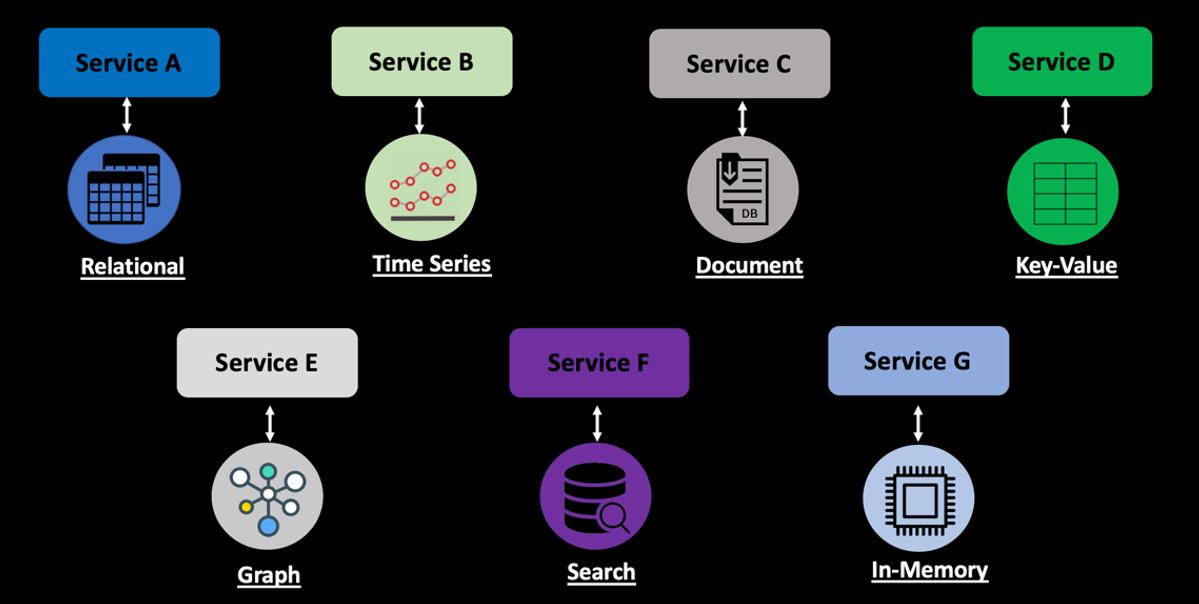
Cloud-native microservices support polyglot persistence; therefore, development teams have flexibility in choosing the appropriate database technology, as seen in Figure 2, for developing their services. These data stores can store both structured and unstructured data to support a variety of functions like search, reporting, time series, caching, and transactional.
| Pattern |
Anti-Pattern |
| Support critical data management functions (e.g., backup/recovery, data replication) and maintain compliance with regulations and laws (e.g., HIPAA, GDPR) to protect consumer rights. |
Excluding data from automated CI/CD pipelines. |
Figure 2: Polyglot persistence in cloud-native applications
Container Image Security
Many organizations are running containerized workloads in production. Containers make it easy to package, deploy, and run your code, thereby increasing the speed and portability of your application. It is necessary to secure the container image in order to secure your environment. Organizations can leverage open-source tools to detect anomalous behavior of applications running inside containers and send timely alerts. A continuous and automated monitoring strategy is needed to address the increasing security risks associated with container environments.
Ensure that images do not contain any known vulnerabilities, passwords and sensitive data, or misconfigurations, and that they are downloaded from trusted providers. Regularly scanning container registries is recommended to boost the quality of containerized deployments.
| Pattern |
Anti-Pattern |
| Implement vulnerability scanning of container images before deploying them to production. |
Lacking an automated strategy for periodic container image scanning. |
Threat Modeling
Developing services in the public cloud can trigger new security threats like malware and ransomware. You can leverage managed services from cloud providers or third-party vendors that use machine learning and AI to identify security threats and vulnerabilities across your organization.
| Pattern |
Anti-Pattern |
| Continuously monitor cloud resources, maintain unified visibility into security incidents, and develop a strategy to detect unauthorized activities. |
Lacking policies for detecting malicious activities like suspicious user actions, unsuccessful login attempts, and network anomalies. |
Infrastructure as Code
Cloud-native architectures leverage the principle of immutability to manage infrastructure resources. If you need to make any configuration changes, you do not modify the server; instead, build a new server with the updated configuration. IaC ensures consistency between environments and enables better DevOps practices by deploying infrastructure code in an automated and repeatable manner.
Development and security teams can use IaC tools to create guardrails, implement policies, patch vulnerabilities, and fix configuration issues seamlessly across environments without worrying about drifts.
| Pattern |
Anti-Pattern |
| Ensure all infrastructure changes are peer reviewed and stored via source control for increased visibility. |
Making infrastructure changes manually, creating configuration drifts across environments. |
Runtime Visibility
With enterprises growing their workloads rapidly and adapting multi-cluster/multi-cloud environments, it is crucial to have a centralized view of your systems. Furthermore, to have a sound observability strategy, you need to continuously profile your applications and collect a considerable volume of data around the clock.
| Pattern |
Anti-Pattern |
| Provide observability to teams as a platform offering, not something they must build and maintain for individual services. |
Lacking robust security tooling to support high volumes of logs, metrics, and trace data produced by applications. |