

From History to the Future of AI Communication—IPC to MCP and A2A
MCP and A2A are stablishing standards while existing middleware markets are promising to provide the rails. The comparison and the outlook.
Join the DZone community and get the full member experience.
Join For FreeGoogle has explicitly positioned its A2A protocol as complementary to Anthropic's MCP, aiming to address different yet related aspects of building sophisticated agentic systems. The core distinction lies in the layer of interaction each protocol standardizes. MCP focuses on the connection between a single AI agent and its external resources (tools and data), while A2A focuses on the communication and collaboration among distinct AI agents.
Architecturally, they operate at different levels. MCP governs the agent-to-resource interface, while A2A governs the agent-to-agent interface. In a typical multi-agent workflow, one agent (the client) might use A2A to request assistance from another specialized agent (the server). This server agent might then use MCP to interact with various tools or data sources required to fulfill the task requested via A2A, before sending the result back using A2A.
Despite being positioned to complement, some discussion exists within the community regarding potential overlap or tension between the two protocols. Could MCP's capabilities, particularly 'Sampling', be extended to handle agent-to-agent communication, making A2A redundant? Google's current strategy appears to be one of supporting both standards publicly while advocating for A2A as the preferred mechanism for inter-agent coordination, effectively hedging its bets. Unclear boundaries or vendor promotion of competing protocol extensions and interpretations could lead to protocol fragmentation or a "war." This situation would cause developer confusion, increased complexity, and the necessity of supporting multiple overlapping standards.
The Evolution: IPC to iPaaS to AI Agent Connectivity
The necessity for concurrently operating processes within a single operating system to exchange data and synchronize operations led to the development of inter-process communication (IPC). The need of computer networking extended these concepts beyond a single machine with Sockets as major abstraction. This gave rise to standardized interface for network communication like TCP and UDP (and specialized protocol like SMTP and FTP) the former was the foundation of emergence of HTTP provided a flexible protocol for the World Wide Web. The distributed system growth, complexity and heterogeneous nature led to the development of various middleware platforms, each addressing specific integration challenges. MCP and A2A are the most recent addition to this list through the advancements in Agentic AI.
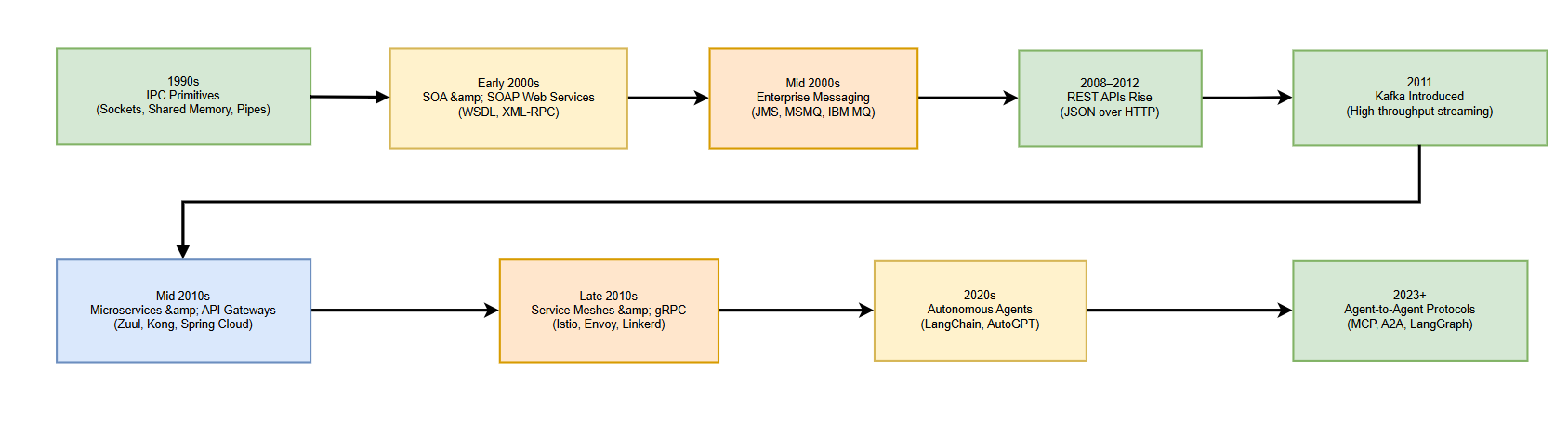
Communication platform development trends towards higher abstraction, hiding network complexities and system differences. Standardization via protocols, APIs, and de facto standards is crucial for interoperability and ecosystem expansion. Decoupling improves resilience, scalability, and independent development by reducing dependencies. Distributed execution is often paired with centralized control and policy management, adapting to architectural shifts from monolithic systems and SOA to microservices, cloud-native, and now, AI agentic systems. Each paradigm shift resolves old issues while introducing new integration and communication challenges, fostering further innovation. This cyclical progression indicates that agent-to-agent communication will likely follow a similar evolutionary path, leveraging or modifying existing approaches.
| Middleware | Primary Flow | Purpose | Coupling | Key Features |
|---|---|---|---|---|
| Message Queue | Async (E-W) | Reliability, Decoupling | Loose | Guaranteed Delivery, Reprocessing, Message Buffering |
| Event Bus | Async (E-W/N-S) | Reactivity, Broadcasting/Decoupled Event Propagation | Loose | Event Routing, Publish-Subscribe |
| API Gateway | Sync (N-S) | API Management, External Access Control | Tight | Policy Enforcement, Request Routing, Rate Limiting, Security |
| Service Mesh | Sync (E-W) | Service Communications, Observability, Reliability | Tight | Traffic Control (routing, load balancing), Security (mTLS), Observability (metrics, tracing) |
| iPaaS | Hybrid (N-S) | Integration & Workflow *AI Agent building capabilities are being integrated with the offering rapidly |
Loose | Connectors, Orchestration,Data Transformation, Workflow Automation, API Hosting *Often Bundled with Message Queues and API Gateways as product. |
Reaction to the Opportunity: Incumbent Platforms
The emergence of A2A, MCP, and the broader agentic AI paradigm is prompting significant adaptation and strategic positioning from a wide range of incumbent technology vendors. These platforms provide the foundational layers and enabling technologies upon which effective AI communication and agent operation depend. Below are the feature matrix based comparison of incumbent platforms in each area.
Major Technology Platforms (Software and Cloud)
| Vendor | Platform / Initiative | Role / Focus Area | Key Capabilities / Contributions |
|---|---|---|---|
| Vertex AI Agent Builder, Apigee | A2A protocol developer & API management governance | Developed A2A protocol; integrated into Vertex AI; governs agent interactions via Apigee as managed API endpoints | |
| Microsoft | Azure AI Foundry, Copilot Studio | Enabler of cross-platform multi-agent AI via A2A | Integrates A2A into Azure; supports Semantic Kernel agents; uses Entra for identity and AI Content Safety for trust |
| OpenAI | OpenAI Agents SDK, MCP server support | Multi-agent workflows & tool use | Focus on handoffs, safety, and tool interoperability; supports MCP servers to enable ecosystem integration |
| Salesforce | A2A partner initiative | Business automation via multi-agent collaboration | Exploring lead generation, HR, and support agents; aims to connect via Workday and other platforms using A2A/MCP |
| SAP | SAP BTP, ABAP integration | Enterprise coordination & ABAP interoperability with remote agents | Investigates HANA Cloud search agents, MCP integration in ABAP for tool-enabled coordination |
| ServiceNow | AI Agent Fabric, AI Control Tower | Native and 3rd-party agent orchestration | Building a governance framework for agent comms (AI Control Tower) and seamless native/remote agent coordination |
Traditional Middleware and Data Virtualization Vendors
| Vendor | Platform | Role / Layer | Core Capabilities | Relevance to A2A / MCP |
|---|---|---|---|---|
| Confluent | Kafka / Confluent Platform | Communication Backbone / Event Log | Event Streaming, Pub/Sub, Durability, Schema Registry | Transport for A2A messages; Log for MCP events (tool use, resource changes) |
| Solace | PubSub+ / Solace Agent Mesh | Event Mesh Framework / Orchestration | Event Brokering, Pub/Sub, EDA, SAM SDK | Transport for A2A; SAM framework potentially implements/uses A2A & MCP |
| Palo Alto Networks | PAN Security Fabric | Security Enforcement / Threat Detection | Firewalling, Threat Intel, Runtime Security, Access Control | Securing A2A communication flows & MCP interactions; Addressing agent-specific threats |
| Denodo | Denodo Platform | Governed Data Access Layer | Data Virtualization, Abstraction, Security, Governance | Providing secure, unified data access for agents, likely via MCP tools/resources |
Compute Platform Vendors
| Vendor | Key Offerings | Software Stack / Ecosystem | Relevance to AI Agents & Communication |
|---|---|---|---|
| NVIDIA | H100 GPUs, Blackwell architecture, DGX Systems | CUDA, NVIDIA AI Enterprise | Core compute for training/inferencing LLMs powering agents and agent comms |
| Intel | Xeon CPUs (with AI), Gaudi accelerators | oneAPI, Intel AI Platforms | Flexible compute for AI agents and communication layers |
| AMD | EPYC CPUs, Instinct MI-series GPUs (e.g., MI300X) | ROCm, AMD AI Solutions | Competitive AI training/inference platform for responsive agent ecosystems |
| Oracle Cloud (OCI) | Bare-metal NVIDIA GPU instances, AI services (e.g., Cohere partnership) | Oracle Cloud Infrastructure AI | Scalable multi-agent deployment environment with strong communication backbones |
General and Specialized Storage Solution Providers
| Vendor | Platform / Offering | Core Focus Area | Key Capabilities / Contributions |
|---|---|---|---|
| Dell Technologies | PowerEdge Servers, PowerScale, PowerStore | Enterprise AI Infrastructure | Scalable compute and high-performance storage for AI model training and agent-based operational workloads |
| HPE | HPE Cray, GreenLake, Alletra | Edge-to-Cloud AI Infrastructure | AI-optimized compute and storage; supports data-intensive agent systems with high-speed access and resilience |
| NetApp | Unified Data Infrastructure for AI | Hybrid Cloud Data Management | Intelligent data pipelines and seamless data movement for agent training and inference in hybrid environments |
| Pure Storage | All-Flash Arrays for AI/ML | High-Speed, Low-Latency Storage | Ultra-fast data access for training/inference; enhances real-time responsiveness of AI agents |
NoSQL Databases and Data Platforms
| Vendor | Platform / Offering | Core Role in AI/Agent Workflows | Key Capabilities |
|---|---|---|---|
| MongoDB | MongoDB Atlas with Vector Search | Contextual Memory + RAG Storage | Stores vector embeddings alongside operational data for semantic search and agent memory |
| Redis | Redis Stack + Vector Similarity Search | Real-Time Context + Low-Latency Feature Store | In-memory store for quick session data, model caching, and vector search for responsive agent queries |
| Elasticsearch | Elasticsearch with Dense/Hybrid Search | Semantic Search + Info Retrieval | Supports vector + keyword hybrid search, ideal for agents needing fast retrieval in RAG pipelines |
| Cassandra | Apache Cassandra | Scalable Ops Data Store | Distributed, high-availability NoSQL store for telemetry, logs, or agent-generated data |
| Couchbase | Couchbase Server | Flexible Edge & Mobile Data Layer | Syncs agent data at edge, supports analytics, and flexible schema for unstructured agent state |
| Neo4j | Neo4j Graph Database | Reasoning & Knowledge Representation | Enables knowledge graphs for agents, facilitating structured reasoning and explainability |
| Databricks | Databricks Lakehouse + Unity Catalog | End-to-End AI Data & Model Pipeline | Integrated environment for data engineering, training, and vector-based reasoning by agents |
| Snowflake | Snowflake Data Cloud + Cortex | Unified Data Access + AI/ML Extensions | Supports unstructured data, model integration, and native vector functions for semantic reasoning by agents |
The commitment of these technology platforms, middleware, foundational hardware, general storage, and specialized NoSQL/vector database vendors is essential. They provide the underlying power, speed, and data accessibility (often tailored for AI-specific needs like semantic search or graph traversal) that enable AI agents to function, learn, remember, and communicate effectively. Their ongoing advancements directly contribute to the growing capabilities of the entire agentic AI ecosystem.
A2A Requirements vs. Incumbent Capabilities
Below is a matrix heatmap showing how well each major vendor/platform meets each A2A/MCP requirement. The strength of each capability is represented using:
*** = Strong support
** = Moderate support
* = Basic/Partial support
X = Not supported / irrelevant / N/A
Major Technology Platforms
| Vendor / Platform | Role / Focus Area | Scalability | Reliability | Security | Dynamic Discovery | Orchestration & State | Agentic Communication | Latency Sensitivity |
|---|---|---|---|---|---|---|---|---|
| Google (Vertex AI, Apigee) | A2A protocol dev + API mgmt | *** | ** | *** | ** | ** | ** | ** |
| Microsoft (Azure AI, Entra) | Cross-platform A2A + trust | *** | *** | *** | ** | *** | ** | ** |
| OpenAI (Agents SDK, MCP) | Multi-agent workflows | ** | ** | ** | ** | *** | *** | ** |
| Salesforce (A2A initiative) | Business agent collab | ** | ** | ** | * | ** | ** | * |
| SAP (ABAP, BTP) | Enterprise coordination | ** | ** | ** | * | ** | * | * |
| ServiceNow (AI Fabric, Tower) | Native/remote agent orchestration | ** | ** | *** | ** | *** | ** | * |
Traditional Middleware and Event Infra
| Vendor / Platform | Role / Focus Area | Scalability | Reliability | Security | Dynamic Discovery | Orchestration & State | Agentic Communication | Latency Sensitivity |
|---|---|---|---|---|---|---|---|---|
| Confluent (Kafka) | Event log + Transport | *** | *** | * | X | * | X | *** |
| Solace (PubSub+) | Event mesh + SDK | *** | ** | ** | X | ** | X | ** |
| Palo Alto (PAN Fabric) | A2A security | * | * | * | X | X | X | ** |
| Denodo Platform | Data virtualization | ** | ** | *** | * | X | X | * |
Compute, Storage, and Infrastructure
| Vendor / Platform | Role / Focus Area | Scalability | Reliability | Security | Dynamic Discovery | Orchestration & State | Agentic Communication | Latency Sensitivity |
|---|---|---|---|---|---|---|---|---|
| NVIDIA (H100, DGX) | AI compute | *** | ** | * | X | X | X | *** |
| Intel (Xeon, Gaudi) | Flexible AI compute | ** | ** | * | X | X | X | ** |
| AMD (EPYC, MI300X) | AI inference | ** | ** | * | X | X | X | ** |
| Oracle OCI | Cloud AI infra | *** | ** | ** | * | * | * | ** |
| Dell / HPE / NetApp / Pure | Storage & compute infra | *** | *** | ** | X | X | X | *** |
NoSQL / Vector DBs
| Vendor / Platform | Role / Focus Area | Scalability | Reliability | Security | Dynamic Discovery | Orchestration & State | Agentic Communication | Latency Sensitivity |
|---|---|---|---|---|---|---|---|---|
| MongoDB Atlas (Vector) | Agent memory (RAG) | *** | ** | ** | * | X | ** | ** |
| Redis Stack | Realtime memory/store | ** | ** | * | X | X | ** | *** |
| Elasticsearch | Semantic retrieval | *** | ** | ** | * | X | ** | *** |
| Cassandra | Agent ops data | *** | ** | * | X | X | * | ** |
| Couchbase | Edge/mobile sync | ** | ** | * | X | * | * | ** |
| Neo4j | Graph reasoning | * | * | * | X | * | ** | * |
| Databricks | Full pipeline + vector | *** | ** | ** | * | ** | *** | ** |
| Snowflake | Unified data + vector | *** | *** | ** | ** | ** | ** | ** |
Build New or Adapt Existing?
Given the requirements of A2A communication and the capabilities and limitations of incumbent offerings, technology leaders face a strategic decision: should they leverage and adapt mature middleware platforms for agent communication, or should they invest in potentially new, specialized platforms purpose-built for this task? Below is a quick starter decision flow chart and a feature radar table.
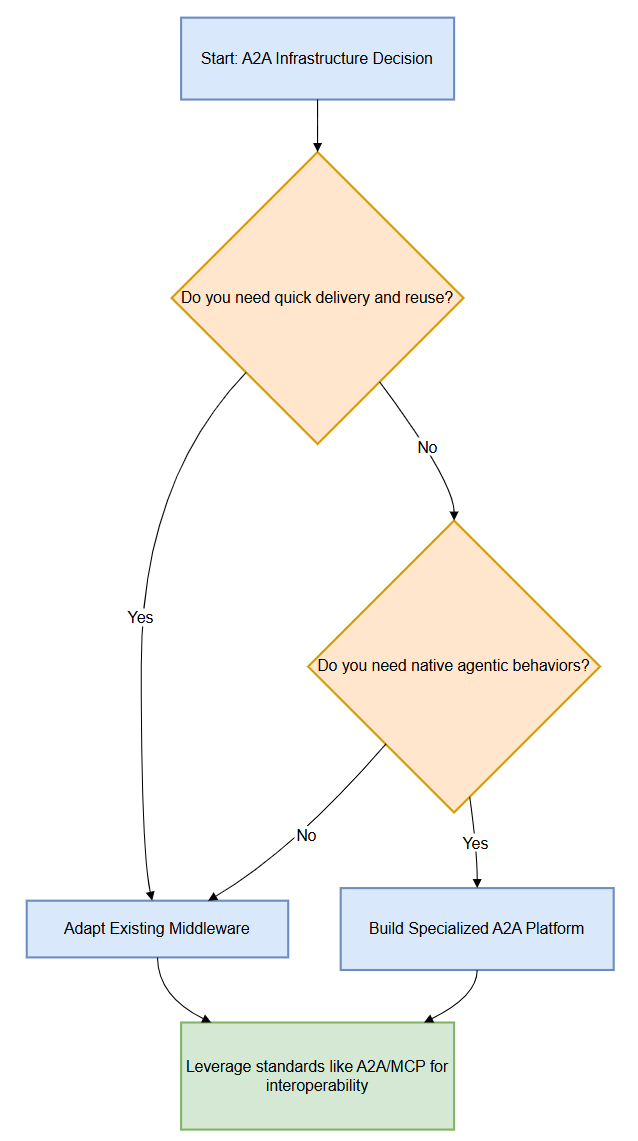
| Criteria | Adapt Existing Platforms | Build Specialized A2A Platforms |
|---|---|---|
| Time-to-Market | Fast | Slow |
| Feature Maturity | High (reliable, observable) | Immature (initially) |
| Ecosystem & Integrations | Rich (connectors/tools) | Limited (initially) |
| Fit for Agentic Patterns | Limited (impedance mismatch) | High (purpose-built) |
| Customization Effort | High (extensions needed) | Tailored from start |
| Innovation Speed | Constrained by legacy | Rapid & flexible |
| Risk & Cost | Lower upfront | Higher initial investment |
| Market Interoperability | Via standards (A2A, MCP) | Requires traction & trust |
Navigating the A2A Market Formation
The emergence of A2A and MCP protocols, alongside the broader push towards multi-agent AI systems, is not just a technical evolution but also a significant economic event, creating new market opportunities, competitive dynamics, and potential pitfalls.
Market Drivers vs. Strategic Risks
| Category | Drivers (Opportunities) | Risks (Pitfalls) |
|---|---|---|
| Efficiency | - Automation reduces costs - Fewer brittle systems |
- Underestimated complexity of agent ecosystems |
| Innovation | - New agent capabilities - Agent marketplaces |
- Premature standardization stifling future innovation |
| Market Forces | - Platform expansion (Kafka, Apigee) - Startups |
- Vendor lock-in, market fragmentation |
| Standardization | - A2A + MCP enable interoperability | - Creates uniform attack surfaces - Standards may ossify too early |
| Security | - Trust frameworks emerging | - New threat surfaces: prompt injection, impersonation, misuse |
| Governance | - Potential for compliance-aware agents | - Difficult traceability, unclear accountability in agent behavior |
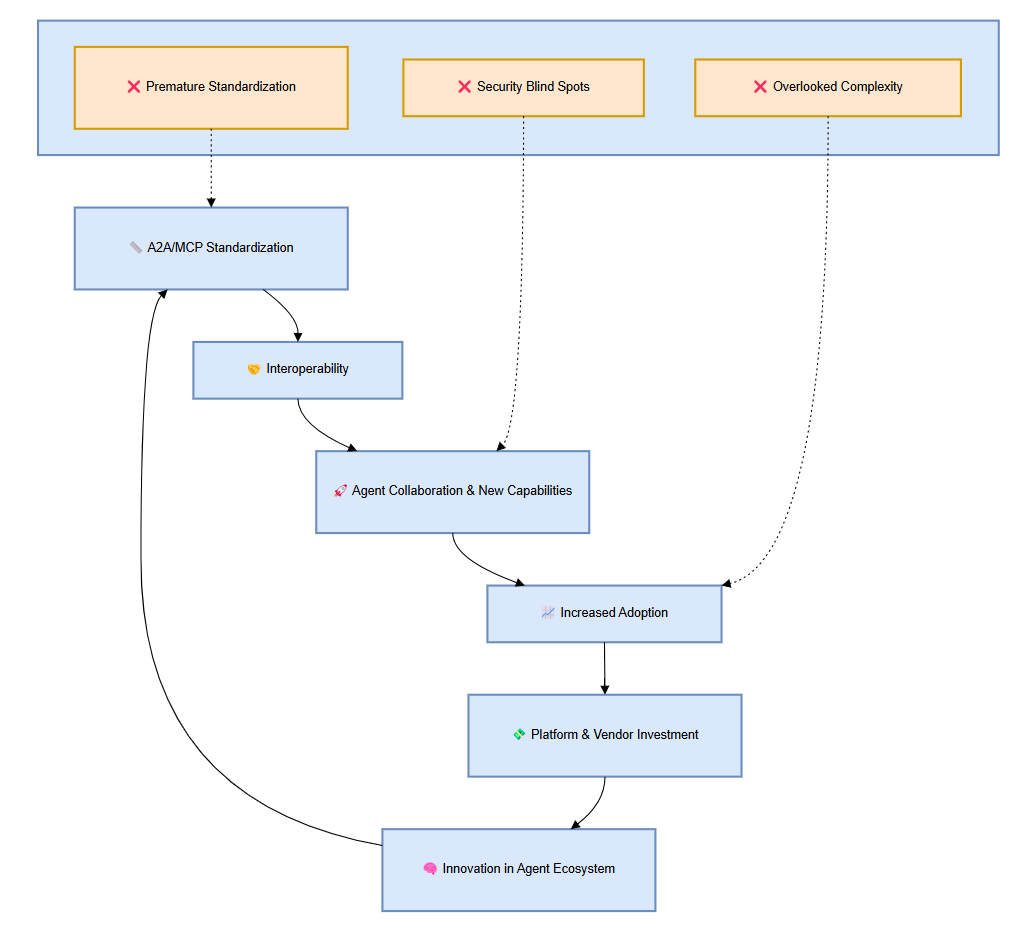
A2A Economic Feedback Loop
The standardization can drive ecosystem growth by fostering interoperability, easing integration, and encouraging the development of supporting tools, benefiting both vendors and users through market acceleration and network effects. However, premature standardization in the rapidly evolving field of agentic AI could solidify immature ideas or create inflexible systems that stifle future innovation. Furthermore, common standards can become attractive targets for attackers, potentially increasing security vulnerabilities if the standards or their implementations are flawed. This highlights the fundamental conflict between the economic advantages of quick standardization and the technical necessity of building resilient, secure, and adaptable protocols
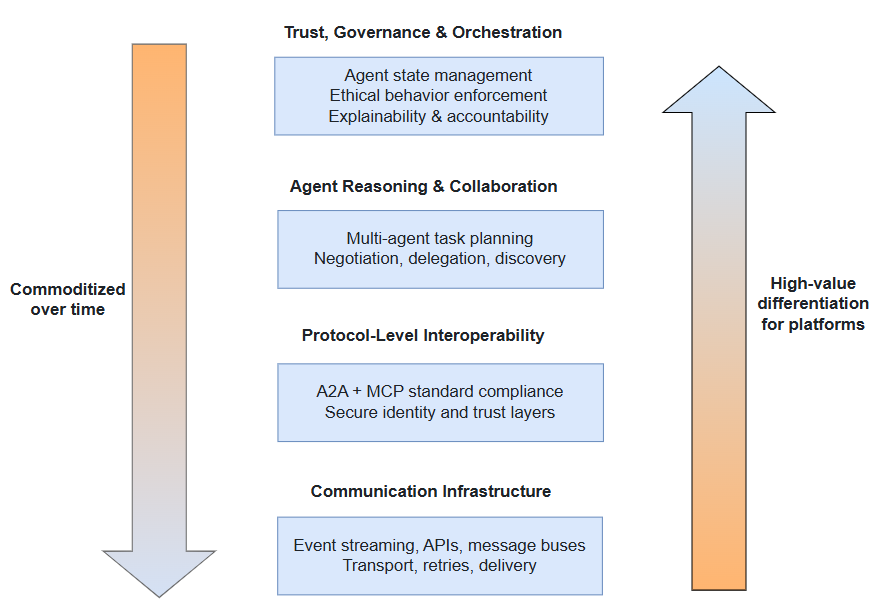
Economic Value Stack in the A2A Ecosystem
The economic value proposition of agent communication infrastructure marks a departure from traditional middleware. While past integration platforms focused on the economics of system connectivity and efficient data transfer, A2A/MCP's value lies in enabling coordinated intelligent autonomy. The economic benefits arise from the automation of intricate reasoning, decision-making, and collaborative problem-solving, functions traditionally performed by humans or complex custom software. Consequently, the basic communication infrastructure may become a commodity. Higher-value opportunities are likely to emerge in platforms and tools that offer advanced capabilities for orchestrating agent behavior, managing agent objectives and status, ensuring trust and security among autonomous agents, and providing strong governance frameworks specifically designed for the challenges of AI agents. Platforms that remain focused solely on basic connectivity risk failing to capture substantial long-term value in the agent economy.
How Will Agent Communication Evolve?
Predicting the precise evolution of agent-to-agent (A2A) communication, a relatively new field, is speculative. However, by examining the development of related technologies and the specific needs of AI agents, we can anticipate several potential trajectories. This could involve the creation of entirely new, AI-specific communication middlewares, mirroring historical patterns, or it might forge a completely distinct and novel path driven by its unique demands.
In the near to medium term, a hybrid approach is most likely. This would blend the advantages of adapting existing infrastructure with the specialized capabilities of new, agent-focused frameworks and data platforms. Success will depend on the ongoing development and adoption of open standards, a strong focus on security and ethical governance, and strategic investments in technologies that support not only communication but also the sophisticated orchestration, data provisioning (including contextual data from vector and graph databases), and overall management of intelligent, autonomous systems. As AI agents become increasingly vital to business operations and innovation, their ability to communicate effectively, access relevant knowledge efficiently, and operate securely will be crucial in realizing the transformative power of AI.
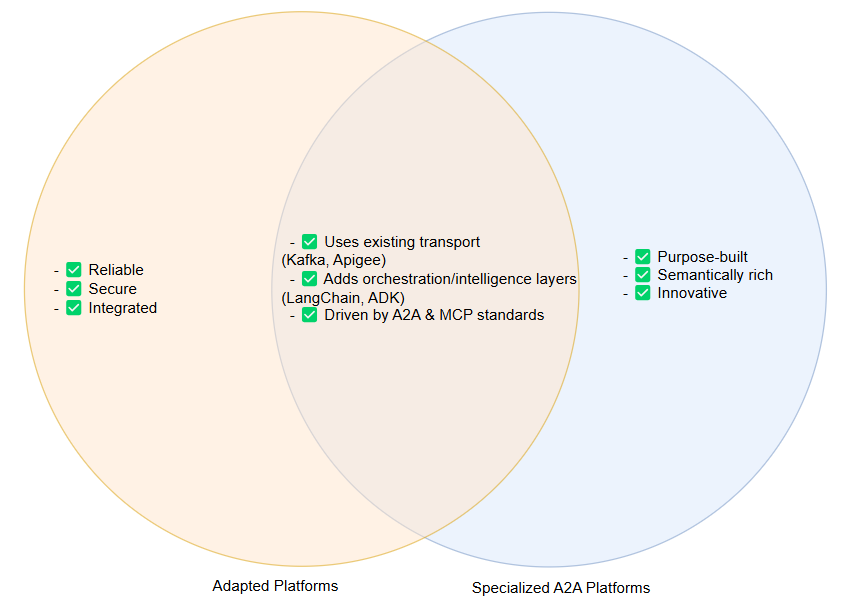
Security is paramount for agent-to-agent communication, whether through existing systems or specialized platforms. Businesses will require strong, verifiable security and governance tailored for autonomous agent interactions with enterprise systems and each other. Platforms and protocols prioritizing robust security, comprehensive monitoring, auditing, and effective governance will be more competitive and trustworthy. This security focus may drive convergence with established secure platforms like API Management and dedicated security solutions or foster security innovation within eventing and messaging platforms. Secure management and governance of agent interactions are as crucial as enabling them.
The path to genuinely collaborative and autonomous AI is in its early stages. Organizations can best harness the transformative power of agent-to-agent communication by: appreciating the historical context, building upon existing advantages, directly tackling specific challenges like security and orchestration, and thoughtfully engaging with the developing landscape of standards.
Published at DZone with permission of Shashi Kumar. See the original article here.
Opinions expressed by DZone contributors are their own.
Comments