

Agentic AI in Cloud-Native Systems: Security and Architecture Patterns
Agentic AI adds autonomy to cloud-native systems, enabling provisioning and remediation. Learn about risks and patterns to secure safe adoption.
 ·
·
Join the DZone community and get the full member experience.
Join For FreeAI has long progressed past statistical models that generate forecasts or probabilities. The next generation of AI systems is agents, autonomous cloud-native systems capable of acting and intervening in an environment without human intervention or approval. Agents can provision infrastructure, reroute workloads, or optimize costs. They can also remediate incidents or apply other autonomous transformations at scale in cloud-native systems.
Autonomy is particularly powerful in cloud-native ecosystems: think of self-tuning Kubernetes clusters, self-adapting CI/CD pipelines that dynamically route riskier code to human gatekeepers, or self-orchestrating serverless functions that maintain performance SLAs under previously unseen load spikes. But with autonomy comes a great responsibility: giving an AI agent the power to act in the cloud-native environment changes the nature of the threat surface in a fundamental way.
In this article, we’ll cover security and architecture patterns that enable organizations to safely build and consume agentic AI in cloud-native systems so they can innovate confidently without losing control.
The New Frontier: Agentic AI
Traditional cloud-based AI systems are by nature bounded: the AI system processes data and provides an output (a forecast, classification, or recommendation), which is then consumed by a human or an API. Agents, in contrast, are AI systems that cross a fundamental threshold. They must have:
- Computational power – reasoning over complex real-time signals (ML models, orchestration state, business risk models)
- Actionability – credentials, APIs, or other hooks to actually execute those decisions
In cloud-native environments, agentic AI could look like:
- Auto-scaling microservices is not just based on CPU utilization thresholds, but also on social media sentiment analysis or predicted spikes in demand
- Intelligent incident remediation bots that proactively patch vulnerable containers, spin up new database replicas, or quarantine containers without manual ticket escalation
- Cost optimization agents that continuously reconfigure microservice workloads and architectures for optimal cost/latency tradeoffs
In each case, the agent has the power to “drive the car” autonomously in the cloud-native environment. But this also means that the agent is a first-class citizen in the threat model.
The Expanded Threat Model: AI Agents
In addition to traditional concerns about human or API misuse, or inadvertent bugs in the agent logic, there are a number of new attack vectors that are opened up when AI agents are introduced in a system:
- Credential abuse: Any API tokens, service accounts, or other credentials in the agent’s control are also potentially attacker-controlled if compromised.
- Autonomous escalation: The agent’s permissions might slowly creep up (intentionally or otherwise), e.g., to resolve an incident, it first escalates its own access rights to resolve the incident and then reduces them, creating the ability to later repeat this behavior.
- Self-replicating exploits: Bad prompts, poisoning of the training data, or other compromises to the agent decision logic can create highly repeatable automated attacks that are difficult to remediate.
- Opaque autonomy: The reasoning process of the agent is non-deterministic (unlike script automation), leading to challenges in monitoring, compliance, and auditing the actions taken by agents.
Simply put, autonomy = risk amplification. The right architecture has to predict and mitigate potential failure modes before an agent is deployed.
Patterns for Safe Autonomy in Cloud-Native Systems
To safely consume or build agentic AI in cloud-native systems, organizations need to adopt patterns and practices that put an emphasis on architectural controls, accountability, and resilience. This results in a number of common patterns that enable autonomous agents while managing the new risks.
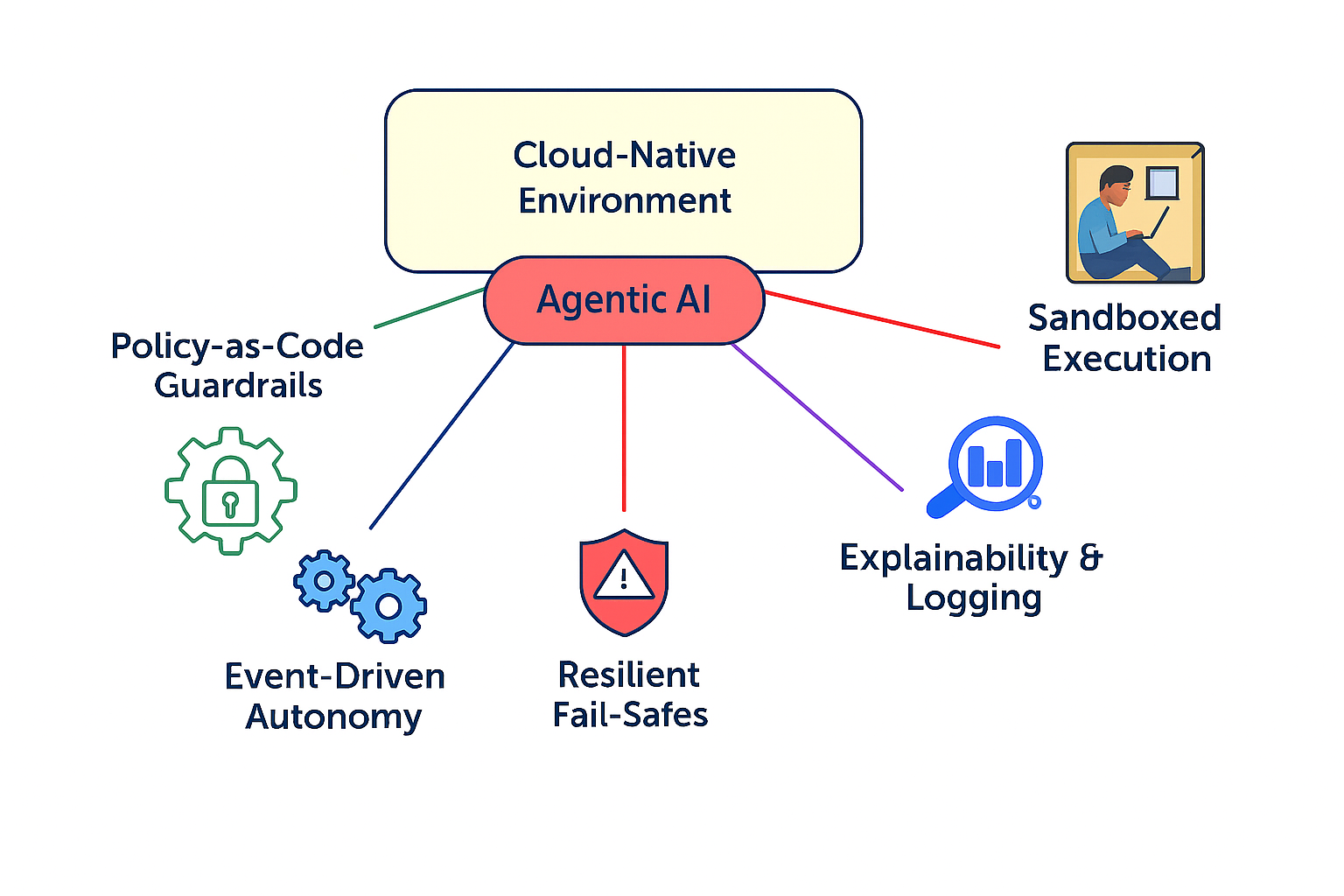
1. Policy-as-Code Boundaries
AI agents must never have a free-form relationship with the runtime environment. Policy boundaries (preferably as code) should be enforced:
- Define boundaries of acceptable action (e.g., restart containers but not delete entire clusters).
- Use Kubernetes native Open Policy Agent (OPA) or Kyverno to enforce the constraints in real time.
- Combine policy-as-code with “deny by default” (agents must explicitly justify every action they want to perform).
Benefit: Predictability and low blast radius
2. Sandboxed Execution
Agents should not execute directly in production environments, or with unrestricted privileges:
- Deploy agents in dedicated namespaces, pods, or serverless sandboxes.
- Use time-bound, scoped credentials via IAM or workload identity federation.
- Route agent’s actions through human-readable approval APIs (middlewares or proxies) between the agent and production systems.
Benefit: Containment — if an agent misbehaves, the damage is limited
3. Event-Driven Autonomy
Instead of continuous, open-ended control, restrict agents to an event-driven model:
- Agents can only change the state of a system in response to approved events (e.g., scale services when a traffic spike is detected).
- Event bus (Kafka, EventBridge, NATS, or similar) for increased auditability of agent actions.
- Agents take a discrete number of clearly observable actions in this way.
Benefit: Action auditing and reversibility of AI actions
4. Explainability and Audit Logging
Opaque decision-making is not acceptable in regulated industries or scenarios:
- Require explainable AI (Explainable Reasoning) for every action taken by agents.
- Store all agent-initiated events/logs in immutable action logs.
- Integrate with Security Information and Event Management (SIEM) or Security Orchestration, Automation, and Response (SOAR) tools for anomaly detection.
Benefit: Accountability and forensic visibility
5. Resilient Fail-Safes
Agents will make mistakes. Architecture must incorporate the assumption of failure:
- Critical actions (e.g., turn off a production database cluster) should be limited to require a human co-signature
- Rollback/override of agent-led processes
- AI agent health monitoring and auto-quarantine on anomalous activity
Benefit: Resilience to both malicious and inadvertent failures
Agentic AI in the Cloud: Developer Checklist
When either building or consuming agentic AI in cloud-native systems, there are a number of questions every engineer or architect should be asking:
- Identity and access: Does the agent have long-lived permissions or enforce least-privilege/scoped credentials with expiration dates?
- Boundaries: Are the policy boundaries the agent operates within codified, enforced, and verified?
- Observability: Is there full auditability and traceability of all actions back to agent reasoning?
- Containment: Is the agent adequately sandboxed, or is its blast radius too large?
- Recovery: Is there the ability to roll back agent decisions or perform an override in real-time?
Case Study: Autonomous Cloud Cost Optimization
As an example, consider an AI agent that autonomously optimizes cloud costs.
Without the following controls, the agent might abruptly deallocate critical resources or production clusters, causing system outages.
- With a policy-as-code control, the agent’s permissible actions are restricted (e.g., to non-production environments)
- With a sandboxed execution control, the agent’s actions are limited via a validation proxy between the agent and production
- With event-driven autonomy, the agent only has the ability to take action when validated events or schedules are met.
- With explainable autonomy, the agent must generate a cost-benefit report before it can take action.
Result: An agent with autonomous power is tightly bound and effectively auditable.
The Future: Autonomous Operators and Resilience
Moving forward, agentic AI will mature from assistants (AI systems that provide analysis and guidance) to become autonomous operators that have the ability to self-heal:
- Kubernetes that automatically rebalances workloads and clusters without human intervention
- Service mesh controllers that negotiate service-level objectives dynamically between microservices
- Cloud-native security agents that automatically quarantine suspicious microservices in real time
The goal is ultimately to create resilience-first autonomous agents that strengthen rather than erode trust in cloud-native systems.
Conclusion
Agentic AI is the natural next phase of cloud-native systems: from passive data analysis to active, autonomous intervention in the cloud-native environment. However, autonomy unbounded by a principled architecture is a recipe for disaster. Policy guardrails, sandboxed execution, event-driven autonomy, explainable autonomy, and resilient fail-safes are all necessary architectural controls to allow AI agents to be safely embedded in cloud-native environments. In the cloud-native world, the most successful systems will be both autonomously secure and automated.
Opinions expressed by DZone contributors are their own.
Comments