

Machine Identity Debt: Why Human Identity Is No Longer Cloud Security's Primary Boundary
Machine identities now outnumber human ones in cloud environments. Learn how to secure workloads with modern identity governance and trust.
 CORE
·
CORE
·
Join the DZone community and get the full member experience.
Join For FreeCloud-native systems now create far more machine identities than human ones. Security strategies built around workforce identity are no longer sufficient. Here's what engineering leaders should build instead.
The Breach That Didn't Need a Password
On August 8, 2025, a threat actor now tracked by Google's Threat Intelligence Group as UNC6395 began quietly moving through the Salesforce instances of hundreds of companies. No phishing email landed in an inbox that day. No password was cracked. No multi-factor prompt was bypassed with a fatigue attack. The attacker simply had something better than a password: a valid OAuth token, stolen months earlier from Salesloft's GitHub account, that let it impersonate the Drift chatbot integration and act with all the trust that integration had been granted.
Over the following ten days, the group ran automated Salesforce Object Query Language searches against more than 700 organizations — Cloudflare, Zscaler, Palo Alto Networks, and PagerDuty among them — harvesting account records, support case text, and, crucially, the AWS keys and Snowflake tokens that customers had pasted into support tickets months earlier. Google's investigation later found the same stolen tokens had reached into Google Workspace mailboxes too. Cory Michal, CSO at AppOmni, put his finger on what made the campaign notable: it wasn't a single lucky break but a methodical operation against hundreds of tenants using nothing but credentials the tenants themselves had issued to a vendor they trusted.
That's the detail worth sitting with. Every access control that companies had built around human identity — MFA, conditional access, session monitoring, SSO — was irrelevant to this attack, because no human ever logged in. The identity that mattered was a machine's, and almost nobody was watching it the way they watch people.
This wasn't an isolated case. In the same twelve months, a compromised API key issued to a DOE staffer gave a stranger standing access to more than 50 large language models at xAI — and stayed active for days after the exposure was discovered, according to reporting from KrebsOnSecurity. A supply-chain attack against the widely used tj-actions/changed-files GitHub Action, relied on by over 23,000 repositories, scraped AWS keys, GitHub tokens, npm credentials, and private RSA keys directly out of CI/CD workflow logs. GitGuardian's 2026 State of Secrets Sprawl report counted 28.65 million new hardcoded secrets pushed to public GitHub repositories in 2025 alone — a 34% jump year over year — and found that AI-assisted commits leak secrets at roughly twice the baseline rate of human-written ones.
None of these incidents required a zero-day. They required an organization to have created a machine identity, granted it access, and then stopped paying attention to it. That is now the default failure mode of cloud security — and it's a failure mode that identity programs built for humans were never designed to catch.
Section 1: Identity Has Already Changed Underneath Us
For most of the last two decades, "identity and access management" meant managing people: employees, contractors, customers. A person logged in, proved who they were, and was granted access based on their role. The infrastructure existed to serve human judgment.
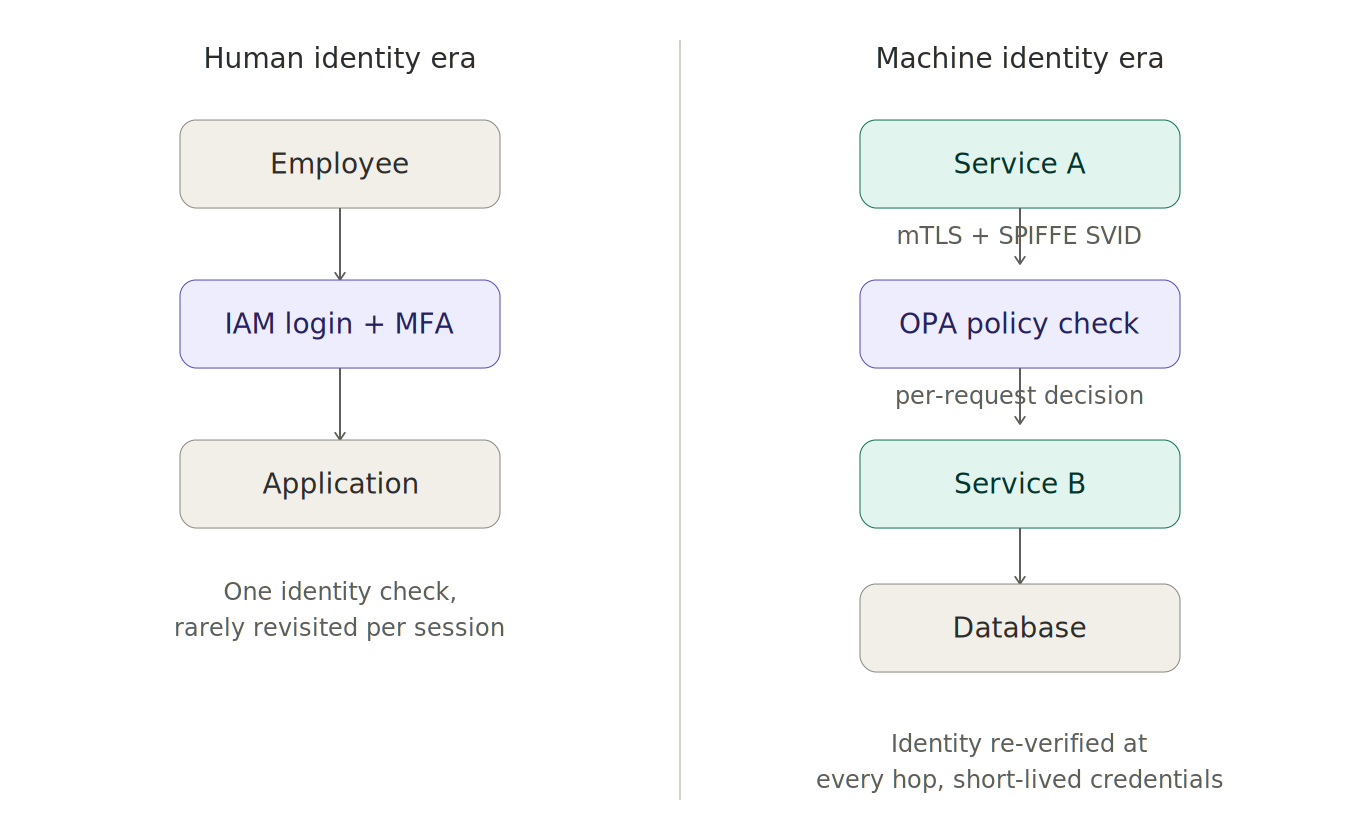
That model quietly stopped matching reality. In a modern cloud environment, the majority of authentication events aren't between a person and a system — they're between systems. A pod in a Kubernetes cluster calls another pod. A CI/CD pipeline authenticates to a cloud provider to deploy an artifact. A SaaS integration holds an OAuth token that lets it act on a company's behalf indefinitely. Each of these is an identity in every meaningful sense — it can be granted permissions, it can be revoked, it can be stolen — but almost none of them are managed with the rigor applied to a human employee's badge.
The mechanisms behind this shift are now familiar to anyone running production infrastructure: Kubernetes service accounts that authenticate workloads to the API server, workload identity federation that lets a pod assume a cloud IAM role without a stored credential, SPIFFE and SPIRE issuing cryptographically verifiable identities to workloads at runtime, OAuth client-credential grants powering service-to-service calls, and service meshes like Istio wrapping every internal request in mutual TLS. Layer on top of that the identities created by CI/CD systems, and it becomes clear that a mid-sized cloud environment can easily contain ten or twenty machine identities for every human one.
Security researchers at IDMWorks, reviewing the identity breaches of the last three years for their 2026 NHI Reality Report, described the pattern bluntly: these attacks succeeded through poor governance, not sophisticated malware. There was no payload to detect — just valid credentials doing exactly what valid credentials are allowed to do. That's a much harder thing to catch than a virus, because there's nothing anomalous about the code path. The only thing that's wrong is which entity is walking it.
Section 2: Why the Existing Security Model Fails Here
Identity and access management built for people assumes a handful of things that simply don't hold for machines. It assumes credentials are issued to a known, accountable owner. It assumes a login event is rare enough to be worth alerting on. It assumes a compromised credential will eventually show up in unusual behavior — an impossible-travel alert, an after-hours login, a new device.
None of that transfers cleanly to a service account. IDMWorks' research is direct about the resulting blind spot: a service account that authenticates ten thousand times a day isn't behaving anomalously — that's just Tuesday. Detecting misuse requires knowing what a credential is supposed to be doing well enough to notice a deviation, and almost no organization has that baseline built for its non-human identities the way it does for its people.
The ownership problem compounds this. Aembit's running catalog of non-human identity breaches documents a 2025 flaw in a major identity provider that let anyone holding a valid API key enumerate every OIDC application in a tenant and pull its client secrets — a bug that, if exploited, would have let an attacker impersonate entire applications and move laterally across an organization's stack. It was responsibly disclosed and patched, but it illustrates how identity providers themselves can become breach multipliers the moment a machine credential leaks.
Then there's lifespan. GitGuardian's research, cited in Snyk's 2026 analysis of the secrets sprawl problem, found that private repositories are six times more likely to contain hardcoded secrets than public ones — largely because private repos get cloned, forked, and handed to contractors without anyone revisiting what's inside them. And because git's data model is append-only, a secret committed and later deleted in a follow-up commit should still be treated as exposed; it lives on in history whether or not it's still visible in the latest diff.
The legal exposure is no longer theoretical, either. In United States v. Sullivan, Uber's former Chief Security Officer was criminally convicted of obstruction of justice for concealing a 2016 breach that began with hardcoded AWS credentials sitting in a GitHub repository — credentials that let attackers pull data on 57 million riders and drivers. The Ninth Circuit's 2025 ruling upheld that conviction, establishing that executives can face personal criminal liability for how they respond to a credential-based breach, not just for the breach itself. That should recalibrate how seriously engineering leadership treats "just another leaked API key."
An Honest Name for the Problem: Machine Identity Debt
Engineering teams already have a vocabulary for the gap between "shipped quickly" and "built correctly" — they call it technical debt. There's no equivalent term for the identical pattern happening in identity, so let me propose one: machine identity debt.
Technical debt accumulates in code: shortcuts taken under deadline pressure that someone eventually has to pay down. Identity debt accumulates in trust: every API key issued and never revisited, every OAuth grant approved by someone who's since left the company, every IAM role created with "just give it admin, we'll fix it later" and never fixed. None of it shows up in a sprint retro. None of it fails a build. It just sits there, compounding, until an attacker finds it and collects the interest all at once — which is close to a literal description of what happened to the 700-plus organizations caught in the Salesloft Drift breach, where OAuth grants approved months or years earlier turned out to still carry far more reach than anyone had tracked.
A rough way to think about what's accumulating:
Machine Identity Debt ≈
    long-lived credentials with no expiration policy
    + service accounts no longer tied to an active workload
    + OAuth grants no one has reviewed since approval
    + secrets discovered in tickets, chat, and docs rather than a vault
    + IAM roles scoped broader than the task requires
    + any machine identity with no accountable human owner
This isn't a precise formula you can drop into a dashboard query today — treat it as a checklist for a conversation, not a KPI. But naming each line item is useful, because each one is independently measurable, and most organizations have never measured any of them.
When enough of this debt accumulates that nobody can produce an accurate answer to "what machine identities exist, who owns them, and what can they reach" — that's not an IAM maturity gap anymore. It's identity bankruptcy: the point where inventory, ownership, and trust have diverged so far from reality that incremental cleanup stops being realistic and the organization needs a forced reconciliation, usually triggered by an incident rather than a planning cycle.
The mechanism that gets organizations there is worth naming too. Every new SaaS integration, every GitHub Action, every Terraform module, every AI agent granted API access mints a new unit of trust — a new thing the organization implicitly promises to govern. Nobody budgets for governing it; the integration just gets approved because it unblocks a project. Multiply that across a growing stack and you get something like trust inflation: the total quantity of trust an organization has extended growing faster than its ability to actually track or revoke any single unit of it. Eventually a credential's nominal access — what the ticket said it was for — and its real access — everything it can actually still reach — drift far enough apart that the gap itself becomes the attack surface.
None of these terms are industry standard — I'm proposing them here because the pattern needed a name and didn't have one. Judge them by whether they make the problem easier to talk about, not by whether you've heard them before.
Section 3: A New Boundary — Adaptive Machine Trust Architecture
If the perimeter used to be defined by "who logged in," it now has to be defined by a different question: can this specific workload be trusted, right now, to do the specific thing it's asking to do? That's a shift from identity as a static credential to identity as a continuously re-evaluated claim.
A workable framework for this — call it Adaptive Machine Trust Architecture, or AMTA — rests on a small number of principles that reinforce each other:
Continuous verification. A workload's identity is checked at the moment of each request, not once at startup. Trust isn't a badge you're handed at the door; it's re-earned per transaction.
Cryptographic workload identity. Instead of a static API key sitting in an environment variable, a workload is issued a short-lived, cryptographically verifiable identity document — the SPIFFE Verifiable Identity Document (SVID) model is the clearest existing implementation of this idea — that ties the identity to what the workload is, not to a secret it happens to be holding.
Just-in-time authorization. Access is granted for the duration of a task and expires automatically, rather than being provisioned once during a rushed deployment and left in place indefinitely, which is precisely the pattern IDMWorks identified as the root cause of most CI/CD credential compromises.
Policy-driven trust decisions. Authorization decisions are externalized to a policy engine that can evaluate context — the requesting workload's identity, its recent behavior, the sensitivity of the resource — rather than being baked into application code as a hardcoded allow-list.
Identity lifecycle management. Every machine identity has a documented owner, a defined purpose, and an expiration path. The absence of exactly this — what IDMWorks calls "no ownership model" — is the single most commonly cited root cause across the non-human identity breaches of the last three years.
Continuous attestation. The system periodically re-proves that a workload is still what it claims to be — still running the expected code, in the expected environment — rather than trusting a credential indefinitely once it's issued.
None of these principles is exotic on its own. What's new is treating them as a single coherent architecture for machine trust, instead of a scattered collection of best practices that get implemented inconsistently across teams.
Section 4: What Implementation Actually Looks Like
The tooling to build this exists today, and it's more mature than most security teams realize.
SPIFFE and its reference implementation, SPIRE, provide the identity layer: workloads receive short-lived X.509 or JWT SVIDs based on attested properties of the environment they're running in — the specific pod, the specific node, the specific Kubernetes namespace — rather than a secret baked into a config file. A workload requesting an SVID doesn't present a password; it presents proof of what it is, and SPIRE's server verifies that against a registration policy before issuing anything.
In a service mesh like Istio, this identity layer can be paired with mutual TLS enforced at the sidecar proxy, so every service-to-service call is authenticated and encrypted without the application code needing to know anything about certificates. Authorization decisions can be externalized to Open Policy Agent, letting teams write access policy as code — reviewable, versioned, testable — instead of scattering if user.role == 'admin' checks through a codebase.
For software supply chain integrity — relevant given that the tj-actions/changed-files compromise spread through a CI/CD pipeline — Sigstore's Cosign and Fulcio provide a way to sign build artifacts and verify their provenance using short-lived certificates tied to an OIDC identity, rather than a long-lived signing key that itself becomes another secret to protect.
None of this is a rip-and-replace project. Teams typically start by identifying their highest-value machine credentials — the ones with production database access, the ones with broad cloud IAM permissions — and migrating those first to short-lived, attested identities, while instrumenting logging so that every machine identity's access can actually be reviewed rather than assumed.
What This Looks Like When Someone Actually Ships It
The architecture described above isn't hypothetical. Pinterest has publicly documented using SPIFFE alongside its internal secrets-management system, Knox, specifically to solve identity in a multi-tenant environment where workloads from different teams share infrastructure and can't be trusted by network location alone. Square presented its adoption of SPIFFE and SPIRE at a SPIFFE Community Day, describing how it used the framework to secure communication across a hybrid infrastructure — cloud and on-premises systems that previously had no consistent way to authenticate to each other. Uber's security team gave a KubeCon talk walking through why it built an internal workload identity platform on these same principles, and ByteDance has separately documented replacing a homegrown certificate system with SPIRE to get PKI-based authentication working at the scale TikTok's infrastructure requires.
The common thread across all four is the same one this piece has argued from the incident side: none of them adopted workload identity because a compliance checkbox required it. They adopted it because operating at their scale made network-location-based trust and long-lived shared secrets genuinely unworkable — the same pressure that's now reaching far smaller organizations as their own machine identity counts climb. The trade-off they all had to work through in public is worth naming honestly: SPIRE introduces real operational overhead — a server and agent fleet to run, node and workload attestation to configure correctly for each hosting environment, and a learning curve for teams used to thinking about secrets rather than attested identity. None of the public talks describe it as a drop-in replacement. They describe it as an infrastructure investment that pays off once the number of services and the rate of change outgrow what static credentials can manage safely.
Section 5: The Metrics That Actually Indicate Progress
Security leaders asking for budget need numbers, not architecture diagrams. The ones worth tracking:
- Mean credential lifetime – how long, on average, does a machine credential remain valid before rotation or expiration? GitGuardian's finding that some leaked keys remained live for months is really a mean-lifetime failure.
- Percentage of workloads using attested workload identity versus static, long-lived secrets – this is the single clearest proxy for how exposed an environment is to the failure pattern behind the xAI and tj-actions incidents.
- Secret rotation frequency, measured against an actual policy rather than an aspirational one.
- Unauthorized service-to-service request rate – a signal that requires the behavioral baselining IDMWorks flagged as largely absent today.
- Credential exposure rate in code, tickets, and chat – Snyk's research found leaks occurring in Slack messages, Jira tickets, and Confluence pages at meaningful rates, not just in source code, so this metric has to look beyond the repository.
- Policy compliance rate for third-party OAuth integrations – the exact control gap that let the Salesloft Drift tokens retain broad, long-lived access to Salesforce, Google Workspace, and AWS simultaneously.
The Reports Keep Saying the Same Thing Independently
It's worth pausing on how many separate organizations, using separate datasets, landed on the same conclusion in the same twelve-month window.
Verizon's 2025 Data Breach Investigations Report — built from 22,052 incidents across 139 countries, the kind of dataset no single vendor could assemble on its own — found 441,780 exposed secrets sitting in public code repositories, with a median remediation time of 94 days once discovered. Nearly half of those were high-privilege Google Cloud API keys tied to automated infrastructure, not human logins. GitGuardian's own 2026 research, working from a different pipeline entirely, arrived at the same order of magnitude: 28.65 million new hardcoded secrets added to public GitHub in 2025 alone. IDMWorks, analyzing three years of non-human identity incidents rather than scanning code, described the same underlying failure in different language: no ownership model, no rotation cadence, detection tooling built for human login patterns that generates nothing but noise against machine behavior. Snyk's research adds the vector most of these reports don't emphasize enough — over a quarter of credential incidents originate entirely outside source code, in Slack messages, Jira tickets, and Confluence pages.
Different data sources, different methodologies, different commercial incentives — and all of them converge on the same sentence: non-human identities are growing faster than the governance built to manage them. That's not a marketing claim from any one vendor. It's what independent datasets keep saying when you line them up next to each other.
What the Trajectory Actually Implies
I won't pretend to know the machine-to-human identity ratio a cloud-native enterprise will have in 2030 — nobody has the longitudinal data to state that number with confidence, and treating a guess as a fact would undercut everything else in this piece. What can be said with more confidence is the direction and the reason.
Every driver behind today's machine identity growth — CI/CD automation, service mesh adoption, multi-cloud workload identity, and now AI agents authenticating to APIs on an organization's behalf — is accelerating, not leveling off. AI agents in particular are a new category of machine identity, not just more volume in an existing one: an agent can be granted a credential, use it in ways its creator never explicitly authorized, and, in the case of the Common Crawl training-data exposure, potentially reproduce a credential it was never supposed to have seen in the first place. If the ratio of machine to human identities is already in the double digits at a typical mid-sized cloud shop today, as the SPIFFE/SPIRE and workload-identity adoption patterns suggest, then adding an autonomous-agent layer on top doesn't nudge that ratio — it compounds it. The honest prediction isn't a specific number for 2030. It's that any organization treating machine identity governance as a 2026 problem to revisit later is already behind a curve that isn't slowing down.
A Rough Map of How Organizations Get Here
Most organizations don't leap from careful to reckless. They drift through recognizable stages, usually without anyone deciding to:
Centralized human IAM
   ↓ Cloud IAM roles multiply per service
   ↓ Service accounts proliferate,
     ownership blurs
   ↓ Workload identity adopted for some, not all, systems
   ↓ AI agents added as a new identity class
   ↓ Identity sprawl outpaces any team's ability to inventory it
   ↓ Machine Identity Debt crosses into Identity Bankruptcy
   ↓ Incident forces the reconciliation that governance should have
Most organizations reading this are somewhere between stage two and stage five. Very few have consciously decided which stage they're in — which is itself the point: nobody plans to reach identity bankruptcy; they just never stop to check how much debt they've taken on since the last audit.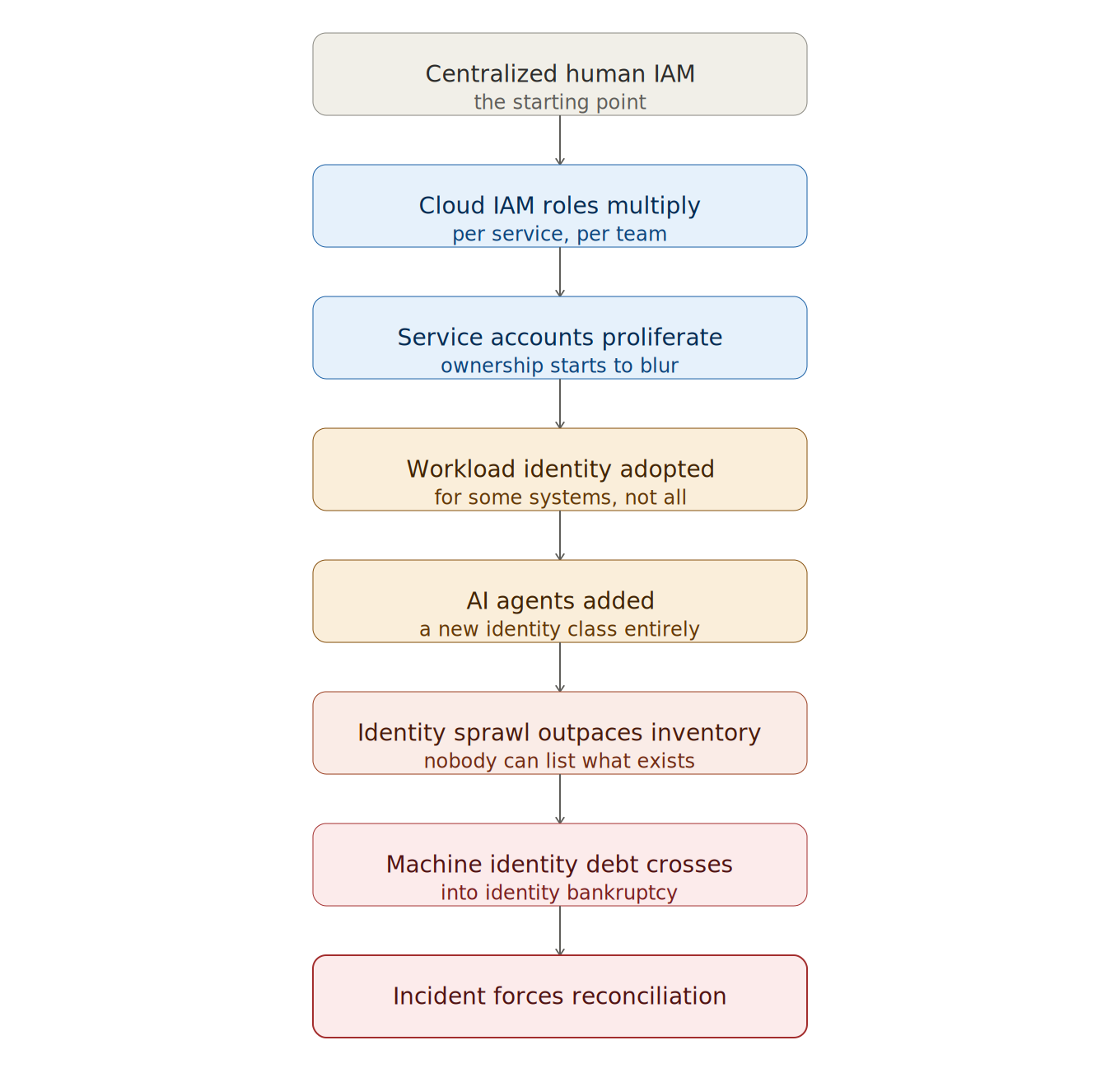
Section 6: Where This Goes Next
A few developments will make machine trust an even sharper problem over the next few years rather than a solved one.
Confidential computing — running workloads inside hardware-enforced trusted execution environments — is moving from research curiosity to something cloud providers offer as a standard instance type, which will let attestation extend down to the hardware layer rather than stopping at the software identity.
AI agents that authenticate to APIs and take autonomous action on an organization's behalf are a new and rapidly growing category of machine identity, and the data-poisoning risk is already visible: Truffle Security's scan of Common Crawl's December 2024 archive, covering roughly 400 terabytes of public web data, found close to 12,000 live, working credentials embedded in text that's now part of the training data feeding future models. An AI system trained on that data can, in principle, reproduce or act on a credential it was never supposed to have.
Post-quantum cryptography considerations will eventually reach workload identity systems, since the SVIDs and certificates underpinning frameworks like SPIFFE rely on cryptographic assumptions that are being reassessed industry-wide.
And identity graphs — mapping which machine identities can reach which resources, and through which chains of trust — are becoming the tool that lets a security team answer the question that mattered most in the Salesloft Drift breach: not "was this OAuth token valid," but "what could this token reach, and did anyone actually decide it should be able to?"
The Question Worth Asking
The organizations that got hit in 2025 weren't running unpatched software or ignoring known vulnerabilities. Cloudflare, Palo Alto Networks, and Zscaler — security vendors with mature programs — were among the hundreds caught in the Salesloft Drift breach. The tokens that got them were valid. The access was, technically, authorized. That's what makes machine identity the harder problem: it doesn't fail loudly.
The practical shift for engineering leadership is to stop asking "who is the user?" as the primary security question and start asking "can this workload be trusted right now, for this specific action?" That means building ownership records for every service account before an incident forces the question, migrating high-value credentials to short-lived attested identities before a leaked key becomes a header on KrebsOnSecurity, and treating third-party OAuth grants with the same scrutiny given to a new employee's laptop.
None of this is speculative. Every incident cited here happened in the past eighteen months, to organizations with real security budgets. The architecture to prevent the next one already exists. What's missing, in most companies, is the decision to build it before the postmortem forces the issue.
The pattern underneath every breach in this piece is the same one: a credential nobody was actively watching, doing exactly what it was built to do, for whoever happened to be holding it. Passwords get the attention because a stolen password is a story people understand — a human made a mistake, or got tricked. A stolen service-account token is a harder story to tell, because the mistake happened months earlier, in a decision nobody remembers making, and the debt just sat there accruing until someone else cashed it in. Paying that debt down before it's due is a less dramatic project than responding to a breach. It's also the only version of this problem that ends with a postmortem you never have to write.
Sources
- Google Cloud / Google Threat Intelligence Group, "Widespread Data Theft Targets Salesforce Instances via Salesloft Drift," August 26, 2025
- The Hacker News, "Salesloft OAuth Breach via Drift AI Chat Agent Exposes Salesforce Customer Data," August 28, 2025
- Anomali, "Reviewing the Salesforce–Salesloft Drift OAuth Supply Chain Breach," December 2025
- Guardz, "The Salesloft Drift Breach and the Impact on Google Workspace," September 2025
- Defakto, "xAI API Key Leak by DOGE Staffer Reveals Cracks in API Security," December 2025
- Snyk, "Why 28 million credentials leaked on GitHub in 2025, and what to do about it," March 2026
- Aembit, "Real-Life Examples of Non-Human Identity Security Breaches," updated regularly
- IDMWorks, "When Service Accounts Attack: How Identities are Weaponized," May 2026
- PointGuard AI, "AI Training Data Secret Leak 2025 | 12,000 API Keys Exposed," January 2026
- CybelAngel, "API Threat Report 2025: Key Findings for Security Teams," March 2026
- United States v. Sullivan, 9th Cir. 2025 (referenced via Snyk's legal-consequences analysis, above)
- Verizon, "2025 Data Breach Investigations Report" (18th edition; 22,052 incidents, 139 countries)
- GitGuardian, "The Secrets Sprawl is Worse Than You Think: Key Takeaways from the 2025 Verizon DBIR," April 2025
- SPIFFE Project, "Case Studies" (Pinterest, Square, Uber, ByteDance talks)
Opinions expressed by DZone contributors are their own.
Comments