

Orchestrating the Agentic Explosion: A Unified Governance Framework for the AI-First Enterprise
Enterprise AI is the operating model; success needs disciplined execution, business KPIs, and the OLEA governance framework.
 ·
·
Join the DZone community and get the full member experience.
Join For FreeThe Dawn of Agentic Chaos
In 2026, the enterprise landscape has shifted from AI as a tool to AI as a Digital Teammate. Recent industry studies from IDC and Deloitte indicate that by the end of this year, nearly one-third of all AI-enabled applications will rely on autonomous agents. Technology companies in 2026 envision anchored democratized agent creation, allowing any role from a financial market analyst to a senior architect to deploy a functional digital assistant in minutes.
However, this democratization has given rise to a new organizational crisis: agent sprawl. Without a centralized orchestration strategy, enterprises face redundant compute costs, double agent security risks, and a fragmented logic layer that threatens the integrity of the corporate data estate. For AI Architect and Strategy leaders, the challenge is no longer just delivery; it is creating a unified agent governance framework that balances the speed of "citizen development" with the rigors of production-grade stability.
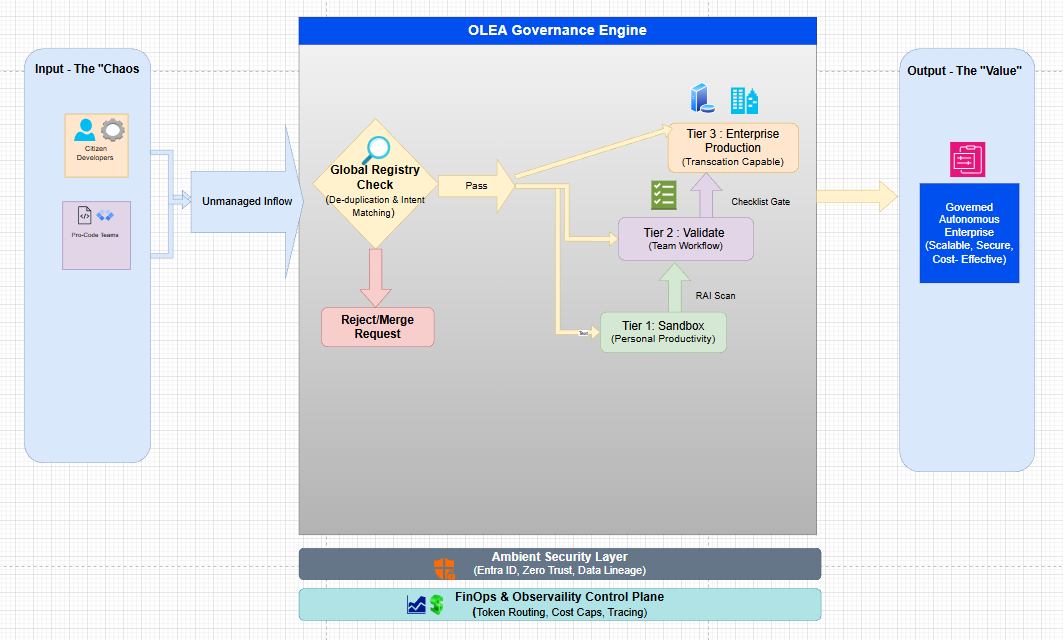
The OLEA Framework: Orchestrated Lifecycle for Enterprise Agents
To control this chaos, I propose the OLEA (Orchestrated Lifecycle for Enterprise Agents) Framework. This original methodology provides a four-stage pipeline for onboarding, validating, and scaling agents across diverse business domains.
1. The Centralized Agent Registry: Avoiding the Duplication Trap
The first pillar of OLEA is the Global Agent Registry. A common failure in rapid AI adoption is the Siloed Intent problem, where the marketing team builds a document summarizer agent while the Legal team unknowingly builds the same tool using a different budget and LLM provider.
Best practice: Implement an integrated registry. Every agent, whether built by a citizen developer in a playground with no -code or a pro-coder via the agent framework, must be registered with a unique Agent ID. This registry process serves as an original source of truth, enabling:
- De-duplication logic: Before a new agent project is approved, the system scans for existing agents with similar intent vectors.
- Capability discovery: Allowing teams to compose multi-agent systems by calling existing, verified agents as tools.
2. The Graduation Model: Balancing Citizen Dev and Production
The OLEA framework utilizes a tiered graduation model to solve the tension between business-led innovation and technical debt.
- Tier 1: Personal/Team Sandbox (Citizen Dev): Agents created for localized tasks (e.g., summarizing personal emails). These operate with minimal oversight but are restricted to "read-only" access in non-production environments.
- Tier 2: Validated Business Unit Agents: Agents that handle team-wide workflows. To "graduate" to this tier, an agent must pass an automated Responsibility AI (RAI) Scorecard, checking for bias and PII (Personally Identifiable Information) leakage
- Tier 3: Enterprise-Grade Production Agents: Agents that can execute transactions (e.g., updating a CRM or triggering a procurement flow). These require a "Production Readiness Review" (PRR), including stress testing for latency and "circuit-breaker" logic.
3. Security and "Environment" Governance
In 2026, security must be autonomous. Trending research highlights that agents should be treated as "digital identities" rather than mere scripts.
Best practice: Every agent in the OLEA framework is assigned an agent ID, giving it the same security protections as a human employee. This allows for conditional access policies:
- Least privilege execution: An agent built for the finance team can read quarterly reports but is blocked from accessing sensitive HR payroll data.
- Traceable lineage: Using OTel-based tracing (OpenTelemetry), an AI Architect can audit the reasoning steps of an agent. If an agent makes a $50,000 procurement error, the framework provides a reasoning log to determine exactly which prompt or data source led to the failure.
4. Inference Economics: The TPM’s Role in FinOps
A significant risk to AI-first organizations is the "token debt." High-performing LLMs are expensive, and running multiple agents in parallel can lead to exponential cost increases.
The OLEA framework introduces token-aware routing. By leveraging the AI agent control plane, the framework dynamically routes requests based on complexity:
- Simple intent is routed to small language models (SLMs) like Phi-4, which are cost-efficient.
- Complex reasoning is escalated to frontier models like GPT-5 only when a specific "confidence threshold" is not met.
- Semantic caching: Common queries are served from a vector cache, reducing inference costs by up to 30%, a critical metric for any expectation team to manage an AI budget.
For an agent to graduate from Tier 2 (Validated) to Tier 3 (Production Enterprise), the AI agent execution team must verify that it passes these ten critical governance gates. Here is the OLEA Production Readiness Checklist:
Security and Identity
1. Agent ID assigned: The agent has a unique non-human identity with strictly defined least privilege, role-based access control (RBAC). It cannot access data outside its specific domain scope.
2. Secrets management rotation: Any API keys or credentials the agent uses to access external tools (e.g., CRM, ERP) are stored in a key vault with automated rotation enabled. No hardcoded secrets in the prompt logic.
Reliability and Performance
3. Circuit breakers and fallbacks: Defined thresholds are in place. If the primary LLM fails or latency exceeds the SLO (e.g., >3 seconds), the agent automatically falls back to a deterministic rule-set or a smaller, faster model, rather than hanging or hallucinating.
4. Scaled load testing: The agent has been tested at 2x expected peak concurrency to ensure shared resources (like vector databases) do not become bottlenecks.
Governance and Responsibility
5. RAI guardrails active: AI Content Safety (or equivalent) filters are active to block jailbreak attempts, PII leakage, and toxic output at the gateway level, before a response reaches the user.
6. Data lineage mapping: The agent’s data access path is fully mapped. We know exactly which data stores it touches, ensuring no unauthorized cross-geo data flows (data sovereignty compliance).
Operations and FinOps
7. Unified observability hooks: The agent emits standardized OpenTelemetry logs. Tracing is enabled to allow forensic analysis of the "chain of thought" for any incorrect decision.
8. Token budget caps: Hard limits are set on daily token usage and compute costs. Alerting is configured at 80% utilization to prevent runaway billing from a looping agent.
Lifecycle Management
9. Prompt version control: The agent’s prompts and configuration settings are managed in git, with a defined CI/CD pipeline for updates, ensuring no "hot-fixes" in production without regression testing.
10. Defined owner and escalation path: A specific human team is registered as the owner. If the agent gets stuck or requires a Human-in-the-Loop decision, the routing path to the human supervisor is verified and active.
Industry Best Practices for Scaling
To make this framework "bulletproof," organizations must adopt three cross-functional disciplines:
- Continuous red teaming: Unlike static software, AI behavior is dynamic. Establish a "Continuous Evaluation" loop where agents are periodically challenged by adversarial "Red Agents" to ensure guardrails have not drifted.
- Human-in-the-loop (HITL) thresholds: Define "Ambiguity Caps." If an agent’s confidence in a decision falls below 85%, the OLEA framework must force an escalation to a human supervisor.
- Unified observability: Move away from per-agent dashboards. A technologist should monitor a "Fleet-Wide" dashboard that aggregates usage, cost, and error rates across the entire organization’s agent ecosystem.
Conclusion: From Chaos to Competitive Advantage
The shift to an AI-first approach is inevitable, but success is not guaranteed. As recent research shows, effective AI agents can accelerate processes by 30-50%, yet 40% of projects will likely be cancelled due to unmanaged complexity.
By implementing the OLEA Framework, technologists can transform "agent chaos" into a structured, scalable, and secure engine for innovation. By focusing on a centralized registry, a tiered graduation model, and inference economics, we move beyond simple automation into the era of the governed autonomous enterprise.
Opinions expressed by DZone contributors are their own.
Comments