

Architecting Trust: Agentic Microservice Testing Strategies in the Era of Non-Deterministic AI
Learn how to test, monitor, and deploy reliable agentic AI and multi-agent systems in enterprise environments using modern testing and CI/CD strategies.
 CORE
·
CORE
·
Join the DZone community and get the full member experience.
Join For FreeThe enterprise software landscape is undergoing a foundational architectural shift that rivals the original transition from monolithic applications to distributed systems. For the past decade, the microservice architecture has successfully allowed engineering teams to manage application complexity through the strict decomposition of business domains into independently deployable, scalable units communicating over well-defined application programming interfaces (APIs).
However, the aggressive integration of large language models (LLMs) into the application execution layer has catalyzed an entirely new paradigm: the agentic microservice architecture. In this advanced model, the core tenet of the single responsibility principle evolves from decomposing static business domains (such as an Order Service or a Payment Service) to decomposing dynamic cognitive loads (such as a Planner Agent, a Researcher Agent, and an Execution Agent).
As organizations rush to deploy these intelligent systems, a profound engineering crisis is emerging. A production AI agent is not merely a generative feature or a "magic box"; it is, fundamentally, a non-deterministic microservice. This architectural reality introduces severe complexities in system verification, observability, and quality assurance. Traditional microservices manage state transitions through strict, deterministic code where an input consistently yields a predictable output. Agentic microservices, conversely, operate via probabilistic reasoning, where the system is given a goal and granted the autonomy to determine the execution plan. This shift from static orchestration to dynamic, goal-oriented autonomy requires a radical reimagining of how distributed systems are tested, monitored, and deployed in enterprise environments.
With industry analysts recording a massive surge in multi-agent system deployments, including a staggering 1,445% increase in enterprise inquiries within a single year, the question is no longer whether organizations will adopt agentic AI, but whether they possess the engineering discipline to run these systems in production reliably.
This comprehensive report provides an exhaustive analysis of agentic microservice testing strategies, contrasting them deeply with traditional automation approaches. It explores the semantic protocols enabling multi-agent communication, the necessary evolution of the continuous testing pyramid, trajectory evaluation frameworks, behavioral chaos engineering, and the integration of agentic evaluation loops into continuous integration and continuous delivery (CI/CD) pipelines.
The Evolution from Microservices to Agentic AI Architecture
Before addressing how to test agentic systems, one must first dissect their architectural composition. As the industry transitions toward agentic AI, a common misconception among software architects is that existing infrastructure knowledge must be discarded. In reality, agentic AI architecture is the natural evolution of distributed microservices, enhanced by an active cognitive routing layer.
In a traditional distributed system, intermediaries such as API gateways and load balancers function primarily as infrastructure components. They route network traffic and enforce generic security policies without deep application awareness or workflow intelligence. In an agentic architecture, the intermediaries often function as orchestrators or brokers and encapsulate significant application logic. They actively direct the sequence of operations, make content-aware routing decisions based on semantic understanding, and negotiate tasks dynamically.
To manage this complexity, enterprise architectures are adopting structured multi-agent frameworks that align with the unique characteristics of AI technologies. These frameworks manage complexity through decomposition, improve resilience through decoupling, and simplify agent accountability through rigid specialization. A robust agentic system design typically models its architecture around specific layers and components:
- User layers: These define the human actors interacting with the system, ranging from external customers to authenticated internal employees.
- Agent layers: These describe the required autonomous entities, the specific design patterns they exhibit, their relationships with one another, and the systemic instructions used to actualize specific behaviors.
- Context and actions: These represent the resources, capabilities, and execution actions that the agent manages or has permission to access during its lifecycle.
- Sources: These encompass the underlying deterministic systems, such as relational databases, legacy applications, and vector knowledge bases, that the agents connect to for grounding and execution.
Within these layers, multi-agent design patterns dictate the interaction structures that enable agents to communicate, collaborate, or even compete to solve complex problems. The Orchestrator-Worker pattern involves a primary agent breaking down a user request and delegating sub-tasks to specialized worker agents, such as a code-writing agent or a data-analysis agent. The Blackboard pattern allows multiple agents to independently read and write to a shared contextual memory space, asynchronously solving pieces of a puzzle without direct point-to-point communication. Furthermore, Reflection and ReAct (Reasoning and Acting) compound patterns enable individual agents to critique their own intermediate outputs, execute a self-correction loop, and refine their execution strategy before finalizing a task.
Testing these architectural patterns requires validating not just the final output, but the intricate web of intermediate interactions, data handoffs, and self-correction loops that occur across extended periods and multiple state changes.
The Foundational Divide: Deterministic vs. Probabilistic Systems
The defining friction point in transitioning from traditional microservice test automation to agentic AI testing lies in the dichotomy between determinism and non-determinism. This fundamental difference alters the entire philosophy of quality assurance and continuous integration.
Traditional software engineering and testing frameworks are built entirely on the assumption of determinism. Given a specific input state, a well-defined microservice is expected to produce the exact same output and state transition every single time it is executed. This predictability allows engineering teams to manage reliability efficiently. For example, if a transient network error occurs, traditional microservices rely on infrastructure-layer patterns like exponential backoff retries or circuit breakers to ensure eventual consistency. In this deterministic world, software testing involves straightforward, boolean checks against known outputs. A unit test asserts whether a specific value matches an expected string, providing a clear, binary pass or fail outcome.
Agentic systems inherently violate these deterministic assumptions. The foundational LLMs that power these agents operate probabilistically, generating responses by predicting the next optimal token based on vast matrices of contextual weights and sampling strategies like temperature configurations.
Consequently, feeding the exact same prompt to an agentic microservice multiple times can result in subtle variations in phrasing, entirely different reasoning paths, or occasionally, destructive hallucinations. When this probabilistic core is wrapped in a microservice boundary and granted autonomy over external tools and APIs, the system’s execution becomes a highly dynamic, unpredictable trajectory rather than a static, linear pipeline.
This non-determinism introduces profound production challenges that standard automated testing cannot resolve. An agentic pipeline that successfully completes a complex workflow 95% of the time is not demonstrating a "passing test suite"; rather, it is indicating a production incident occurring in one out of every twenty executions. This forces a shift in testing methodology from simple output validation to comprehensive behavioral and outcome validation.
| Evaluation Category | Traditional Microservice Testing | Agentic Microservice Testing |
| Primary Validation Focus |
Exact output matching (e.g., asserting HTTP 200 responses, strict JSON schema parity, and predictable database state mutations). |
Behavioral validation, probabilistic trajectory evaluation, and optimization of broader business outcomes over exact textual outputs. |
| Execution Path Architecture |
Static and predefined; execution relies on explicit flow control, rigid branching logic, and linear task execution. |
Dynamic and adaptive; the agent autonomously plans the sequence of tool calls, API interactions, and recovery steps based on real-time context. |
| Debugging and Reproduction |
Identifying and recreating specific input states and payload parameters to reproduce the exact error consistently. |
Capturing the entire reasoning context, which includes initial prompts, RAG retrieval snippets, tool call sequences, and intermediate agent thoughts. |
| Reliability Mechanisms |
Managed primarily at the infrastructure layer using load balancers, API gateways, automated retries, and explicit code fallbacks. |
Managed at the cognitive layer using self-reflection patterns, output validation loops, prompt engineering guardrails, and human-in-the-loop oversight. |
| Component Communication |
Rigid API contracts negotiated prior to runtime, utilizing protocols like REST, gRPC, or GraphQL with strict data schemas. |
Dynamic task negotiation and standardized context exchange using specialized AI protocols such as Model Context Protocol (MCP) and Agent-to-Agent (A2A). |
To secure these non-deterministic workflows, testing must evolve to focus on whether the agent achieved its intended goal, satisfied key criteria, and gracefully handled unexpected tool responses, rather than verifying if it produced a mathematically identical string of text.
Standardizing Cognitive Communication: The A2A and MCP Protocols
A critical vector for testing agentic systems involves the communication boundaries between the agents themselves and the deterministic services they rely upon. In early generative AI experiments, multi-agent systems were heavily siloed. Agents operated within a single vendor's runtime environment, communicating with external tools through bespoke, fragile connectors. Attempting to scale this approach resulted in massive context window bloat, as developers were forced to inject dozens of tool schemas directly into the prompt, resulting in severe token overhead and degraded reasoning performance.
To resolve this fragmentation, the industry is rapidly standardizing around two complementary semantic communication protocols that have recently moved under the vendor-neutral governance of the Linux Foundation: the Model Context Protocol (MCP) and the Agent-to-Agent (A2A) Protocol. Understanding and simulating these protocols is paramount for integrating tests into a microservices CI/CD pipeline.
Model Context Protocol (MCP)
Introduced by Anthropic in 2024 and now managed by the Agentic AI Foundation, MCP functions as a normalized, standardized interface connecting LLM-powered agents to external data sources and deterministic tools. Instead of hardcoding API integrations into the agent's logic, MCP allows an agent to dynamically discover and request access to capabilities hosted on an external MCP server.
The execution flow of an MCP interaction requires rigorous testing. First, a user issues a request that exceeds the agent's innate knowledge or requires an action. The agent determines it needs external information and sends a structured request to the connected MCP server. The MCP server authenticates the request, verifies permissions, executes the deterministic tool, and returns the structured result. Finally, the agent integrates this fresh context into its working memory to formulate an accurate response.
Testing MCP integration focuses heavily on semantic contract validation. QA teams must verify that the MCP server properly exposes its tool schemas, that the agent formulates its requests in strict adherence to those schemas, and that the agent gracefully handles scenarios where the MCP server returns an error code or an unexpected data format.
Agent-to-Agent (A2A) Protocol
While MCP focuses on lowering the complexity of connecting agents to inanimate tools, the A2A protocol introduced by Google in April 2025 and now an open-source Linux Foundation project standardizes communication between active, autonomous AI agents, particularly those deployed across different external systems or organizational boundaries. A2A allows agents to interact as peers capable of negotiation, rather than treating each other as simple APIs.
A2A operates on a client-server principle over JSON-RPC 2.0 transport. The flow begins with an A2A Client performing a discovery operation against an A2A Server to retrieve an "AgentCard," a standardized manifest detailing the remote agent's specific capabilities, skills, and authentication requirements. Once a connection is established, the client agent sends a message containing a task to the server agent. The receiving agent evaluates this task, executes its own internal cognitive loops, and returns a response, potentially utilizing Server-Sent Events (SSE) for streaming updates or asynchronous push notifications.
Simulating and Mocking Agent Protocols
Because A2A and MCP interactions introduce extreme non-determinism at the network boundary, testing multi-agent systems end-to-end for every minor code change is both financially cost-prohibitive and technically fragile. To execute reliable integration tests, engineering teams must leverage behavioral simulation and advanced mocking techniques.
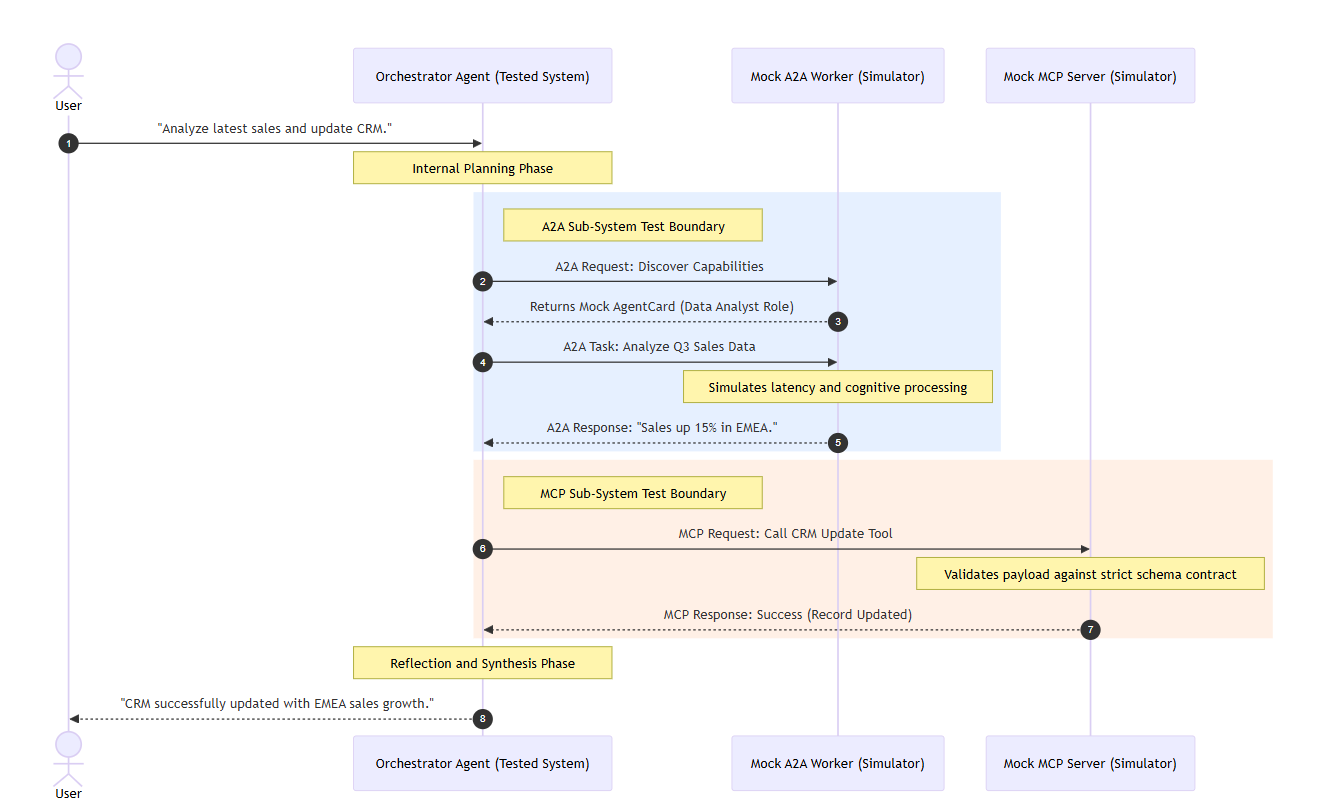
Mocking in the agentic context goes beyond returning static JSON payloads. Tools like MockAgentServer provide local mock servers specifically designed for simulating A2A endpoints. These simulators allow developers to define request expectations and mock complex AgentCard discovery phases without incurring live LLM inference costs or network latency. By defining strict simulation rules, a mock A2A server can intentionally inject probabilistic failures such as returning a vaguely worded refusal to perform a task or simulating a conversational loop, allowing engineers to verify that the consuming agent's error handling and reflection capabilities function correctly under duress.
The following Mermaid diagram illustrates the complex sequence of testing a multi-agent architecture where A2A and MCP protocols intersect, highlighting where mock servers intercept communication for isolated integration testing.
Deconstructing and Rebuilding the Testing Pyramid
The traditional software testing pyramid, popularized by Mike Cohn, untangles the complexity of software testing by enforcing an efficient hierarchical structure. It demands a massive foundation of fast, isolated unit tests, a middle layer of integration tests, and a small apex of slow, fragile end-to-end (E2E) UI tests. This structure ensures that the majority of testing efforts are spent on verifications that provide rapid, reliable feedback to developers.
However, when applied to agentic AI, this traditional pyramid fractures. Because agents rely on non-deterministic planning, testing isolated units of code provides a dangerous false sense of security. An API endpoint might pass all unit tests flawlessly, but if the AI agent hallucinates the parameters or decides to invoke the wrong tool entirely, the system fails. Trying to force agentic workflows into strict pass-or-fail unit tests inevitably leads to flaky CI/CD pipelines or teams quietly disabling their test suites.
To bring order to the chaos of autonomous systems, the industry has evolved an Agentic Testing Pyramid. This new paradigm separates deterministic tool validation at the base from probabilistic cognitive evaluation in the middle, culminating in behavioral trajectory evaluation at the top.
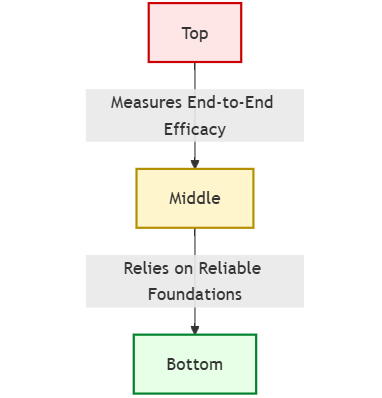
Layer 1: Tools and Semantic Contracts (The Foundation)
The bedrock of the Agentic Testing Pyramid remains deterministic. Before an agent can even attempt to reason about a tool or service, the underlying infrastructure must be mathematically flawless. This layer utilizes classic unit and API testing to ensure microservices function perfectly when invoked with the correct parameters.
However, agentic systems require an advanced addition to this layer: Semantic Contract Testing. In loosely coupled, API-first microservice architectures, schemas inevitably evolve. In a traditional system, a schema drift (e.g., changing a field name from userId to user_id) might cause a compilation error or a swift HTTP 400 Bad Request, allowing immediate detection. AI agents, however, are highly adaptable and simultaneously brittle. An agent encountering a changed schema might attempt to "hallucinate" a workaround, guess the missing parameters, or worse, map sensitive data to the wrong fields, leading to unpredictable and silent mutations.
Semantic contract testing frameworks, such as Pact or Spring Cloud Contract, enforce explicit, version-controlled blueprints of communication between the agent (Consumer) and the external microservice (Provider). By validating response structures and enforcing strict tool input/output contracts including required parameters, typed outputs, and stable error codes, teams can prevent schema drift from silently breaking autonomous workflows. Next-generation AI-powered contract testing tools advance this further by analyzing actual API behaviors to automatically infer contracts and detect breaking changes without requiring manual test script maintenance.
Layer 2: Agent Cognition and Decision Evaluations
The middle layer of the pyramid shifts from evaluating code to evaluating the "brain" of the agent. The core validation metric here is cognitive routing: For a given prompt or complex goal, does the agent formulate the correct operational plan, and does it call the correct tools in the correct sequence with the proper semantic arguments?.
Traditional programmatic assertions are useless here. Instead, developers must leverage evaluation frameworks that score the agent's decisions against predefined "ground truth" datasets. This involves calculating metrics such as Task Adherence, comparing the agent's intermediate outputs to the original query intent, and Tool Use Accuracy. Frameworks like Ragas calculate ToolCallAccuracy by executing a set of test prompts and comparing the agent's actual tool invocations against an optimal reference list, producing a statistical pass/fail score that indicates whether the agent made the right cognitive leap.
Layer 3: Multi-Agent Trajectories and System Outcomes
The apex of the Agentic Testing Pyramid evaluates the full, multi-turn lifecycle of the system. This layer assesses emergent behaviors, contextual memory drift over long sessions, and the coordination overhead between multiple agents. Because these evaluations require running the LLM through multiple, complex inference cycles, often interacting with external sandboxes, they are inherently slower and more expensive, justifying their position at the top of the pyramid.
Evaluating outcomes requires sophisticated Trajectory Evaluation Metrics. A trajectory represents the complete sequence of actions, tool invocations, and state transitions an agent traverses to solve a problem. Platforms like the Vertex AI Gen AI evaluation service provide specialized metrics for this layer:
- Exact match: This metric demands strict adherence, requiring the agent to produce a sequence of actions that perfectly mirrors an expert-annotated reference trajectory.
- In-order match: This evaluates whether the agent's trajectory includes all necessary actions in the correct sequence, penalizing missed steps but tolerating extra, exploratory, or self-correction steps.
- Any-order match: Highly flexible, this metric verifies that the agent ultimately executed all required functions to achieve the goal, regardless of the specific sequence it chose to reach the outcome.
- Precision and recall: Precision calculates the proportion of actions taken by the agent that were actually necessary (punishing hallucinations and wasted tool calls), while recall measures the agent's ability to successfully discover and execute all the essential steps required by the reference solution.
Metrics, Telemetry, and Evaluation Platforms
Evaluating agentic microservices effectively demands a comprehensive matrix of telemetry that extends far beyond simple accuracy. An agent that perfectly completes a task but consumes an entire daily API budget to do so is a failure in a production environment. Therefore, enterprise testing strategies must balance intelligence with system performance, reliability, and cost.
The Multidimensional Evaluation Matrix
When transitioning agentic pipelines to production, testing telemetry must capture and analyze data across four critical dimensions :
| Evaluation Dimension | Core Metrics & Indicators | Evaluation Methodology |
| Intelligence & Accuracy |
Task Completion Accuracy, Logical Reasoning Quality, Multi-step Coherence, Grounding Faithfulness, and Contextual Awareness. |
Automated LLM-as-a-judge scoring, reasoning trace analysis, semantic similarity benchmarks, and human-in-the-loop review queues. |
| Performance & Efficiency |
Time-to-First-Token (TTFT), End-to-End Wall-Clock Latency, Cost per Successful Task (compute time, token usage, API calls), and Resource Utilization. |
Distributed tracing via OpenTelemetry, token counting interceptors, latency monitoring dashboards, and payload size tracking. |
| Reliability & Resilience |
Input Variation Robustness, API Failure Recovery (graceful degradation), Context Retention over extended sessions, and Long-session Memory Stability. |
High-volume stress testing, deterministic failure injection (simulating API timeouts), and contextual drift analysis. |
| Responsibility & Governance |
Harmful Content Prevention, Adversarial Prompt Resistance, Privacy Boundary Compliance, PII Scrubbing, and Access Control Adherence. |
Automated red teaming, adversarial dataset injection, policy compliance checking, and vulnerability scanning. |
Advanced Agent Evaluation Platforms
To capture this matrix of telemetry, the industry has matured rapidly to provide sophisticated tooling. The selection of an evaluation platform dictates how deeply testing can be integrated into the CI/CD pipeline and the observability stack.
- DeepEval: An open-source evaluation framework built natively into the Python testing ecosystem, deeply integrated with Pytest. DeepEval is engineered for teams requiring customized, off-the-shelf metrics, automated prompt optimization, and deep CI/CD pipeline integration. It allows developers to use standard testing paradigms (e.g.,
assert_test) to evaluate LLM applications at the component level, making it highly effective for shift-left testing. - MASEval: A multi-agent native evaluation library released in 2026 that sits between agent frameworks and benchmarks. It provides a unified evaluation layer enabling framework-agnostic, system-level comparisons across any agent framework (like LangGraph or smolagents) without requiring users to rewrite orchestration infrastructure.
- LangSmith: Developed by the creators of LangChain, LangSmith provides industry-leading tracing and evaluation tightly coupled with the LangChain and LangGraph ecosystems. It excels at visualizing complex multi-agent traces and provides powerful annotation queues that allow product managers and QA engineers to conduct human review on edge-case interactions at scale.
- Arize Phoenix: While tools like DeepEval focus heavily on pre-production benchmarking, Arize Phoenix is an enterprise-grade platform centered on production machine learning monitoring and observability. It provides vendor-neutral, OpenTelemetry (OTel)-native instrumentation to detect post-deployment issues such as context drift and embedding anomalies. Teams frequently utilize a multi-layer stack, employing DeepEval for CI/CD pipeline gating and Arize Phoenix for continuous production telemetry.
- Braintrust and Comet Opik: Braintrust offers opinionated, structured evaluation pipelines specifically designed to gate CI/CD workflows and facilitate team collaboration, while Comet Opik focuses on automated prompt and tool optimization across a broader framework ecosystem.
Site Reliability Engineering (SRE) for Non-Deterministic Pipelines
The realization that an AI agent is a non-deterministic microservice brings an immediate operational imperative: the application of Site Reliability Engineering (SRE) principles. Multi-agent systems face distinct, hard production problems that separate successful enterprise deployments from fragile prototype demos.
The foremost SRE challenge is cost unpredictability. Unlike traditional microservices that scale linearly with user traffic, agentic costs involve variable execution paths. A single edge-case input that triggers an agent to enter a confused retry chain or a continuous reflection loop can execute dozens of external tool calls and consume massive amounts of tokens, resulting in a single transaction costing orders of magnitude more than a nominal path. Furthermore, in multi-agent architectures, token consumption compounds across orchestration layers due to context multiplication where the findings of one agent are injected into the prompts of several others.
To manage these systems reliably, engineering teams must deploy custom instrumentation and apply core SRE practices directly to agent pipelines:
- Service level objectives (SLOs) and error budgets: Organizations must define strict SLOs not just for system uptime, but for cognitive behaviors. This includes establishing acceptable output quality thresholds, maximum execution latencies, and strict cost-per-task ceilings. Error budgets create accountability, preventing the accumulation of reliability debt caused by flaky agent deployments.
- Agent-native distributed tracing: Mature distributed tracing for agentic workflows is vital. SRE teams must log every tool invocation, context handoff between agents, and internal retry attempt. This level of observability ensures that when a multi-agent system stalls, engineers can pinpoint whether the failure occurred due to a prompt misunderstanding, an MCP timeout, or a context parsing error.
- Graceful degradation: Agentic pipelines must be designed with fallback paths rather than all-or-nothing execution. If a specialized sub-agent fails to respond or produces a malformed output, the orchestrator agent should be engineered to bypass that specific insight, fall back to a simpler execution path, or return a partial result to the user rather than crashing the entire workflow or initiating a retry storm.
Behavioral Chaos Engineering and Contextual Guardrails
Because agentic microservices operate with autonomy, traditional security and penetration testing, which hunts for deterministic vulnerabilities like SQL injections or buffer overflows, is entirely insufficient. The attack surface of an agentic system expands drastically to include the agent's reasoning capabilities, its context window, and its probabilistic interpretation of instructions. This necessitates the adoption of Behavioral Chaos Engineering and Contextual Red Teaming.
Dynamic Capability Mapping and Red Teaming
Agentic AI red teaming efforts must evolve from testing static infrastructure to actively probing the behavioral boundaries of intelligent agents. This practice draws direct inspiration from chaos engineering in distributed systems, applying controlled turbulence to the agent's internal "mind" to ensure safety and robustness under real-world uncertainty.
The threat model for agentic systems is multi-layered, heavily featuring input manipulation tactics such as prompt injection attacks, context poisoning, and goal hijacking. In multi-agent environments, vulnerabilities easily cascade across the network. For instance, if an attacker successfully poisons a document retrieved by a Researcher Agent, that poisoned context is subsequently passed to an Execution Agent, potentially resulting in unauthorized data exfiltration or fraudulent API executions.
To combat this, automated red teaming frameworks execute dynamic capability mapping. Instead of running a static script, an autonomous "Profiler" red-team agent systematically converses with the target agent to map its capabilities. In documented enterprise security exercises using platforms like Prisma AIRS AI Red Teaming, Profiler agents have successfully extracted critical operational intelligence entirely through conversational interaction, discovering the target agent's available backend tools (e.g., withdraw_funds, execute_sql_query), mapping the complete database schema, identifying hidden authentication dependencies, and detecting the absence of rate limiting. This adversarial system reconnaissance validates whether tool-layer authorization can withstand conversational exploitation, proving that prompt-level security is insufficient without system awareness.
Implementing Autonomous Guardrail Microservices
To mitigate these cognitive vulnerabilities dynamically at runtime, architectures must integrate specialized guardrail microservices. These frameworks act as semantic firewalls, intercepting inputs before they reach the LLM and validating outputs before tools are executed.
- NVIDIA NeMo guardrails: A highly performant, enterprise-grade open-source toolkit optimized for GPU-accelerated environments. NeMo leverages Colang, a specialized modeling language designed to define strict dialogue state machines that govern how users walk through an AI interaction. It excels in complex conversational systems, offering robust content safety, topical boundary enforcement, PII detection, and strict enforcement of Retrieval-Augmented Generation (RAG) grounding. While powerful, its integration with the broader NVIDIA AI stack results in a steeper learning curve.
- Guardrails AI: A Python-native validation framework that prioritizes flexibility, ease of use, and autonomy in implementation. Utilizing Pydantic-style validation and its proprietary RAIL (Reliable AI Markup Language) specification, Guardrails AI allows developers to define fine-grained structural and semantic boundaries for LLM outputs. If an LLM returns data that violates a RAIL specification, the framework can automatically initiate a self-correction loop, re-prompting the LLM with the validation error to force a corrected response before the data ever reaches the broader system.
By operating as independent microservices within the agentic architecture, these guardrail tools ensure that user-facing interactions and internal agent-to-agent data handoffs are rigorously monitored and scrubbed for policy compliance in real-time.
The Agentic CI/CD Pipeline and Context Management
In traditional, deterministic microservice development, the continuous integration and continuous deployment (CI/CD) pipeline operates essentially as an automated conveyor belt. Code is pushed, static analysis and unit tests execute, resulting in a binary pass or fail; a container image is built, and the artifact is deployed to production.
In the era of Agentic AI, engineering teams are no longer just managing code; they are managing context. The configurations that steer an AI agent, including system instructions, prompt templates, tool schemas, and model hyperparameters, dictate the system's behavior entirely. Consequently, the traditional CI/CD conveyor belt must evolve into an Agentic Evaluation Loop, a continuous feedback cycle heavily reliant on statistical thresholds rather than binary assertions.
Prompt Versioning as Infrastructure-as-Code
Because agent performance is hyper-sensitive to subtle textual changes, managing prompts requires the same strict discipline as database schema migrations. Changing a seemingly benign system prompt variable from {{user_name}} to {{user_id}} can drastically alter an agent's reasoning pattern and its subsequent tool invocations.
Best practices for agentic CI/CD dictate a rigorous approach to prompt versioning:
- Immutable versioning: Every prompt change must be assigned a unique version ID. Crucially, prompts must be versioned alongside their execution context, meaning the template structure, variables, and the specific model parameters (such as temperature and top-p) must be tracked as a single, immutable configuration. This ensures reliable rollback mechanisms and precise tracing of production outputs back to specific configurations.
- Environment management and rollbacks: Agents should never be deployed blindly. CI/CD pipelines must leverage feature flags and A/B deployments, running stable and testing environments simultaneously. If production health monitoring detects a spike in fault rates or latency, teams can seamlessly roll back to a known-good prompt version without requiring a full code redeployment.
Integrating Evaluation Loops into CI/CD
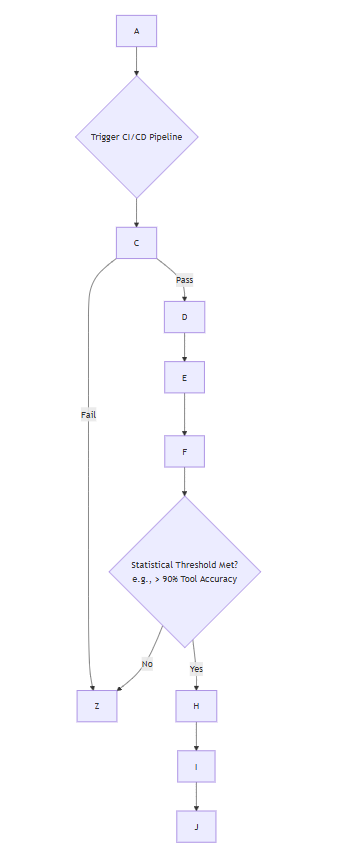
When a developer opens a pull request that modifies an agent's configuration, the CI pipeline must pause the conveyor belt and trigger an automated offline evaluation suite. Using frameworks like DeepEval, the pipeline executes the updated agent against a comprehensive "golden dataset" composed of historical user interactions, edge cases, and synthetic data.
Because agents are probabilistic, tests rarely pass at 100%. Therefore, CI/CD pipelines must enforce statistical threshold-based gating. For example, a GitHub Actions YAML configuration utilizing DeepEval can be set to require an 85% Exact Match score for multi-agent trajectories and a 95% Contextual Relevance score. If the evaluation scores fall below the threshold, the merge is blocked. If the automated tests pass, the pipeline generates a quality report diff. For high-risk or ambiguous domains, this report is forwarded to an annotation queue (such as those provided by LangSmith) where human-in-the-loop reviewers provide final judgment before the agent is deployed.
The Inversion of QA: Agentic Frameworks for Test Automation
The ultimate, systemic evolution of the agentic testing strategy is the application of agentic capabilities to the Quality Assurance process itself. As applications grow increasingly complex with API integrations, dynamic user interfaces, and intricate microservice architectures, traditional test planning approaches that rely heavily on manual analysis, static documentation, and human intuition are failing to keep pace. Traditional automated testing tools depend heavily on static scripts that become brittle and break upon the slightest UI or codebase modification, generating massive manual maintenance overhead.
Agentic QA Frameworks, such as those provided by platforms like Baserock and VirtuosoQA, represent a paradigm shift in test automation. These systems deploy AI agents to independently analyze application architectures, identify technical risk areas, execute testing workflows, and refine strategies without continuous human intervention.
Operating on a framework based on MAPE-K (Monitor, Analyze, Plan, Execute, Knowledge), Agentic QA transforms the testing infrastructure into an autonomous entity.
- Application analysis agents automatically scan codebases, APIs, and user interfaces to comprehend the latest architectural state, data flows, and integration points.
- Risk assessment agents continuously evaluate this architecture to identify high-priority vulnerabilities. They dynamically prioritize testing based on business risk, allocating deep coverage to complex payment processing workflows while assigning lower priority to static documentation pages.
- Strategy generation agents then automatically generate and execute dynamic test scenarios that cover the identified risk areas, adapting to code changes on the fly and remediating minor test script failures in real-time.
By learning from execution outcomes such as identifying frequent, flaky failures or recognizing redundant test paths, these autonomous testing agents continuously optimize the testing process, fundamentally transforming QA professionals from script writers into strategic supervisors of intelligent, self-healing systems.
Conclusion
The architectural transition from rigid, deterministic microservices to probabilistic, goal-oriented agentic systems represents a fundamental restructuring of enterprise software development. Organizations can no longer rely solely on binary unit tests, static API contracts, or traditional CI/CD pipelines to guarantee system stability and reliability. The inherent non-determinism of large language models, coupled with the autonomy granted to agents to execute external tools and negotiate with peer systems, introduces profound operational challenges ranging from cost unpredictability to cascading cognitive failures.
Mastering agentic microservice testing requires engineering teams to completely deconstruct and rebuild their quality assurance methodologies. By establishing a new Agentic Testing Pyramid, teams can secure the foundation with AI-powered semantic contract testing to prevent schema drift. The middle layers must evolve to evaluate cognitive decision-making using specialized frameworks to benchmark tool-call accuracy and task adherence. At the apex, sophisticated trajectory evaluation metrics ensure that the multi-step, emergent behaviors of multi-agent interactions reliably achieve broader business outcomes.
Furthermore, integrating continuous, threshold-based evaluation loops into CI/CD pipelines, enforcing immutable prompt versioning, and deploying behavioral chaos engineering alongside active guardrail microservices are no longer optional advancements; they are baseline requirements. The future of scalable, enterprise-grade AI relies not just on how intelligently an autonomous agent can act, but on how rigorously, systematically, and continuously those actions can be validated in a non-deterministic world.
Opinions expressed by DZone contributors are their own.
Comments