

Your Terraform Monolith Isn't Too Big. It's Tightly Coupled.
Terraform monoliths hurt when one state couples too many resources and owners. Split around ownership boundaries, not size.
 ·
·
Join the DZone community and get the full member experience.
Join For FreeThe first warning sign wasn't an outage. It was a boring pull request. We changed one App Service setting. It was the sort of change that should have resulted in a small plan and a quick review. Instead, Terraform refreshed networking, private endpoints, DNS, Key Vaults, storage accounts, app services, and monitoring before showing what would actually change.
Nothing was broken; that was the point. Terraform did exactly what it was designed to do: account for everything represented in state before calculating change. The problem was that our Terraform state had become a single, platform-sized boundary that every small change had to pass through, and one no team could fully own.
If you have run a landing zone as a single Terraform configuration, you have probably had a version of that pull request. The instinct afterward is to blame size: the configuration has grown too large, so break it up. That instinct is wrong, or at least incomplete. Size is uncomfortable, but coupling is what actually hurts. Nothing in the change touched networking, DNS, or those key vaults. They were dragged into the plan because everything was bound together through one state. At first, that coupling just means slow plans and noisy reviews. Later, it raises a harder question: who actually owns this?
Where the Coupling Shows Up
Start with the plan. In a monolith, Terraform has to account for everything represented in the state before it can tell you what changed. You can target a single resource, but that is an escape hatch, not a way to run a platform. So the wait scales with the size of the estate, not your change. Both a one-line edit and a fifty-resource migration get stuck behind the same refresh before the diff appears.
Provider upgrades show the same problem. A single root configuration pins one set of provider versions, so you cannot move networking to a newer azurerm version and leave everything else behind. Every upgrade becomes all-or-nothing, which means it keeps losing to smaller, safer priorities. Ours sat on azurerm 2.97 and only moved to the 4.x line once the upgrade could no longer be put off. The monolith had made the jump too big to schedule any sooner.
The bigger concern is blast radius. One state file, one lock, one plan. A bad apply, a corrupted state, a destroy that catches more than you aimed at: whatever goes wrong can reach more of the platform than the change was ever meant to touch, because nothing in the layout is there to contain it. The dependency graph suffers too. Unrelated resources get sequenced together just because they share a graph. A network change might wait on unrelated compute, DNS on policy. The graph ends up reflecting accidental grouping rather than real dependencies.
The result is clear. There is no small change. You cannot ship a DNS record or a new Key Vault without running the entire configuration through plan and apply. Every change is a platform change, carrying platform risk and requiring review, no matter how minor. These look like separate problems, but all come from the same design choice: too many unrelated concerns tied into one Terraform boundary.
Where Coupling Becomes Ownership
It is easy to call these operational annoyances: slow plans, awkward upgrades, risky applies, the tax you pay for a big configuration. But the same coupling appears in review and approval, where it stops being just an operational problem. Once too many concerns share the same state, pipeline, and approval path, the question is no longer only "how long did the plan take?" It becomes "who is accountable for the boundary this change is crossing?"
Take private connectivity. A single private endpoint on Azure isn't handled by just one team. The application team owns the service behind it. The platform team manages the landing zone, subnet, and endpoint placement. Private DNS zones might be managed centrally or by another team. Security or governance may require the service to be private. How these map to teams varies, but in a monolith, everything ends up in the same state, pipeline, and plan.
So "who owns this?" rarely has a clear answer. However you split teams, they are coupled through a single configuration that none can truly own. When the application team changes its service, the same config still carries platform connectivity and governance controls. You cannot draw ownership along your real organizational boundaries, because the code does not have them. Both slow plans and unclear ownership trace back to the same issue: shared concerns treated as if they belong to just one team.
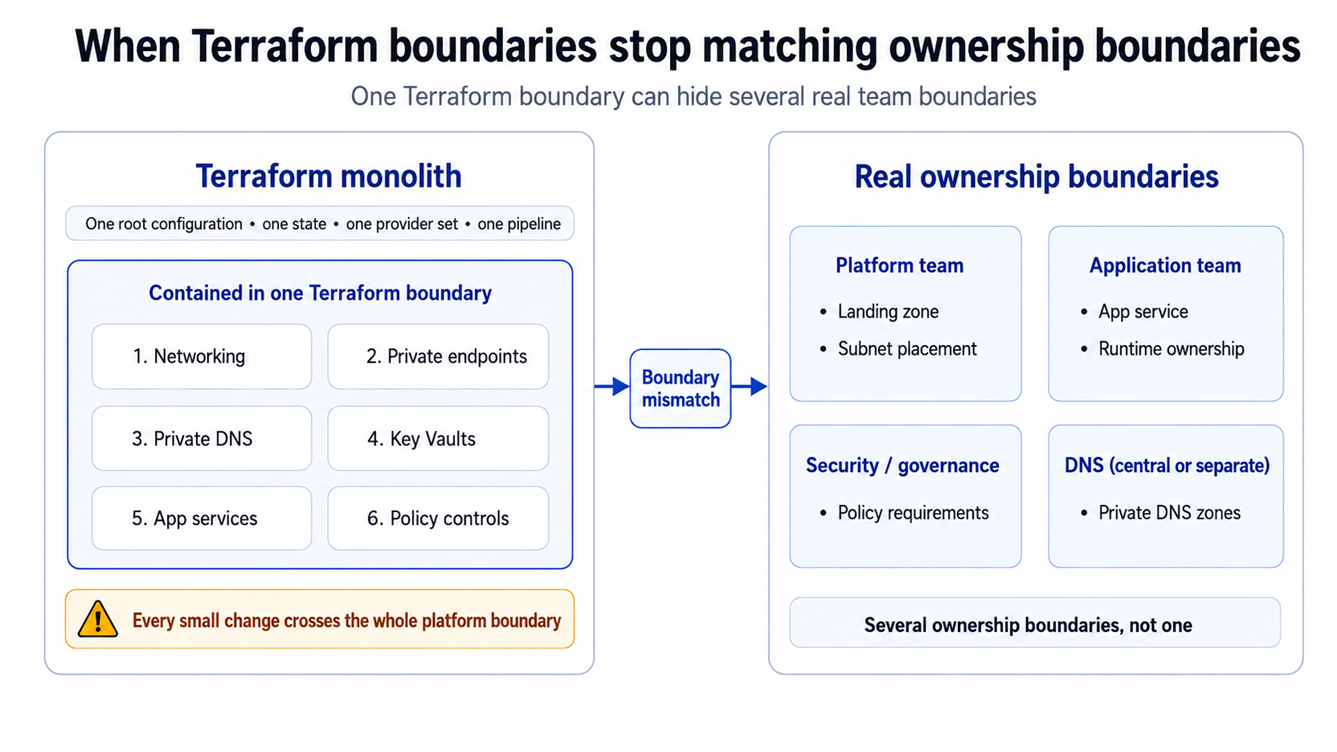
Reach for the Coupling, Not the Size
The reflex now is to split the state and move on. But splitting a landing zone poorly can be worse than leaving it alone. If you split along the wrong lines, you trade one blast radius for tangled cross-state dependencies. You also lose the single plan that at least showed the whole graph in one place.
For example, splitting private endpoints into one state and private DNS zones into another may look clean on paper. But if different teams deploy them without a clear agreement, every new endpoint becomes a coordination headache, not a smaller change. Moving files into separate folders does nothing if the same pipeline, credentials, and approval path still govern everything. Decomposition should follow actual coupling, not just line count.
So the next question is not "how many states should we create?" It is "which boundaries are real enough for teams to own, deploy, and recover independently?" If your Terraform monolith hurts, do not start by counting files or resources. Look at what is actually being coupled. Slow plans and unclear ownership are both signs that your Terraform boundaries no longer match your real ownership boundaries.
Opinions expressed by DZone contributors are their own.
Comments