

Agile AI Agents
Can ChatGPT’s Agent Mode really handle agile team tasks? I tested real use cases to see what it can do, what it misses, and where it needs improvement.
 CORE
·
CORE
·
Join the DZone community and get the full member experience.
Join For FreeTL; DR: Thinking About Use Cases
I tried ChatGPT’s new Agent Mode: Is it really a new Agile AI Agent that autonomously identifies noteworthy signals in the daily communication and data noise? Or is it a glorified automated prompt execution device?
Let’s find out. (Note: I only have a Plus account, which limits the experience.)
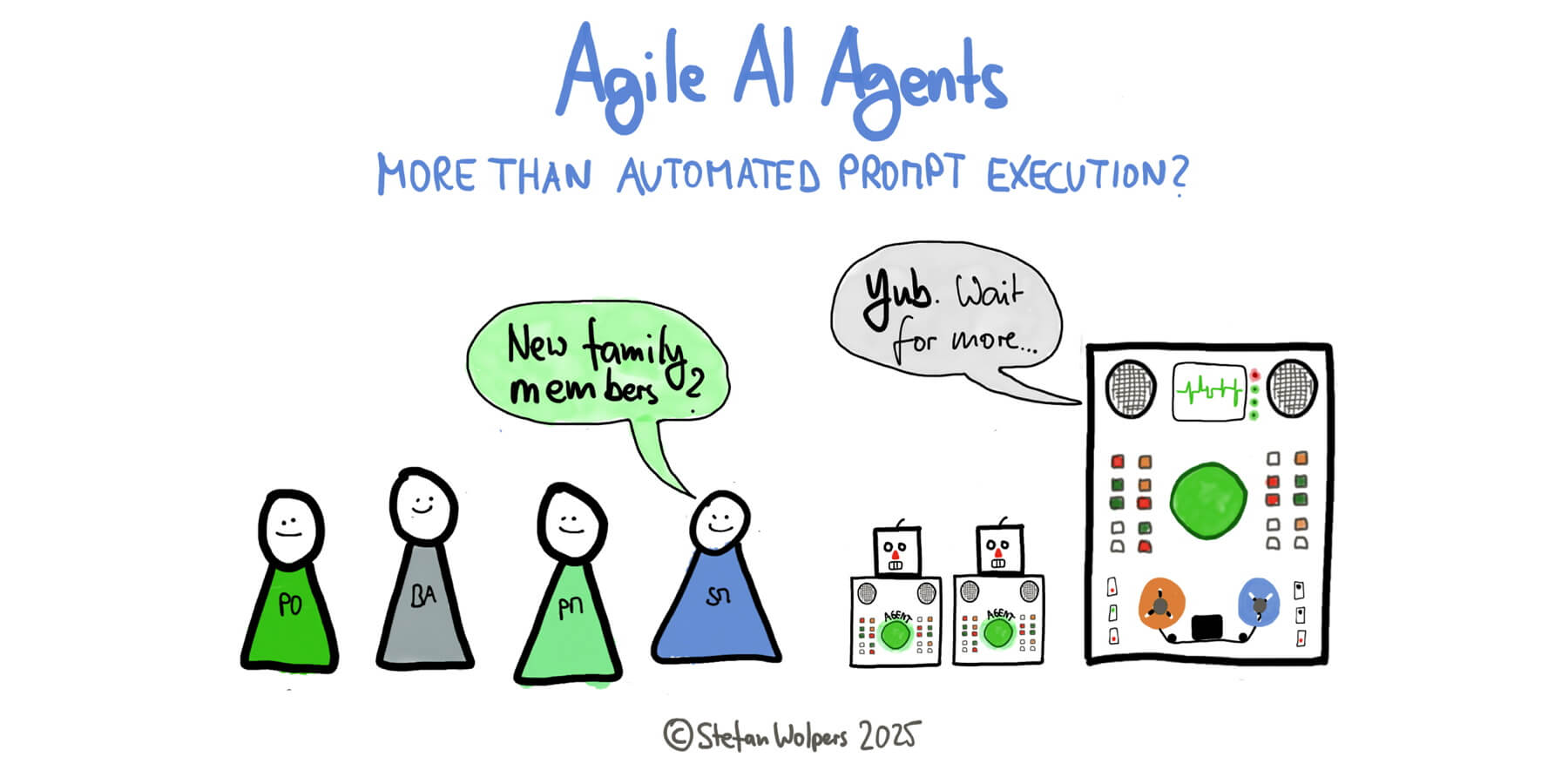
What Comes to Mind for Agile AI Agent Use Cases
When I started my exploration, I thought about a few fun applications, for example:
- The Product Discovery Agent: Whenever a new customer interview or a feature request is recorded, analyze its content and compare it to the current product strategy or product goal. If it is supportive of those, interesting, or innovative, suggest a hypothesis to the human in charge. Otherwise, suggest archiving it with a summary. (The anti-Product Backlog is a good place for useless suggestions.)
- The End-of-Sprint Report Agent: At the end of a Sprint or any other suitable (reporting) period, analyze what has been accomplished, how that will increase customer value delivered, and whether the team makes progress toward its next goal or milestone, or whether that goal needs to be inspected. Take real feedback from customers and users into account. Don’t stop at summarizing Jira; update the risk analysis, and package everything into a report that meets stakeholder expectations and, probably, governance requirements. Submit the draft to the human in charge for changes or approval.
- Sprint Planning Risk Adviser: Before the next Sprint Planning, the agile AI Agent analyzes typical constraints for the upcoming planning: availability of teammates, tools, and skills, dependencies to other teams or outside providers, state of the Product Backlog or your team’s planning artifact, and previous team performance. Based on the analysis, it creates an advisory report for the team before the planning starts.
- Organizational Anti-Patterns Spotter: Continuously, our agile AI Agent scans communication, artifacts, meetings, and other useful sources for repeated organizational anti-patterns that limit your teams’ productivity. Reported regularly, coaches can then act upon them.
Observations on Agile AI Agent Use Cases in Practice
Contrary to the agile AI Agent fantasies, see above, here are my observations from an OpenAI Plus account holder regarding agile AI Agent use cases.
The Task for ChatGPT’s Agent
I tasked the AI Agent with analyzing critical team performance data and using Retromat to design a Retrospective to help that team meet a milestone. The team context is available to the Agent.
Observations and the Response from the Agent
Here is what happens:
- Within a customer GPT, you cannot use Agent mode.
- Instead, to provide context, use a normal chat and the Web, connected sources, or upload the data manually.
- Since I do not have a Pro or Team account, the only connection is GitHub.
- During the test, since Cloudflare blocked access to Retromat in a way that the Agent could not overcome, the Agent switched to TeamRetro. (Good thinking.)
- Otherwise, the outcome in this Retrospective test was mediocre at best. (I could have created a significantly more nuanced result in less time with an ordinary prompt in my Scrum Anti-Patterns Guide GPT.)
- You cannot schedule any AI Agent task.
- You cannot have an AI Agent run a task repeatedly or regularly.
- The Agent seems to be okay as a research agent, but wait: we had Deep Research before. (See the screenshot below; in a second attempt, I tasked the Agent to search for a vintage car, a Citroen 2CV6, within defined constraints.)
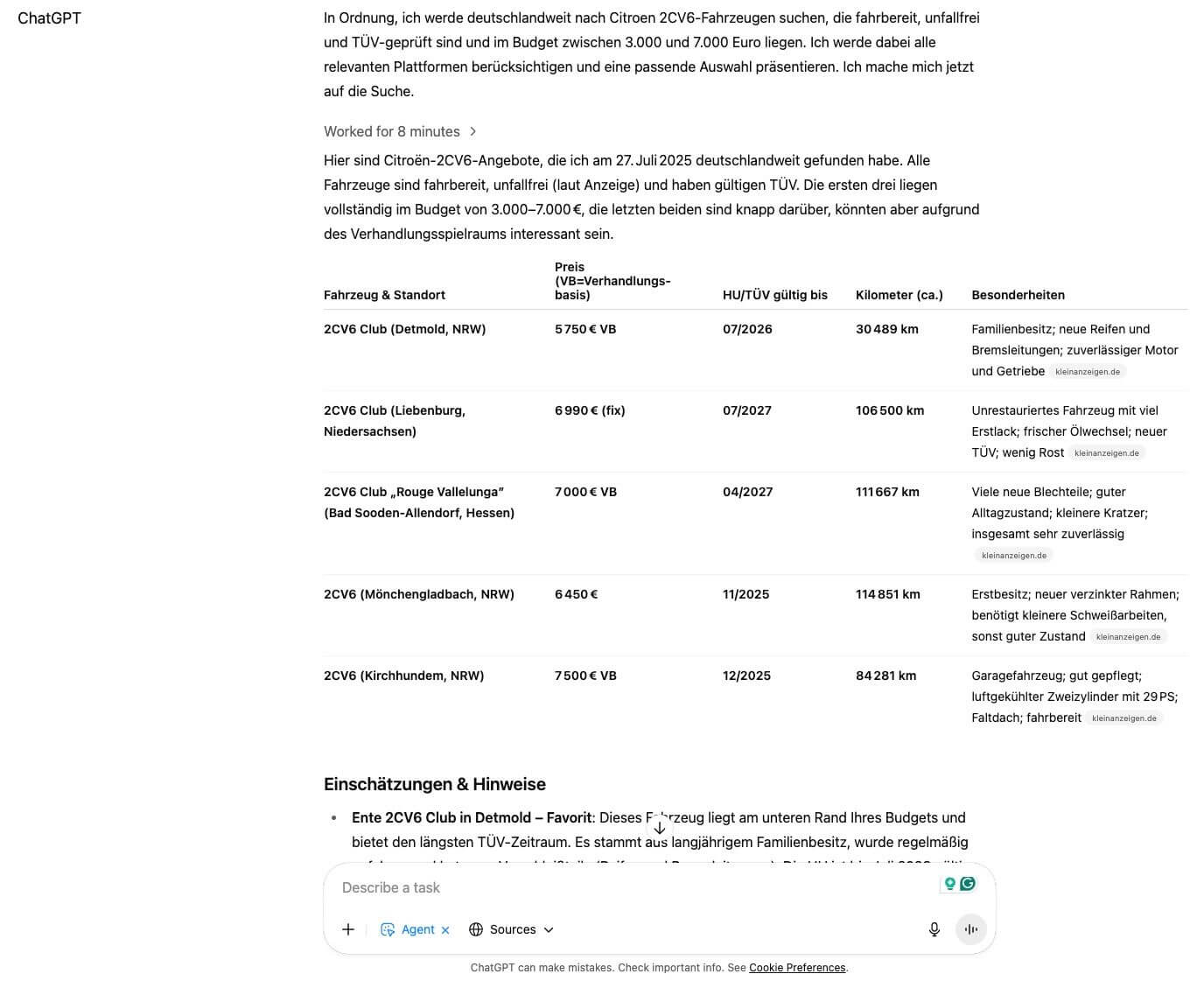
Trying ChatGPT’s new Agent mode was a sobering experience. I am sure capabilities will improve, but until then, all interesting agile AI Agent use cases seem distant if you cannot program.
I will continue exploring this use case, including other LLMs, and keep you posted.
Realistic Near-Term Applications
In the context described above, rather than pursuing autonomous task-accomplishment, I suggest using current AI capabilities, which do not require any kind of coding experience, differently: Use them as analytical assistants. Some ideas on how to employ generative AI with immediate benefits are:
Pattern Recognition Support
- Identify recurring themes in Retrospective data across multiple teams.
- Analyze customer feedback volume and sentiment trends.
- Track impediment patterns for organizational coaching.
Documentation and Knowledge Synthesis
- Maintain and update team working agreements based on decisions.
- Synthesize distributed knowledge into accessible formats.
- Generate initial drafts of process documentation for human refinement.
Research and Preparation Support
- Gather relevant frameworks and techniques for specific team challenges.
- Compile industry data for strategic planning sessions.
- Prepare background research for stakeholder communications.
These applications leverage AI’s strengths in information processing while preserving human judgment in complex decision-making.
Conclusion
I expect an agile AI Agent to accept reasonable prompts and perform the necessary reasoning to accomplish a task, and then report back to the human in charge. Moreover, it would not require any coding or utilize no-code tools like n8n.
Of course, alternatively to AI Agents, you can switch to an agentic workflow design, where you perform the reasoning and coding. (I guess we had that option before.)
Have you tried ChatGPT’s AI Agent already?
Published at DZone with permission of Stefan Wolpers. See the original article here.
Opinions expressed by DZone contributors are their own.
Comments